While we work on solidifying the memory interfaces, handle common chat
history formats.

This may break linting on anyone who has been passing in
`get_chat_history` .

Somewhat handles #3077

Alternative to #3078 that updates the typing
This PR extends upon @jzluo 's PR #2748 which addressed dialect-specific
issues with SQL prompts, and adds a prompt that uses backticks for
column names when querying BigQuery. See [GoogleSQL quoted
identifiers](https://cloud.google.com/bigquery/docs/reference/standard-sql/lexical#quoted_identifiers).

Additionally, the SQL agent currently uses a generic prompt. Not sure
how best to adopt the same optional dialect-specific prompts as above,
but will consider making an issue and PR for that too. See
[langchain/agents/agent_toolkits/sql/prompt.py](langchain/agents/agent_toolkits/sql/prompt.py).
Use numexpr evaluate instead of the python REPL to avoid malicious code
injection.

Tested against the (limited) math dataset and got the same score as
before.

For more permissive tools (like the REPL tool itself), other approaches
ought to be provided (some combination of Sanitizer + Restricted python
+ unprivileged-docker + ...), but for a calculator tool, only
mathematical expressions should be permitted.

See https://github.com/hwchase17/langchain/issues/814
Mentioned the idea here initially:
https://github.com/hwchase17/langchain/pull/2106#issuecomment-1487509106

Since there have been dialect-specific issues, we should use
dialect-specific prompts. This way, each prompt can be separately
modified to best suit each dialect as needed. This adds a prompt for
each dialect supported in sqlalchemy (mssql, mysql, mariadb, postgres,
oracle, sqlite). For this initial implementation, the only differencse
between the prompts is the instruction for the clause to use to limit
the number of rows queried for, and the instruction for wrapping column
names using each dialect's identifier quote character.
`combine_docs` does not go through the standard chain call path which
means that chain callbacks won't be triggered, meaning QA chains won't
be traced properly, this fixes that.

Also fix several errors in the chat_vector_db notebook
Added support for passing the openai_organization as an argument, as it
was only supported by the environment variable but openai_api_key was
supported by both environment variables and arguments.

`ChatOpenAI(temperature=0, model_name="gpt-4", openai_api_key="sk-****",
openai_organization="org-****")`
Add support for defining the organization of OpenAI, similarly to what
is done in the reference code below:

```
import os
import openai
openai.organization = os.getenv("OPENAI_ORGANIZATION")
openai.api_key = os.getenv("OPENAI_API_KEY")
```
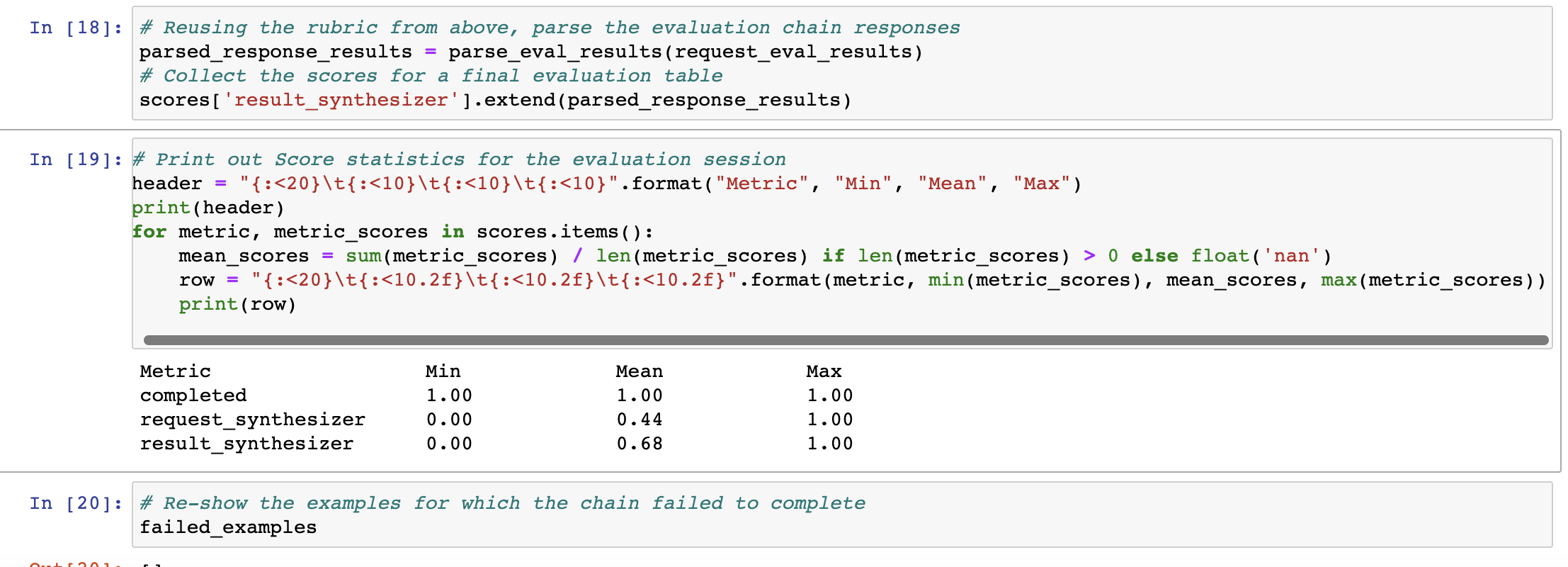
Evaluation so far has shown that agents do a reasonable job of emitting
`json` blocks as arguments when cued (instead of typescript), and `json`
permits the `strict=False` flag to permit control characters, which are
likely to appear in the response in particular.

This PR makes this change to the request and response synthesizer
chains, and fixes the temperature to the OpenAI agent in the eval
notebook. It also adds a `raise_error = False` flag in the notebook to
facilitate debugging
This still doesn't handle the following

- non-JSON media types
- anyOf, allOf, oneOf's

And doesn't emit the typescript definitions for referred types yet, but
that can be saved for a separate PR.

Also, we could have better support for Swagger 2.0 specs and OpenAPI
3.0.3 (can use the same lib for the latter) recommend offline conversion
for now.
`predict_and_parse` exists, and it's a nice abstraction to allow for
applying output parsers to LLM generations. And async is very useful.

As an aside, the difference between `call/acall`, `predict/apredict` and
`generate/agenerate` isn't entirely
clear to me other than they all call into the LLM in slightly different
ways.

Is there some documentation or a good way to think about these
differences?

One thought:

output parsers should just work magically for all those LLM calls. If
the `output_parser` arg is set on the prompt, the LLM has access, so it
seems like extra work on the user's end to have to call
`output_parser.parse`

If this sounds reasonable, happy to throw something together. @hwchase17
Fix the issue outlined in #1712 to ensure the `BaseQAWithSourcesChain`
can properly separate the sources from an agent response even when they
are delineated by a newline.

This will ensure the `BaseQAWithSourcesChain` can reliably handle both
of these agent outputs:

* `"This Agreement is governed by English law.\nSOURCES: 28-pl"` ->
`"This Agreement is governed by English law.\n`, `"28-pl"`
* `"This Agreement is governed by English law.\nSOURCES:\n28-pl"` ->
`"This Agreement is governed by English law.\n`, `"28-pl"`

I couldn't find any unit tests for this but please let me know if you'd
like me to add any test coverage.
Use the following code to test:

```python
import os
from langchain.llms import OpenAI
from langchain.chains.api import podcast_docs
from langchain.chains import APIChain

# Get api key here: https://openai.com/pricing
os.environ["OPENAI_API_KEY"] = "sk-xxxxx"

# Get api key here: https://www.listennotes.com/api/pricing/
listen_api_key = 'xxx'

llm = OpenAI(temperature=0)
headers = {"X-ListenAPI-Key": listen_api_key}
chain = APIChain.from_llm_and_api_docs(llm, podcast_docs.PODCAST_DOCS, headers=headers, verbose=True)
chain.run("Search for 'silicon valley bank' podcast episodes, audio length is more than 30 minutes, return only 1 results")
```

Known issues: the api response data might be too big, and we'll get such
error:
`openai.error.InvalidRequestError: This model's maximum context length
is 4097 tokens, however you requested 6733 tokens (6477 in your prompt;
256 for the completion). Please reduce your prompt; or completion
length.`
I got this during testing

```
ValueError: Missing some input keys: {'existing_answer'}
```

Upon review, the initial prompt should be `QUESTION_PROMPT_SELECTOR`.

Co-authored-by: Bao Nguyen <bnguyen@roku.com>
 Tom Dyson