### Description
Add Support for Lucene Filter. When you specify a Lucene filter for a
k-NN search, the Lucene algorithm decides whether to perform an exact
k-NN search with pre-filtering or an approximate search with modified
post-filtering. This filter is supported only for approximate search
with the indexes that are created using `lucene` engine.

OpenSearch Documentation -
https://opensearch.org/docs/latest/search-plugins/knn/filter-search-knn/#lucene-k-nn-filter-implementation

Signed-off-by: Naveen Tatikonda <navtat@amazon.com>
First cut of a supabase vectorstore loosely patterned on the langchainjs
equivalent. Doesn't support async operations which is a limitation of
the supabase python client.

---------

Co-authored-by: Daniel Chalef <daniel.chalef@private.org>
This occurred when redis_url was not passed as a parameter even though a
REDIS_URL env variable was present.
This occurred for all methods that eventually called any of:
(from_texts, drop_index, from_existing_index) - i.e. virtually all
methods in the class.
This fixes it
This pull request addresses the need to share a single `chromadb.Client`
instance across multiple instances of the `Chroma` class. By
implementing a shared client, we can maintain consistency and reduce
resource usage when multiple instances of the `Chroma` classes are
created. This is especially relevant in a web app, where having multiple
`Chroma` instances with a `persist_directory` leads to these clients not
being synced.

This PR implements this option while keeping the rest of the
architecture unchanged.

**Changes:**
1. Add a client attribute to the `Chroma` class to store the shared
`chromadb.Client` instance.
2. Modify the `from_documents` method to accept an optional client
parameter.
3. Update the `from_documents` method to use the shared client if
provided or create a new client if not provided.

Let me know if anything needs to be modified - thanks again for your
work on this incredible repo
### Background

Continuing to implement all the interface methods defined by the
`VectorStore` class. This PR pertains to implementation of the
`max_marginal_relevance_search` method.

### Changes

- a `max_marginal_relevance_search` method implementation has been added
in `weaviate.py`
- tests have been added to the the new method
- vcr cassettes have been added for the weaviate tests

### Test Plan

Added tests for the `max_marginal_relevance_search` implementation

### Change Safety

- [x] I have added tests to cover my changes
re
https://github.com/hwchase17/langchain/issues/439#issuecomment-1510442791

I think it's not polite for a library to use the root logger

both of these forms are also used:
```
logger = logging.getLogger(__name__)
logger = logging.getLogger(__file__)
```
I am not sure if there is any reason behind one vs the other? (...I am
guessing maybe just contributed by different people)

it seems to me it'd be better to consistently use
`logging.getLogger(__name__)`

this makes it easier for consumers of the library to set up log
handlers, e.g. for everything with `langchain.` prefix
Add a method that exposes a similarity search with corresponding
normalized similarity scores. Implement only for FAISS now.

### Motivation:

Some memory definitions combine `relevance` with other scores, like
recency , importance, etc.

While many (but not all) of the `VectorStore`'s expose a
`similarity_search_with_score` method, they don't all interpret the
units of that score (depends on the distance metric and whether or not
the the embeddings are normalized).

This PR proposes a `similarity_search_with_normalized_similarities`
method that lets consumers of the vector store not have to worry about
the metric and embedding scale.

*Most providers default to euclidean distance, with Pinecone being one
exception (defaults to cosine _similarity_).*

---------

Co-authored-by: Harrison Chase <hw.chase.17@gmail.com>
Same as similarity_search, allows child classes to add vector
store-specific args (this was technically already happening in couple
places but now typing is correct).
Minor cosmetic changes
- Activeloop environment cred authentication in notebooks with
`getpass.getpass` (instead of CLI which not always works)
- much faster tests with Deep Lake pytest mode on
- Deep Lake kwargs pass

Notes
- I put pytest environment creds inside `vectorstores/conftest.py`, but
feel free to suggest a better location. For context, if I put in
`test_deeplake.py`, `ruff` doesn't let me to set them before import
deeplake

---------

Co-authored-by: Davit Buniatyan <d@activeloop.ai>
Optimization :Limit search results when k < 10
Fix issue when k > 10: Elasticsearch will return only 10 docs


[default-search-result](https://www.elastic.co/guide/en/elasticsearch/reference/current/paginate-search-results.html)
By default, searches return the top 10 matching hits

Add size parameter to the search request to limit the number of returned
results from Elasticsearch. Remove slicing of the hits list, since the
response will already contain the desired number of results.
**Problem:**

The `from_documents` method in Qdrant vectorstore is unnecessary because
it does not change any default behavior from the abstract base class
method of `from_documents` (contrast this with the method in Chroma
which makes a change from default and turns `embeddings` into an
Optional parameter).

Also, the docstrings need some cleanup.

**Solution:**

Remove unnecessary method and improve docstrings.

---------

Co-authored-by: Vijay Rajaram <vrajaram3@gatech.edu>
Avoid using placeholder methods that only perform a `cast()`
operation because the typing would otherwise be inferred to be the
parent `VectorStore` class. This is unnecessary with TypeVar's.
Improvements to Deep Lake Vector Store
- much faster view loading of embeddings after filters with
`fetch_chunks=True`
- 2x faster ingestion
- use np.float32 for embeddings to save 2x storage, LZ4 compression for
text and metadata storage (saves up to 4x storage for text data)
- user defined functions as filters

Docs
- Added retriever full example for analyzing twitter the-algorithm
source code with GPT4
- Added a use case for code analysis (please let us know your thoughts
how we can improve it)

---------

Co-authored-by: Davit Buniatyan <d@activeloop.ai>
Using `pytest-vcr` in integration tests has several benefits. Firstly,
it removes the need to mock external services, as VCR records and
replays HTTP interactions on the fly. Secondly, it simplifies the
integration test setup by eliminating the need to set up and tear down
external services in some cases. Finally, it allows for more reliable
and deterministic integration tests by ensuring that HTTP interactions
are always replayed with the same response.
Overall, `pytest-vcr` is a valuable tool for simplifying integration
test setup and improving their reliability

This commit adds the `pytest-vcr` package as a dependency for
integration tests in the `pyproject.toml` file. It also introduces two
new fixtures in `tests/integration_tests/conftest.py` files for managing
cassette directories and VCR configurations.

In addition, the
`tests/integration_tests/vectorstores/test_elasticsearch.py` file has
been updated to use the `@pytest.mark.vcr` decorator for recording and
replaying HTTP interactions.

Finally, this commit removes the `documents` fixture from the
`test_elasticsearch.py` file and replaces it with a new fixture defined
in `tests/integration_tests/vectorstores/conftest.py` that yields a list
of documents to use in any other tests.

This also includes my second attempt to fix issue :
https://github.com/hwchase17/langchain/issues/2386

Maybe related https://github.com/hwchase17/langchain/issues/2484
### Features include

- Metadata based embedding search
- Choice of distance metric function (`L2` for Euclidean, `L1` for
Nuclear, `max` L-infinity distance, `cos` for cosine similarity, 'dot'
for dot product. Defaults to `L2`
- Returning scores
- Max Marginal Relevance Search
- Deleting samples from the dataset

### Notes
- Added numerous tests, let me know if you would like to shorten them or
make smarter

---------

Co-authored-by: Davit Buniatyan <d@activeloop.ai>
- Create a new docker-compose file to start an Elasticsearch instance
for integration tests.
- Add new tests to `test_elasticsearch.py` to verify Elasticsearch
functionality.
- Include an optional group `test_integration` in the `pyproject.toml`
file. This group should contain dependencies for integration tests and
can be installed using the command `poetry install --with
test_integration`. Any new dependencies should be added by running
`poetry add some_new_deps --group "test_integration" `

Note:
New tests running in live mode, which involve end-to-end testing of the
OpenAI API. In the future, adding `pytest-vcr` to record and replay all
API requests would be a nice feature for testing process.More info:
https://pytest-vcr.readthedocs.io/en/latest/

Fixes https://github.com/hwchase17/langchain/issues/2386
In the case no pinecone index is specified, or a wrong one is, do not
create a new one. Creating new indexes can cause unexpected costs to
users, and some code paths could cause a new one to be created on each
invocation.
This PR solves #2413.
This PR updates Qdrant to 1.1.1 and introduces local mode, so there is
no need to spin up the Qdrant server. By that occasion, the Qdrant
example notebooks also got updated, covering more cases and answering
some commonly asked questions. All the Qdrant's integration tests were
switched to local mode, so no Docker container is required to launch
them.
This PR fixes a logic error in the Redis VectorStore class
Creating a redis vector store `from_texts` creates 1:1 mapping between
the object and its respected index, created in the function. The index
will index only documents adhering to the `doc:{index_name}` prefix.
Calling `add_texts` should use the same prefix, unless stated otherwise
in `keys` dictionary, and not create a new random uuid.
Minor change: Currently, Pinecone is returning 5 documents instead of
the 4 seen in other vectorstores, and the comments this Pinecone script
itself. Adjusted it from 5 to 4.
**Context**
Noticed a TODO in `langchain/vectorstores/elastic_vector_search.py` for
adding the option to NOT refresh ES indices

**Change**
Added a param to `add_texts()` called `refresh_indices` to not refresh
ES indices. The default value is `True` so that existing behavior does
not break.
I'm using Deeplake as a vector store for a Q&A application. When several
questions are being processed at the same time for the same dataset, the
2nd one triggers the following error:

> LockedException: This dataset cannot be open for writing as it is
locked by another machine. Try loading the dataset with
`read_only=True`.

Answering questions doesn't require writing new embeddings so it's ok to
open the dataset in read only mode at that time.

This pull request thus adds the `read_only` option to the Deeplake
constructor and to its subsequent `deeplake.load()` call.

The related Deeplake documentation is
[here](https://docs.deeplake.ai/en/latest/deeplake.html#deeplake.load).

I've tested this update on my local dev environment. I don't know if an
integration test and/or additional documentation are expected however.
Let me know if it is, ideally with some guidance as I'm not particularly
experienced in Python.
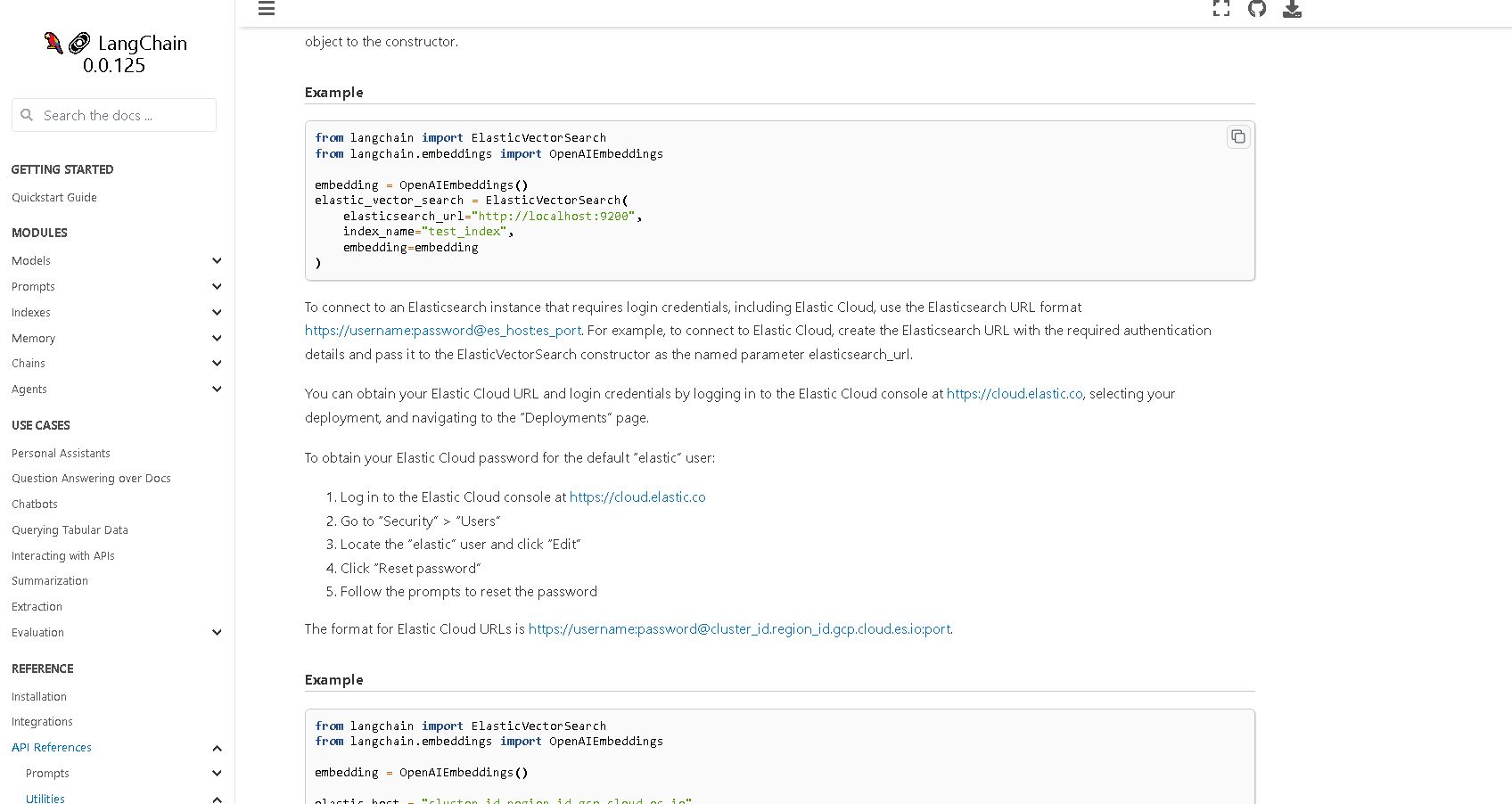
This merge includes updated comments in the ElasticVectorSearch class to
provide information on how to connect to `Elasticsearch` instances that
require login credentials, including Elastic Cloud, without any
functional changes.
The `ElasticVectorSearch` class now inherits from the `ABC` abstract
base class, which does not break or change any functionality. This
allows for easy subclassing and creation of custom implementations in
the future or for any users, especially for me 😄
I confirm that before pushing these changes, I ran:
```bash
make format && make lint
```
To ensure that the new documentation is rendered correctly I ran
```bash
make docs_build
```
To ensure that the new documentation has no broken links, I ran a check
```bash
make docs_linkcheck
```
Also take a look at https://github.com/hwchase17/langchain/issues/1865
P.S. Sorry for spamming you with force-pushes. In the future, I will be
smarter.
# Description
***
Add function similarity_search_limit_score and
similarity_search_with_score

# How to use
***
``
rds = Redis.from_existing_index(embeddings,
redis_url="redis://localhost:6379", index_name='link')

rds.similarity_search_limit_score(query, k=3, score=0.2)

rds.similarity_search_with_score(query, k=3)
``

---------

Co-authored-by: Peter <peter.shi@alephf.com>
 Naveen Tatikonda
