 liuxuely0626andluoyun
0cc37bf444
* feat(subscription): add development login, models and web search

* feat(subscription): refine account flows and host integration

Align desktop and VS Code subscription UI, add account logout and confirmed plan display, and map subscription thinking parameters. Remove simulation code and obsolete native authentication paths, consolidate design documentation, and cover cancellation and recovery boundaries.

* fix(subscription): preserve request errors and remove unused compatibility

* fix(subscription): refine command visibility and client logout flows

* fix(subscription): simplify account actions and desktop sign-in feedback

* docs(subscription): clarify sign-in and provider guidance

* feat(subscription): support switching accounts across clients

* fix(subscription): align account actions and open plans on demand

* fix(subscription): restore model selection after logout

Filter subscription-only commands consistently across terminal renderers, preserve model catalog error classification, and display the subscription authentication name consistently.

* fix(subscription): unify status authentication labels across clients

* fix(subscription): preserve provider connections across client logout

Restore configured providers after subscription logout across CLI, Desktop, and VS Code. Keep unrelated connections and conversation history, synchronize model state silently, and return to an unconfigured chat when no provider remains.

* fix(subscription): correct native client logout state

* feat(subscription): enable sign-in without development mode

* refactor(ui): 优化会员登录成功提示和界面交互体验

- 移除订阅欢迎提示相关状态和行为,简化 UI 状态管理
- 替换登录成功提示为四行摘要,包含邮箱、套餐、模型及常用命令提示
- 更新国际化文本,支持新的登录成功摘要内容
- 取消订阅模式下输入框下方的命令提示行,改为在登录成功摘要中展示
- 移除多余的测试用例,新增登录成功消息的单元测试校验
- 优化 AppHeader 组件,不再显示订阅启动重复提示
- 调整 Composer 组件逻辑,删除订阅提示相关副作用及渲染条件
- 修改历史消息显示组件以适应新的成功提示格式

* fix(subscription): enable Flash reasoning controls in shared UI

* fix(subscription): prioritize authorized models and simplify login dialogs

* fix(subscription): preserve gateway errors and request IDs

* fix(subscription): synchronize account state across clients

Preserve model selections after sign-out, synchronize account commands and model catalogs, and retain explicit browser sign-in flows across CLI, Web Shell, and VS Code. Cancel subscription background agents on logout and normalize expired refresh credentials without SDK error wrapping.

* fix(subscription): reset default model on explicit sign-in

Choose the default served model when explicitly signing in to Qwen Subscription, preferring Max over a previously saved Flash selection. Preserve normal startup behavior and other provider flows, and cover CLI and workspace activation with regression tests.

* fix(vscode): refresh models after successful sign-in

* fix(web-shell): hide account actions during automatic sign-in

* fix(web-shell): align model details and auth keyboard navigation

* docs(subscription): revert previous guide changes

* fix(core): reuse subscription catalog for same-login model switches

* docs(subscription): document Qwen membership sign-in

* fix(subscription): unify quota notices and preserve provider switching

Carry structured subscription quota details through chat and search errors for localized CLI, Desktop, and VS Code display. Keep other providers available when subscription discovery fails and refine sidebar account actions.

* fix(web-shell): align Chinese subscription entry title with CLI

* fix(subscription): open plans for saved non-member accounts

* fix(web-shell): show subscription commands after desktop sign-in

* fix(subscription): reauthorize explicit account sign-ins

* fix(auth): add model switching hint to subscription success

* docs(auth): list Qwen OAuth as the first option

* docs(models): simplify subscription sign-in guidance

* docs(models): remove legacy OAuth from supported auth types

* docs(subscription): link membership references and remove obsolete allowance note

* fix(subscription): preserve session until reauthorization succeeds

* fix(subscription): use pre for browser authorization and plans

* fix(subscription): use production endpoints

* test(vscode): fix editor message test formatting

* fix(subscription): preserve unauthenticated session startup

* fix(cli): classify subscription auth during ACP preflight

* fix(subscription): scope activation to the current project

---------

Co-authored-by: luoyun <[email protected]>
13 KiB


The open-source AI coding agent for your terminal, editor, desktop, browser, and chat.
中文 | Deutsch | français | 日本語 | Русский | Português (Brasil) | 한국어
Why Qwen Code?
- Agentic out of the box — Auto-Memory, Auto-Skills, SubAgents, Agent Teams, and MCP. Dynamic workflows, zero setup.
- Open-source, inside and out — The framework and the Qwen models are open-source. They evolve together. No vendor lock-in.
- Multi-protocol — Supports OpenAI, Anthropic, Gemini, and Qwen APIs. Any third-party provider or local model (Ollama / vLLM). Switch at runtime.
- Beyond the terminal — IDE plugins, Desktop app, Web UI, SDKs, and chat integrations (Telegram / DingTalk / WeChat / Feishu).
Tip
Qwen Code is actively iterating on itself — using its own agent and models to file issues, submit PRs, review code, and run tests. Powered by the community, driven by AI.
Installation
Linux / macOS:
curl -fsSL https://qwen-code-assets.oss-cn-hangzhou.aliyuncs.com/installation/install-qwen-standalone.sh | bash
Windows:
irm https://qwen-code-assets.oss-cn-hangzhou.aliyuncs.com/installation/install-qwen-standalone.ps1 | iex
Restart your terminal after installation to ensure environment variables take effect.
NPM / Homebrew
NPM (requires Node.js 22+):
npm install -g @qwen-code/qwen-code@latest
Homebrew (macOS / Linux):
brew install qwen-code
Quick Start
Open a terminal in your project and start Qwen Code:
cd /path/to/your-project
qwen
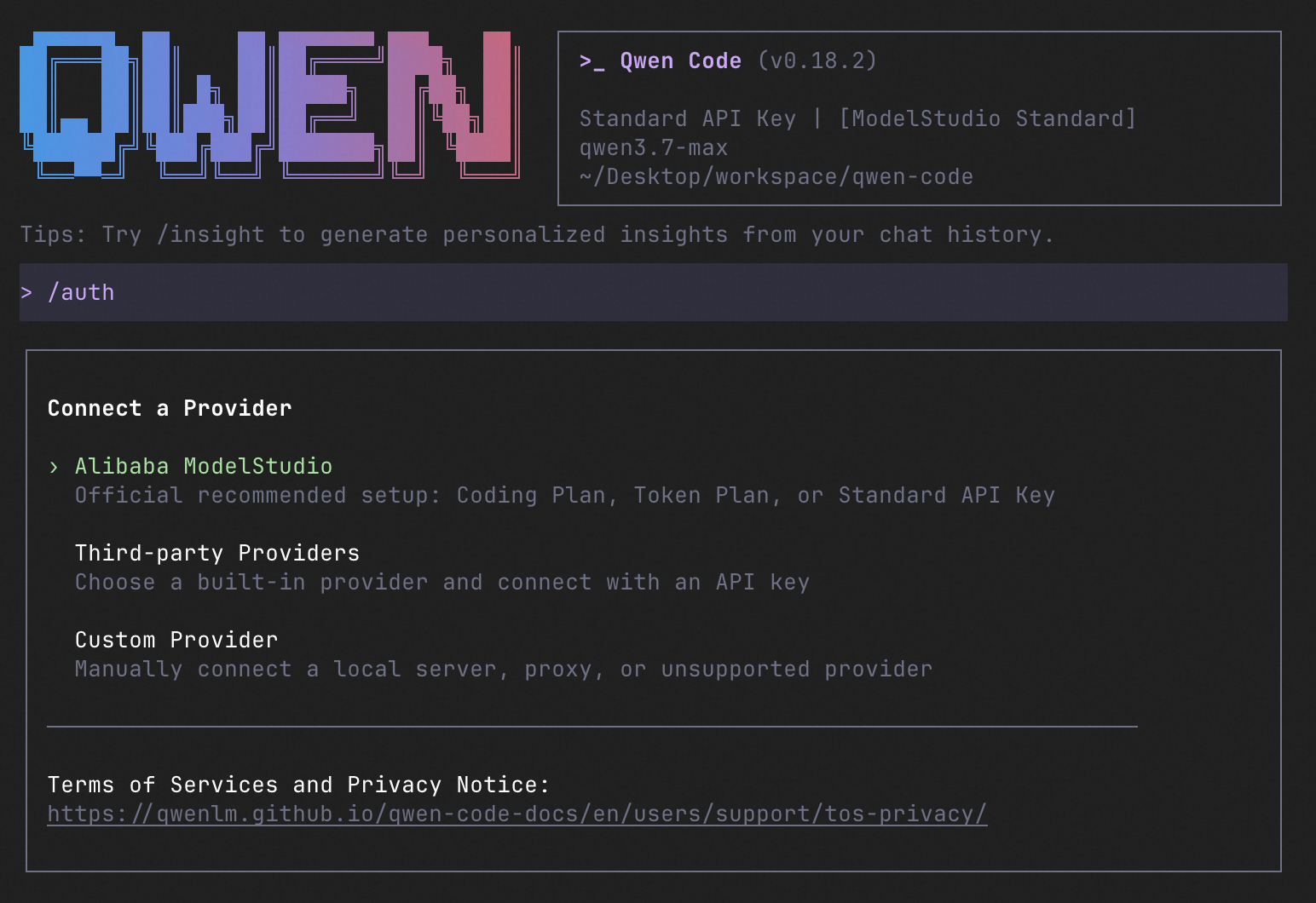
Inside the session, run /auth and choose Qwen Account with Subscription to sign in with your Plus or Pro subscription, or configure a provider with an API key. Then try:
Explain this repository and show me where to start.
See the Authentication Guide and Settings Reference for detailed setup.
See the terminal interface
How to Use Qwen Code
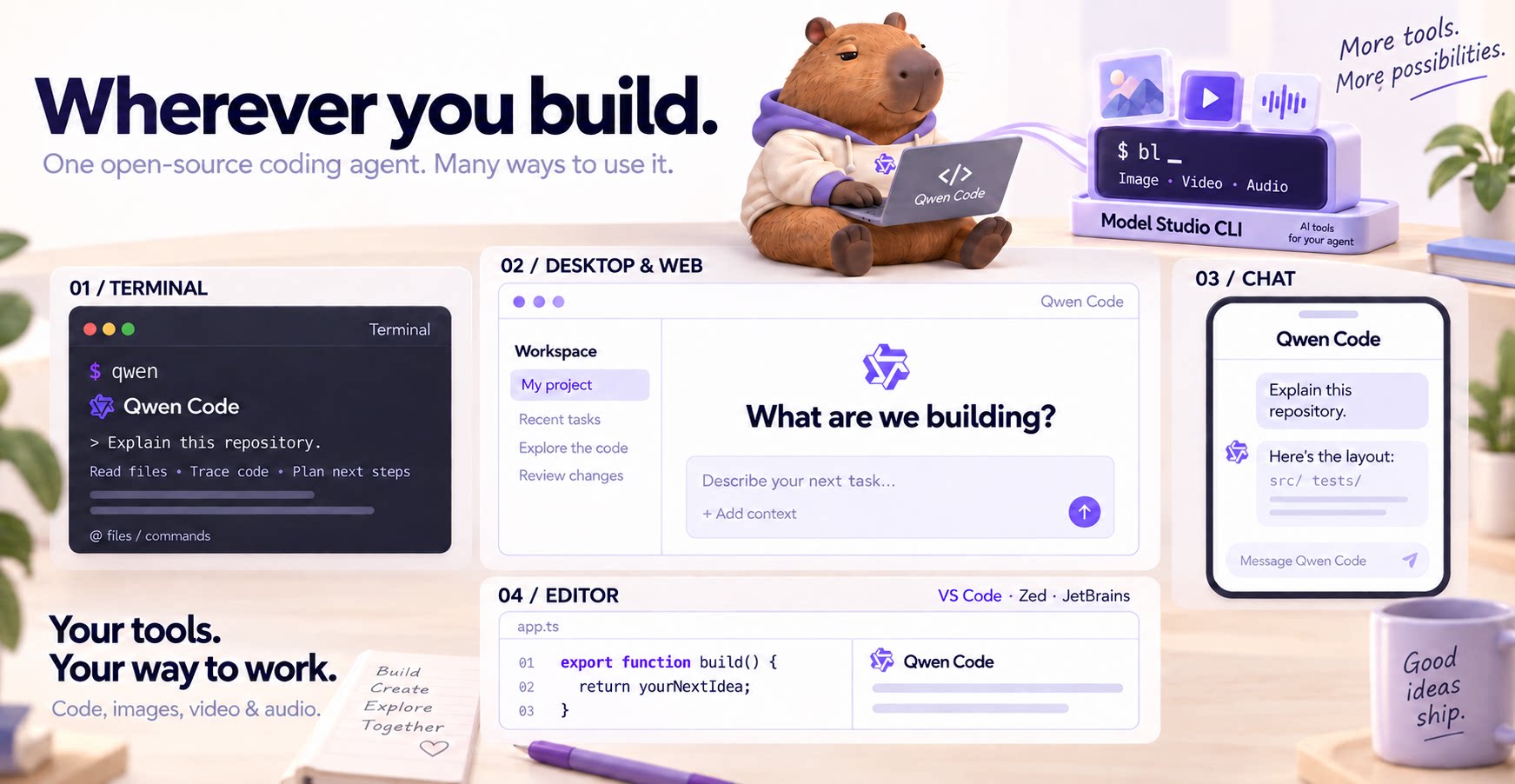
Choose the interface that fits your workflow:
| Interface | Get started |
|---|---|
| Terminal | Run qwen in your project — see Quick Start. |
| Desktop | Download Qwen Code Desktop for macOS, Windows, and Linux. |
| Web | Run qwen serve --open to open the Web UI in your browser. (experimental) |
| Editor | Set up VS Code, Zed, or JetBrains. |
| Chat | Connect Telegram, DingTalk, WeChat, or Feishu, then run qwen channel start. |
For automation and custom integrations:
- Headless — Run
qwen -p "..."in scripts, CI/CD, or batch jobs. - SDKs — Build with TypeScript, Python, or Java.
- Daemon — Run
qwen serveto connect clients over HTTP + SSE (ACP). (experimental) Daemon guide. - Computer Use — Set up native MCP tools or Node REPL + SDK in Qwen Code, Claude Code, or Codex.
SDK example (Python)
import asyncio

from qwen_code_sdk import is_sdk_result_message, query


async def main() -> None:
    result = query(
        "Summarize the repository layout.",
        {
            "cwd": "/path/to/project",
            "path_to_qwen_executable": "qwen",
        },
    )

    async for message in result:
        if is_sdk_result_message(message):
            print(message["result"])


asyncio.run(main())
Daemon Mode
Run Qwen Code as a long-lived service when you want browser, editor, SDK, and automation clients to share agent sessions without each starting a separate process. The daemon provides the built-in Web Shell and an HTTP + SSE API, supports multiple workspaces, and lets clients reconnect to active sessions.
Start it in the foreground and open the Web Shell:
qwen serve --open
The default address is http://127.0.0.1:4170. To run and manage it in the background instead:
qwen daemon start
qwen daemon status
qwen daemon logs -f
qwen daemon stop
By default, the daemon listens on loopback without bearer authentication; any local process that can reach it can use the full API, including code execution. On shared or untrusted hosts, set QWEN_SERVER_TOKEN and use --require-auth. See the Daemon guide for workspaces, authentication, remote access, and the API.
Capabilities
If you know Claude Code, you already know Qwen Code — and then some. We've put significant effort into bringing Qwen Code to feature parity with Claude Code, improving both breadth and reliability across the board.
| Feature | Qwen Code | Claude Code |
|---|---|---|
| SubAgents, Agent Teams, Dynamic Workflows | ✓ | ✓ |
| Auto-Memory, Auto-Skills, Hooks | ✓ | ✓ |
| Built-in Skills (/review, /batch, /loop, /bugfix…) | ✓ | ✓ |
| MCP, Plan Mode, LSP Integration | ✓ | ✓ |
| Auto Mode, Sandbox, Git Worktrees | ✓ | ✓ |
| Computer Use (desktop automation) | ✓ | ✓ |
| IDE Plugins (VS Code / JetBrains / Zed) | ✓ | ✓ |
| SDK | ✓ | ✓ |
| Headless Mode, Session Management | ✓ | ✓ |
| Open-source — model and framework | ✓ | — |
| Multi-protocol (OpenAI / Anthropic / Gemini / Qwen + any provider) | ✓ | — |
| Agent Arena (multi-model head-to-head on same task) | ✓ | — |
Daemon Mode — qwen serve (multi-client shared agent) |
✓ | — |
| IM Channels (Telegram / DingTalk / WeChat / Feishu) | ✓ | — |
Qwen Code Evaluation
On SWE-bench Verified, seven Qwen Code versions scored 76.40%–77.80% on average using the same Qwen 3.7 Max model (500 tasks, three trials per version).

Full results and evaluation configuration →
Ecosystem
-
Qwen Code Desktop — Official desktop app for macOS, Windows, and Linux
-
AionUi — A modern GUI for command-line AI tools including Qwen Code
-
Gemini CLI Desktop — A cross-platform desktop/web/mobile UI for Qwen Code
-
qwen-audio-agent — Realtime full-duplex voice frontend for Qwen Code over ACP — talk hands-free with barge-in and a local wake word
-
🦞 Qwen Code Claw — Let other agents (Claude, Codex, etc.) delegate coding tasks to Qwen Code via ACP. Paste this prompt into your agent:
Use Qwen Code as a coding agent. First, fetch and read this skill reference:
https://raw.githubusercontent.com/QwenLM/qwen-code/refs/heads/main/.qwen/skills/qwen-code-claw/SKILL.md
Then follow the instructions inside to install, authenticate, and use Qwen Code via acpx for all coding tasks.
- Aliyun Model Studio CLI — Official CLI for Aliyun's AI platform (
bailian-cli). Extends Qwen Code with image/video generation, knowledge retrieval, app orchestration, and model deployment
Privacy
See the Terms of Service and Privacy Notice, including Chrome extension and Browser Use data handling.
Contributing
Contributions are welcome! See CONTRIBUTING.md for guidelines.
Acknowledgments
This project was originally based on Google Gemini CLI v0.8.2. We gratefully acknowledge the Gemini CLI team's excellent work. Starting from Qwen Code v0.1, we stopped syncing with upstream and began independent development as a multi-protocol, multi-platform agent framework with deep integrations for Qwen models and beyond.