 Harry
9a9dd306ff
Harry
9a9dd306ff
- Updated the GmailMessageAddedEvent class to support uploading up to 20 attachments, with improved handling for inline content and external links.
- Introduced new methods for extracting links from HTML and text, allowing for better integration of external attachments.
- Modified the output schema in the YAML to reflect changes in attachment metadata, including renaming fields for clarity.
Gmail Trigger (Push + History)
Overview
- Gmail Trigger is a Dify provider that receives Gmail push notifications via Cloud Pub/Sub and emits concrete events based on Gmail History:
gmail_message_added(new messages)gmail_message_deleted(deleted messages)gmail_label_added(labels added to messages)gmail_label_removed(labels removed from messages)
- Dispatch verifies/auths the push, pulls the history delta once, and splits changes for events to consume.
- Note: API Key is NOT supported for Gmail API access. Use OAuth (gmail.readonly) only.
Prerequisites
- A Google account authorized for Gmail API (used during OAuth)
- A Google Cloud project with Pub/Sub API enabled (configured at tenant-level by administrator)
Step-by-step Setup
- Install the plugin in Dify
- Options:
- If packaged as
.difypkg, import it in Dify’s Plugin Center (Plugins → Import). - For local run during development, ensure the runtime installs dependencies in
requirements.txt.
- If packaged as
- Configure GCP resources (Administrator, one-time setup)
-
Create or select the Google Cloud project that will host your Pub/Sub resources. Make sure the following APIs are enabled (APIs & Services → Library):
-
Create a dedicated service account and grant Pub/Sub permissions:
-
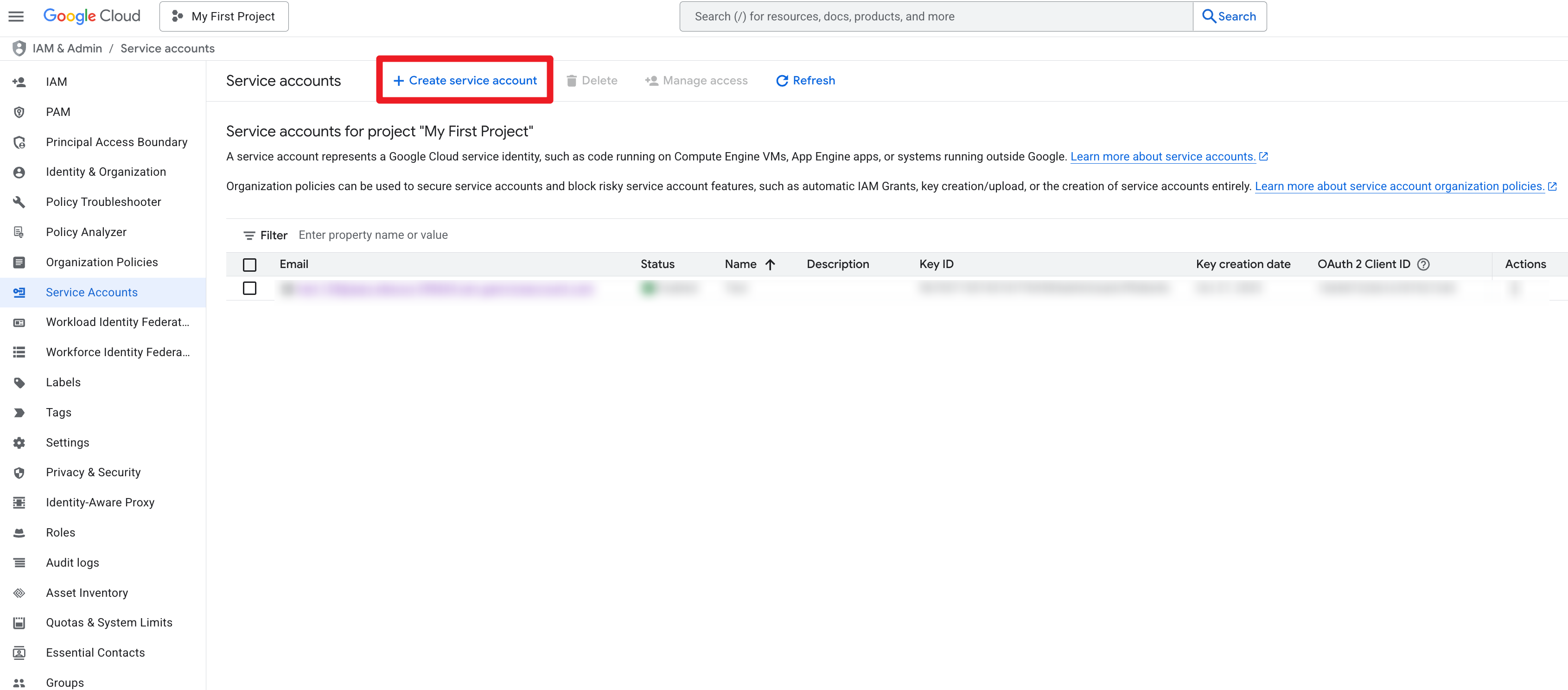
Go to IAM & Admin → Service Accounts → Create Service Account.
Console URL: https://console.cloud.google.com/iam-admin/serviceaccountsScreenshot:
-
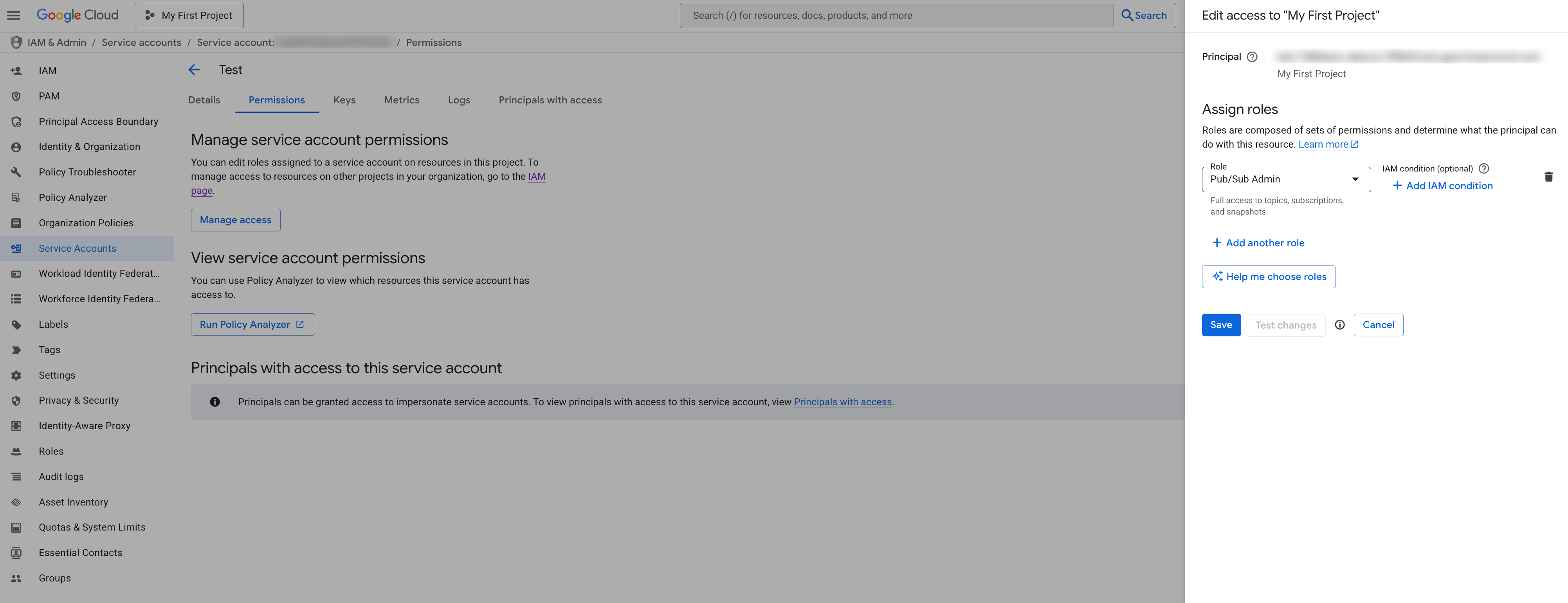
Assign the
roles/pubsub.adminrole to this service account or select "Pub/Sub Admin" role which already includes the necessary permissions (required so the plugin can create topics, subscriptions, and update IAM policies automatically).-
Alternatively, a custom role must include:
pubsub.topics.create,pubsub.topics.getIamPolicy,pubsub.topics.setIamPolicy,pubsub.subscriptions.create,pubsub.subscriptions.get,pubsub.subscriptions.delete,pubsub.subscriptions.list.Screenshot:
-
-
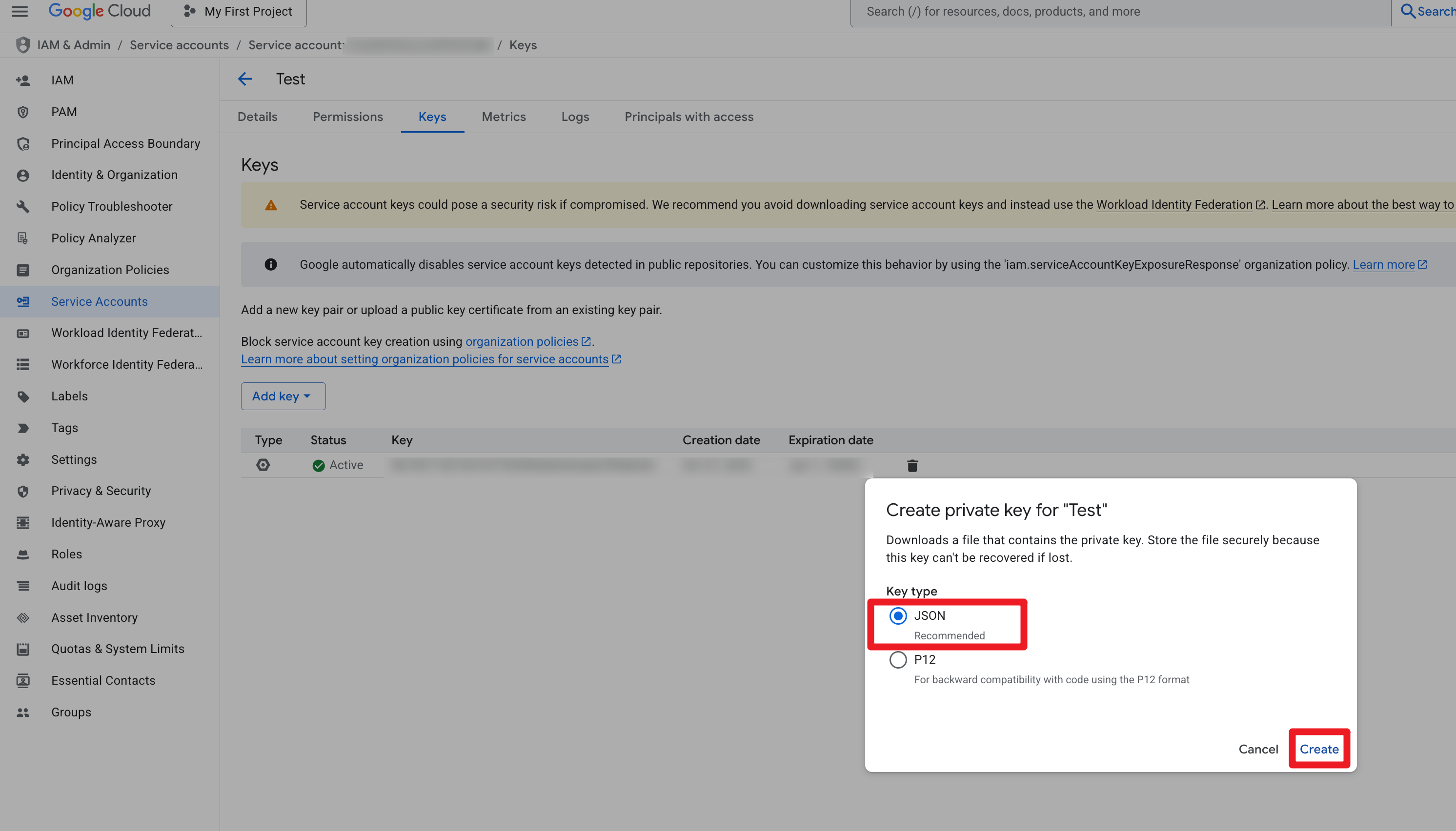
Create a JSON key for this service account and download it securely. Screenshot:
-
-
Note your Google Cloud Project ID (displayed on the project dashboard or IAM page).


- Configure OAuth client for the plugin (Administrator, one-time setup)
-
In Google Cloud Console → APIs & Services → Credentials → Create Credentials → OAuth client ID.
Console URL: https://console.cloud.google.com/apis/credentialsScreenshot:

- Application type: Web application
- Authorized redirect URIs: copy the redirect URI shown in Dify when you set up the plugin (e.g.,
https://<your-dify-host>/console/api/plugin/oauth/callback)
-
Capture the generated Client ID and Client Secret for later use.

- Enter OAuth client parameters in Dify
- In the plugin configuration form:
client_id: The OAuth client ID created above.client_secret: The corresponding client secret.gcp_project_id: The Google Cloud project ID with Pub/Sub enabled.gcp_service_account_json: Paste the full JSON key created for the service account (keep it private).
- Dify will automatically derive a per-user Pub/Sub topic when the end user authorizes the plugin.
- User: Authorize and create subscription
- Click "Authorize" to complete OAuth (gmail.readonly scope)
- Create a Gmail subscription with optional parameters:
label_ids(optional): Scope to specific labels (INBOX, UNREAD, etc.)- Properties (optional, for enhanced security):
require_oidc: Enforce OIDC bearer verificationoidc_audience: Webhook endpoint URL (auto-filled)oidc_service_account_email: Service account used for Push subscription
What happens automatically:
- Plugin creates/reuses a Pub/Sub Topic in your GCP project
- Plugin grants Gmail API publisher permission to the topic
- Plugin creates a dedicated Push subscription for this user
- Plugin calls Gmail
users.watchAPI to start monitoring - On unsubscribe, plugin cleans up the Push subscription (topic is preserved for reuse)
Where To Get OIDC Values
oidc_audience- Use the exact webhook endpoint URL shown in the Dify subscription details (Endpoint). Example:
https://<your-dify-host>/api/plugin/triggers/<subscription-id>
- The YAML field includes a URL to Google docs for the
audienceclaim: see the OIDC token reference.
- Use the exact webhook endpoint URL shown in the Dify subscription details (Endpoint). Example:
oidc_service_account_email- The service account used by the Pub/Sub push subscription (set via
--push-auth-service-account). - Find it under Google Cloud Console → IAM & Admin → Service Accounts, or via:
gcloud iam service-accounts list --format='value(email)'
- The YAML field links to the Service Accounts console page.
- The service account used by the Pub/Sub push subscription (set via
How It Works
- Dispatch (trigger)
- Optionally verifies OIDC bearer from Pub/Sub push (iss/aud/email)
- Decodes
message.datato gethistoryId/emailAddress - Calls
users.history.list(startHistoryId=...)once to gather deltas - Splits changes per family and stores pending batches in Dify storage
- Returns the list of concrete event names for Dify to execute
- Events
- Read the pending batch for their family
gmail_message_addedfetches full message metadata (headers, attachments meta)- Output matches the event YAML
output_schema
Event Outputs (high-level)
gmail_message_addedhistory_id: stringmessages[]: id, threadId, internalDate, snippet, sizeEstimate, labelIds, headers{From,To,Subject,Date,Message-Id}, has_attachments, attachments[]
gmail_message_deletedhistory_id: stringmessages[]: id, threadId
gmail_label_added/gmail_label_removedhistory_id: stringchanges[]: id, threadId, labelIds
Attachment Handling
- The trigger attempts to upload at most 20 real attachments (with
attachmentIdor inline content), skipping individual files larger than 5 MiB. attachments[].file_urlis the only externally exposed download address;attachments[].file_sourceidentifies its origin (gmailfor original links ordify_storagefor Dify mirror).- When attachments are successfully uploaded to Dify, both
upload_file_idandoriginal_url(Gmail/Drive original address) are returned; if not mirrored,original_urlis omitted. - Gmail often returns Drive links for oversized attachments, or provides sharing addresses directly in the message body. The event scans text/HTML content to extract these links and returns them as attachment items for unified handling by callers.
- Callers only need to use
file_url, determining whether to access Gmail/Drive directly or go through Dify storage based onfile_source.
Lifecycle & Refresh
- Create: Plugin auto-provisions Pub/Sub, then calls
users.watchwithtopicNameand optionallabelIds - Refresh:
users.watchis called again before expiry (Gmail watch is time-limited, ~7 days) - Delete: Calls
users.stopand cleans up the Push subscription
Testing
- Send an email to the watched mailbox (INBOX). You should see
gmail_message_added - Mark read/unread (UNREAD label removed/added) triggers label events
- Delete an email triggers
gmail_message_deleted - Tip: You can view recent deliveries in Pub/Sub subscription details; Dify logs/console will show trigger and event traces.
Troubleshooting
- Plugin fails to create subscription: Check GCP credentials are correctly configured in OAuth client parameters
- Nothing triggers: Verify Gmail API and Pub/Sub API are enabled in your GCP project
- 401/403 at dispatch: OIDC settings mismatch; verify service account and audience
historyIdout of date: Plugin resets checkpoint to the latest notification and skips the batch- OAuth issues: Re-authorize; ensure gmail.readonly scope is granted
References