---
title: How to set up A/B tests in Angular
date: 2024-01-23
author:
- lior-neu-ner
tags:
- experimentation
---
import { ProductScreenshot } from 'components/ProductScreenshot'
export const EventsInPostHogLight = "https://res.cloudinary.com/dmukukwp6/image/upload/posthog.com/contents/images/tutorials/angular-ab-tests/events-light.png"
export const EventsInPostHogDark = "https://res.cloudinary.com/dmukukwp6/image/upload/posthog.com/contents/images/tutorials/angular-ab-tests/events-dark.png"
A/B tests help you make your Angular app better by enabling you to compare the impact of changes on key metrics. To show you how to set one up, we create a basic Angular app, add PostHog, create an A/B test, and implement the code for it.
## 1. Create an Angular app
First, ensure [Node.js is installed](https://nodejs.dev/en/learn/how-to-install-nodejs/) (version 14.20.0 or newer). Then, install the Angular CLI and create a new Angular app:
```bash
npm install -g @angular/cli
ng new angular-ab-tests
```
Select `CSS` as your stylesheet and `No` for server side rendering and static site generation.
Next, Replace the code in `src/app/app.component.html` with a simple heading and button:
```html file=app.component.html
Angular A/B Test
```
Then, edit the `app.component.ts` file to include the click handler:
```typescript file=app.component.ts
import { Component } from '@angular/core';
@Component({
selector: 'app-root',
templateUrl: './app.component.html',
styleUrls: ['./app.component.css'],
standalone: true
})
export class AppComponent {
handleClick() {
// Event handling logic will go here
}
}
```
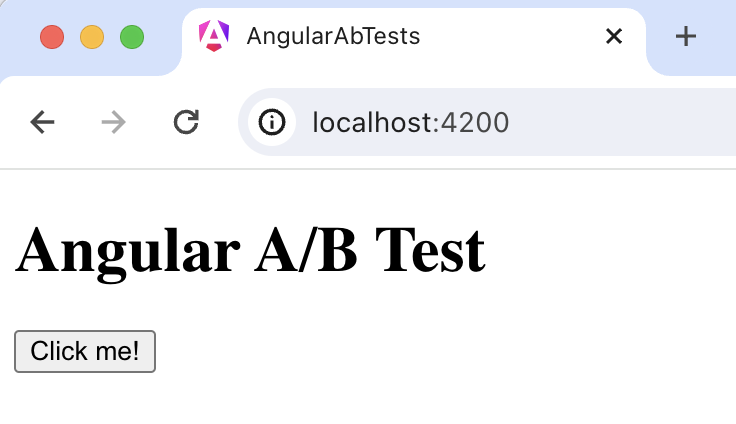
Run `ng serve` and navigate to http://localhost:4200 to see your app in action.
## 2. Add PostHog to your Angular app
With our app set up, it’s time to install and set up PostHog. To start, install the [JavaScript web SDK](/docs/libraries/js):
```bash
npm i posthog-js
```
In `src/main.ts`, initialize PostHog using your project API key and instance address. You can get both in your [project settings](https://us.posthog.com/project/settings).
```ts file=main.ts
import { bootstrapApplication } from '@angular/platform-browser';
import { appConfig } from './app/app.config';
import { AppComponent } from './app/app.component';
import posthog from 'posthog-js'
posthog.init('', {
api_host:'',
defaults: ''
})
bootstrapApplication(AppComponent, appConfig)
.catch((err) => console.error(err));
```
Once you’ve done this, reload your app and click the button a few times. You should see events appearing in the [PostHog events explorer](https://us.posthog.com/events).
## 3. Capture a custom event
The first part of setting up our A/B test in PostHog is setting up the goal metric. We'll use the number of clicks on the button as our goal.
To measure this, we [capture a custom event](/docs/product-analytics/capture-events) `home_button_clicked` when the button is clicked. To do this, import `posthog-js` into `app.component.ts` and capture an event in `handleClick()`:
```typescript file=app.component.ts
import { Component } from '@angular/core';
import posthog from 'posthog-js'
@Component({
// existing component code
})
export class AppComponent {
handleClick() {
posthog.capture(
'home_button_clicked',
)
}
}
```
With this set up, refresh your app and click the button a few times to see the event captured in PostHog.
## 3. Create an A/B test in PostHog
Next, go to the [A/B testing tab](https://us.posthog.com/experiments) and create an A/B test by clicking the **New experiment** button. Add the following details to your experiment:
1. Name it "My cool experiment".
2. Set "Feature flag key" to `my-cool-experiment`.
3. Use the default values for all other fields.
4. Click **Save as draft**.
Once created, set the primary metric to a trend of `home_button_clicked` and then click **Launch**.
## 4. Implement the A/B test code
To implement the A/B test, we fetch the `my-cool-experiment` feature flag and update the button text based on whether the user is in the `control` or `test` variant of the experiment.
To do this, update your code in `app.component.ts` to use the [`ngOnInit`](https://angular.io/api/core/OnInit) lifecycle hook to implement the [`posthog.onFeatureFlags`](/docs/libraries/js/features#ensuring-flags-are-loaded-before-usage) callback. Then, we'll update the button text using [`ChangeDetectorRef`](https://angular.io/api/core/ChangeDetectorRef):
```typescript file=app.component.ts
import { Component, ChangeDetectorRef } from '@angular/core';
import posthog from 'posthog-js'
@Component({
selector: 'app-root',
templateUrl: './app.component.html',
styleUrls: ['./app.component.css'],
standalone: true
})
export class AppComponent {
constructor(private changeDetector: ChangeDetectorRef) {}
buttonText = 'No variant';
ngOnInit() {
posthog.onFeatureFlags(() => {
console.log(posthog.getFeatureFlag('my-cool-experiment'))
if (posthog.getFeatureFlag('my-cool-experiment') === 'control') {
this.buttonText = 'Control variant';
} else if (posthog.getFeatureFlag('my-cool-experiment') === 'test') {
this.buttonText = 'Test variant';
}
this.changeDetector.detectChanges();
});
}
handleClick() {
// rest of your code
}
}
```
Lastly, update `app.component.html` to use the `buttonText` state variable.
```html file=app.component.html
Angular A/B Test
```
Now if you refresh your app, you should see the button text updated to either `Control variant` or `Test variant`.
With this, you’re ready to launch your A/B test! PostHog will randomly split your users into the each variant and track whether it has an impact on the button click-through rate. You can [view your test results](/docs/experiments/testing-and-launching#viewing-experiment-results) on the experiment page in PostHog.
> **💡 PostHog Tip:** You may notice the button text "flicker" while the page loads and PostHog fetches the feature flag. To fix this, you can [bootstrap the flag value](/docs/feature-flags/bootstrapping).
## Further reading
- [How to set up Angular analytics, feature flags, and more](/tutorials/angular-analytics)
- [How to set up surveys in Angular](/tutorials/angular-surveys)
- [How to set up session replays in Android](/tutorials/android-session-replay)