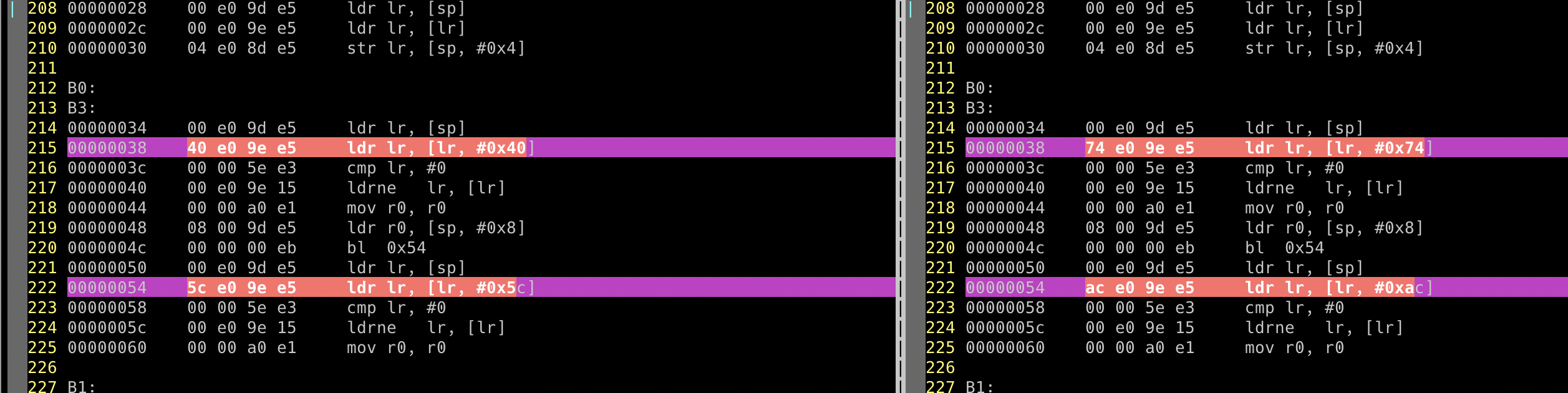
* [runtime] Treat calling a non-virtual method through an open delegate the same as the normal case instead of the OPEN_VIRTUAL case.
* [amd64] Fix the return value mapping in gsharedvt calls, the return address might be in different registers in the caller and callee.
* [runtime] Always initialize del->method_ptr even if interp_method is set, JITted code makes calls through it in mixed mode.
* Add a test for open delegates and gsharedvt.
* Increase nrgctx trampoline count, its needed by dynamic-method-churn.exe in full-aot-interp mode.
The extraneous call basically guarantees that the following waitpid invocation will fail. Fixes merp stating that its process has failed when it hasn't.
* [merp] Introduce a new 'dump mode' that allows different signal behavior when dumping
The primary reason for this is gaining the ability to interpret SIGTERM properly as a crashing signal when outside of 'dump mode', and as a utility signal during the 'thread summarizer' dumping process.
* Removing all fixes to fix#15203 and #17083, and trying a new approach to fix this #17084, together.
The thing is when we are executing on hybrid suspend the caller is executed inside try catch in the runtime_invoke_ method that is generated. And this try catch should be ignored for the debugger exception, otherwise it's the last try catch in main thread, but should always be considered to generate the stack trace.
Fixes#17084
* This test check the case that we were missing. On preemptive this test always runs perfectly, on Hybrid, never run well until this PR.
* Changing how call unit test. Changing variable name.
If we have coverage profiling enabled for a method (mono_profiler_coverage_instrumentation_enabled, with coverage_filter callback), then we should be able to allocate a coverage info structure (mono_profiler_coverage_alloc). After https://github.com/mono/mono/commit/52429673dc617fd437518757c04c7448211075e9, coverage_filter was reporting wrapper methods as ok to profile, while mono_profiler_coverage_alloc was refusing to allocate the necessary structure, leading to crashes.
* BeginConnect complete to early when not using callback.
The following commit, https://github.com/mono/mono/commit/068e8fe0424806753d7ab72a7b9bf0e54b58408b#diff-33b28a9dc0b8032650ed77213481a99f
changed the way we do DNS resolve in BeginConnect using host name. Instead
of doing a blocking DNS resolve, it switched to an async DNS resolve, followed
by an async connect. The returned IAsyncResult was just representing the
completion of the DNS resolve task and not the underlying connect. It
also turns out that part of doing EndConnect, we did some validation
of the used IAsyncResult making sure it was an instance of SocketAsyncResult,
meaning that if EndConnect was called on the returned IAsyncResult from
BeginConnect, EndConnect would throw and exception.
NOTE, this only happens if you use pattern like this:
var result = sock.BeginConnect (hostName, port, null, null);
result.AsyncWaitHandle.WaitOne (2000);
sock.EndConnect (result);
It did not happened if you used callbacks, since then EndConnect would
be called as part of callback and that IAsyncResult was of correct type,
or if you did a BeginConnect with an EndPoint or IPAddress[] since that
won't trigger the DNS resolve.
Fix is to make sure we hand out the SocketAsyncResult instance that will
be used in our internal connect calls from BeginConnect. We also make
sure, we chain the DNS resolve task together with a task doing the async
connect (using the same SocketAsyncResult instance). This will make sure
the IAsyncResult returned from BeginConnect is the same one as used in
internal connect call, so it will only complete when the connect call
completes.
* Adding test for BeginConnect using host name.
* Bump API snapshot submodule
Backport of #17035.
* Fix GSS on Linux
* fix build
* use gssapi_krb5
* enable on linux
* [csproj] Update project files
* enabled GSS for monodroid
* [csproj] Update project files
* Fix SafeHandle marshalling in ref/in/out parameters
* Reorder code to make it exception safe, update comments
* Revert the code reordering because it breaks the invariant that new handle returned from native code should always create new SafeHandle on the managed side
* Fix test_0_safehandle_ref test. The test was expecting incorrect behavior, verified on .NET Core 3 and .NET Framework 4.8.
* Address PR feedback
* Fix cut & paste error
* Fix build
* Really fix the test_0_safehandle_ref tests
* Add more tests for SafeHandle marshalling
* Add exclusion for broken CoreFX test
* Update parameters in MERP WerReportMetadata xml
To enable backend analysis, we need to update our parameters to match our back end event type, which is MonoAppCrash.
It doesn't make sense to me that the previous implementation constructed the XML here in Mono, but depended on the user (VSMac in this case) to add the "correct" event type. The parameters in the XML, must match exactly what is expected for the given EventType, and so we should ensure they are always in-sync by defining them here. Thus, I removed the usage of `eventType` in `mono_merp_enable` and hard coded the expected eventType.
* [merp] Don't pass eventType from managed
The eventType must me MONO_MERP_EVENT_TYPE_STR ("MonoAppCrash") - the backend
determines the format of the other fields based on the event type, so it
doesn't make sense to pass other values from managed since the runtime controls
the other fields.
For compatability Mono.Runtime.EnableMicrosoftTelemetry will still take a
string parameter (now called "unused" instead of "eventType_str") but it will
not pass it down to the internal call.
* Bump corlib version
* [merp] Revert paramerters in WerReportMetadata.xml
Still need event type to be `MonoAppCrash` but the parameters will be the same as before.
* [merp] Include any managed methods in the 'unmanaged_frames' portion of the output also
This can help correlate the two lists when we have mixed managed & unmanaged stacks in our crash output.
* Wehn symbol/function address is not found, still output the IaP
* Don't set native_offset to ip, that's not what it means
* [merp] Bump protocol version
* Minor formatting fix
* Remove unused var
* Refactor filling in managed info for stack frame
* [merp] Don't call install_state_summarizer in EnableMicrosoftTelemetry
install_state_summarizer installs a SIGTERM handler. Unfortunately
sigterm_signal_handler assumes that it will only be called when a crash is
already in progress (it assumes it won't be the supervisor, and so it doesn't
setup the memory for capturing a crash report among other things).
* [merp] Register SIGTERM handler in dump_native_stacktrace
Previously it was installed by EnableMicrosoftTelemetry, which is too early.
Now we get here without a handler installed even when mono_merp_enabled returns true.
* [merp] Print missing status marker file for stage 1 (setup)
* Zeroing is not necessary, snprintf() always null-terminates in this case
* Remove unused variable
[2019-08][arm] Fix fetching of method addresses
After https://github.com/mono/mono/commit/9ff3b0d65ee4, in an aot image we can emit addresses either as bl offset (which uses 4 bytes) or as ldr pc, =<label>; <addr> (which uses 8 bytes). Before this commit we were dereferencing an instruction pointer, in get_call_table_entry, assuming 8 bytes per entry. This could overflow and crash if we used in fact only 4 bytes per entry. Fix this by including the entry size in the aot image.
Fixes random crashes on arm CI on full-aotmixed suite.
Backport of https://github.com/mono/mono/pull/17099
[2019-08] [sgen] Fix invalid value passed to write barrier
When doing memory copy dest is the destination address and src is the source address. If we are copying a single reference, we need to emit a write barrier and pass to the write barrier the value, not the pointer where the value is stored. Otherwise nursery checks will fail and we won't mark the card table.
Backport of #17236.
/cc @marek-safar @BrzVlad
[2019-08] [IO] Remove read-only logic in mono_w32_get_disk_free_space
Fixes#17151
This brings us in line with GetDiskFreeSpaceExW on Windows as well as .NET Core.
I checked with the Android folks and it seems like this won't fail their test - all they check is that the returned value isn't `long.MaxValue`.
Backport of #17177.
/cc @akoeplinger @CoffeeFlux
* If there is a perform_wait_callback in the stack there will be another catch generated by the owner thread, so we don't need to throw, we can continue and find the next catch. Fixes#17083
* Reverting unit test changed on commit 405d521.
* Fixing assert when calling mono_jit_info_get_method if it was a trampoline.
* Revert "[Mono.Debugger.Soft] Properly close connections"
This reverts commit 2da7707373.
This was previously reverted because it was causing issues and it still does. It is a hack fix. We signal the connection for closing and next we send the dispose command over the network. This is obviously racy.
* [Mono.Debugger.Soft] Make sure receiving thread always closes
When we want to close the connection, setting the close flag is not enough, because a thread can be already stuck in a blocking receive, without getting to check the flag. We fix this by additionaly breaking the connection, by using socket.Shutdown.
Fixes https://github.com/mono/mono/issues/7377
* Bump API snapshot submodule
[2019-08] [merp] Put thread into async context before running summarizer
Followup work for https://github.com/mono/mono/pull/17090
In order to get managed method info for unmanaged stacktraces, we call
`mini_jit_info_table_find_ext` which calls `decode_exception_debug_info` which may
allocate if it's not in async context.
Do the switch in `mono_threads_summarize_execute` so that non-supervising threads
all switch when they run the `sigterm_signal_handler`. `mono_threads_summarize`
already does it for the supervisor thread.
Fixes https://github.com/mono/mono/issues/17180
Backport of #17194.
/cc @lambdageek
[2019-08] [reflection] Only duplicate MonoMarshalSpec strings for custom types
Fixes#16570
We were treating the union as though it was a different type than it really is, and so we got junk data for the pointers and attempting to access them caused a crash.
Also fixed a typo seen along the way.
Backport of #17175.
/cc @lambdageek @CoffeeFlux
* [merp] Don't overrun buffer in copy_summary_string_safe
MonoFrameSummary:str_destr is an array of MONO_MAX_SUMMARY_NAME_LEN bytes, not
MONO_MAX_SUMMARY_NAME_LEN + 1 bytes.
Fixes Coverity CID 1454563
* [merp] Use g_strlcpy for copy_summary_string_safe
Fixes Coverity CID 1454563
We would sometimes write to MonoSummaryFrame:str_descr which is
MONO_MAX_SUMMARY_NAME_LEN bytes long at index MONO_MAX_SUMMARY_NAME_LEN which
is one past the end of the array.
* nit: rename confusing parameter names
old names were confusing - we were copying from 'out' to 'in'. Now we copy to
'dest' from 'src'
* Use macOS version not Darwin version in MERP
Fixes#17004
* Update mono-merp.c
Ensure this is only for Mac
* Don't allocate in macos_version_string
Use a static buffer.
Also some formatting fixes.
* Simplify error path code when getting the product version
* Add G_STRING_CONSTANT_AND_LENGTH macro
Cherrypicked from
https://github.com/mono/mono/commit/8c288f06664c65050b153da0a8952209adc958a0
Backport of #16899 and #15622
* [merp] Add API method that whitelists all native libraries
This is so that complex consumers such as Visual Studio for Mac can forego attempting to enumerate all loaded libraries, register them one at a time and potentially keep the list updated
* Set out_module, to avoid getting no useful information in the printout
It seems that without this, most/all entries in the unmanaged frames list are have no useful information.
* Add stub of new function when crash reporting is disabled
* Remove problematic assert from SIGILL handler
mono_handle_native_crash() function can actually return if the native crash has triggered or has been trigerred by more than one signal. So it is possible to reach the point of the assert
* Guard writing to out_module
* Fix pointing to stack on string && some add tracing
* [merp] Fix logic of 'is_managed' attribute
* [merp] Output native library module name when 'whitelist all' mode is enabled (#16899)
Contributes to https://github.com/mono/mono/issues/16689
* Bump MONO_CORLIB_VERSION
[2019-08] [runtime] Respect runtime_version in mono_init_internal
In 6d2c77fb33 we changed the representation of
the runtimes that we will probe from a NULL-terminated array to a linked list.
Unfortunately we made a typo, and in the case where the caller of
`mono_init_internal` provided a runtime_version, we still picked
`DEFAULT_RUNTIME_VERSION` instead of the given `runtime_version`.
This is an issue for embedders like XA that use the "mobile" runtime - all
their BCL assemblies are compiled with the "mobile" version number (2.0.5.0) but
Mono running with the default runtime configuration will remap to 4.0.0.0. As
a result, when there are references to 2.0.5.0 assemblies, the load requests
will be remapped to 4.0.0.0 which will never see the already loaded 2.0.5.0
assemblies, and we will fall back on the embedder's preload hook or filesystem
probing every single time. This is a performance fail.
Backport of #17085.
/cc @lambdageek
There is an issue with jumping into DST for some time zones when the incorrect date-time offset is returned for date-time in UTC (which comes from DateTime.Now). The fix is to just check if the incoming date-time is in UTC
Also I added set of tests for some time zones but they verify jumping into DST in general.
Fixes#16395
Backport of https://github.com/mono/mono/pull/16430
[2019-08] [threads] clear small_id_key TLS when unregistering a thread
Fixes
```
* thread #12, name = 'tid_a507', stop reason = EXC_BREAKPOINT (code=1, subcode=0x1be66144)
* frame #0: 0x1be66144 libsystem_c.dylib`__abort + 184
frame #1: 0x1be6608c libsystem_c.dylib`abort + 152
frame #2: 0x003e1fa0 monotouchtest`log_callback(log_domain=0x00000000, log_level="error", message="* Assertion at ../../../../../mono/utils/hazard-pointer.c:158, condition `mono_bitset_test_fast (small_id_table, id)' not met\n", fatal=4, user_data=0x00000000) at runtime.m:1251:3
frame #3: 0x003abf44 monotouchtest`monoeg_g_logv_nofree(log_domain=0x00000000, log_level=G_LOG_LEVEL_ERROR, format=<unavailable>, args=<unavailable>) at goutput.c:149:2 [opt]
frame #4: 0x003abfb4 monotouchtest`monoeg_assertion_message(format=<unavailable>) at goutput.c:184:22 [opt]
frame #5: 0x003904dc monotouchtest`mono_thread_small_id_free(id=<unavailable>) at hazard-pointer.c:0:2 [opt]
frame #6: 0x003a0a74 monotouchtest`unregister_thread(arg=0x15c88400) at mono-threads.c:588:2 [opt]
frame #7: 0x00336110 monotouchtest`mono_thread_detach_if_exiting at threads.c:1571:4 [opt]
frame #8: 0x003e7a14 monotouchtest`::xamarin_release_trampoline(self=0x166452f0, sel="release") at trampolines.m:644:3
frame #9: 0x001cdc40 monotouchtest`::-[__Xamarin_NSTimerActionDispatcher release](self=0x166452f0, _cmd="release") at registrar.m:83445:3
frame #10: 0x1ce2ae68 Foundation`_timerRelease + 80
frame #11: 0x1c31b56c CoreFoundation`CFRunLoopTimerInvalidate + 612
frame #12: 0x1c31a554 CoreFoundation`__CFRunLoopTimerDeallocate + 32
frame #13: 0x1c31dde4 CoreFoundation`_CFRelease + 220
frame #14: 0x1c2be6e8 CoreFoundation`__CFArrayReleaseValues + 500
frame #15: 0x1c2be4c4 CoreFoundation`CFArrayRemoveAllValues + 104
frame #16: 0x1c31ff64 CoreFoundation`__CFSetApplyFunction_block_invoke + 24
frame #17: 0x1c3b2e18 CoreFoundation`CFBasicHashApply + 116
frame #18: 0x1c31ff10 CoreFoundation`CFSetApplyFunction + 160
frame #19: 0x1c3152cc CoreFoundation`__CFRunLoopDeallocate + 204
frame #20: 0x1c31dde4 CoreFoundation`_CFRelease + 220
frame #21: 0x1c304a80 CoreFoundation`__CFTSDFinalize + 144
frame #22: 0x1bfa324c libsystem_pthread.dylib`_pthread_tsd_cleanup + 644
frame #23: 0x1bf9cc08 libsystem_pthread.dylib`_pthread_exit + 80
frame #24: 0x1bf9af24 libsystem_pthread.dylib`pthread_exit + 36
frame #25: 0x0039df84 monotouchtest`mono_threads_platform_exit(exit_code=<unavailable>) at mono-threads-posix.c:145:2 [opt]
frame #26: 0x0033bb84 monotouchtest`start_wrapper(data=0x1609e1c0) at threads.c:1296:2 [opt]
frame #27: 0x1bf9b914 libsystem_pthread.dylib`_pthread_body + 128
frame #28: 0x1bf9b874 libsystem_pthread.dylib`_pthread_start + 44
frame #29: 0x1bfa3b94 libsystem_pthread.dylib`thread_start + 4
```
Debugged by @lambdageek. Contributes to https://github.com/mono/mono/issues/10641
Edit: C/p into PR description so it's in the commit message:
We think what happens is:
1. `start_wrapper` runs `unregister_thread` when the thread is exiting. At that point the `small_id` for the thread is cleared from the hazard pointer bitset by `mono_thread_small_id_free (small_id)`
2. Some other TLS destructor runs and attaches the thread again (which runs `mono_thread_info_register_small_id` which first calls `mono_thread_info_get_small_id` which tries to get the small id from the `small_id_key` TLS key and so the new `MonoThreadInfo` has the same `small_id` as the previously destroyed `MonoThreadInfo` - but the hazard pointer bitset is **not** updated).
3. This other TLS destructor runs and calls `mono_thread_detach_if_exiting` which calls `unregister_thread` again.
4. `unregister_thread` calls ` mono_thread_small_id_free (small_id)` a second time which asserts because we already cleared that id from the hazard pointer bitset.
Backport of #16973.
/cc @lewurm
* Doing the same fix from Android to IOS, I removed the ifdef, I don't think that this will happen when not using IOS nor Android, but I prefer to let the if there to avoid the exception. On mini-exceptions.c check if there is no ji we can continue and generate the exception without checking wrapper_type.
Fixes#16824
* Removing unnecessary check.
* Creating a new version of MOD_KIND_EXCEPTION_ONLY to support VsWin features, discussed with Joaquin Jares. Because we don't have this functionality of get every other exception that is not specified, VsWin was getting every exception and filtering later. But this causes a slowness during the debugger because we stop all thread on each exception that we get, even if they are caught and we don't want to stop.
* Fixing other unit test because now we have 2 nested classes. Fixing indentation.
* Creating a flag in the MOD_KIND_EXCEPTION_ONLY protocol event and not creating a new protocol event.
* Changing what was suggested by Zoltan.
* Coding style
* Bump API snapshot submodule
The check was done incorrectly, the include files need to be separated by newlines otherwise we would get a false negative result.
config.log contained this:
```
conftest.c:279:23: warning: extra tokens at end of #include directive [-Wextra-tokens]
#include <sys/types.h>, #include <sys/stat.h>
^
//
```
This means that when doing File.GetCreationTime() we'd fall back to returning the last modified time.
It regressed when we switched to System.IO.File to the CoreFX implementation i.e. System.Native in https://github.com/mono/mono/commit/8f5cef936491e8b20888bbf18d426482c890637c.
Fixes https://github.com/mono/mono/issues/16974
* [merp] Use a separate program as the hang supervisor.
Fixes https://github.com/mono/mono/issues/15646
macOS does not like signals being sent from the forked supervisor process, possibly towards anywhere but definitely when sent to the parent process. The following message is currently spewed after the supervisor process attempting to send a SIGSEGV to a hanged Mono process:
"The process has forked and you cannot use this CoreFoundation functionality safely. You MUST exec()."
We follow that direction and introduce a new binary that, when available in the mono executable's binary directory, is used to abort the parent process for us.
* Experiment: remove line possibly causing bad compilation under C++
[2019-08] [System] Make FileSystemWatcher backend non-static
The FileSystemWatcher `watcher` field is the backend IFileWatcher that's
supposed to be used for the actual operations.
Each backend has a `bool GetInstance (out watcher)` method that returns a
singleton object, so each new instance of FileSystemWatcher gets the same
IFileWatcher instance. (They will get different `watcher_handle` instances
which are used by some backends to uniquely identify this FileSystemWatcher).
However when the first FileSystemWatcher instance is `Dispose`d, it will set
`watcher = null` which will prevent the remaining instances from calling
watcher?.StopDispatching (watcher_handle);
watcher?.Dispose (watcher_handle);
which means that the backend won't properly cleanup resources for any other FSW
instances that have other `watcher_handle` values.
Addresses https://github.com/mono/mono/issues/16709
<!--
Thank you for your Pull Request!
If you are new to contributing to Mono, please try to do your best at conforming to our coding guidelines http://www.mono-project.com/community/contributing/coding-guidelines/ but don't worry if you get something wrong. One of the project members will help you to get things landed.
Does your pull request fix any of the existing issues? Please use the following format: Fixes #issue-number
-->
Backport of #16922.
/cc @steveisok @lambdageek
[2019-08] [mini] Add missing membars when initializing rgctx entries
Whenever we are publishing changes to the rgctx arrays, we are racing with rgctx_lazy_fetch_trampoline, so we need to make sure any pointers we set there must have their contents initialized.
Backport of #16904.
/cc @marek-safar @BrzVlad
[2019-08] [arm64_32] make "Debug Mode" work on Watch series 4 with --interpreter
Main objective for reviewers: This PR shouldn't change anything for `arm64`.
Context: "Debug Mode" on the Apple Watch allows execution of regular machine code and thus is pretty similar to FullAOT on iPhone, i.e. it doesn't require bitcode, but _still_ doesn't allow `signal(3)` so cooperative suspend is required.
Apple Watch Series 4 and onward use an ARM64 chip, but with a different ABI, also known as `arm64_32`. This PR changes the AOT compiler and related trampolines so that the AOT compiler can generate all necessary code to run the interpreter on this target.
Changes:
--------------------------------------
[arm64_32] set register size to 8 in cross compiler too
-----------------------------------------
[machine] update `target_mgreg_t` definition
`SIZEOF_REGISTER` is usually the same as `TARGET_SIZEOF_VOID_P`, except when `MONO_ARCH_ILP32 is defined.
`target_mgreg_t` should represent the width of the hardware register, that is, `SIZEOF_REGISTER`.
---------------------------------------------
[arm64_32] fix AOT image layout
---------------------------------------------
[arm64_32] make trampolines bitwidth aware
* replace pointer loads/stores with bitwidth-dependent macro
* reflect `specific` trampolines so that only two instructions are used for ILP32, since the related pair in the data page only needs 2 * 32bits too
* replace some `sizeof (target_mgreg_t)` with `TARGET_SIZEOF_VOID_P` (former is hardware register size, latter is pointer size)
---------------------------------------------
These regression tests are _not_ passing: https://github.com/mono/mono/issues/16864 Also some of monotouch-tests are crashing, see https://github.com/mono/mono/issues/16819
Here is a screenshot of a debug session in VSMac:
<img width="1321" alt="Screenshot 2019-09-16 at 19 13 22" src="https://user-images.githubusercontent.com/75403/64981326-1dfbc000-d8bc-11e9-9d16-48036f36b638.png">
Contributes to https://github.com/mono/mono/issues/10641
Backport of #16865.
/cc @lewurm
We sometimes saw the following build error in Mono SDKs builds on Jenkins:
```
[2019-09-16T01:03:30.709Z] CSC [xammac] nunit-lite-console.exe
[2019-09-16T01:03:30.709Z] error CS0009: Metadata file '/Users/builder/jenkins/workspace/archive-mono/2019-08/mac/release/mcs/class/lib/xammac/nunitlite.dll' could not be opened -- PE image doesn't contain managed metadata.
```
Taking a closer look we found out that nunit-lite was trying to be built twice for the same profile which caused a race where the file was corrupted.
The reason for this is that the corlib Makefile defines two test assemblies: the normal PROFILE_corlib_test.dll and BinarySerializationOverVersionsTest.dll and
integrating the BinarySerializationOverVersionsTest.dll via the `test-vts` target incorrectly overwrote the `test` target instead of using `test-local`.
Backport of #16894.
[2019-08] [metadata] Fix leaks when handling a few attributes
Callers of mono_reflection_create_custom_attr_data_args_noalloc were leaking some of the returned information. Accessed attributes are FixedBufferAttribute and UnmanagedFunctionPointerAttribute.
Backport of #16675.
/cc @BrzVlad
* Fix infrequent hangs in test-runner.
test-runner has been plagued with very infrequent hangs causing long
timeouts on CI. Turns out that there is a race in AsyncStreamReader
used by Process class for handling stdout/stderr when closing down
process. Since AsyncStreamReader::Dispose didn't make sure no pending
async read requests were still in flight before closing the stream
and underlying handle, it led to a race condition deadlocking the
complete process, hanging test-runner. A similar race has also been
observed but instead of causing a deadlock, it could also manifest as an
System.ObjectDisposedException when doing EndRead while another thread
is disposing the underlying stream. Hitting that race didn't deadlock
the process but failed to complete invoke of test-runner.
Fix is to better protect the async callback and the thread doing the
dispose call. In order to make sure we don't close underlying handle
while still having async reads in flight, fix also checks async result
for completion and if not completed when trying to dispose AsyncStreamReader
it will try to cancel outstanding pending IO and wait for completion
before closing the stream.
Since the issue has only been seen on Windows, the fix will try
to cancel pending IO and wait for completion before closing stream
on Windows. On other platforms, old behavior will be preserved, meaning
that the implementation will still be vunarable to race between pending
reads and close of stream, but since problem has not been observed on
other platforms and since there is no good way of cancel outstanding
blocking reads, old behavior is kept.
At some point in future we should look into replacing the implementation
of AsyncStreamReader and use cancelation tokens, but since we don't have
all corefx support around cancelation in Mono BCL, that currently won't
solve the issue, meaning that we need to bring in more classes. Since the
problem also occur in test-runner using the build BCL profile, even more
needs to be added to that profile in order to get similar support. But due
to the infrequency of the problem and that it has only been observed on
Windows, the isolated fix seems more reasonable.
Backport of #16793.
[2019-08] [aot] Do not put quotes around wrapped path
Should fix: https://github.com/xamarin/xamarin-android/issues/3619
As it results in double quoting, which vanishes the effect and breaks
AOT for XA on Windows.
The actual error:
[aot-compiler stdout] Stripping the binary: ""C:\Program Files (x86)\Microsoft Visual Studio\2019\Stable\MSBuild\Xamarin\Android\ndk\arm-linux-androideabi-"strip" --strip-symbol=\$a --strip-symbol=\$d obj\Release\90\aot\armeabi-v7a\libaot-Xamarin.Android.Arch.Core.Common.dll.so.tmp
[aot-compiler stderr] '""C:\Program' is not recognized as an internal or external command,
[aot-compiler stderr] operable program or batch file.
[aot-compiler stderr] AOT of image C:\Users\peter\source\repos\App9\App9\App9.Android\obj\Release\90\android\assets\Xamarin.Android.Support.CoordinaterLayout.dll failed.
Backport of #16792.
/cc @lewurm @radekdoulik
-p PORT allows easier retrieval of AOT profile from the application
running with aot profiler, using the socket connection on local PORT
-f instructs the tool to try setup adb port forwarding to/from Android
device or emulator
Example usage, retrieve the AOT profile from Android:
> mono aprofutil.exe -s -v -f -p 9998 -o my.aprof
Calling 'adb forward tcp:9998 tcp:9998'...
Reading from '127.0.0.1:9998'...
Read total 94903 bytes...
Summary:
Modules: 6
Types: 262
Methods: 1,162
Going to write the profile to 'my.aprof'
* [aotprof-tool] Initial import
Imported https://github.com/radekdoulik/aotprofile-tool and updated it
to use Mono.Profiler.Log
* [aotprof-tool] Added man page
* [aotprof-tool] Use the shortened name in README.md
Add RenamedEvent* to FSW sources from CoreFX
Fixes#16486 - This was only partially fixed until now
* [csproj] Update project files
* Add test files which test these code paths on corefx
Fixes https://github.com/mono/mono/issues/14080
Consider the following example:
```csharp
static void CommonCallTarget () { }
static void TailA () {
tailcall CommonCallTarget ();
}
static void TailB () {
tailcall CommonCallTarget ();
}
```
Since `TailA` and `TailB` are tailcalling into `CommonCallTarget`, the resolution at patch-time is a bit tricky, that is, since it's a jump-like instruction the patching machinery won't know where it was called from. That's why we maintain a global hashtable `jump_target_hash` where each jump-site is signed up to be patched. At patch-time we know the target method (in the example `CommonCallTarget`), but since we don't know where we are coming from, we will just apply all patches for that target.
This works since ages, so why did it crash on arm64 sometimes?
When the patching happens, we check if the displacement between jump-site and target fits into it (24bit). If not, which happens not very often, we have to allocate a _thunk_:
https://github.com/mono/mono/blob/36296ce291f8a7b19de3eccb7a32c7e4ed9df8f2/mono/mini/mini-arm64.c#L928-L942
So instead of jumping to the target directly, we'll branch to the thunk. This is a little trampoline that loads the full address of the target and then finally branches to it. This one will live close-by the jump-site, because during compilation we will reserve specifically for that scenario some space after the generated code. For this, however, we need the JitInfo of the jump-site. And that's where the origin of the race is. Let's say:
* Thread A compiles `TailA`, and then jumps into it. Thus one patch point is in the `jump_target_hash`.
* Now Thread B compiles `TailB`, registers the patch point but has _not_ yet registered its JitInfo.
* Then Thread A continues, does the tailcall into `CommonCallTarget`, enters the patching machinery, which sees two patches. Now assume when applying the patch for `TailB` the displacement is too large, thus it tries to allocate a thunk but can't find the relevant JitInfo for it that it needs to emit the thunk. So it crashes as reported in https://github.com/mono/mono/issues/14080
As far as I can tell this only affects ARM64, ARM and PPC.
* Remove MAX_PATH usage in w32process
* Fixes
* Shrink buffer temporarily
* More fixes
* Reset buffer size to 260
* Fix length check and add notes
* Actually free things
* Add tracing and zero len at start
* Typo
* Fix another leak
* Simplify logic
* Fixing single step inside Exception on Android... The method is null because on ss_create_init_args the IL is -1 when calling method Mono_UnhandledException_internal what I think it's expected, because of that I ignore the single step on android if there is no method. (debugger-engine.c) After that the sequence point cannot be found because it's calling a method of class DynamicMethodNameCounter what I think it's expected, because of that I remove the assert on android. (debugger-agent.c) Fixes#14772
* Changing comment to make it clear...
* Use the right FileSystemWatcher sources
The corefx code for FileSystemEventArgs has some changes to support
constructing one with a null filename.
Fixes#16486
* Remove the mono sources for the newly replaced files
* [csproj] Update project files
Resolves#16122
Since we put in the corefx version of GZipStream, it is expected that
our version of DeflateStream actually implements Write+ReadAsyncMemory.
This change does that by just calling the plain WriteAsync & ReadAsync
methods until we decide (or not) to pull in the corefx DeflateStream.
Backport of #16523.
* [ci] add make -C mono/mini llvmaotcheck to FullAOT LLVM lanes
* [arm64] use opcode emulation for fconv/rconv
LLVM eagerly optimizes constants such as NaN in a way that does not align with .NET behaviour. In the future we can change it so that we only do opcode emulation when LLVM is used.
Fixes https://github.com/mono/mono/issues/16411
* [arm] account only 4 bytes on stack for single precision arguments
Fixes `test_0_arm64_small_stack_args` in gshared.cs when
* `test_0_arm64_small_stack_args` is compiled with LLVM
* `Foo3.Floats` is compiled with Mini
* [arm] use opcode emulation for fconv/rconv
* [llvmaotcheck] require sse3 being available for regression tests
* [amd64] use opcode emulation for fconv/rconv
* fix cast and signature for mono_rconv_u4
The poll+select i/o selector backend can't handle file descriptor ids greater
than FD_SETSIZE. This can happen if too many files are open and we want to
wait on it.
Previously, mono would fail in the i/o selector thread by which point it was
too late to do anything.
With this change we will fail eagerly on the thread that calls IOSelector.Add
by throwing a NotSupportedException.
Addresses https://github.com/mono/mono/issues/15931
* [w32socket] Translate some errno codes to WSA_ errors imprecisely.
These aren't a perfect match, but better than falling into the `default` case
where Mono asserts and crashes.
Addresses part of https://github.com/mono/mono/issues/16024
* [w32error] Add WSA_INVALID_PARAMETER and WSA_INVALID_HANDLE
* Revert "[aot] partial revert of #14043 (#14135)"
This reverts commit 223e0bd78d.
* Revert "[aot] change method table generation so that it works for larger assemblies on ARM (#14043)"
This reverts commit 9ff3b0d65e.
As of XCode 11 beta6 the MacOSX SDK defines the MAP_32BIT symbol.
This causes the `mono_valloc()` function to try to use the `MAP_32BIT` flag for `mmap()`.
However as mentioned in the comment for the symbol in mman.h it seems to require a special entitlement which isn't available/documented anywhere yet.
This in turn causes the mmap call to fail presumably because we're missing that entitlement.
Instead we now skip setting this flag on Apple platforms to make `mmap()` behave like it did before.
Backport of https://github.com/mono/mono/pull/16441
[2019-08] Pass --clr-memory-model in csc/vbc wrapper script
Should help with random CSC crashes on ARM (we've been using it in the Mono build for a while).
Backport of #16439.
/cc @akoeplinger
[2019-08] [coop] Add a handle frame in construct_culture
Otherwise we see warnings like these:
```
ves_icall_System_Globalization_CultureInfo_internal_get_cultures_raw USED 680 handles
```
Backport of #16299.
/cc @akoeplinger @lambdageek
Using the CoreCLR version of this line fixed the problem and my investigations
also revealed why.
The `SafePipeHandle` contains a reference to both the Socket as well as the
`SafeSocketHandle`, taking ownership of them. If there are no additional
references to either of them, so that both are collected in the same GC pass,
their finalizer may be invoked in any order.
If the Socket gets finalized first, it's `SafeSocketHandle` will have a `_mstate`
of 8 (two references) at the beginning of `DangerousReleaseInternal()` - which
will set it to 6 (one reference plus disposed flag).
Then when the `SafePipeHandle` gets collected, it will call `DangerousRelease ()`
on it's `SafeSocketHandle`. As mentioned above, it's `_mstate` will be 6.
Now we own the handle, so we'll decrease it's reference count by one and set the
`Closed` flag - the new `_mstate` should thus be 3.
However, using
new_state = (old_state & RefCount_Mask) - RefCount_One;
would set it to 1 - thus effectively clearing the `Disposed' flag. And since it's
reference count is now also zero, the next finalize pass will then throw.
The CoreCLR version of this class uses
new_state = old_state - RefCount_One;
which fixes this.
Backport of #16244.
The intention of calling `g_file_test (file, G_FILE_TEST_EXISTS)` where file is
the name of a shared library we want to open is to speed up probing for
non-existent libraries.
See https://github.com/mono/mono/pull/12074
The problem is that if file is just a simple "libdl.so" then `dlopen (file)`
doesn't just look for it in the current working directory, it will probe some
other paths too. (For example on desktop linux you'd also look in all the
directories in LD_LIBRARY_PATH). So the g_file_test() call is not a robust way
to avoid calling dlopen if the filename is relative.
But it actually broke more things: https://github.com/xamarin/xamarin-android/issues/3388
When probing for "libdl.so" on Android mono_lookup_pinvoke_call will first try
prepending some paths that it knows about and we end up calling
`dlopen ("/system/lib/libdl.so")` which will fail because Bionic has security
restrictions on what code can dlopen something from /system/lib with an
absolute path. Eventually mono_lookup_pinvoke_call will go back to trying the
bare "libdl.so" which hits `g_file_test` and returns NULL.
The new code only does the file test if we pass it an absolute path, which
gives Bionic's dlopen a chance to deal with relative paths however it needs to.
* Pass -fvisibility=hidden to profiler modules.
This appears to not break the profilers:
```
directhex@breakfast:/tmp$ nm -g /tmp/ponyponyponypony/lib/libmono-profiler-log.so | grep close_socket_fd
directhex@breakfast:/tmp$
directhex@breakfast:/tmp$ /tmp/ponyponyponypony/bin/mono --profile=log:report bottle.exe
99 bottles of beer on the wall, 99 bottles of beer.
Take one down and pass it around, 99 bottles of beer on the wall.
[..]
No more bottles of beer on the wall, no more bottles of beer.
Go to the store and buy some more, 99 bottles of beer on the wall.
Mono log profiler data
Profiler version: 3.0
Data version: 17
Arguments: log:report
Architecture: x86-64
Operating system: linux
Mean timer overhead: 86 nanoseconds
Program startup: Mon Aug 19 14:18:30 2019
Program ID: 17715
Server listening on: 41539
JIT summary
Compiled methods: 753
Generated code size: 228046
JIT helpers: 0
JIT helpers code size: 0
GC summary
GC resizes: 0
Max heap size: 0
Object moves: 0
Metadata summary
Loaded images: 3
Loaded assemblies: 3
Exception summary
Throws: 0
Executed finally clauses: 3
Thread summary
Thread: 0x7fcd968c9700, name: "Finalizer"
Thread: 0x7fcd966c8700, name: "Profiler Sampler"
Thread: 0x7fcd9b036780, name: "Main"
Thread: 0x7fcd964c7700, name: "Profiler Helper"
Thread: 0x7fcd954c5700, name: "Profiler Dumper"
Thread: 0x7fcd95cc6700, name: "Profiler Writer"
Domain summary
Domain: (nil), friendly name: "bottle.exe"
Context summary
Context: (nil), domain: (nil)
Counters:
Mono System:
User Time : 70.000ms
System Time : 0.000ms
Total Time : 140.000ms
Working Set : 22032384
Private Bytes : 63455232
Virtual Bytes : 449630208
Page Faults : 3004
CPU Load Average - 1min : 1.870000
CPU Load Average - 5min : 2.670000
CPU Load Average - 15min : 2.900000
Mono JIT:
Methods from AOT : 536
Methods JITted using mono JIT : 154
Methods JITted using LLVM : 0
```
* Add missing annotations and includes
(cherry picked from commit 3070ab6a96)
Fixes https://github.com/mono/mono/issues/16032
When we switched to corefx File.Copy on unix, the behavior changed where it opened a source and destination stream in order to pass the safe handles to Interop.Sys.CopyFile. This exposed a flaw in our sharing validation rules in MonoIO.Open, which threw an exception in this scenario:
new FileStream("source.txt", FileMode.OpenOrCreate, FileAccess.ReadWrite, FileShare.ReadWrite, 2048, FileOptions.DeleteOnClose);
new FileStream("source.txt", FileMode.Open, FileAccess.Read, FileShare.Read, 2048, FileOptions.None);
Simplified the FileShare check down to:
1. If the caller specifies FileShare.None, then it's an exclusive lock and no
sharing is allowed.
2. If the caller specifies some other FileShare option, then FileShare.None
cannot be specified.
1002a4de2b added Authenticode cert support on non-WatchOS. The tests,
however, were not non-WatchOS-only. Fix this, so Watch doesn't try to
run Authenticode tests.
* Fix linking of OS-provided zlib
This is a reduced version of https://github.com/mono/mono/pull/16091
without the Z_PREFIX stuff
* Get rid of HAVE_ZLIB, be explicit about HAVE_SYS_ZLIB vs HAVE_STATIC_ZLIB
Backport of #16177.
This will allow the interpreter to use System.Reflection.Emit.
Note: There is a small size increase (about 50kb) for an application
built in release mode with the LLVM backend (even if the interpreter
is now used).
Backport of https://github.com/mono/mono/pull/16151
https://bugzilla.xamarin.com/show_bug.cgi?id=14976
Credit goes to datnhanlz for noting that removing XChangeProperty(DisplayHandle, hwnd.whole_window, _XEMBED_INFO, _XEMBED_INFO, 32, PropertyMode.Replace, atoms, 2); would also fix the bug.
Note that the type of Atom is actually unsigned long (see usr/include/X11/X.h), however the code used a C# int for the atoms. As such the code worked without a problem on 32 bit linux, but broke on 64 bit linux.
I switched to using IntPtr instead to make the code also work on 64-bit.
Upstream msbuild doesn't have a branch for vs16.4, so tracking master
for now.
Prompted by mono/msbuild#126:
This includes:
- merge mono-2019-06
- SDK update to track dotnet release/3.0.100-preview8
- Roslyn updated to 3.3.0-beta2-19381-14
* Fixed RuntimeType.GetConstructorCandidates("") to return 0 elements.
https://github.com/mono/mono/issues/16010
The current behavior for GetConstructorCandidates when the name is null, "",
or "*" is to return the set of constructors for the type. For "", .NET Core and
.NET Framework return 0 elements. This PR adds a check for "" to match that
behavior.
* Removed unncessary changes
* Unnecessary spaces
* Made the if check a bit more readable
Backport of #16054.
* Bump api-doc-tools to latest master
Disable building mdoc.exe in mcs mode since it no longer builds because of new C# features.
* Fix mcs build by disabling more mdoc invocations
* Bump monodroid_tools to compile against v4.7 reference assemblies
mdoc needs ValueTuple which is not in v4.6.
Backport of #16035.
* Fix ordering of keywords in member signatures
* Add StyeCop.Analyzers
Most rules are disabled. Many of them we'll want to leave disabled, however there are a handful it'll be good to enable over time.
* Use built-in type alias
* Fix straggling stylecop warnings in all configurations
* Replace tabs with spaces
Signed-off-by: dotnet-bot <[email protected]>
* Make a dedicated polling thread for EventCounters
* Cleanup
* remove debug prints
* nit
* Fix comment
* addressing issues from code review
* Fix an assertion from getting fired when we have multiple listeners
* Fix a test issue
* code review feedback
* Fix a potential deadlock
* Fix another deadlock
* Allow s_sleepDurationInMilliseconds to be reset to a larger value
* More issues fix
* Let thread wake up from sleep if needed
* Some suggestions for the counters fix.
The resulting behavior should be the same as what is there now (assuming I didn't mess anything up), these are all just code simplifications that hopefully make it easier to review and maintain going forward. In total I think this reduces the change size in CounterGroup.cs by ~30%.
- With the addition of the AutoResetEvent the ManualResetEvent is no longer needed, removed it.
- Removed the various if foo != null checks for the shared state, it is all initialized once when then thread is created and then assumed to be non-null elsewhere.
- Removed a 2nd lock acquisition inside OnTimer
- Replaced an if with Math.Min in PollForValues
* fix test
Signed-off-by: dotnet-bot <[email protected]>
* Eliminate extra time zone conversions in DateTimeOffset
Revised members dealing specifically with local time by removing delegation to DateTime methods to avoid an extra call to TimeZoneInfo to determine offset:
Now
FromFileTime(long)
ToLocalTime()
* Fix DateTimeOffset.ToLocalTime(bool)
* Consolidate conversion from UTC DateTime to Local DateTimeOffset
Signed-off-by: dotnet-bot <[email protected]>
When we rewrote the async methods implementation with AsyncStateMachineBox, we neglected to call AddToActiveTasks if the debugger is paying attention to tasks. This hasn't mattered as the debugger's support for Tasks hasn't worked for other reasons in .NET Core, but there is now a renewed focus on it, and this is preventing some of that support from working.
This change is a minimal fix to ensure that we're adding the state machine box task when it's created and removing it when it completes. Post-3.0, we should look at overhauling this, e.g. to clean up a lot of this logging and tracking that's done, to use a weak table in order to avoid keeping task objects alive artificially if they're dropped without completing by the developer code, etc.
This only affects when the debugger is attached, as the s_asyncDebuggingEnabled field is only ever set by the debugger.
Signed-off-by: dotnet-bot <[email protected]>
* Typo
* Enable loaded_assemblies and lock
* Make mono_domain_assembly_open_internal ALC-aware
* Populate loaded_assemblies
Switch from prepend to append
* Some notes
* Exclude add_assembly_to_alc on non-netcore
* Cleanup appdomain.c
* Remove mono_alc_cleanup for now
* Update comment
* Disable using loaded_assemblies in the search hook
* Adjust alc cleanup
Preferable would be native only, i.e. for interpreter and for when
it is actually unused, but ok for now.
Between removing the managed and the native, managed is preserved
in case there uses of MonoError in C# other than icall wrappers.
Keep them safe.
But again ideally move it to native and remove the managed type,
pending debugging WebAssembly failure doing so.
* [llvm] Add support for llvm 9.0.
Works with this branch:
https://github.com/mono/llvm/tree/release_90
* Add support for JIT + LLVM 9.
* Don't assume that all memset targets will be aligned; fixes LLVM 6 on amd64.
Fixes regression related to floating point introduced in #15930.
This does mean we have to take a slower path instead of using the
PPC instruction, but it provides consistent results. Other CPUs
have to do this too, so it's not like PPC is impacted unfairly.
(i.e, NaN gives an inconsistent result, at least with POWER7 and
some amd64 CPUs tested)
Fixes#15990.
* Don't use clock_nanosleep on PASE
PASE exports this AIX syscall so autoconf detects it, but using it
will trigger SIGILL (for unimplemented syscall), which emits a LIC
log entry type of 4700-000F.
* Change ifdef guard for clock_nanosleep in threads
It only used clock_nanosleep on Linux, but enable it for all except
PASE. Android used to be guarded against, but the reasoning was
unknown, so @akoeplinger requested to have that guard removed.
* [netcore] Implement GetLoadContext
* [netcore] Implement ALC-aware referenced assembly resolution.
The process is described in
https://docs.microsoft.com/en-us/dotnet/api/system.runtime.loader.assemblyloadcontext?view=netcore-3.0#usage-in-the-runtime
We try four things until one of them returns a non-null assembly.
1. Check if the assembly is already loaded in the ALC of the requesting
assembly.
2. If the ALC is not the default ALC, invoke the Load override.
3. Try the default ALC (TPA - trusted platform assemblies) loading.
4. Invoke the Resolving event of the original ALC.
The implementation borrows some managed code from
https://github.com/dotnet/coreclr/blob/8ba2e15201361402acd0ae9710bd37d50785cdfa/src/System.Private.CoreLib/src/System/Runtime/Loader/AssemblyLoadContext.CoreCLR.cs#L84-L187
It would be nice if that code was shared between the runtimes.
* [runtime] Implement mono_assembly_name_culture_is_neutral
* [netcore] Add mono_alc_invoke_resolve_using_resolve_satellite
* [netcore] Use ResolveSatelliteAssembly for satellite assembly refs
* [netcore] Some AssemblyLoadContextTest tests now pass
System.Runtime.Loader.Tests.AssemblyLoadContextTest.PublicConstructor_Default
System.Runtime.Loader.Tests.AssemblyLoadContextTest.GetAssemblyNameTest_NullParameter
System.Runtime.Loader.Tests.AssemblyLoadContextTest.LoadFromAssemblyName_AssemblyNotFound
System.Runtime.Loader.Tests.AssemblyLoadContextTest.PublicConstructor_Theory (with isCollectible: False)
System.Runtime.Loader.Tests.AssemblyLoadContextTest.GetAssemblyNameTest_ValidAssembly
System.Runtime.Loader.Tests.AssemblyLoadContextTest.GetLoadContextTest_SystemPrivateCorelibAssembly
System.Runtime.Loader.Tests.AssemblyLoadContextTest.DefaultAssemblyLoadContext_Properties
System.Runtime.Loader.Tests.AssemblyLoadContextTest.GetAssemblyNameTest_AssemblyNotFound
System.Runtime.Loader.Tests.AssemblyLoadContextTest.GetLoadContextTest_ValidTrustedPlatformAssembly
So currently we have two .NET Core:
1) `mono-repo/.dotnet` - we use it to bootstrap and build stuff (the SDK version is specified in `global.json`) - if you open `netcore/Makefile` it's referred there as `$(DOTNET)` variable.
2) `mono-repo/netcore/.dotnet` - it's just a runtime + CoreFX libs (it doesn't contain SDK stuff, templates, msbuild, etc) - we use it only to run tests because this runtime is synchronized with corefx tests in `eng/Versions.prop` file which is updated by a bot and `netcore/shared` sources for our System.Private.CoreLib also depend on that exact runtime version (the sources also updated by the bot).
This PR introduces a rule to copy mono bits to the `mono-repo/.dotnet` folder to be able to run real world apps (at your own risk) using mono-netcore (so when you run `mono-root/.dotnet/.dotnet run -c Release` for an app - even MSBuild will use mono runtime to build that app). However in theory we need exact SDK for the runtime version we have but I have no idea where and how to get one.
BTW, currently MSBuild crashes when it's powered by mono on `$(DOTNET) build` command for a hello world.
```
monoeg_assertion_message
mono_domain_assembly_preload
invoke_assembly_preload_hook
...
at <unknown> <0xffffffff>
at System.Reflection.RuntimeAssembly:GetExportedTypes <0x000a2>
at AssemblyInfoToLoadedTypes:ScanAssemblyForPublicTypes <0x0008e>
```
[interp] Remove unconditional branches to next instruction
These are very common, at least in debug builds. Optimize them away so it doesn't distort performance numbers.
- Provide extra definitions to the linker to ensure the type, methods and/or fields are not eliminated from your application.
* Use a <LinkDescription> item as follows:
```
<ItemGroup>
<LinkDescription Include="customlinker.xml" />
</ItemGroup>
```
This will then be added to the `WasmLinkAssemblies` step.
* Merge the `System.Diagnostics/ProcessStartInfo.cs` part into the referencesource file to avoid CS0282.
* Remove duplicate `using`.
* Fix unreachable code warning that got introduced in my last PR.
Non-Linux systems largely do not support `--binary`. Since the patch appears to be text anyway, it's probably safe to remove for all platforms.
With `patch -p0` , mdoc test now provides accurate pass/fail on FreeBSD.
* [sgen] Remove dead unpin_queue argument
* [sgen] Fix check-nursery-pinned debug option
And rename it to better reflect what is is doing now (which is to check that we don't leave any vtables tagged at the end of a collection). It used to also check that nursery objects are pinned, back when we were doing a nursery collection as part of the finishing pause of a concurrent collection.
* [jit] Align float/double Nan/Inf to uint conversion behavior with CoreCLR/LLVM
* Fix float/double -> ulong conversion for edge cases
* Fix mono_fconv_u8 / mono_rconv_u8 to also return 0 for PositiveInfinity
* Enable support for platform specific implementations of OP_RCONV_U8/OP_FCONV_U8/OP_FCONV_U4
* Restore OP emulation on WASM target
* Update tests
* Disable failing tests for now
* Adjust tests
* Adjust tests
* Fix float -> uint conversion on WASM
* Make interpreter consistent with compiled code
* Blind attempt to fix WASM test leg
* Implement remaining conversions in LLVM
* Fix ARM32
* Workaround for Windows x64 FullAOT+LLVM
* Bump AOT version
* [marshal] Always use gchandles in delegate_hash_table
Makes the code easier to follow and it also fixes race from https://github.com/mono/mono/commit/caa4a753ca8e15d43baaa01adb0f56f374b74a2b with boehm.
* [marshal] Free delegates with target that are passed to native code.
For static method delegates, we have a unique delegate_trampoline that is shared among all delegates. We always keep alive the first static method delegate passed to native, by creating a normal gchandle to it and storing it in delegate_hash_table. For instance methods, each delegate will create a separate wrapper and these wrappers are never shared (which was wrongly assumed in https://github.com/mono/mono/commit/caa4a753ca8e15d43baaa01adb0f56f374b74a2b). We shuldn't keep the delegate alive and this commit reverts the behavior for delegate with instance methods introduced in the mentioned commit.
Fixes https://github.com/mono/mono/issues/15751
We need to clearly distinguish between synchronous and asynchronous completions
and avoid any ambiguities and race conditions when it comes to error handling.
On synchronous completion, we must not invoke the async completion delegate.
In `System.Net.Sockets/Socket.cs`, the internal `BeginSConnect()` and `BeginMConnect()`
now return a `bool` indicating whether or not an async operation is pending.
If any error happens prior to starting the async operation, then we shall call
`SocketAsyncResult.Complete(..., true)` and return `false`. And since this is
a synchronous completion, it's `AsyncCallback` will not be invoked.
In `referencesource/System/net/System/Net/Sockets/_MultipleConnectAsync.cs`,
I compared the entire file against the CoreFX version and then copied the
`AttemptConnection()` method from their implementation to adapt their behavior.
The difference is that on synchronous completion, the `InternalConnectCallback(null, args)`
should be invoked.
* Add Roslyn maestro dependency
This should bring down the Microsoft.Net.Compilers package,
which contains the Roslyn binaries needed for mono packaging.
* Add Version to Versions.props as well
Preferable would be native only, i.e. for interpreter and for when
it is actually unused, but ok for now.
Between removing the managed and the native, managed is preserved
in case there uses of MonoError in C# other than icall wrappers.
Keep them safe.
But again ideally move it to native and remove the managed type,
pending debugging WebAssembly failure doing so.
On some operating systems, this test can take forever because the worker starves the other threads by holding the gc_lock. Bump sleeping so it doesn't rely on OS scheduling that much and guarantees other threads can progress in reasonable amount of time.
Circa 2010 to circa 2017.
Retrieved with apt-get source zlib on WSL Ubuntu 18.04.2 LTS.
This matches Debian or Ubuntu (they differ by one commit, and one of them restores a dummy function for compat).
---
* [minizip] Ensure we don't ever accidentally change calling convention
Make sure we always #define ZCALLBACK to empty so we don't change
the calling convention on windows by including a header which defines
'CALLBACK'. This will keep things as cdecl as required by the c#
pinvokes.
* Update zlib readme.
* Update zlib from 1.2.5 to 1.2.11.
* [zlib] Small fix for Visual C++.
see https://github.com/madler/zlib/pull/435/files#diff-0558e84b0c24a83ca790dcb05cd26212R1087
and https://github.com/madler/zlib/pull/435/files#diff-0558e84b0c24a83ca790dcb05cd26212R1104
* Add gzguts.h to Makefiles.
* Add .h files to Visual Studio project files just for GUI purposes.
O_NOATIME (Linux > 2.6.8): Do not update the file last access time (st_atime in the inode) when the file is read(2). Programs that merely index the existence of a file (backup programs e.g.) can reduce disk load using this flag.
* [runtime] Convert Volatile to use the same approach as the netcore version, get rid of most Volatile icalls.
* [runtime] Reduce the number of handles used by construct_culture ().
* [runtime] Convert some icalls to handles.
* Fix signature of FAMNextEvent.
* [aot] Avoid aoting the gsharedvt versions of Volatile:Read<T>/Write<T>.
* Bump API snapshot submodule
* Convert Marshal:UnsafeAddrOfPinnedArrayElement to use coop handles.
If the thread info TLS key dtor runs unregister_thread from a foreign thread
and we have work in the hazard pointer queue, we need to first switch to GC
Unsafe mode because some of the free methods passed to
mono_thread_hazardous_try_free need to be coop-aware.
Also, added checked mode assertions that conc_table_free and
jit_info_table_free are called from GC Unsafe mode.
Fixes https://github.com/mono/mono/issues/15878
- Remove unused.
- Add missing that just happened to work.
- Synchronize size between netcore and regular. `#if` considered bad.
Extracted from https://github.com/mono/mono/pull/15859.
* Build System.Native.
* Disable `pthread_mutexattr_setprotocol` use, since it returns EINVAL on Haiku.
* Disable the `strerror` cache on Haiku. On Haiku, errors begin at `0x8000_0000` like a Win32 HRESULT. This means the indexing would be on negative numbers, which is a no-no. There are a few alternative ways to keep it though: hashtable, tuple array, offset...
Unfortunately, doesn't build all the way through. Has a tendency to bomb out during building `build-unix`. Will investigate why.
* [wasm] Touch the dummy .exe files created during linking if they already exist.
* [wasm] Display longer stack traces on v8.
* [wasm] Add a --native-strip option to the packager, defaults to true.
* Add targets for separate interpreter test projects. Normalize main.exe command line arguments.
We test dlopen with no library and in libdl later, without the
use of this setting.
Got the hint since I'm building for a configuration which had it set wrong.
It is racy because it is doing on-demand initialization, which is often racy.
The rewrite changes the result to be one pointer, atomically swapped, which implies a full barrier and data dependency, so no race.
It could also be fixed by copying and sorting an array of pairs, and one pointer to that.
However in order to save memory I instead use indirect data that is an array of uint16 pointing into the original data. That is a slight memory vs. time tradeoff.
Yes there is debugging code left, under #if, that I prefer to leave, both as evidence that I tested it, and to make it somewhat but ideally testable in future.
The code also was using an unnecessary somewhat risky but probably ok here way to compare pointers, that I fixed.
As well the result is marginally smaller and faster because it was inlining something like bubblesort, now reuses qsort.
* [interp] Simplify the control flow in the main loop to speed up compilation of interp.c.
Get rid of the handle_finally and main_loop labels.
* [interp] Move some rarely used locals to InterpFrame to speed up compilation and to increase the chance that the other locals end up in registers.
* Add macros for throwing exceptions to shorten the code a bit.
* Fix a previous change.
The python file was unreliable on macOS, let's see whether a simple msbuild replacement is better.
Also fixed dependencies on some of the Makefile targets so that they correctly detect when they need to run.
* boehm-gc.c:1923:14: warning: variable old_obj set but not used [-Wunused-but-set-variable]
* class-init.c:1720:1: warning: compare_by_interface_id defined but not used [-Wunused-function]
* class.c:1724:1: warning: compare_interface_ids defined but not used [-Wunused-function]
* icall.c:8190:13: warning: variable klass set but not used [-Wunused-but-set-variable]
* image.c:1063:20: warning: variable header set but not used [-Wunused-but-set-variable]
* metadata.c:2573:25: warning: right shift count >= width of type [-Wshift-count-overflow]
* sgen-dynarray.h:194:1: warning: dyn_array_int_is_copy defined but not used [-Wunused-function]
* sgen-mono.c:255:1: warning: emit_managed_allocater_noilgen defined but not used [-Wunused-function]
sgen-mono.c:238:1: warning: emit_nursery_check_noilgen defined but not used [-Wunused-function]
* sgen-tarjan-bridge.c:449:25: warning: right shift count >= width of type [-Wshift-count-overflow]
* threads.c:1451:11: warning: variable res set but not used [-Wunused-but-set-variable]
* w32process-unix-default.c:239:19: warning: variable min_dev set but not used [-Wunused-but-set-variable]
w32process-unix-default.c:239:10: warning: variable maj_dev set but not used [-Wunused-but-set-variable]
* w32process-unix.c:2107:25: warning: variable waitret set but not used [-Wunused-but-set-variable]
* aot-compiler.c:4180:1: warning: add_lazy_init_wrappers defined but not used [-Wunused-function]
* aot-compiler.c:7200:86: warning: format %lu expects argument of type long unsigned int, but argument 3 has type gsize {aka unsigned int} [-Wformat=]
* aot-compiler.c:10013:7: warning: unused variable index [-Wunused-variable]
* aot-compiler.c:10012:15: warning: variable method set but not used [-Wunused-but-set-variable]
* method-to-ir.c:4031:22: warning: variable tmpreg set but not used [-Wunused-but-set-variable]
* mini-runtime.c:2977:14: warning: variable invoke set but not used [-Wunused-but-set-variable]
* mono-rand.c:94:1: warning: mono_getentropy defined but not used [-Wunused-function]
When https://github.com/mono/mono/commit/9010d2f290d28dc97ac276e0c0d32a2932b7550f was merged we stopped including mcs/build/config.make.
However, that file set the VERSION variable which wasn't migrated to the new netcore/config.make so the nuget package missed the version.
Additionally, System.Private.CoreLib sources were moved into the netcore folder and we now seemingly need to pass `-p:IsPackable=true` for dotnet pack to build the nuget package.
* Re-enable CA1802 (use consts instead of readonly statics)
I enabled it only for privates and internals, as we've previously violated this in public surface area, and as everything goes through API review moving forward, didn't seem worthwhile fighting it and adding suppressions in various places.
* Address PR feedback
Signed-off-by: dotnet-bot <[email protected]>
Fixes https://github.com/mono/mono/issues/10748
The calls for chown, lchown, fchown, and fchownat (from `Mono.Unix.Native.Syscall`) are all declared with unsigned integers for the `owner` and `group` parameters. This is incorrect.
Directly from the manpage
`man 2 chown`
<pre><code>
...
int chown(const char *pathname, uid_t owner, gid_t group);
int fchown(int fd, uid_t owner, gid_t group);
int lchown(const char *pathname, uid_t owner, gid_t group);
...
int fchownat(int dirfd, const char *pathname,
uid_t owner, gid_t group, int flags);
...
...
<b>If the owner or group is specified as -1</b>, then that ID is not changed.
...
</pre></code>
Emphasis added on the documentation explaining how the parameters can take the value -1, clearly not an unsigned integer. The `uid_t` struct is not an unsigned integer. I am assuming this was just an oversite on whoever re-wrote `Mono.Unix.Native.Syscall`.
The original calls from `Mono.Posix.Syscall` (now marked as Obsolete) all correctly use signed integers.
```
[DllImport ("libc", SetLastError=true)]
public static extern int chown (string path, int owner, int group);
[DllImport ("libc", SetLastError=true)]
public static extern int lchown (string path, int owner, int group);
```
Even the documentation directly from `mcs/class/Mono.Posix/Documentation/en/Mono.Unix.Native/Syscall.xml`
```
<para>
One of the owner or group id's
may be left unchanged by specifying it as -1.
</para>
```
* [netcore] Implement AssemblyLoadContext.GetLoadedAssemblies()
* No refonly on netcore
* Ifdef out AppDomain.GetAssemblies() on netcore
* Don't init the error
* Unnecessary ifdef
* [metadata] Fields whose types are gparams with a reference type constraint
aren't blittlable.
Don't try to layout the field to find out if it's blittable.
For gshared gparams, follow the blittability of the constraint.
Fixes certain recursive examples.
```
using System;
namespace TestRecursiveType
{
class Program
{
static void Main(string[] args)
{
SubClass subC = new SubClass();
Console.WriteLine(subC.GetTest());
}
}
public struct ValueTest<U>
{
// When U is instantiated with T, from BaseClass, we know it'll be a
// reference field, so we know the instantiation ValueTest<T> won't
// be blittable.
public readonly U value;
}
public abstract class BaseClass<T> where T : BaseClass<T>
{
public ValueTest<T> valueTest = default(ValueTest<T>);
}
public class SubClass : BaseClass<SubClass>
{
private String test = "test";
public string GetTest()
{
return test;
}
}
}
```
Fixes https://github.com/mono/mono/issues/15760
---
The failure is happening when we are doing mono_class_setup_fields ("BaseClass<T>") which needs to decide for each field whether it is blittable or not. So therefore we are trying to decide if ValueTest<T> (that is: the ValueTest<U> field inside BaseClass<T>) is blittable or not.
So we instantiate U with T.
Now to decide whether VaueTest<T> is blittable or not, we look at every field.
So then we look at T value.
To decide if T is blittable we first check if it's a reference type.
That check is currently inadequate for generic parameters - what the PR adds is the ability to see if theres a T : class constraint or a T : C constraint - where C is some class. As soon as we know that T's constraint will force it to be a reference type we can definitely say that T won't be blittable without having to initialize C, at all.
Previously, Mono would see that T is some kind of type for which it couldn't definitively decide that it's a reference type and it would call: mono_class_setup_fields (field_class) which would then try to setup the fields of the parent class BaseClass<T>. And that would hit the recursion check.
GNU ld accept single or double dash, means the same thing.
AIX ld warns on single dash, errors on double dash, in autoconf, and then errors on single dash later.
We want the double dash so autoconf rejects it on AIX.
Before, reflection_create_dynamic_method could end up being called by two threads simultaneously. At the end of the method the ilgen field of the MonoReflectionDynamicMethod object is cleared, to enable its collection since it is no longer needed. The problem with this is that it can confuse the other thread compiling the dynamic method, making it see that there is no body.
We could either bother making this clearing work with multiple threads (and I'm not 100% convinced that the rest of the code is thread safe), disable the clearing of ilgen (which would make us use more memory) or go with the simple approach of locking on this DynamicMethod so only one thread is compiling it at one time.
* Remove !s and TODO-NULLABLE comments for [DoesNotReturn]
* Remove !s and TODO-NULLABLE comments for [NotNullIfNotNull]
* Remove !s and TODO-NULLABLE comments for writes via Interlocked.CompareExchange
* Remove !s and TODO-NULLABLE comments for Debug.Assert on fields
* Update/add several TODO-NULLABLE comments
Signed-off-by: dotnet-bot <[email protected]>
If the debugger evaluates a `ValueTask<T>`'s `Result`, that counts as the "you should only consume a `ValueTask<T>`" once, and ends up breaking / hanging / throwing exceptions and other bad stuff while stepping through code in the debugger.
This commit addresses that in two ways:
1. Adds `[DebuggerBrowsable(Never)]` to `Result` to prevent it from showing up in debugger views.
2. Adds a NotifyOfCrossThreadDependency call to its ToString. This prevents the debugger from using ToString to show an implicit representation of the instance, and it forces the developer explicitly trying to access ToString (e.g. in the watch window) to click a button acknowleding the impact.
(Post 3.0, we should consider removing the `ValueTask<T>.ToString()` override altogether.)
Signed-off-by: dotnet-bot <[email protected]>
* Fix regression in Timers with long timeouts
Early in .NET Core 3.0, we added an important optimization to significantly reduce lock contention and CPU overheads in situations where lots of timers were firing. The optimization worked by splitting the set of timers into those expected to fire in the very near future and then everything else. However, for really long timers (e.g. > 24 days), due to integer overflows we can accidentally put a long timer onto the short list and cause a timer that shouldn’t fire for days to instead fire in milliseconds. This is not the first such bug we’ve had in Timer, and there is a fair amount of complicated casting (that we sometimes get wrong, obviously) in order to keep the tick count usage within the Int32 domain. This PR addresses the problem (and hopefully others in the future) by switching over to using Int64. We’re already paying to get 64-bit tick counts on both Windows and Unix, so this just removes truncation that was being performed, does a little more addition/comparison with 64-bit values instead of with 32-bit, and stores an Int64 instead of Int32 in each TimerQueueTimer. On 64-bit, this has a 0 increase in memory consumption, as it simply ends up utilizing padding space that was previously in TimerQueueTimer. On 32-bit, it increases memory allocation when creating a Timer by 4 bytes from 80 to 84 (still 3 allocations), but I believe it’s the right trade-off for reduced complexity and bug likelihood.
* Address PR feedback
Signed-off-by: dotnet-bot <[email protected]>
* [runtime] Convert locale code to use handles.
* Sort a list of defines.
* Remove a do-while.
* Fix c++-ism.
* Use mono_string_handle_to_utf8 (). Update comments.
* Re-enable test
* Parse assembly info case-insensitively
* Lowercase the parsed public key token
* Case-insensitive comparison of public key tokens
* Fix string copy
* Fix build on Autoconf 2.63
This was broken in e7f9dbe73c, because
AS_VAR_APPEND does not exist until v2.63b (?!)
* Work around autoconf for Mac not being fit for purpose
The correct way to do this is with AC_DEFUN in a special m4 file
But this dies on Mac, because reasons.
See also https://github.com/jedisct1/libsodium/issues/217
* Clarify contents of list
* Fix mono_assembly_get_alc
* Remove pointless ifdef
* Prepend to domain_assemblies
* Revert "Prepend to domain_assemblies"
This reverts commit dbe6e47b80470fa13d22d97d32721d18c4764597.
* Ditch another ifdef
* [interp] Split code for obj / vt newobj instruction
* [interp] Enable inlining of object constructors
If the ctor was inlined, the newobj instruction receives a max ushort as the data item for the index, so it doesn't execute the ctor in this case. Also, when inlining, we need to push on the stack the allocated object, once as argument for the ctor and the second needs to remain on the stack as the result of the IL newobj instruction.
* Formatting fix
* Special-case arrays of interfaces/generic parameters
* Make more generic, fix typo
* Consider class constraint and add more elucidating comment
* Fix for potential crash
* Add test
* Fix test
`Expression.Bind` should throw `ArgumentException` if called with `FieldInfo` for a global field. The exception is thrown from validation of the (null) `DeclaringType` (see https://github.com/dotnet/corefx/pull/15318).
Mono returns `"<Module>"` in this case and doesn't throw so the test fails.
Fixes#14917 .
In some jobs we use throttle() logic which would mean only one job can execute on master, blocking other jobs in the meantime.
We don't really care which node executes this so let Jenkins pick one.
The C# version doesn't work on 64bit. It would require to update its dependencies, but Zoltan already added a Python version for WebAssembly which works fine.
Some notes:
* changed the semantics of `--xcode-path` in order to match the output of `xcode-select -p`
* switched to python3/pip3
* removed hack for arm64_32, it works properly now because the Python version uses stock `clang`
* removed some leftover usages of `XCODE32_DIR`.
Manually verified by comparing output with the C# version.
This will unblock the iOS team when building on Catalina/Xcode11, as they can't consume SDK archives there. See https://github.com/xamarin/xamarin-macios/pull/6603#issuecomment-512803082
Contributes to https://github.com/mono/mono/issues/9621
According to the manual, it is recommended to use clock_nanosleep instead of nanosleep when the sleep can be repeatedly interrupted by signals and resumed. The remaining sleep interval was greater than the original timespec.
Fixes random timeouts of finalizer-abort.exe
* Add a temporary mono_domain_ambient_alc function
Just use this to mark places where we need to pass through an ALC
* [runtime] Mark mono_assembly_loaded_full external only.
Runtime should use mono_assembly_loaded_internal.
* [loader] Add mono_install_assembly_search_hook_v2
Use it to install mono_domain_assembly_search and
mono_domain_assembly_postload_search.
The principal difference is that we can pass an assembly load context to the
hook. But also we cleanup the "requesting assembly" hack for
mono_domain_assembly_postload_search.
* [domain] Comments and mono_assembly_get_alc ()
* [debugger] Comment on suspicious loader lock
* Add property HardLimitBytes to GCMemoryInfo
This adds a new property HardLimitBytes.
Unlike TotalAvailableMemoryBytes,
this will reflect an explicitly set COMPLUS_GCHeapHardLimit.
It will also reflect the fraction of a container's size that we use,
where TotalAvailableMemoryBytes is the total container size.
Normally, though, it is equal to TotalAvailableMemoryBytes.
Fix#38821
* Remove HardLimitBytes; have TotalAvailableMemoryBytes take on its behavior
* Fix typos
* Separate total_physical_mem and heap_hard_limit
so we can compute highMemoryLoadThresholdBytes and memoryLoadBytes
* Do more work in gc.cpp instead of Gc.cs
* Consistently end names in "Bytes"
Signed-off-by: dotnet-bot <[email protected]>
This is to handle the following example. The issue is that in Check() we have
a constrained call where the called method is IAdder`1<!!U>::PlusPlus() which
is a default interface method, and we need to determine at runtime whether to
box the this argument.
```
using System;
public interface IAdder<T> {
int Add (int x);
int PlusPlus () {
return Add (1);
}
}
interface IGen3<T> { }
struct Adder<T> : IAdder<IGen3<T>> {
int _field;
public int Add (int x) {
_field = x + _field;
return _field;
}
}
public class P {
public static int Check<T, U>(T t) where T : IAdder<U> {
return t.PlusPlus () + t.PlusPlus ();
}
public static void Main () {
var x = new Adder<object> ();
int y = Check<Adder<object>, IGen3<object>> (x);
Console.WriteLine ("expect 2, got {0}", y);
}
}
```
[interp] Use correctly-sized writes and reads in Unsafe.AddByteOffset and Unsafe.ByteOffset
The truncated store to the top of the stack in`MINT_INTRINS_UNSAFE_BYTE_OFFSET` could cause the upper bytes of the address used as the first argument to `ByteOffset` to linger, yielding inaccurate (and usually excessively large) offsets on systems where `sizeof(void *) > sizeof(guint32)`; this made
`System.Text.Unicode.Utf8Utility.GetPointerToFirstInvalidByte` return nonsense results.
The truncation in `MINT_INTRINS_UNSAFE_ADD_BYTE_OFFSET` hasn't, as far as I know, caused any test failures. But `AddByteOffset` takes an `IntPtr` as its second argument, not an `int`.
Fixes#14847.
Implement a couple of things:
1. Add a `MonoAssemblyLoadContext` opaque struct
2. On netcore Mono, use it to keep track of which `MonoImage`s are loaded. (Addresses part of #13891)
In a bit more detail:
- Add a `MonoLoadedImages` struct to hold the hash tables that we use for checking if a `MonoImage` is already loaded
- Add an opaque `MonoAssemblyLoadContext` typedef
- (Framework Mono) Add a `get_global_loaded_images()` function to get the shared `MonoLoadedImages`
- (netcore Mono) Add a `MonoAssemblyLoadContext` struct that owns a `MonoLoadedImages` and add a `default_alc` member to `MonoDomain
- Pass a `MonoAssemblyLoadContext*` to most `MonoImage`-loading functions - on Framework Mono its usually NULL and we fall back to the global loaded images, on netcore Mono it's usually `domain->default_alc->loaded_images`
- (netcore Mono) Create a default Assembly Load Context when a `MonoDomain` is created
- Add a `MonoAssemblyLoadContext*` field to `MonoAssemblyLoadRequest` and pass an ALC in a few places.
---
Remaining work:
(netcore Mono) There are still places where a `MonoAssemblyLoadRequest` or a `MonoAssemblyOpenRequest` has a `NULL` ALC - those will need to be tracked down and fixed.
(netcore Mono) Eventually `MonoAssemblyLoadContext` should keep track of the loaded `MonoAssembly`s, not just images. One goal on netcore Mono is to ifdef out `MonoDomain:domain_assemblies`.
---
* [loader] Add a MonoLoadedImages struct to own the MonoImage sharing
Initially, there's just a single global set of loaded images.
Once we have AssemblyLoadContext support, each ALC will have a separate set.
NOTE:
- Some of the existing Mono API is difficult to support with this design
since it assumes each MonoImage is loaded at most once.
* [loader] Add a MonoAssemblyLoadContext member to MonoImage for netcore
* [loader] Unregister image from its owner when closing
* [loader] Pass MonoLoadedImages to register_image
* [domain] Add mono_domain_default_alc and mono_alc_get_loaded_images
* [loader] Add an AssemblyLoadContext argument to mono_image_loaded_internal
* [metadata] Add mono_image_get_alc ()
* [loader] Pass MonoAssemblyLoadContext to mono_image_open_from_data_internal
* [loader] Pass MonoAssemblyLoadContext to mono_image_open_from_module_handle
* [loaded] Pass MonoLoadedImages to mono_image_open_a_lot_parameterized
* [loader] Pass MonoAssemblyLoadContext to mono_image_open_a_lot
* [runtime] Mark mono_image_open_full external only
Runtime should use mono_image_open_a_lot.
* [runtime] Mark mono_image_loaded_by_guid external only
Also mark mono_image_loaded_by_guid_full external only
Runtime will need some (as yet unwritten) mechanism that takes a MonoAssemblyLoadContext as an argument.
* [domain] Create a default ALC for each MonoDomain
* [netcore] Pass default ALC in mono_core_preload_hook
If the assembly name matches a trusted platform assembly, open it in the default ALC of the root domain
* [mini] Open main assembly in default ALC in the root domain
* [netcore] Don't define get_global_loaded_images()
Every assembly load request should come from an assembly load context. Each ALC has a set of loaded images. So we should never need a global list.
With this PR, we no longer share MonoImages across distinct ALCs. So in principle, each ALC can open the same assembly but resolve its references in different ways.
Fixes part of https://github.com/mono/mono/issues/13891
* [runtime] Mark mono_pe_file_open external only
* [loader] Pass MonoAssemblyLoadContext to mono_image_open_raw and mono_image_open_metadata_only
* [loader] Pass MonoAssemblyLoadContext to do_mono_image_open and set MonoImage:alc
* [loader] Add version 2 of assembly preload hook
Pass MonoAssemblyLoadContext through the preload hook. This is used in mono_assembly_request_byname_nosearch which, in turn, is called by load_reference_by_aname_default_asmctx which is used to resolve references from one assembly to another.
* [netcore] Pass native ALC ptr to AssemblyLoadContext.InternalLoadFile
* [netcore] Implement AssemblyLoadContext.InternalInitializeNativeALC
also implement mono_domain_create_individual_alc ()
* [netcore] Pass ALC to System.Reflection.Assembly.InternalLoad
Pass the domain default ALC to mono_assembly_load ()
Also pass MonoAssemblyLoadContext to mono_assembly_load_full_gac_base_default ()
* [loader] Implement MONO_LOADED_IMAGES_ASSEMBLY properly
Store the MonoLoadedImages for netmodules in the MonoImage for the main image of an assembly. This is also used by SRE - the dummy module of the AssemblyBuilder has the loaded_images that contains the ModuleBuilders.
* [loader] Use global_loaded_images for netmodules with framework Mono
The new stuff is only for ALC support in netcore
* [loader] Drop netmodule support in MonoAssemblyLoadContext
netmodules are not supported in netcore
* [loader] Spin out image hashing out of image.c
Move MonoLoadedImages support code to loaded-images.c loaded-images-global.c and loaded-images-netcore.c
Also spin out assembly-load-context.c for MonoAssemblyLoadContext functions
* Move ALC icall to assembly-load-context.c
* formatting fix
* [msvc] Add new files to .filters
* update comments
* [image] Change mono_loaded_images_remove_image to decrement the refcount
Decrement the refcount and remove the image from the loaded images hashes in
one place. Change mono_loaded_images_remove_image to return TRUE if the rest
of image unloading should proceed or not.
* [loader] Drop unused argument to mono_alc_init
For some reason when using a separate file and loading the function
from there Jenkins still requires us to have a node() context when
calling the function which is not what we want.
(cherry picked from commit d410e07d8b)
* [interp] Pass the vtable to get_virtual_method () to reduce the number of objrefs being passed around.
* No longer a prototype.
* [interp] Make the code GC safe on wasm.
* Use frame->o only on WASM.
Mono historically was quite lax in how it resolved assembly references - it
would pick the first assembly with a matching simple name. The "strict"
mode (available in framework Mono with `--assembly-loader=strict`) follows the
spec behavior: the version and public key token of the candidate assembly must
match what is requested.
* The example that reproduces the bug does this:
var thread = vm.GetThreads()[0];
greetingValue = program.InvokeMethod(thread, greeting, new Value[0]) as StringMirror;
But sometimes the Thread[0] was the MainThread of the program and it works, and other times was the GC Finalizer, but when it tries to run something on GC Finalizer thread, the thread is not suspended and throws an exception.
In the fix I removed the Finalizer thread if it's not executing a managed code of the list that is returned when CMD_VM_ALL_THREADS is called.
Fix#13311
* Permit DYLD mangling, so p/invokes work from non-system paths
* Add com.apple.security.cs.disable-library-validation
This is required for the .dylibs used in p/invokes to work.
* Use adhoc signing
# Fix the runtime paths evaluation.
- If running from a master build the runtime builds path is different from the nuget paths.
- From a master build the runtime builds are found in `wasm\builds` now.
# Browser Tests modifications:
- Moved all sources to a sources directory `tests\browser\src\`.
- Create a solutions project that can be built by VSfMac or VS using the SDK
- Create separate projects for each TestSuite.
- Change makefile target for the browser tests to use `dotnet` to build instead of the `packager.exe`
# SDK modifications and fixes:
Fix sdk build to run `monolinker.exe` using `dotnet`
- Run `mono` as task tool if running from `dotnet` and not running under Windows instead of executing the `monolinker.exe` directly
- Clean up WasmLinkAssemblies code.
- Add routine to determine if build was initiated from `dotnet` instead of msbuild.
- Add common routine to find the correct monolinker.exe to execute depending on running local or nuget.
Without the previous fixes, `monolinker` step can fail with the following message when using `dotnet build`
```
.nuget/packages/mono.webassembly.build/0.1.0-preview1/build/netstandard2.0/Mono.WebAssembly.Build.targets(76,3): error MSB6006: "monolinker.exe" exited with code 8.
```
The faling msbuild target is:
```
_MonoWasmLink:
/Users/Jimmy/.nuget/packages/mono.webassembly.build/0.1.0-preview1/build/tools/monolinker.exe --verbose --exclude-feature
... the rest of the command is cut off from here to save space
```
With the fixes command above becomes the following which execute the `monolinker` with `mono`. :
```
_MonoWasmLink:
/Library/Frameworks/Mono.framework/Versions/Current/Commands/mono /Users/Jimmy/.nuget/packages/mono.webassembly.build/0.1.0-preview1/build/tools/monolinker.exe --verbose --exclude-feature remoting --exclude-feature com
... the rest of the command is cut off from here to save space
```
Android NDK r20 contains a header file (`ioctl.h`) with this code:
int ioctl(int __fd, int __request, ...);
#if !defined(BIONIC_IOCTL_NO_SIGNEDNESS_OVERLOAD)
/* enable_if(1) just exists to break overloading ties. */
int ioctl(int __fd, unsigned __request, ...) __overloadable __enable_if(1, "") __RENAME(ioctl);
#endif
The `_RENAME` macro is defined as `__asm__(x)` and serves the purpose of
replacing an existing symbol with the new one, decorated with the keyword.
Unfortunately, Mono's `offsets-tool` doesn't parse the header properly as
`CppSharp` doesn't understand `__asm__`:
Processing triple: armv7-none-linux-androideabi
Error parsing '/Users/rodo/git/xa2/external/mono/mono/metadata/metadata-cross-helpers.c'
/Users/rodo/android-toolchain/ndk/sysroot/usr/include/bits/ioctl.h(60,5): error: conflicting types for 'ioctl'
Error parsing '/Users/rodo/git/xa2/external/mono/mono/mini/mini-cross-helpers.c'
/Users/rodo/android-toolchain/ndk/sysroot/usr/include/bits/ioctl.h(60,5): error: conflicting types for 'ioctl'
make: *** [/Users/rodo/git/xa2/external/mono/sdks/builds/android-cross-arm-release/armv7-linux-android.h] Error 1
The workaround, implemented in this commit, is to define the
`BIONIC_IOCTL_NO_SIGNEDNESS_OVERLOAD` macro thus removing the "conflicting"
declaration from the picture, which changes nothing from the offset tool's point
of view and lets us process the headers in NDK r20 properly.
* Fixes https://github.com/mono/mono/issues/14839
The local timezone name was not known and defaulted to "Local".
This change adds an sdk function that returns the local name.
According to ECMA-335 § II.15.3, calling conventions other than "default" and
"vararg" describe unmanaged methods. Accordingly they should be treated as
pinvokes so that that their calling conventions are respected.
This change allows a number of games, such as DARK, to start successfully. The games use X509Certificate.CreateFromSignedFile() to load the certificate from their assemblies in order to verify them.
* Added support for creating an AuthenticodeDeformatter for an assembly
that has been loaded into memory
* Allow importing a certificate from an assembly signed with authenticode
when using BTLS
* Allow importing a certificate from an assembly signed with authenticode
when not using BTLS
* Added a test for loading certificates from assemblies signed with
authenticode
* Partial enablement of alternate stack for AIX/i
It turns out much like macOS, AIX doesn't like to do mprotect/valloc
for the first thread's guard pages, so skip those. It seems mostly
fine except for one or two crashes causes it to grab the wrong IAR
and deadlock dumping memory. As such, leave the code and configure
script override to disable in place, just change the comment and
add support code.
* Use Qp2getifaddrs on PASE
Not sure if proper way to implement. Reuses getifaddrs code as much
as possible, since it's merely a name change based on the docs, due
to it being namespaced in case AIX gets it or something.
I'm not sure how many of these codepaths still work properly;
one had a questionable order of ifdef.
This will eventually prepare for CoreFX NetworkInterface, so test
it here.
* Add TypeForwards for:
* System.IO.Enumeration.FileSystemName
* System.Security.Cryptography.CryptographicOperations
Since these were removed in NS 2.1
* Bump API snapshot submodule
* [netcore] Don't default to mscorlib in Assembly.GetType
* Add argument for whether or not to search mscorlib
* Reorder and rename search_mscorlib argument
* Use gboolean exclusively
- Create a `Mono.WebAssembly.Templates.cproj`
- Moved the existing DotNet template to a new subfolder Templates\templates
- Add `dotnet pack` of the project to the Makefile.
* [interp] Avoid declaring MonoError's in interp_exec_method_full (), it increases the native stack frame size because the optimizer can't seem to figure out live ranges.
* Remove some unused fields from InterpFrame.
[System]: Allow reading fully buffered `HttpWebResponse` body after close.
If we have already read the entire response body, then we should allow the
user to read it even after the request has been aborted.
* `WebConnectionStream.Read ()`: Move `Operation.ThrowIfClosedOrDisposed ()`
call down after argument checks and call a new protected abstract method
called `TryReadFromBufferedContent ()` prior to it.
* `WebResponseStream.TryReadFromBufferedContent ()`: Implement it here.
If the entire response body has been buffered, then `bufferedEntireContent`
is true and `innerStream is BufferedReadStream` and we can call the new
`BufferedReadStream.TryReadFromBuffer ()`.
* `WebResponseStream.ReadAllAsync ()`: Set `bufferedEntireContent = true`
after reading the entire response body.
* `BufferedReadStream.TryReadFromBuffer ()`: New internal method.
Fixes#10645.
We had some inconsistency around accessing mini_debug_options in the runtime (both directly as well as through the function, mini_get_debug_options). This PR makes the access consistent through the runtime.
* [sdks] Use @loader_path for mono and libmonosgen
This way we are able to dynamically load libmonosgen and also use host
mono binary.
The library dependencies look like this after the change:
```
otool -L /Users/rodo/git/mono/sdks/out/android-host-Darwin-release/bin/mono
/Users/rodo/git/mono/sdks/out/android-host-Darwin-release/bin/mono:
@loader_path/libmonosgen-2.0.dylib (compatibility version 2.0.0, current version 2.0.0)
...
otool -L /Users/rodo/git/mono/sdks/out/android-host-Darwin-release/lib/libmonosgen-2.0.dylib
/Users/rodo/git/mono/sdks/out/android-host-Darwin-release/lib/libmonosgen-2.0.dylib:
@loader_path/libmonosgen-2.0.dylib (compatibility version 2.0.0, current version 2.0.0)
...
```
* [netcore] Simplify CI build invocation
We now have build.sh as a one-stop entry to the build system.
* [netcore] Read NETCORETESTS_VERSION and NETCOREAPP_VERSION from eng/Versions.props
The Versions.props is auto-updated by Arcade so we automatically get new versions.
Advantages:
Dynamic linker gets out of the way of random function calls,
in terms of timing, in terms of locking, and in term of success,
and possibly in terms of security (readonly function pointers).
If you successfully load, then you can make function calls with impunity,
without regard as to if they are in the same .so as the caller, well,
assuming they are to a leaf like libc, or to something itself built with -z now.
The "success" is significant, as otherwise loaded LLVM has unresolved symbols lurking, depending on which code paths you send it down.
Disadvantage: Slower startup.
Mixed:
Platform consistency, since this is how Windows behaves usually (unless you say link /delayload)
This will combine well with an upcoming revision of https://github.com/mono/mono/pull/14524.
Difficult alternative: Force the binding along sensitive paths by calling their callees earlier.
Typical alternative: Ignore the matter.
Android: It is believed this switch produces a warning, which is ignored, there is no affect, and it is unclear if the behavior is actually "now" or "lazy". Logs could be checked and a test run, but neither.
Untested, but we need to do it anyway soon. This will help us to understand the situation on Xamarin.Android while finishing the work for Xamarin.iOS.
Contributes to https://github.com/mono/mono/issues/9621
* Interpreter reads last error to late after pinvoke.
This could lead to clobbered last error since interpreter loop needs to
run two additional IL instructions in order to read out the value. This works
on JIT since the lowering saving the last error will happen right after
pinvoke.
This fix makes sure interpreter will get needed information to read out
last error right after pinvoke (if requested).
It adds a new IL prefix issued in managed->native wrapper that will tell
codegen (and interpreter) that upcoming calli instruction needs to save
last error, meaning that it could be done right after issuing the call,
no need to run any additional IL instructions to do that work, closing
the gap between the return of pinvoke call and save of last error.
Should fix, https://github.com/mono/mono/issues/15541.
* Optimize emit_get_last_error.
- Installs the required packages to run
- Modify make target `run-threads-sample` to use npm to install and run the test.
- There are two targets in the package.json file one for `test` and another 'start`
* [netcore] Make System.Reflection.Tests.TypeTests.GetEnumUnderlyingType Pass
* Remove recursive name parsing in case of "+" character; remove if condition for nested names
Before this commit, we were creating the array class from the element class during run time, also taking a lock in the meantime. This makes array allocation 2x faster. (on multithread much faster)
When a preemptive suspend fails, state machine will get into an invalid
state and the thread is in an unknown state (running/self-suspended). In case of
failure in mono_threads_suspend_begin_async_suspend, a new method should be
called, mono_threads_transition_abort_async_suspend making sure state machine
reflects correct thread state as well as reporting correct result to initial
caller of mono_threads_suspend_begin_async_suspend.
i.e. so it can be used in C instead of make.
i.e. so it can actually work.
The lone use is here:
```
C:\s\mono2\mono\utils\mono-dl.c(271):#if MONO_DL_NEED_USCORE
```
* [wasm] Avoid AOTing mscorlib if the input file haven't changed.
* [wasm] Store the wasm builds in a builds/ subdir.
* [wasm] Add a run-chrome- target to run test suites under chrome using a puppeteer script.
* [wasm] Link with -O0 in debug mode.
* [wasm] Add a runtime-threads make target.
* [wasm] Compile driver.o etc. with -Oz. Make the build-native -> packager.exe dependency order only.
* [wasm] Run the threads sample using chrome.
* Bump emscripten to 1.38.37.
* Fix the build.
* Fix the tests.
* Fix the tests.
* Add support for TLS callbacks on Windows.
Mono runtime depends on DllMain to be called by OS in order to correctly
detach threads from the runtime. If this doesn't happen,
threads from native thread pools (not owned by runtime) and attached
using native->managed callback, won't detach resulting in attached
threads no longer running. Since threads are still attached
to runtime, next GC will try to suspend the thread and that will fail
and that in turn will put the state machine in an incorrect state,
bringing down the runtime at next GC (when the thread state is revisited).
This problem is currently handled by DllMain, but since DllMain only exist
in DLL's, statically link Mono runtime will get us into the above scenario.
This commit add support to hook up a TLS callback using the same mechanism
used by MSVC linker and c-runtime (also available under MINGW). The
callback will be included in a section/segment of an object file and included
in final image (DLL or EXE) by linker and called by OS loader, solving the
problem with static linked Mono runtime not being able to detach terminating
threads.
The commit keeps current DllMain method when building a DLL but
includes a mechanism making sure we only use one of the callback techniques
at runtime, if both have been included in final image. This will simplify the build
of libmini since we can always build the object including the callback, regardless
how the library will be consumed.
This test was checking a broken Mono-specific behavior, which has been
removed after we switched to the new corefx-based handler. It also does
not make much sense to use a `Transfer-Encoding` header with a GET request.
#4484 broke Windows mingw build due to new dependency, zlib1.dll not available in PATH on build bots. Disabling for now until we know how this should be handled (and also fixed for MSVC build runtime).
We were missing methods that got added for 3.0. The only LoadContext that works is the default one though.
Signed-off-by: dotnet-bot <[email protected]>
Enum.HasFlag generates bigger IL and depends on complex JIT optimization for a good code.
The classic bit check is strongly preferred accross CoreCLR and CoreFX.
Signed-off-by: dotnet-bot <[email protected]>
ICU map the C locale to en-US_POSIX which has a non desired collation behavior as it doesn't support case insensitive comparison.
This change is to force mapping C locale to Invariant instead.
Signed-off-by: dotnet-bot <[email protected]>
* Updating Dragon4 to ensure the number buffer always provides a significant digit if one exists.
* Changing System.Number.RoundNumber to not round up floating-point numbers.
* Re-enabling the RealFormatterTestsBase CoreFX tests
* Updating Number.RoundNumber to take a isCorrectlyRounded parameter and to use IEEE compliant rounding for floating-point numbers.
* Change SinglePrecisionCustomFormat to 7, ensuring it matches the value used in netcoreapp2.1
Signed-off-by: dotnet-bot <[email protected]>
Based on conversation with Levi, I don't think this flag is needed.
The flag currently controls two things:
* Disqualifies the method from precompilation
* Disables Tier-0 JIT for the method
Removing the attribute allows us to precompile some of the methods (not all, because of `Vector<T>`). It measurably helps improve startup time because many of the attributed methods are complex and take a while to compile.
Once tier-1 JIT kicks in, the generated code should be identical to what we were getting before.
Signed-off-by: dotnet-bot <[email protected]>
proxy the version response through our logic so that we match
the actual protocol versions. Refactor the mapping logic so we
just rewrite specific keys that we understand and pass the rest
along.
We want to avoid throwing inside ErrorDataReceived on unexpected
input because tends to hang the process in a bad state. Instead
we return null from extract_conn_url and let the normal cleanup
process happen.
- Add a central versioning file `common\Versions`
- Modify projects to use the central version file
- Auto generate a versions file for the SDK versions so that they can be updated automatically.
* Emitting bad image exception when a non virtual call is calling an abstract method.
* Fixing side-effect.
Implementing the same thing on interpreter.
Adding unit test.
According to documentation of mono_threads_suspend_begin_async_suspend:
"If begin suspend fails the thread must be left uninterrupted and resumed."
Current implementation on Windows didn't resume thread in case GetThreadContext
fails, leaving a thread in suspended state on failure.
Fix is to resume thread if GetThreadContext fails.
* Went through the majority of corefx tests that were being skipped in CoreFX.issues.rsp.
For each failure, a github issue was logged and if possible, a more expanded
failure reason was specified.
Part of the https://github.com/mono/mono/issues/14787 epic work
* Cleaned up header that no longer had tests in it
* Pesky -method still around. It'll ignore now
In managed, these functions are used as `static external IntPtr`. This means that previously on arm64 the top bits of the return value were garbage. A comparison with 64-bit -1 like in LinuxNetworkChange.EnsureSocket would never be true, which was causing us to hit other assertions in the runtime.
Co-authored-by: Aleksey Kliger <[email protected]>
* [configure] Cosmetic AC_MSG_WARN fix
* [runtime] Mark mono_file_map_error as MONO_API, always
Fixed the `--with-static_mono=no` build on non-Win32
* [sdks] dynamically link libmonosgen to mono-sgen for monodroid host builds
CADMessages are passed directly between appdomains. When using contained data, we need to make sure we don't create any cross domain references.
When domains are unloaded, all threads executing code in that appdomain are aborted and the entire heap is traversed and objects in that appdomain are cleared. If any objects in other domains are directly referencing objects in the unloaded domain, they will reference junk. If any, cross domain refs should only be allowed when the referenced object is in the root domain which is never unloaded.
Calc_section mutex is meant to be a lower level mutex used only for synchronization on InterpMethod contents. Before this commit we were taking the loader mutex which was leading to deadlocks.
* [netcore] Revert changes to build.sh
It appears to have accidentally been changed in #15215, and the script no longer works correctly as a result, so revert
* Strip call to make
* Revise monolite due to memory model change.
* Fix tarball builds wrt netcore/config.make.
* Remove System.Private.CoreLib from mcs/class/Makefile, it was moved to netcore/
* Bump min_mono_version in basic-profile-check
The new MONO_DEBUG=clr-memory-model runtime option isn't available in earlier Mono versions.
* Add cooperative suspend aware threads for hybrid suspend.
When running in hybrid suspend and having threads in blocking mode, GC Safe
mode, threads will still be preemptive suspended. This is done to make sure
compatibility is kept with embedders since current embedding API is not coop
aware. If, however the external attached threads promise to follow the coop
rules for a thread in Safe mode, it could still be possible to have them
running, making sure they won't be preempted when running STW. Unlocking this
possibility could have large performance wins if embedding threads runs a lot
of native code on threads attached to runtime.
This commit adds support for a new pair of API's where an external thread can
mark itself as cooperative suspend aware. Doing that guarantees the runtime
that it will follow all rules as dictated by cooperative suspend when a thread
is in safe mode. The change only goes one way since this is a lifetime commitment
for a thread. Once’s set, thread will be kept running when in safe mode.
* [debug] Refactor the code in mono-debug.c.
Store the domain->debug info table mapping in MonoDomain to avoid a hashtable lookup.
Rename MonoDebugDataTable to DebugDomainInfo to better reflect its meaning.
* Remove some mono_ prefixes from static functions, along with the full/internal prefixes.
* [aot profiler] Listen for commands on given port
Extended the aot profiler so, that it can receive commands over the network.
Added new option `port=PORT`, which enables command server and specifies
the port the server should listen at.
We have 2 commands so far.
save ... save the profile data to socket and close it
quit ... quit the profiler. it also saves the profile to the file
in case the output option was specified.
It makes the aot profiling much easier to use on Android as we don't need to
save the profile to a file on the device. That means we don't need to set
`<application android:debuggable="true"/>` flag, which changes the Android
app behavior and thus influence the profile itself. It is also convenient way
for IDEs to retrieve the aot profiles.
Example use for Xamarin.Android. Save and receive the profile data:
adb shell setprop debug.mono.profile aot:verbose,port=9999
adb forward tcp:9999 tcp:9999
nc -v 127.0.0.1 9999 > profile.aotprof
found 0 associations
found 1 connections:
1: flags=82<CONNECTED,PREFERRED>
outif lo0
src 127.0.0.1 port 50398
dst 127.0.0.1 port 9999
rank info not available
TCP aux info available
Connection to 127.0.0.1 port 9999 [tcp/distinct] succeeded!
save
Check what we received:
aotprofile-tool -sd profile.aotprof
Modules:
132475FF-85AA-430D-913C-7642CBD8587E mscorlib
F7BDCAB5-83D3-4A0A-A33D-BBE94284667D Mono.Android
22897151-27C9-4064-B001-8A04F5847812 System
AA3FC224-D486-4304-A8C9-EBF316556B26 Java.Interop
00D98403-051B-4168-A391-F3F601637CBD System.Core
FD06519A-C321-426C-BDD8-C97777452057 xat_latests_and_greatest_vsmac_8._1
9ECB003E-D449-438B-BE35-58810DCBC917 Xamarin.Android.Support.v7.AppCompat
11659962-EFAC-400D-9F8D-AF925B26AE41 Xamarin.Android.Support.Fragment
48C436F7-611D-470D-9949-AC13FFDCF613 Xamarin.Essentials
2792D10D-7E13-46E6-BB4A-933C25635F48 Xamarin.Android.Support.Design
Summary:
Modules: 10
Types: 221
Methods: 932
* Try to fix WIN32 compilation
* Add helper.c to mono-profiler-log.vcxproj
* Add helper.c to mono-profiler-log.vcxproj.filters as well
We hit the following assert when doing full AOT of some assemblies:
wrong maximal instruction length of instruction localloc (expected 96, got 99)
Assertion: should not be reached at mono\mono\mini\mini-amd64.c:6801
Turns out that that size could be hit when a couple of things happens as part
of lowering OP_LOCALLOC and OP_LOCALLOC_IMM:
sreg1 is not RAX, RCX or RDI
dreg is not RAX, RCX or RDI
cfg->param_area is bigger than 127
Fix is to increase max size of the instruction, from 96 -> 120 (same as x86).
* Force secondary await continuations to run asynchronously
For performance reasons, await continuations have been invoked synchronously, meaning they're invoked as part of the antecedent task's completion (as long as that task allows it, as long as there's sufficient stack space, etc.) This generally works out well in the case where there's a single await continuation, which is far and away the common case. However, it can cause problems in situations where there are multiple await continuations, as those continuations will end up being serialized, which can lead to slowdowns and deadlocks in niche situations. To address that, this commit backs off a bit. The first await continuation is still invoked synchronously, but subsequent await continuations are invoked asynchronously, such that they are not blocked by a previously registered await continuation.
* Fix nits
Signed-off-by: dotnet-bot <[email protected]>
Enable using a system-supplied message while also providing an argument/parameter name by passing in a null message. Made to match the behavior of FileNotFoundException.
Signed-off-by: dotnet-bot <[email protected]>
* Address nullable feedback for System.Diagnostics.Tracing and StackTrace
* Disable corefx tests that need to be updated
Signed-off-by: dotnet-bot <[email protected]>
When the _metadata dictionary contains a single key/value pair, the method ends up allocating an unnecessary StringBuilder, char[] beneath it, and input string.
When the _metadata dictionary contains more key/value pairs, the method ends up allocating an unnecessary string per key/value pair.
Signed-off-by: dotnet-bot <[email protected]>
- Improving performance calling only once mono_wasm_get_var_info.
- Adding support to debug local vars in async methods. They are special in the way that local variables can be lifted to generated class fields.
We have seen sporadic failures in thread pool tests on CI related to
test case:
System.Threading.ThreadPools.Tests.ThreadPoolTests.QueueRegisterPositiveAndFlowTest [FAIL]
Assert.Equal() Failure
Expected: 0
Actual: 1
Stack Trace:
at System.Threading.ThreadPools.Tests.ThreadPoolTests.QueueRegisterPositiveAndFlowTest () [0x00143] in D:\j\workspace\z3\label\w64\external\corefx\src\System.Threading.ThreadPool\tests\ThreadPoolTests.cs:337
at (wrapper managed-to-native) System.Reflection.RuntimeMethodInfo.InternalInvoke(System.Reflection.RuntimeMethodInfo,object,object[],System.Exception&)
at System.Reflection.RuntimeMethodInfo.Invoke (System.Object obj, System.Reflection.BindingFlags invokeAttr, System.Reflection.Binder binder, System.Object[] parameters, System.Globalization.CultureInfo culture) [0x0006a] in D:\j\workspace\z3\label\w64\mcs\class\corlib\System.Reflection\RuntimeMethodInfo.cs:395
Finally managed to track down the issue to a race when using the same final
event in sequential calls to RegisterWaitForSingleObject. The event could, depending on
timing, get signaled multiple times for the same RegisterWaitHandle instance
causing a thread waiting for completion on another RegisterWaitHandle using same event
to be signaled before that callback was completed. That will cause the race seen in the
failing test above.
Fix make sure we only signal the final event one time per RegisterWaitHandle
instance.
We recently switched the AOT compiler for iOS armv7 from 32bit host to 64bit host. At the same time we _also_ switched from LLVM 3.6 to the newer LLVM 6.0 fork we support.
In a Xamarin.iOS Release build for iOS armv7 exception handling would crash. Specifically the problem was that the exception object wasn't properly injected into the handler block. The way it works is, that the exception handler machinery passes the pointer to the exception object via `r0`.
With the newer LLVM the generated code of the exception handling block
looks like this:
```
LBB1_15: @ %EH_CLAUSE0_BB3
Ltmp8:
ldr r0, [sp, #24]
str r0, [sp, #4]
ldr r0, [sp, #28]
ldr r0, [sp, #12]
ldr r0, [r0]
cmp r0, #0
beq LBB1_17
```
thus overwriting `r0`, so that the pointer to the exception object is lost. With the older LLVM 3.6 the generated code looks like this:
```
LBB1_8: @ %EH_CLAUSE0_BB3
Ltmp8:
str r0, [sp, #4]
ldr r0, [r6]
cmp r0, #0
beq LBB1_10
```
correctly storing the exception object into a stack slot for later usage.
After some time I figured out that there are _different_ exception handling models. Depending on the model, the exception pointer is passed in `r0` or not:
https://github.com/mono/llvm/blob/2bd2f1db1803f7b36687e5abf912c69baa848305/lib/Target/ARM/ARMISelLowering.cpp#L14416-L14428
`SjLj` stands for "SetJump / LongJump" and means that exception handling is implemented with this. On iOS this is the default model that is used. We want `dwarf` instead, so we tell this `llc` now and the generated code handles it correctly.
So why was it working before? In our older LLVM 3.6 fork we hardcoded it:
https://github.com/mono/llvm/blob/f80899cb3eb75f7f5640b4519e83bd96991bffb8/lib/Target/ARM/ARMISelLowering.cpp#L756-L762
The `-exception-model=` option is also not available in LLVM 3.6.
Contributes to https://github.com/mono/mono/issues/15058 and https://github.com/mono/mono/issues/9621
mono_aot_init_gshared_method_this
mono_aot_init_gshared_method_mrgctx
mono_aot_init_gshared_method_vtable
Update comments that refer to them, to refer to the renames.
mini_llvm_init instead of mono_aot_init.
See 80bc0069e4 and 04d65f2986.
I'm here because I broke something nearby in a work-in-progress PR
and the existance of these functions made me look into them.
* Add basic implementation of Environment.FailFast
* Add comment about __failfast on Windows 8+
* Re-add some test exclusions and clarify the comment around them
* Update icall.c
* [api] Add mono/metadata/profiler-legacy.h header
Add a header with the legacy Mono profiler API. New code should use the API
from mono/metadata/profiler.h.
* [profiler] Mark the legacy profiler API with MONO_DEPRECATED
* [runtime] Don't install the profiler-legacy.h header
Make the decision later whether these should be in the set of public API headers
Homebrew Git 2.22.0 misparses the submodule command and passes arguments like --hard and -xdff to git-submodule instead of to git-reset or git-clean. Passing the entire command as a single argument seems to help.
Git mailing list bug report: https://public-inbox.org/git/[email protected]/
Previously, using TransactionScope would always produce transactions
that use serializable isolation level even when user specified another
level (like ReadCommited).
fixes#13945
* Address nullable feedback for System.Threading.Overlapped
* Address nullable feedback for System.Memory
* Address nullable for System.Runtime.InteropServices
* Update xml comments and make CultureInfo nullable to match String.ToLower/Upper feedback
* PR feedback: revert accepting null comparer in BinarySearch
* Disable test that needs to be updated in corefx
Signed-off-by: dotnet-bot <[email protected]>
* Change ArgumentException message to one line
* Disable 2 tests
* Remove duplication in AggregateException.ToString()
* Inner exceptions on new lines
* Caps letter
* Typo
Signed-off-by: dotnet-bot <[email protected]>
By default when called through macros like MONO_ENTER_GC_UNSAFE
code will always dump current registers into stack space on hybrid/coop.
The registers will be scanned but only when hitting a GC and when running
in GC unsafe, that will only happen when we block in the enter or hit a safe
point at a later point in time. There are currently a couple of frequent
scenarios where we go into GC safe when thread won't be suspended and in
that case the copy of the registers will only reflect the state when
entering GC unsafe.
Commits add option to enable/disable copy_stack_data support in configure step:
--enable-copy-stack-data, --disable-copy-stack-data.
copy_stack_data is enabled by default on all platforms except desktop platforms
macos, linux and windows (both 32/64-bit), since these platforms already support
full context as well as capabilities to scan the stack of a running thread.
* When the catch found is in a MONO_WRAPPER_RUNTIME_INVOKE the exception should be treated as an UNHANDLED by the debugger.
* Adding unit test.
* trying to fix side effect.
* I've tested the MonoTests.DebuggerTests.UnhandledException_2 test on VsWin using .net Framework and I think the test is wrong because the first break is in throw and the next break will be on breakpoint.
In our implementation we were ignoring the unhandled exception and stopping only on breakpoint.
Alias analysis attempts to remove indirection when using OP_LDADDR (which fetches the address of a variable). For example :
ldaddr r1 <- r0
load_mem r2 <- r1
is equivalent to
mov r2 <- r0
The remembered r1 alias needs to be forgotten in case r1 is changed. We were handling this for direct assignment with MOV, but not for the more subtle case where an alias to r1 would be passed to a call, which could lead to changing r1.
https://github.com/mono/mono/issues/14872
* [jit] Move value storing in a new write barrier emitting method
Brings together ref storing and the write barrier generation.
* [jit] Add debug option to attempt using the CLR memory model
Which prevents reordering of stores. Part of the way this is done on CoreCLR is by adding memory barriers to the write barrier, so we attempt a similar behavior.
This is not a complete implementation.
* [build] Add memory model flag to csc when building the bcl
This should prevent random crashes during the build
* [build] Add memory model flag to compiler server
* [build] Add memory model flag to test building
Add support to run full interpreter test suite on CI for Windows x64 Full AOT.
Since Windows x64 Full AOT uses a different full AOT profile WinAOT a separate
testing profile was setup for the interpreter testing. NOTE, this profile is
pure for testing, inline with the other testing profiles. It is also reusing
most of its sources from other sources files (mainly WinAOT) to reduce maintenance
of the profile.
Commit also includes some smaller adjustments needed in order to get full
pass rate for Windows x64 Full AOT + Interpreter on CI.
Xamarin.Mac can call back here from a native thread that isn't attached to the
runtime. SGen gchandle code is lockfree, and the profiler event can fire
without involving Mono.
runtime.
Some profiler events (for example gc_handle_deleted) could be raised on threads
that aren't attached to the runtime. Since the thread won't participate in
Mono's stop the world (since the runtime can't see it), there's no need to do
the transition to GC Safe while the thread is trying to grab the profiler
buffer lock.
* Correctly set ReflectionType with inherited generic methods
* Allow ValueType
* Re-enable relevant test
* Switch to mono_class_from_mono_type_internal
* Update the checks for ByRef return type in reflection invocation to also check for IsByRefLike types. This was missed as part of #13901 and noted in the description.
Fixes#14959, #14960, #14961, #14963
* Modify the reflection checks for IsByRef/IsByRefLike to check for same conditions as CoreCLR
* Handle reflection invocation with ref void return type
* Update test-ref-07 to have Main method that is valid to invoke through reflection (as the test runner does)
* Update expected IL
We have several issues (e.g. https://github.com/mono/mono/issues/14181) where the installer occasionally fails in the postinstall script for unknown causes, on some hosts.
This seems to be sometimes the culpable section and this patch should help trace the issue or alleviate the common symptoms of it (see https://github.com/mono/mono/issues/14181)
Fixes#14724
This may need to be reverted if customers are relying on the existing behavior, but we can cross that bridge when we come to it.
The larger issue of incompatibility with .NET Core should be addressed later.
- Use the Headers `entries{}` iterator object.
- This replaces the `foreach` delegate call where the object returned in the delegate was being disposed of too early.
- The foreach delegate takes three objects name, value, other. The `other` being disposed was causing a problem when calling back into the delegate later.
- Removes the lamda expression called by the delegate without the worry of a memory leak if the finally is removed.
This reverts commit bf2f1abe01978102c22d76b4a10996e8d8b50b0f.
The logic is not clear as to if there is a bug, so leave the warning.
There are two uses of the possibly uninitialized variable.
One is guarded and not a bug.
The other is not clear, and don't want to blindly use 0.
tramp-arm64-gsharedvt.c:217:54: warning: variable 'callee_stack_area_offset' set but not used [-Wunused-but-set-variable]
int caller_reg_area_offset, callee_reg_area_offset, callee_stack_area_offset;
^~~~~~~~~~~~~~~~~~~~~~~~
interp/mintops.c:87:37: warning: format '%lld' expects argument of type 'long long int', but argument 3 has type 'long int' [-Wformat=]
g_string_append_printf (str, " %lld", (gint64)READ64 (ip + 1));
object.c: In function 'mono_class_proxy_vtable':
../../mono/metadata/profiler-private.h:191:4: warning: 'pvt' may be used uninitialized in this function [-Wmaybe-uninitialized]
mono_profiler_raise_ ## name args; \
^~~~~~~~~~~~~~~~~~~~
object.c:2338:19: note: 'pvt' was declared here
MonoVTable *vt, *pvt;
^~~
w32file-unix.c:4994:19: warning: 'length_hi' may be used uninitialized in this function [-Wmaybe-uninitialized]
return length | ((gint64)length_hi << 32);
^~~~~~~~~~~~~~~~~
interp/interp.c:1847:3: warning: 'orig_domain' may be used uninitialized in this function [-Wmaybe-uninitialized]
mono_threads_detach_coop (orig_domain, &attach_cookie);
^~~~~~~~~~~~~~~~~~~~~~~~~~~~~~~~~~~~~~~~~~~~~~~~~~~~~~
os-event-unix.c:195:12: warning: 'start' may be used uninitialized in this function [-Wmaybe-uninitialized]
elapsed = mono_msec_ticks () - start;
~~~~~~~~^~~~~~~~~~~~~~~~~~~~~~~~~~~~
from os-event.h:9,
from os-event-unix.c:11:
../../mono/eglib/eglib-remap.h:146:25: warning: 'data' may be used uninitialized in this function [-Wmaybe-uninitialized]
#define g_ptr_array_add monoeg_g_ptr_array_add
^~~~~~~~~~~~~~~~~~~~~~
os-event-unix.c:121:19: note: 'data' was declared here
OSEventWaitData *data;
^~~~
marshal.c:2662:8: warning: 'sig_cache' may be used uninitialized in this function [-Wmaybe-uninitialized]
res = (MonoMethod *)g_hash_table_lookup (sig_cache, sig_key);
~~~~^~~~~~~~~~~~~~~~~~~~~~~~~~~~~~~~~~~~~~~~~~~~~~~~~~~~~~~~
sgen-dynarray.h:331:1: warning: 'dyn_array_ptr_set_all' defined but not used [-Wunused-function]
dyn_array_ptr_set_all (DynPtrArray *dst, DynPtrArray *src)
^~~~~~~~~~~~~~~~~~~~~
dyn_array_ptr_set (DynPtrArray *da, int x, void *ptr)
^~~~~~~~~~~~~~~~~
sgen-dynarray.h:202:1: warning: 'dyn_array_ptr_init' defined but not used [-Wunused-function]
dyn_array_ptr_init (DynPtrArray *da)
^~~~~~~~~~~~~~~~~~
sgen-dynarray.h:194:1: warning: 'dyn_array_int_is_copy' defined but not used [-Wunused-function]
dyn_array_int_is_copy (DynIntArray *da)
^~~~~~~~~~~~~~~~~~~~~
sgen-dynarray.h:188:1: warning: 'dyn_array_int_copy' defined but not used [-Wunused-function]
dyn_array_int_copy (DynIntArray *dst, DynIntArray *src)
^~~~~~~~~~~~~~~~~~
sgen-dynarray.h:182:1: warning: 'dyn_array_int_ensure_independent' defined but not used [-Wunused-function]
dyn_array_int_ensure_independent (DynIntArray *da)
^~~~~~~~~~~~~~~~~~~~~~~~~~~~~~~~
sgen-dynarray.h:168:1: warning: 'dyn_array_int_get' defined but not used [-Wunused-function]
dyn_array_int_get (DynIntArray *da, int x)
^~~~~~~~~~~~~~~~~
sgen-dynarray.h:161:1: warning: 'dyn_array_int_add' defined but not used [-Wunused-function]
dyn_array_int_add (DynIntArray *da, int x)
^~~~~~~~~~~~~~~~~
sgen-dynarray.h:147:1: warning: 'dyn_array_int_size' defined but not used [-Wunused-function]
dyn_array_int_size (DynIntArray *da)
^~~~~~~~~~~~~~~~~~
sgen-dynarray.h:141:1: warning: 'dyn_array_int_uninit' defined but not used [-Wunused-function]
dyn_array_int_uninit (DynIntArray *da)
^~~~~~~~~~~~~~~~~~~~
sgen-dynarray.h:135:1: warning: 'dyn_array_int_init' defined but not used [-Wunused-function]
dyn_array_int_init (DynIntArray *da)
^~~~~~~~~~~~~~~~~~
../../mono/metadata/reflection-cache.h:43:1: warning: 'free_reflected_entry' defined but not used [-Wunused-function]
free_reflected_entry (ReflectedEntry *entry)
^~~~~~~~~~~~~~~~~~~~
w32handle.c:1146:13: warning: 'start' may be used uninitialized in this function [-Wmaybe-uninitialized]
elapsed = mono_msec_ticks () - start;
~~~~~~~~^~~~~~~~~~~~~~~~~~~~~~~~~~~~
mono-mmap.c:401:82: warning: format '%llu' expects argument of type 'long long unsigned int', but argument 5 has type 'guint64 {aka long unsigned int}' [-Wformat=]
*error_message = g_strdup_printf ("%s failed file:%s length:0x%zX offset:0x%lluX error:%s(0x%X)\n",
threadpool.c:571:91: warning: 'end' may be used uninitialized in this function [-Wmaybe-uninitialized]
res = mono_coop_cond_timedwait (&tpdomain->cleanup_cond, &threadpool.domains_lock, end - now);
* Make DisplayUnits string.Empty by default instead of null
* PR feedback on DisplayName and setter validation
Signed-off-by: dotnet-bot <[email protected]>
which is meant to be all about handling race conditions.
1. Less severe:
Add missing read barrier to mono_lazy_initialize().
This is unfortunate.
The general pattern of:
if initialized
use the data
else:
initialize the data, possibly with lots of locks and barriers
mark initialized
is racy, because "use the data" can be scheduled ahead of "if initialized".
"Barriers come in pairs" generally, and this was missing one.
It depends somewhat. If the data is all pointers, initialized in the else path,
from null to non-null, and use includes dereferencing, which is a common
but not universal case, then it is ok on all non-Alpha processors, due
to "data dependency".
But if the data includes reading globals, then there is a race.
This is a bit of a slow down on fast paths on arm, and possibly
other architectures.
There are barrier-free ways to solve this, involving a thread local,
that should seriously be considered, and applied throughout the runtime.
The runtime has a lot of on-demand initialization and a lot of looks racy.
See www.open-std.org/jtc1/sc22/wg21/docs/papers/2008/n2660.htm.
Which would have to be adopted to be coop-friendly which should not be difficult.
Notice that the existing "lazy" mechanism is also not coop-friendly.
That is not changed by this PR.
2. Change `status` to `*lazy_init` to fix severe race condition.
The thread_stopped profiler event can be raised by the thread_info_key_dtor tls
key destructor when the thread is already doesn't have a domain set. In that
case, don't call process_profiler_event since it cannot handle a thread with
null TLS values.
Addresses https://github.com/xamarin/xamarin-android/issues/2920
with the following stack trace
```
* thread #20, name = 'Filter', stop reason = signal SIGSEGV: invalid address (fault address: 0xbc)
* frame #0: libmonosgen-2.0.so`mono_class_vtable_checked(domain=0x0000000000000000, klass=0x0000007200230648, error=0x00000071e92f9178) at object.c:1890
frame #1: libmonosgen-2.0.so`get_current_thread_ptr_for_domain(domain=0x0000000000000000, thread=0x00000071ebfec508) at threads.c:595
frame #2: libmonosgen-2.0.so`mono_thread_current at threads.c:1939
frame #3: libmonosgen-2.0.so`process_event(event=<unavailable>, arg=<unavailable>, il_offset=<unavailable>, ctx=<unavailable>, events=<unavailable>, suspend_policy=<unavailable>) at debugger-agent.c:3715
frame #4: libmonosgen-2.0.so`thread_end [inlined] process_profiler_event(event=EVENT_KIND_THREAD_DEATH, arg=0x00000071ebfec508) at debugger-agent.c:3875
frame #5: libmonosgen-2.0.so`thread_end(prof=<unavailable>, tid=<unavailable>) at debugger-agent.c:3991
frame #6: libmonosgen-2.0.so`mono_profiler_raise_thread_stopped(tid=<unavailable>) at profiler-events.h:105
frame #7: libmonosgen-2.0.so`mono_thread_detach_internal(thread=<unavailable>) at threads.c:979
frame #8: libmonosgen-2.0.so`thread_detach(info=0x00000071e949a000) at threads.c:3215
frame #9: libmonosgen-2.0.so`unregister_thread(arg=<unavailable>) at mono-threads.c:544
frame #10: libmonosgen-2.0.so`thread_info_key_dtor(arg=0x00000071e949a000) at mono-threads.c:774
frame #11: 0x00000072899c58e8 libc.so`pthread_key_clean_all() + 124
frame #12: 0x00000072899c5374 libc.so`pthread_exit + 76
frame #13: 0x00000072899c5264 libc.so`__pthread_start(void*) + 44
frame #14: 0x000000728996617c libc.so`__start_thread + 72
```
* [mini] Move some MONO_API functions to public header
And mark them all MONO_RT_EXTERNAL_ONLY.
mono_set_use_llvm is new - Xamarin.Android previously assigned to mono_use_llvm
directly.
We can hit the following deadlock when loading assemblies (using reflection)
together with bundling:
One thread calls mono_assembly_open_from_bundle, that will take assemblies lock
and then try to load assembly. If this race with a different load of the
same assemblies, one will lose, and that method will call mono_image_close that
in turn will call unload hook (mono_class_unregister_image_generic_subclasses)
that will take loader lock.
If we at the same time have a different thread that calls mono_class_create_from_typedef
, it will take loader lock and then it might end up calling mono_assembly_load_reference
that will take assemblies lock, but since that thread takes the locks
in different order compare to first thread, they could deadlock.
Looking into the use of assemblies lock in mono_assembly_open_from_bundle it
uses a static variable, bundles, that is not protected in other scenarios
and only set by mono_register_bundled_assemblies, normally called during
boot. The method called in the loop mono_image_open_from_data_internal is called
at several places without locks (and looks internal using image lock), so that
doesn't need to be protected. The rest is local data access and the only thing the
lock could do is serialize the whole loop between threads (but that shouldn't be needed).
Fix will remove the locking and also eliminating the incorrect lock order
causing the deadlock.
Don't create a cycle when translating IL `break` to IR.
`mono_emit_jit_icall` adds the instruction it generates to the current
basic block, and the redundant use of `MONO_ADD_INS` on an instruction
that has already been added to a BB will create a cycle in the `prev`
link chain.
Fixes#9706.
* Add internal version of mono_unicode_to_external to propagate error
* Migrate things to _error version where sensible
* Remove redundant goto
* Print input string when conversion fails
* Remove todos
* Switch everything to MonoError
* Naming: err -> error
* Actually print out *filename correctly
The following warning is generated when building master for interpreter as well as during AOT build of driver.c
```
driver.c:346:31: warning: initializing 'const MonoBundledAssembly **' with an expression of type 'MonoBundledAssembly **' discards qualifiers in nested pointer types [-Wincompatible-pointer-types-discards-qualifiers]
const MonoBundledAssembly **bundle_array = g_new0 (MonoBundledAssembly*, assembly_count + 1);
^ ~~~~~~~~~~~~~~~~~~~~~~~~~~~~~~~~~~~~~~~~~~~~~~~~~
```
Mono issue: https://github.com/mono/mono/issues/13804
The hypothesis is that at reconfigure using the configure cache file, the lack of explicit setting of the host somehow breaks the build process.
Current steps:
- Call MONO.mono_wasm_init_aot_profiler (null) before calling MONO.mono_load_runtime_and_bcl ().
- Call WebAssembly.Runtime.StopProfile () from the c# code to stop profiling.
- The profile data will be in Module.aot_profile_data.
Our run-step logic uses `bc` to calculate step times, so `bc` is
needed to avoid ugly things on the console like:
```
../scripts/ci/./run-step.sh: line 59: echo: write error: Broken pipe
```
This was removed accidentally as part of overhauling the async infrastructure in 2.1. VS depends on it for some task tracking logic.
Signed-off-by: dotnet-bot <[email protected]>
* [jit] Throw exception if casting fails for special array interface
After the standard interface check (mini_emit_iface_cast), for special interfaces we need to do additional checks. We were skipping these checks if the object was not an array, without throwing a cast exception. This code path is reached for configurations where remoting is disabled.
Fixes https://github.com/mono/mono/issues/14729
* [tests] Add test for interface casting case
This test would have failed on fullaot lane for example.
mono_image_open_metadata_only and its callees all dupe the filename string, so free the string after mono_image_open_metadata_only is done with it:
```
1 (128 bytes) ROOT LEAK: 0x7fb07f086c80 [128] length: 105 "/Users/therzok/Work/md/md-addins/external-addins/MonoDevelop.MonoDroid/build/Xamarin.Installer.Common.pdb"
```
* [System.Net.Http]: Add hack to the legacy HttpClient to pass down Timeout property. #12577.
* `HttpClientHandler`, `IMonoHttpClientHandler`: add new internal `MonoSetTimeout (TimeSpan)` function.
* `HttpClient.SendAsyncWorker()`: if `handler` is `HttpClientHandler`, call the new internal
`MonoSetTimeout()` function to pass down the timeout.
* `MonoWebRequestHandler.SendAsync()`: this is only used here to pass the timeout to the `HttpWebRequest`.
* Address feedback.
* Update HttpMessageInvoker.cs
* Make it build.
* Really make it build (forgot monotouch_watch).
We need to revise our use of nullable for `IComparable<T>` and `IEquatable<T>`:
- For reference types that implement `IComparable<T>`, the implementation should use `IComparable<T?>`, e.g. `String : IComparable<String?>`, so that the type can be used in methods with a `where T : IComparable<T>` constraint: `IComparable<T>`'s contravariance then allows both `T` and `T?` to work as generic type arguments.
- For reference types that implement `IEquatable<T>`, we can't take advantage of such contravariance, as by design `IEquatable<T>` is invariant (it would be a breaking change to make it contravariant, and even if it wasn't doing so is of questionable design given that equality and inheritance don't mix well). Given the current language design, we have little option but to explicitly make any reference type implementations of `IEquatable<T>` be oblivious, and also make all `where T : IEquatable<T>` constraints be oblivious. Otherwise, regardless nullable annotations, a developer will get a warning for using either or both of `T`/`T?` with any given method employing such a constraint.
Signed-off-by: dotnet-bot <[email protected]>
* Debug.Print should call Debug.WriteLine
- to behave similar to .NET Framework
* temporarily disable tests
- Waiting for coreclr/fx changes to propagate
Signed-off-by: dotnet-bot <[email protected]>
* [llvm] Enable disabling inlining on llvm
* [llvm] Fix disabling direct calls on llvm
* [llvm] Rename mono_inited even when doing self_init (generated init functions refer to it)
Prevent the SDKs from making dangling symlinks when packaging the MXE
cross-compilers: should hav
mono.exe -> mono-sgen.exe
rather than
mono -> mono-sgen (dangling).
* Work toward removing JIT icall hashing by address.
* Remove JIT icall hashing by address.
* Cleanup amd64 emit_call use.
* Move MonoJumpInfoTarget to among types, not functions.
If mini.h includes mini-runtime.h, then can move it nearer MonoJumpInfo.
Or if returned by out parameter (pointer) instead of struct by value.
Or pair of out parameters instead of struct.
* Closer to historical semantics, at least to avoid assertion failure, will try to refine in a later PR.
* Remove new comments about partial barriers, I think the comments are wrong and the code is correct (except that lock/unlock probably need to be full barriers, if they are not.)
* PR: Don't worry about size of MonoCallInst.jit_icall_id. Let it be 32 or 64 bits instead of 9.
* [runtime] Add some options to the aot profiler:
- write-at-method=<METHOD> Write the data when <METHOD> is compiled.
- send-to-method=<METHOD> Call <METHOD> with the collected data.
* [wasm] Fix profiler support in the packager.
* [wasm] Add prototype for generating aot profile data.
* Fix indentation.
After this change, CoreRT only uses S.P.Interop to host the interop hashtable readers. Those can't move to CoreLib because they call into the type loader.
I didn't touch ProjectN's version of Marshal and I left the `PInvokeMarshal` class in place to help with that. I guess we'll need to make a call at some point on what to do with S.P.Interop since without MCG the code in it is kind of useless.
Signed-off-by: dotnet-bot <[email protected]>
And it is reasonable to expect that to remain the case, as C compilers
do not generate code as would occur with the last parameter = TRUE.
They allocate the room for their maximum outgoing parameters at function entry,
and keep a constant stack, except for functions that call _alloca,
and this code risks but not necessarily breaks ABI compliance.
In particular, the rsp adjustment either needs unwind codes, or needs
to only occur in a function with a frame pointer other than RSP.
And the uwind codes for adding to RSP are very tricky to impossible.
Normally you only ever subtract from RSP. There is an unwind code for that.
But there isn't really for add.
You might be able to simulate it with chained unwind, making these
regions look kinda like end of function.
But this is all most unlikely.
Fix for issue where NamedPipeServerStream.GetImpersonationUserName() throws unexpected InvalidationOperationException("The operation completed successfully") when impersonation is not allowed, when in fact it should simply return an empty string.
The fix will call GetNamedPipeHandleStateW once. If it fails, it will try to load sspicli.dll if it was not loaded, and will reattempt the call to GetNamedPipeHandleStateW.
This fix is only for Win32: UAP does not allow calling LoadLibraryEx, and Windows Nano says denies access to GetNamedPipeHandleStateW even after attempting to load sspicli.dll.
Signed-off-by: dotnet-bot <[email protected]>
* [wasm] Switch to the llvm wasm backend.
* [wasm] Packager changes for the wasm backend.
* -s EMULATED_FUNCTION_POINTERS=1 no longer needed.
* Run wasm-strip on the final binary.
* Run opt during AOT.
* Disable the dynamic build for now, it doesn't seem to work with the wasm backend.
* [wasm] Use STACK_MAX instead of STACK_BASE for the bottom limit of the stack.
* [aot] Handle llvmopts= in llvmonly mode as well.
* [wasm] Disable an assertion which is no longer true with the wasm backend.
* [wasm] Disable computed gotos in the interpreter, the wasm backend doesn't support it.
Fix llvm target layout so its compatible with clang compiled code.
* [wasm] Pass llvm-path to the cross compiler.
* [wasm] Fix some problems with the dynamic build, still doesn't work. Fix packaging.
* [wasm] Pass -s DISABLE_EXCEPTION_CATCHING=0 to the runtime build, otherwise catch clauses are not generated in llvm-runtime.cpp.
* [aot] Allow llvmopts= argument multiple times.
* Bump emscripten version to 1.38.34.
* [wasm] Add https://github.com/emscripten-core/emscripten/pull/8457 as a patch.
* [wasm] Compile the aot .bc files to .o in a separate step using emcc, this will help with incremental compilation later.
* [wasm] Source emsdk_set_env.sh instead of emsdk_env.sh the latter calls emsdk construct_env to construct emsdk_set_env.sh which is racy.
* Allow using SysV-style sonames on AIX/PASE
This uses a far saner naming convention with libtool, and is
consistent with the official PASE RPM repository. However, some
loader changes are required to make it "just work" and workaround
some real dumb behaviour on AIX's part.
Note that while Mono works when built without the different soname
tweak, it won't when installed, because the convention is strange
and the libtool .la archives won't be installed. It's recommended
as such that installation of Mono keeps the libtool files or just
uses SVR4 sonames like the rest of the world, even if they're made
strange like AIX.
* Specify a specific version of unixODBC, make an include
A workaround against PASE RPMs of unixODBC not including the just
"libodbc.so" except in the development version. If a platform needs
a specific version (the macOS reference not changed in the DllMap)
then it can be specified in the configure script.
AIX doesn't need a special name because both AIX Toolbox and Perzl
include non-archive libraries in /opt/freeware/lib - unexpected.
* Don't try to use shm_open on PASE due to it not being implemented
All this will do is cause a coredump if running the script on PASE,
and write an entry to the SLIC diagnostic logs. This test could be
re-enabled if i 7.4 supports it properly.
* fix ODBC include
* Check for what library to use for libintl when dlopenning on AIX
These checks are for the benefit of the DllMap. The construct used
is kinda hacky, IMHO, but it resolves the concerns of hardcoding.
In the event that this doesn't work (it does for me), it falls back
to what the IBM RPMs seem to use for linking gettext et al.
Not sure of the utility for other platforms, since they usually
use sane soname conventions and the one-liner here depends heavily
on an AIX developer tool and its output format.
The use of cut/awk should work with the stock AIX utils, no GNU
necessarily needed.
* Implement RSACertificateExtensions.CopyWithPrivateKey(). #14152.
* RSACertificateExtensions.CopyWithPrivateKey(): implement.
Since `RSACertificateExtensions` lives in `System.Core` and only `mscorlib`
internals (but not `System` internals) are visible to it, we need to use a
little trick here:
* System.Security.Cryptography.X509Certificates.X509CertificateImpl:
add new abstract methods CopyWithPrivateKey() and CreateCertificate().
* System.Security.Cryptography.X509Certificates.X509Certificate2Impl:
sealed implement them here.
The `httpcfg` tool, only checks whether the key is valid, so we don't really
need to call `CopyWithPrivateKey()` (which requires us to take a dependency
on `System.Core`).
* Do the same thing in HttpListener.
* [AppDomain] Cross-appdomain wrapper throws NIE for methods with ref struct arguments
If we have a ref struct and a method that takes it as an argument:
```
[Serializable]
public ref struct R {
public int i;
}
public interface I {
public void M1 (R r, SomeClass o);
}
public class M : MarshalByRefObject, I {
public void M1 (R r, SomeClass o) { ... }
}
```
If we create an instance of M in another domain and try to call it:
```
I obj = (I)otherDomain.CreateInstanceAndUnwrap (typeof(M).Assembly.FullName,
nameof(M));
R r;
r.i = 42;
SomeClass o = ...;
obj.M1 (r, o);
```
Mono will need to create a wrapper that can invoke M.M1 in the other domain.
The way the wrapper works in `mono_marshal_get_xappdomain_invoke` is by
creating an array of all the arguments that need to be serialized (see
`mono_get_xdomain_marshal_type`) and then serializing the whole array (by
calling out to `System.Runtime.Remoting.RemotingServices.SerializeCallData`).
In the example it would make a two element array and try to serialize `r` and
`o` into it. For valuetypes it normally does this by boxing the argument.
However since `R` is a ref-struct, boxing it is not allowed.
This works on .NET Framework.
However for Mono we would need to serilize `R` without boxing it, which seems
challenging with our current setup.
So for now we generate a wrapper that just throws a NotImplementedException if
it is ever called.
This fixes https://github.com/mono/mono/issues/14809 (in that marshalling a
TextWriter across domains works again) but in an unsatisfactory way (because
you can't call any of the ReadOnlySpan<char> overloads on the transparent proxy
object).
* [corlib] Add back Serializable attribute on some reflection classes
Tests that use https://www.nuget.org/packages/NUnit.ApplicationDomain/
need to serialize MethodInfo (and hence MethodBase).
* [corlib] Add test for transparent proxies for classes with methods that take
ref struct args
Regression test for https://github.com/mono/mono/issues/14809
* Bump API snapshot submodule
* Marking Vector128<T>.Count and Vector256<T>.Count as [Intrinsic]
* Fixing NI_Vector128_Count and NI_Vector256_Count to use clsHnd when getting the simdSize and baseType
* Applying the formatting patch.
* Changing some comments to just be "vector element count".
* Fixing impBaseIntrinsic to set the baseType so Vector128_Count and Vector256_Count don't return nullptr
Signed-off-by: dotnet-bot <[email protected]>
Contributes to https://github.com/mono/mono/issues/9621
Fixes https://github.com/mono/mono/issues/14841
Note that it breaks iOS 32bit on devices. The Apple Watch _might_ still works (only tested on `2019-02`). It unblocks some build related issues on the Xamarin.iOS `2019-06` integration, and we have to do it anyway. I'll come back to it to fix device related issues.
Fixes#14555
The NULL check alone is not enough, because interfaces are also parented to NULL for some reason, and so I've moved `class_kind` out from the bitfield section to make it accessible from IR. The beginning of the struct is going to be padded to 32 bits anyway at the least, so this move should save space if anything.
Our type checking overall is not very robust, and in particular the supertype comparison doesn't work well for anything that isn't an object, so it's possible there are some other weird corner cases. As far as I can tell looking through the array of objects stuff though, we should have reasonable coverage with the existing tests + the stuff I added.
Fixes#12141
Switched to a list because in theory any number of tags can be present. Old behavior was to put them into an array of size 3 and zero the byte following them, which was causing the crash with more than two tags. There's no null check for the default runtime because that should never happen, and the list is reversed to preserve the order from the XML. Changing the signature of `get_runtimes_from_exe` should be fine because it's static and only called in the one place.
* [wasm][bcl] Use zlib for DeflateStream on WASM profile
- Add `-s USE-ZLIB=1` flag for the emscripten build of `mono.js`
- Add new `zlib-helper` module build that is included in the `mono` wasm build.
- This adds roughly 300 kb to the size.
* Add zlib calls to `icall` for `WASM` profile
* Address comments use `TARGET_WASM` instead of `HOST_WASM`
* Hack around JS exception: RuntimeError: indirect call signature mismatch
- Instead of using the function pointer from DeflateStream (Marshal.GetFunctionPointerForDelegate) obtain the callback functions from the object itself.
* Update error messages and add exception parameter to `mono_runtime_invoke`.
* Add `mono/support` zlib include sources files to make `package` target.
* Add `zlib-helper` build to packager.
- Note: Right now only supports zlib build from mono tree build.
- Add `zlibtest.cs` scenario to compress and uncompress using DeflateStream and GZip.
- Add test to make file to build and run aot version of ziplibtest.
* Add copy of zlib header support files to `package-wasm-runtime`
- The support library is not built for wasm but the zlib include files are needed to build support during wasm build.
- See mono.js build and the use of the `-s USE_ZLIB=1` flag.
- The include files will be used in packager.exe to build zlib support for wasm.
* Use the zlib includes from support to build the zlib support.
* Setup base tests for testing System.IO.Compression integration
* Formatting
* Add more ziparchive tests
* Formatting and indentation
* Add more Zip tests
* Add more tests.
- Add more tests for ZipArchive.
- Add tests for Deflate - small, large and very large strings.
- Add tests for GZipStream - small, large and very large strings.
* Fix merge of EMCC_FLAGS
* Add new option to packager to enable the use of zlib
- --enable-zlib (enable the use of zlib for System.IO.Compression support)
type: bool default: false
- update packager doc
* Address review comments
- Change `enable-zlib` to `zlib`
1) CC_MD5_Init, CC_MD5_Update and CC_MD5_Final are deprecated.
```c
mono-md5.c:45:2: error: 'CC_MD5_Init' is deprecated: first deprecated in macOS 10.15 - This function is
cryptographically broken and should not be used in security contexts. Clients should migrate to SHA256
(or stronger). [-Werror,-Wdeprecated-declarations]
CC_MD5_Init (ctx);
^
```
2) objc_msgSend is deprecated
```
mono-threads-mach-helper.c:95:17: error: too many arguments to function call, expected 0, have 2
objc_msgSend (value, release);
~~~~~~~~~~~~ ^~~~~~~~~~~~~~
```
XCode has a special switch `Enable Strict Checking of objc_msgSend Calls` which is now `true` by default. It's fixed by `-DOBJC_OLD_DISPATCH_PROTOTYPES=1` flag to clang or the corresponding define in the source file.
3) Fixes https://github.com/mono/mono/issues/14793
It worked on pre 10.15 without `-framework GSS`, because it got pulled in through the dependencies. You can see it by running DYLD_PRINT_LIBRARIES=1 csharp and then trace it back. On Mojave /System/Library/Frameworks/GSS.framework/Versions/A/GSS got loaded as dependency of /usr/lib/libcups.2.dylib and so on. Unlike Windows, macOS will resolve the symbols to whatever is already available so it was just happy that someone loaded GSS before libmono-native[-compat/-unified].
* [interp] Add support for inlining methods with locals
For each local in the inlined method we allocate a new local in the parent method.
* [interp] Enable inlining of methods using ldarga opcode
* [interp] Don't inline methods that do localloc
Inlining localloc in a loop leads to stack overflows. JIT has same behavior.
Due to few recent updates to dotnet/standard (NETStandard 2.1) we had 40 apicompat issues.
Mostly copy-pasted from dotnet/corefx.
Didn't implement Cryptography stuff yet.
Checked all profiles.
Implements #14609
* Treat ternary operations as non-constant... (#13873)
...during constant evaluation and propagation.
* Move ternary SSA cfold test from basic.cs to objects.cs.
* [arm64] Correct exception filter stack frame size
Fixes: https://github.com/mono/mono/issues/14170
Fixes: https://github.com/xamarin/xamarin-android/issues/3112
The `call_filter()` function generated by `mono_arch_get_call_filter()`
was overwriting a part of the previous stack frame because it was not
creating a large enough new stack frame for itself. This had been
working by luck before the switch to building the runtime with Android
NDK r19.
I used a local build of [xamarin/xamarin-android/d16-1@87a80b][0] to
verify that this change resolved both of the issues linked above. I
also confirmed that I was able to reintroduce the issues in my local
environment by removing the change and rebuilding.
After this change, the generated `call_filter()` function now starts by
reserving sufficient space on the stack to hold a 64-bit value at the
`ctx_offset` location. The 64-bit `ctx` value is saved to the
`ctx_offset` location (offset 344 in the new stack frame) shortly
afterwards:
stp x29, x30, [sp,#-352]!
mov x29, sp
str x0, [x29,#344]
As expected, the invocation of `call_filter()` now no longer modifies
the top of the previous stack frame.
Top of the stack before `call_filter()`:
(gdb) x/8x $sp
0x7fcd2774a0: 0x7144d250 0x00000000 0x2724b700 0x00000000
0x7fcd2774b0: 0x1ee19ff0 0x00000071 0x0cc00300 0x00000071
Top of the stack after `call_filter()` (unchanged):
(gdb) x/8x $sp
0x7fcd2774a0: 0x7144d250 0x00000000 0x2724b700 0x00000000
0x7fcd2774b0: 0x1ee19ff0 0x00000071 0x0cc00300 0x00000071
Additional background information
=================================
The original lucky, "good" behavior worked as follows for
[mono/mono/2018-08@725ba2a built with Android NDK r14][1]:
1. The `resume` parameter for `mono_handle_exception_internal()` is
held in register `w23`.
2. That register is saved into the current stack frame at offset 20 by
a `str` instruction:
0x00000000000bc1bc <+3012>: str w23, [sp,#20]
3. `handle_exception_first_pass()` invokes `call_filter()` via a `blr`
instruction:
2279 filtered = call_filter (ctx, ei->data.filter);
0x00000000000bc60c <+4116>: add x9, x22, x24, lsl #6
0x00000000000bc610 <+4120>: ldr x8, [x8,#3120]
0x00000000000bc614 <+4124>: ldr x1, [x9,#112]
0x00000000000bc618 <+4128>: add x0, sp, #0x110
0x00000000000bc61c <+4132>: blr x8
Before the `blr` instruction, the top of the stack looks like this:
(gdb) x/8x $sp
0x7fcd2774a0: 0x7144d250 0x00000000 0x0a8b31d8 0x00000071
0x7fcd2774b0: 0x00000000 0x00000000 0x1ef51980 0x00000071
4. `call_filter()` runs. This function is generated by
`mono_arch_get_call_filter()` and starts with:
stp x29, x30, [sp,#-336]!
mov x29, sp
str x0, [x29,#344]
Note in particular how the first line subtracts 336 from `sp` to
start a new stack frame, but the third line writes to a position
that is 344 bytes beyond that, back within the *previous* stack
frame.
5. After the invocations of `call_filter()` and
`handle_exception_first_pass()`, `w23` is restored from the stack:
0x00000000000bc820 <+4648>: ldr w23, [sp,#20]
At this step, the top of the stack looks like this:
(gdb) x/8x $sp
0x7fcd2774a0: 0x7144d250 0x00000000 0xcd2775b0 0x0000007f
0x7fcd2774b0: 0x00000000 0x00000000 0x1ef51980 0x00000071
Notice how `call_filter()` has overwritten bytes 8 through 15 of the
stack frame. In this original lucky scenario, this does not affect
the value restored into register `w23` because that value starts at
byte 20.
6. `mono_handle_exception_internal()` tests the value of `w23` to
decide how to set the `ji` local variable:
2574 if (resume) {
0x00000000000bb960 <+872>: cbz w23, 0xbb9c4 <mono_handle_exception_internal+972>
Since `w23` is `0`, `mono_handle_exception_internal()` correctly
continues into the `else` branch.
The bad behavior for
[mono/mono/2018-08@725ba2a built with Android NDK r19][2]
works just slightly differently:
1. As before, the local `resume` parameter starts in register `w23`.
2. This time, the register is saved into the stack frame at offset 12
(instead of 20):
0x00000000000bed7c <+3200>: str w23, [sp,#12]
3. As before, `handle_exception_first_pass()` invokes `call_filter()`
via a `blr` instruction.
At this step, the top of the stack looks like this:
(gdb) x/8x $sp
0x7fcd2774a0: 0x7144d250 0x00000000 0x2724b700 0x00000000
0x7fcd2774b0: 0x1ee19ff0 0x00000071 0x0cc00300 0x00000071
4. `call_filter()` runs as before. And the first few instructions of
that function are the same as before:
stp x29, x30, [sp,#-336]!
mov x29, sp
str x0, [x29,#344]
5. `w23` is again restored from the stack, but this time from offset 12:
0x00000000000bf2c0 <+4548>: ldr w23, [sp,#12]
The problem is that `call_filter()` has again overwritten bytes 8
through 15 of the stack frame:
(gdb) x/8x $sp
0x7fcd2774a0: 0x7144d250 0x00000000 0xcd2775b0 0x0000007f
0x7fcd2774b0: 0x1ee19ff0 0x00000071 0x0cc00300 0x00000071
So after the `ldr` instruction, `w23` has an incorrect value of
`0x7f` rather than the correct value `0`.
6. As before, `mono_handle_exception_internal()` tests the value of `w23` to
decide how to set the `ji` local variable:
2574 if (resume) {
0x00000000000be430 <+820>: cbz w23, 0xbe834 <mono_handle_exception_internal+1848>
But this time because `w23` is *not* zero, execution continues
*incorrectly* into the `if` branch rather than the `else` branch.
The result is that `ji` is set to `0` rather than a valid
`(MonoJitInfo *)` value. This incorrect value for `ji` leads to a
null pointer dereference, as seen in the bug reports.
[0]: https://github.com/xamarin/xamarin-android/tree/xamarin-android-9.3.0.22
[1]: https://jenkins.xamarin.com/view/Xamarin.Android/job/xamarin-android-freestyle/1432/Azure/
[2]: https://jenkins.xamarin.com/view/Xamarin.Android/job/xamarin-android-freestyle/1436/Azure/
* reduce frame size
INTERP_PUSH_LMF_WITH_CTX_BODY is not fully supported under Windows MSVC
since that compiler doesn't support taking address from a label, needed
by current implementation to correctly resume after unwinding exceptions
happening in native frames as tested by install_eh_callback.exe.
This fix add support to restore to a known location and use a flag
indicating if we have been resumed to the location or just passing by
for the first time. If we resume it will transfer control to specified label.
This will mimic the behavior of taking the address of a label and use that
address as the restore point and works like how setjmp/longjmp work.
I also considered switching to setjmp/longjmp but that would have had a bigger
impact on all platforms and needed changes into the resume context
machinery as well.
While doing the implementation I also found an interesting issue with
MONO_CONTEXT_GET_CURRENT under Windows x64. On most other platforms it is
implemented as inline assembler, but on MSVC x64 inline assembler is not
supported so it is implemented as a function. Problem with that is how IP
was resolved, since it won't be resolved to the last instruction in the
expanded macro, but to the IP within the mono_context_get_current. This has
not had any visible effects in the past since it will just do the ret and get
back to the call site, but when this was used in INTERP_PUSH_LMF_WITH_CTX_BODY
it caused some issues. This was fixed to make sure rsp and rip reflect location
in caller frame and not within mono_context_get_current, similar to how
it works on all platforms with inline assembler support.
* Clean the `managed` directory files on `/t:Clean` build target
* Modify the `CleanManaged` target to `_CleanManagedOutputDir`.
- Address comments by Mikayla.
Before the code
(a, b) = (b, a);
was the equivalent of
a = b;
b = a;
now, it evaluates it to so something like
tmp1 = a;
tmp2 = b;
a = tmp2;
b = tmp1;
Signed-off-by: Bijan Tabatabai <[email protected]>
* Download and use local .NET Core SDK
* depend on 'all' rule in nupkg
* fix build error
* Windows support
* use InitializeToolset function
* ouput full path of dotnet in init-tools.sh
* remove init-tools
* Add init-tools.ps1 (Windows)
* fix / issue on cygwin
* address Jo's feedback
* add powershell to PATH for make nupkg
* add netcore/build.sh
* handle pack and test commands
* Update tools.ps1
* Update tools.ps1
* follow the ICU User Guide recommendation to optimize the perf of InvariantCultureIgnoreCase on Linux:
1. try to guess the max size and call ucol_getSortKey just once
2. if the buffer is not big enough, call the method again providing the actual sort key length
* handle 0 case
* handle integer overflow
* shorten the time the buffers are pinned
* use the cheapest pinning
* code review fixes: don't use variable length stackalloc, don't copy text from docs (licensing) + don't try to go with the fast path when it would require allocating more managed memory for big strings
* simplify the condition
Signed-off-by: dotnet-bot <[email protected]>
On Windows default thread stack size has been 1MB for a long time
(both 32/64-bit). When starting to use interpreter some of the tests
include deep recursions that will hit stackoverflow on Windows
(ackermann.exe as one example). This commit adjust the default reserved
stack size to 8MB for debug builds and 1.5MB (same as coreclr), for main
thread only. All other threads will still default to 1MB stack size
(both debug/release).
* Removing the TestAllOnes, TestAllZeros, and TestMixOnesZeros methods from the Sse41 class
* Removing JIT support for the SSE41_TestAllOnes, SSE41_TestAllZeros, and SSE41_TestMixOnesZeros intrinsics
* Removing tests for the Sse41.TestAllOnes, Sse41.TestAllZeros, and Sse41.TestMixOnesZeros methods
Signed-off-by: dotnet-bot <[email protected]>
* Update TPN with Mono entry
* Update THIRD-PARTY-NOTICES.TXT
Add additional notice for Mono
* Update THIRD-PARTY-NOTICES.TXT
Update the Novell MIT-specific license
* Update THIRD-PARTY-NOTICES.TXT
Group various patterns of Mono license together
* Improve fatal err msg
* Match SO format
* a
* Remove dead define
* More adjustments to ex msg
* And PAL
* Remove special case for SOE
* Remove excess Debug.Assert newline
* Remove excess newline
* typo
* New format
* Remove DebugProvider redundancy
* Adjustments
* Remove preceding newline
* Make other SOE and OOM consistent
* Tidy up assertion msg
* Fix missing newline after inner exception divider
* CR when no inner exception
* ToString never CR terminated
* disable corefx tests temporarily
Signed-off-by: dotnet-bot <[email protected]>
* [arm64] Set a llvm target layout. Assert in llvm if the target layout is not set, the defaults used by 'opt' are not correct.
* Add a llvm target layout for amd64.
Flush() behaves like Flush(false) and writes out any buffered data but doesn't P/Invoke to FlushFileBuffers/FSync to flush the OS buffers.
But whereas FlushAsync() is supposed to just be an async equivalent of Flush(), it's actually behaving like Flush(true). This makes FlushAsync() inconsistent and much more expensive. (This is separate from FlushAsync not actually being async, which is an impactful problem to be solved separately.)
This changes FlushAsync to behave like Flush()/Flush(false) rather than Flush(true). If someone wants the FlushFileBuffers/FSync behavior, they can call Flush(true).
Signed-off-by: dotnet-bot <[email protected]>
* Add support for marshalling DateTime and DateTimeOffset
* Add type checking to Runtime.GetDateValue
- Update to use clr ToUnixTimeMillisecons and FromUnixTimeMilliseonds to replace manual calculations.
- Moved magic numbers to managed side to address comments left by Katelyn and Jay.
If this was not possible due to them being called during runtime initialization, a short comment was left noting the specific reason why.
Fixes#14377
This includes a couple other random fixes I noticed on the way, most notably replacing SEE_MASK_FLAG_DDEWAIT with SEE_MASK_FLAG_NOASYNC as the former is deprecated.
https://github.com/mono/mono/pull/14607 broke LLVM build on Windows MSVC.
This is just a quick fix falling back to old behavior on Windows MSVC. Since
all LLVM tools will be available in the same folder as mono runtime binary
there is no specific need to point out other build folders hosting LLVM tooling.
SUBDIRS=$(build_with_msvc) mk po $(libgc_dir) llvm mono $(ikvm_native_dir) support data runtime scripts man samples $(tools_dir)$(build_without_msvc)$(docs_dir) acceptance-tests
endif
SUBDIRS=$(build_with_msvc) mk po $(libgc_dir) llvm mono $(ikvm_native_dir) support data runtime scripts man samples $(tools_dir)$(build_without_msvc)$(docs_dir) acceptance-tests
# Keep in sync with SUBDIRS
DIST_SUBDIRS=$(build_with_msvc) m4 mk po $(libgc_dir) llvm mono ikvm-native support data runtime scripts man samples tools $(build_without_msvc) docs acceptance-tests netcore
AC_MSG_RESULT(zlib not found, using embedded zlib)
have_sys_zlib=no
zlib_msg="bundled zlib"
fi
;;
esac
AC_ARG_WITH(static-zlib, [ --with-static-zlib=PATH use the specified static zlib instead of -lz],[STATIC_ZLIB_PATH=$with_static_zlib],[STATIC_ZLIB_PATH=])
if test "x$STATIC_ZLIB_PATH" != "x"; then
have_static_zlib=yes
have_sys_zlib=no
zlib_msg="static zlib from $STATIC_ZLIB_PATH"
AC_SUBST(STATIC_ZLIB_PATH)
fi
AM_CONDITIONAL(HAVE_STATIC_ZLIB, test x$have_static_zlib = xyes)
AM_CONDITIONAL(HAVE_ZLIB, test x$have_zlib = xyes)
AC_DEFINE(HAVE_ZLIB,1,[Have system zlib])
AM_CONDITIONAL(HAVE_SYS_ZLIB, test x$have_sys_zlib = xyes)
AC_ARG_WITH(testing_aot_hybrid, [ --with-testing_aot_hybrid=yes,no If you want to build the testing_aot_hybrid assemblies (defaults to no)], [], [with_testing_aot_hybrid=default])
AC_ARG_WITH(testing_aot_full, [ --with-testing_aot_full=yes,no If you want to build the testing_aot_full assemblies (defaults to no)], [], [with_testing_aot_full=default])
AC_ARG_WITH(winaot, [ --with-winaot=yes,no If you want to build the Windows friendly AOT assemblies (defaults to no)], [], [with_winaot=default])
AC_ARG_WITH(testing_winaot_interp, [ --with-testing_winaot_interp=yes,no If you want to build the Windows friendly AOT + Interpreter testing assemblies (defaults to no)], [], [with_testing_winaot_interp=default])
AC_ARG_WITH(orbis, [ --with-orbis=yes,no If you want to build the Orbis assemblies (defaults to no)], [], [with_orbis=default])
AC_ARG_WITH(unreal, [ --with-unreal=yes,no If you want to build the Unreal assemblies (defaults to no)], [], [with_unreal=default])
AC_ARG_WITH(wasm, [ --with-wasm=yes,no If you want to build the WebAssembly (defaults to no)], [], [with_wasm=default])
AC_ARG_WITH(runtime-preset, [ --with-runtime-preset=net_4_x,all,aot,aot_llvm,hybridaot,hybridaot_llvm,fullaot,fullaot_llvm,winaot,winaot_llvm,bitcode,bitcodeinterp,unreal,fullaotinterp,fullaotinterp_llvm Which default profile to build (defaults to net_4_x)], [], [with_runtime_preset=net_4_x])
AC_ARG_WITH(runtime-preset, [ --with-runtime-preset=net_4_x,all,aot,aot_llvm,hybridaot,hybridaot_llvm,fullaot,fullaot_llvm,winaot,winaotinterp,winaot_llvm,winaotinterp_llvm,bitcode,bitcodeinterp,unreal,fullaotinterp,fullaotinterp_llvm Which default profile to build (defaults to net_4_x)], [], [with_runtime_preset=net_4_x])
AC_ARG_WITH(spectre-mitigation, [ --with-spectre-mitigation=yes,no If you want to build the runtime with compiler flags that enable Spectre mitigation (defaults to no)], [], [with_spectre_mitigation=default])
AC_ARG_WITH(spectre-indirect-branch-choice, [ --with-spectre-indirect-branch-choice=keep,thunk,inline,extern Convert indirect branches to the specified kind of thunk (defaults to inline)], [], [with_spectre_indirect_branch_choice=inline])
AC_ARG_WITH(spectre-function-return-choice, [ --with-spectre-function-return-choice=keep,thunk,inline,extern Convert function return instructions to the specified kind of thunk (defaults to inline)], [], [with_spectre_function_return_choice=inline])
for feature in `echo "$enable_minimal" | sed -e "s/,/ /g"`; do
eval "mono_feature_disable_$feature='yes'"
@@ -1837,6 +1941,11 @@ if test "x$mono_feature_disable_sockets" = "xyes"; then
AC_MSG_NOTICE([Disabled sockets])
fi
if test "x$mono_feature_disable_gac" = "xyes"; then
AC_DEFINE(DISABLE_GAC, 1, [Disable GAC])
AC_MSG_NOTICE([Disabled GAC support])
fi
AC_ARG_ENABLE(executables, [ --disable-executables disable the build of the runtime executables], enable_executables=$enableval, enable_executables=yes)
AM_CONDITIONAL(DISABLE_EXECUTABLES, test x$enable_executables = xno)
@@ -2049,30 +2158,31 @@ if test x$host_win32 = xno; then
AC_MSG_WARN([No dynamic loading support available])
Test profiles: AOT Full ($with_testing_aot_full), AOT Hybrid ($with_testing_aot_hybrid)
Test profiles: AOT Full ($with_testing_aot_full), AOT Hybrid ($with_testing_aot_hybrid), AOT Full Interp ($with_testing_aot_full_interp), Windows Full AOT Interp ($with_testing_winaot_interp)
# Sets VSS_NUGET_EXTERNAL_FEED_ENDPOINTS based on the "darc-int-*" feeds defined in NuGet.config. This is needed
# in build agents by CredProvider to authenticate the restore requests to internal feeds as specified in
# https://github.com/microsoft/artifacts-credprovider/blob/0f53327cd12fd893d8627d7b08a2171bf5852a41/README.md#environment-variables. This should ONLY be called from identified
# internal builds
functionSetupCredProvider{
param(
[string]$AuthToken
)
# Install the Cred Provider NuGet plugin
Write-Host"Setting up Cred Provider NuGet plugin in the agent..."
Write-Host"Getting 'installcredprovider.ps1' from 'https://github.com/microsoft/artifacts-credprovider'..."
# Create the JSON object. It should look like '{"endpointCredentials": [{"endpoint":"http://example.index.json", "username":"optional", "password":"accesstoken"}]}'
# Create the JSON object. It should look like '{"endpointCredentials": [{"endpoint":"http://example.index.json", "username":"optional", "password":"accesstoken"}]}'
# Source for this file was taken from https://github.com/microsoft/azure-pipelines-task-lib/blob/11c9439d4af17e6475d9fe058e6b2e03914d17e6/powershell/VstsTaskSdk/LoggingCommandFunctions.ps1 and modified.
# NOTE: You should not be calling these method directly as they are likely to change. Instead you should be calling the Write-Pipeline* functions defined in tools.ps1
$script:loggingCommandPrefix='##vso['
$script:loggingCommandEscapeMappings=@(# TODO: WHAT ABOUT "="? WHAT ABOUT "%"?
[string]$GuardianPackageName,# Required: the name of guardian CLI package (not needed if GuardianCliLocation is specified)
[string]$NugetPackageDirectory,# Required: directory where NuGet packages are installed (not needed if GuardianCliLocation is specified)
[string]$GuardianCliLocation,# Optional: Direct location of Guardian CLI executable if GuardianPackageName & NugetPackageDirectory are not specified
[string]$Repository=$env:BUILD_REPOSITORY_NAME,# Required: the name of the repository (e.g. dotnet/arcade)
[string]$BranchName=$env:BUILD_SOURCEBRANCH,# Optional: name of branch or version of gdn settings; defaults to master
[string]$SourceDirectory=$env:BUILD_SOURCESDIRECTORY,# Required: the directory where source files are located
[string]$ArtifactsDirectory=(Join-Path$env:BUILD_SOURCESDIRECTORY("artifacts")),# Required: the directory where build artifacts are located
[string]$AzureDevOpsAccessToken,# Required: access token for dnceng; should be provided via KeyVault
[string[]]$SourceToolsList,# Optional: list of SDL tools to run on source code
[string[]]$ArtifactToolsList,# Optional: list of SDL tools to run on built artifacts
[bool]$TsaPublish=$False,# Optional: true will publish results to TSA; only set to true after onboarding to TSA; TSA is the automated framework used to upload test results as bugs.
[string]$TsaBranchName=$env:BUILD_SOURCEBRANCH,# Optional: required for TSA publish; defaults to $(Build.SourceBranchName); TSA is the automated framework used to upload test results as bugs.
[string]$TsaRepositoryName=$env:BUILD_REPOSITORY_NAME,# Optional: TSA repository name; will be generated automatically if not submitted; TSA is the automated framework used to upload test results as bugs.
[string]$BuildNumber=$env:BUILD_BUILDNUMBER,# Optional: required for TSA publish; defaults to $(Build.BuildNumber)
[bool]$UpdateBaseline=$False,# Optional: if true, will update the baseline in the repository; should only be run after fixing any issues which need to be fixed
[bool]$TsaOnboard=$False,# Optional: if true, will onboard the repository to TSA; should only be run once; TSA is the automated framework used to upload test results as bugs.
[string]$TsaInstanceUrl,# Optional: only needed if TsaOnboard or TsaPublish is true; the instance-url registered with TSA; TSA is the automated framework used to upload test results as bugs.
[string]$TsaCodebaseName,# Optional: only needed if TsaOnboard or TsaPublish is true; the name of the codebase registered with TSA; TSA is the automated framework used to upload test results as bugs.
[string]$TsaProjectName,# Optional: only needed if TsaOnboard or TsaPublish is true; the name of the project registered with TSA; TSA is the automated framework used to upload test results as bugs.
[string]$TsaNotificationEmail,# Optional: only needed if TsaOnboard is true; the email(s) which will receive notifications of TSA bug filings (e.g. [email protected]); TSA is the automated framework used to upload test results as bugs.
[string]$TsaCodebaseAdmin,# Optional: only needed if TsaOnboard is true; the aliases which are admins of the TSA codebase (e.g. DOMAIN\alias); TSA is the automated framework used to upload test results as bugs.
[string]$TsaBugAreaPath,# Optional: only needed if TsaOnboard is true; the area path where TSA will file bugs in AzDO; TSA is the automated framework used to upload test results as bugs.
[string]$TsaIterationPath,# Optional: only needed if TsaOnboard is true; the iteration path where TSA will file bugs in AzDO; TSA is the automated framework used to upload test results as bugs.
[string]$GuardianLoggerLevel="Standard",# Optional: the logger level for the Guardian CLI; options are Trace, Verbose, Standard, Warning, and Error
[string[]]$CrScanAdditionalRunConfigParams,# Optional: Additional Params to custom build a CredScan run config in the format @("xyz:abc","sdf:1")
[string[]]$PoliCheckAdditionalRunConfigParams# Optional: Additional Params to custom build a Policheck run config in the format @("xyz:abc","sdf:1")
Write-Host"Guardian tsa-onboard failed with exit code $LASTEXITCODE."
exit$LASTEXITCODE
}
}else{
Write-Host"Could not onboard to TSA -- not all required values ($$TsaCodebaseName, $$TsaNotificationEmail, $$TsaCodebaseAdmin, $$TsaBugAreaPath) were specified."
steps:[]# optional -- any additional steps that need to happen before pulling down the performance repo and sending the performance benchmarks to helix (ie building your repo)
variables:[]# optional -- list of additional variables to send to the template
jobName:''# required -- job name
displayName:''# optional -- display name for the job. Will use jobName if not passed
pool:''# required -- name of the Build pool
container:''# required -- name of the container
extraSetupParameters:''# optional -- extra arguments to pass to the setup script
frameworks:['netcoreapp3.0']# optional -- list of frameworks to run against
continueOnError:'false'# optional -- determines whether to continue the build if the step errors
dependsOn:''# optional -- dependencies of the job
timeoutInMinutes:320# optional -- timeout for the job
enableTelemetry:false# optional -- enable for telemetry
WorkItemDirectory:'$(WorkItemDirectory)'# WorkItemDirectory can not be empty, so we send it some docs to keep it happy
CorrelationPayloadDirectory:'$(PayloadDirectory)'# it gets checked out to a folder with shorter path than WorkItemDirectory so we can avoid file name too long exceptions
# Please remember to update the documentation if you make changes to these parameters!
parameters:
HelixSource:'pr/default'# required -- sources must start with pr/, official/, prodcon/, or agent/
HelixType:'tests/default/'# required -- Helix telemetry which identifies what type of data this is; should include "test" for clarity and must end in '/'
HelixBuild:$(Build.BuildNumber) # required -- the build number Helix will use to identify this -- automatically set to the AzDO build number
HelixTargetQueues:''# required -- semicolon delimited list of Helix queues to test on; see https://helix.dot.net/ for a list of queues
HelixAccessToken:''# required -- access token to make Helix API requests; should be provided by the appropriate variable group
HelixPreCommands:''# optional -- commands to run before Helix work item execution
HelixPostCommands:''# optional -- commands to run after Helix work item execution
WorkItemDirectory:''# optional -- a payload directory to zip up and send to Helix; requires WorkItemCommand; incompatible with XUnitProjects
CorrelationPayloadDirectory:''# optional -- a directory to zip up and send to Helix as a correlation payload
IncludeDotNetCli:false# optional -- true will download a version of the .NET CLI onto the Helix machine as a correlation payload; requires DotNetCliPackageType and DotNetCliVersion
DotNetCliPackageType:''# optional -- either 'sdk' or 'runtime'; determines whether the sdk or runtime will be sent to Helix; see https://raw.githubusercontent.com/dotnet/core/master/release-notes/releases.json
DotNetCliVersion:''# optional -- version of the CLI to send to Helix; based on this: https://raw.githubusercontent.com/dotnet/core/master/release-notes/releases.json
EnableXUnitReporter:false# optional -- true enables XUnit result reporting to Mission Control
WaitForWorkItemCompletion:true# optional -- true will make the task wait until work items have been completed and fail the build if work items fail. False is "fire and forget."
Creator:''# optional -- if the build is external, use this to specify who is sending the job
DisplayNamePrefix:'Send job to Helix'# optional -- rename the beginning of the displayName of the steps in AzDO
condition:succeeded() # optional -- condition for step to execute; defaults to succeeded()
continueOnError:false# optional -- determines whether to continue the build if the step errors; defaults to false
Write-Host"-msbuildEngine must be specified, or /global.json must specify 'tools.dotnet' or 'tools.vs'."-ForegroundColorRed
Write-PipelineTelemetryError-Category"InitializeToolset"-Message"-msbuildEngine must be specified, or /global.json must specify 'tools.dotnet' or 'tools.vs'."
ExitWithExitCode1
}
@@ -415,11 +413,13 @@ function GetSdkTaskProject([string]$taskName) {
Loaded 100 of 1456 files, more files were not shown because too many files have changed in this diff.
Show more
Reference in new issue
Block a user
Blocking a user prevents them from interacting with repositories, such as opening or commenting on pull requests or issues. Learn more about blocking a user.
 Alexander Köplinger