* [crash] Early exit if callbacks not set
* [crash] Report which thread was crashing
* [runtime] Make sure lldb/gdb dump happens when MERP fails
* [crash] Create supervisor thread for crash dumper
* [runtime] Add waitpid to probed-for libc functions
* [crash] Add crash reporter logger
* [crash] Disable mono-merp when disabling crash reporting
* [crash] Switch merp dumper to no-allocate file writer
- Pass merp directory to backend (optional)
- Adds tests that needed the named change
* [crash] Make mono-state use non-allocating format strings
* [crash] Add json formatting validators to mono/tests
* [crash] Make crash-sending icalls use const strings
* [crash] Use fork+exec for merp
* [crash] Throw exception when unable to contact merp
* [runtime] Remove duplicate merp invoke line
Backport of #12036
* [crash] Disable merp-json-valid test on non-OSX
* [crash] Fix state disabler on OSX
* [crash] Fix mono-state writer trailing comma
* [crash] Add missing entry for native method reporting
* [crash] Disable crash logger test on linux
* [backport] Revert API change, disable test
Otherwise it might have left-over files from previous builds since it
uses our custom submodule system which isn't catched by Jenkins cleaning.
(cherry picked from commit 49a5af74f7)
(cherry picked from commit b429e290e8)
[2018-06] [aot] Emit runtime invoke wrappers for up to 40 parameters for bitcod…
…e, newly added tests depend on it.
Fixes https://github.com/mono/mono/issues/11874.
<!--
Thank you for your Pull Request!
If you are new to contributing to Mono, please try to do your best at conforming to our coding guidelines http://www.mono-project.com/community/contributing/coding-guidelines/ but don't worry if you get something wrong. One of the project members will help you to get things landed.
Does your pull request fix any of the existing issues? Please use the following format: Fixes #issue-number
-->
Backport of #11891.
/cc @vargaz
[2018-06] [interp] Compile method for errors when needed
Partial backport of https://github.com/mono/mono/pull/10095
This change is also needed for the following situation: On a native-to-managed transition the interpreter executes the `NATIVE_TO_MANAGED` wrapper. This wrapper makes sure that the thread is attached. However, doing `transform` requires an attached thread in some cases (e.g. when you run with `--debug`). This commit makes sure that we transform the `InterpMethod` when the thread is attached, that is, when the entry point for the native-to-managed transition is requested.
FYI: This is already in `2018-08` and up.
[mini] use AOT trampolines in interp mixed mode
Fixes this on mscorlib/mixed mode on Xamarin.iOS:
```
[FAIL] NonExceptional.Serialization_Deserialization : System.Runtime.Serialization.SerializationException : An error occurred while deserializing the object. The serialized data is corrupt.Â
[FAIL] NonExceptional.Serialize_Deserialize_FixedDateRule : System.Runtime.Serialization.SerializationException : An error occurred while deserializing the object. The serialized data is corrupt.Â
[FAIL] NonExceptional.Serialize_Deserialize_FloatingDateRule : System.Runtime.Serialization.SerializationException : An error occurred while deserializing the object. The serialized data is corrupt.Â
[FAIL] SerializationTests.Serialization_Deserialization : System.Runtime.Serialization.SerializationException : An error occurred while deserializing the object. The serialized data is corrupt.Â
[FAIL] TimeZoneTest.CurrentTimeZone_SerializationRoundtrip : System.Runtime.Serialization.SerializationException : An error occurred while deserializing the object. The serialized data is corrupt.Â
```
[2018-06] [interp] attempt to intrinsify again after a method is resolved regarding generics
discovered when running https://github.com/Clancey/gMusic
Backport of #11712.
/cc @luhenry @lewurm
* [llvm] bump for armhf callingconv fix
Commit list for mono/llvm:
* mono/llvm@f80899cb3e [mono] respect hardfloat/softloat setting in ARM ABI (#16)
* mono/llvm@f80899cb3e (HEAD -> master, origin/master) [mono] respect hardfloat/softloat setting in ARM ABI (#16)
* mono/llvm@37e14bd72e Fix the mono calling convention on arm64+linux.
* mono/llvm@acb33f3436 Pack 32bits llc, opt and llvm-dis in archive as well
* mono/llvm@9b92b4b876 Merge pull request #14 from lateralusX/lateralusX/build-llvm-windows-x64
* mono/llvm@e2ae3309b0 Fixes Mono LLVM usage on Windows x64.
* mono/llvm@384caa9849 Build LLVM Windows x64 using CMake + VS2015 or VS2017.
* mono/llvm@0b3cb8ac12 Emit an LSDA for methods without landing pads too since we need the information about the 'this' register.fbbfbae4fea [ci] Enable x86/amd64 backends. (#9)
* mono/llvm@8e14f6654a Add 3.9 Packaging Scripts and Cross Compilation Support (#8)
* mono/llvm@bdb3a116db Change some code slighly in AArch64InstrInfo.cpp to work around a gcc optimizer problem. https://github.com/xamarin/xamarin-android/issues/1182.
* mono/llvm@3b82b3c904 [ci] Really compile the 32 bit llvm as 32 bit.
* mono/llvm@73c983a02a [ci] Distribute 32 bit llvm-config.
* mono/llvm@0692a5ea23 [ci] Install 64-bit binaries into usr64 for consistency.
* mono/llvm@804c869e6b [ci] Fix 32 bit build.8dfa8ebfc25 [ci] Compile a 32 bit version of llvm as well.07582cba7cc [ci] Package llvm-config as well.
* mono/llvm@a9cfb50e5a [ci] Fix an rm statement which can fail.
* mono/llvm@a21fcae962 Add a jenkins build script.
* mono/llvm@21492ec92e Revert "Add a workaround to the problem where the amd64 JIT would make all calls as register indirect."
* mono/llvm@6aa74ae572 Fix a regression caused by:
* mono/llvm@5056b9f2bc Rename the temp labels used by DwarfMonoException so they don't collide with the ones used by the GNU EH frame.
* mono/llvm@975e3a6903 Align the size of the Mono EH table to 8 to prevent an ld assertion. Fixes#55553.
* mono/llvm@dbb6fdffde [arm] Handle CallingConv::Mono in getEffectiveCallingConv (), previously it would be handled by the default branch, which would fall through to the next switch case because llvm_unreachable() was a noop in release builds.
* mono/llvm@5b94bc7097 Avoid making the EH table symbol global, its not needed any more.
* mono/llvm@8b1520c8aa Merge pull request #6 from Xaltotun/feature/cmake_build
* mono/llvm@8d00fd3845 Fixed MONO_API_VERSION define for the cmake build. For #cmakedefine to work, the variable needs to be declared in the cmake script otherwise it will be commented out in the generated file.
* mono/llvm@73df95d02d Merge pull request #5 from alexanderkyte/mastere
* mono/llvm@51cd999c98 [mono] Fix MONO_API_VERSION usage with cmake
Diff: https://github.com/mono/llvm/compare/9f79399f87282524fee099b328bd8cbf07929daf...f80899cb3eb75f7f5640b4519e83bd96991bffb8
* [arm64] Pass small stack args correctly on linux. Fixes pinvoke.exe with llvm+full aot.
Backport of #10674.
[2018-06] [ios] remove DISABLE_POLICY_EVIDENCE
Originally it was introduced with db3591b
It seems like only the icall definitions were disabled for device
runtimes (which aren't shipped there anyway), however the icalls
themselves are _included_ in the device runtime. Not sure what the
rationale was behind this. Since the original change is very old, I
think it just happened to be like that today. When running with the
interpreter we need the definitions at runtime too (via the optional
icall table that is linked in, so no additional cost for the fullAOT
runtime due to this change).
Backport of https://github.com/mono/mono/pull/11565
The change which made the handler return (rather than crashing the
runtime) did not consider this control flow path that causes the sigterm
signal handler to trigger the merp dumper if we return.
We now always return.
This was previously so that a random sigterm could be used to trigger a
dump. This isn't really used, and won't work right now anyways
(we don't register it until right before we dump). My fix is to remove
it, and to make the signal handler only work as part of the dumper
machinery.
* [interp] Overflow fixes (#9688)
* [interp] Fix some conv ovf opcodes
* [interp] Correctly hande a few conv ovf cases
For conversion from unsigned value to i1 and i2.
* [interp] Fix multiplication overflow case
* [interp] Remove some constants from code
* [interp] throw overflow exception when {float,double}.NaN is converted to an int type (#11380)
[interp] throw overflow exception when {float,double}.NaN is converted to an int type
A comparison with NaN is always `false`.
Mono doesn't use libxml2 and neither do the LLVM bits used by Mono when building
the AOT cross-compilers. Presence of `-lxml2` on the command line breaks 32-bit
builds on 64-bit Linux hosts:
libtool: link: cc -shared -fPIC -DPIC -Wl,--whole-archive ./.libs/libmini.a ./.libs/libmono-ee-interp.a ./.libs/libmono-dbg.a ../../mono/metadata/.libs/libmonoruntimesgen.a ../../mono/sgen/.libs/libmonosgen.a ../../mono/utils/.libs/libmonoutils.a ../../mono/eglib/.libs/libeglib.a -Wl,--no-whole-archive -lLLVMBitWriter -lLLVMAnalysis -lLLVMProfileData -lLLVMObject -lLLVMMCParser -lLLVMMC -lLLVMBitReader -lLLVMCore -lLLVMBinaryFormat -lLLVMSupport -lLLVMDemangle -L$HOME/xamarin-android/external/mono/sdks/out/llvm-llvm32/lib -lz -ltinfo -lxml2 -lstdc++ -lm -lrt -ldl -lpthread -O0 -ggdb3 -m32 -g -mno-tls-direct-seg-refs -Wl,-export-dynamic -Wl,-soname -Wl,libmonosgen-2.0.so.1 -o .libs/libmonosgen-2.0.so.1.0.0
mv -f .deps/libmini_la-aot-runtime-wasm.Tpo .deps/libmini_la-aot-runtime-wasm.Plo
/usr/bin/ld: skipping incompatible //usr/lib/x86_64-linux-gnu/libxml2.so when searching for -lxml2
/usr/bin/ld: skipping incompatible //usr/lib/x86_64-linux-gnu/libxml2.a when searching for -lxml2
/usr/bin/ld: cannot find -lxml2
collect2: error: ld returned 1 exit status
make[7]: *** [Makefile:1495: libmonosgen-2.0.la] Error 1
Installation of `libxml2-dev` (on Ubuntu/Debian + friends) for the x86
architecture (or x86_64 architecture on 32-bit host) would be possible but then
it would break the 64-bit build because the 64-bit version of the library would
be absent. It would be a problem if Mono+LLVM actually used xml2, but since it
doesn't we can just disable the feature completely.
[2018-06] [aot] Reenable recursion checking when initing shared got entries
Backport of #11258.
/cc @BrzVlad
Description:
Broken in https://github.com/mono/mono/pull/11190
<!--
Thank you for your Pull Request!
If you are new to contributing to Mono, please try to do your best at conforming to our coding guidelines http://www.mono-project.com/community/contributing/coding-guidelines/ but don't worry if you get something wrong. One of the project members will help you to get things landed.
Does your pull request fix any of the existing issues? Please use the following format: Fixes #issue-number
-->
* [arm64] Remove the limitation on the number of nullable arguments for dyncalls. (#11186)
* [arm64] Remove the limitation on the number of nullable arguments for dyncalls.
Fixes https://github.com/xamarin/xamarin-macios/issues/4984.
* [amd64] Remove the limitation on the number of nullable arguments for dyncalls.
* [jit] Add tests for dyncalls with lots of nullable arguments.
* fix merge conflict
Flags to DrawText never reached MeasureText therefore strings with '&' were measured incorrect when drawn with flag TextFormatFlags.NoPrefix.
Fixes#6352
* [runtime] Add icall to format crashes to disk in uniform way
* [crash] More gentle error handling around stack walking
* [crash] Make self-summarizier not need managed thread state
* [crash] Remove reliance on sgen/gchandles
* [crash] Refactor dumper mechanism
* [crash] Make threads not die during thread dump
* [crash] Add silent option to dumper
* [crash] Print error when unable to dump thread
* [crash] Add icalls to directly trigger telemetry-style walks
* [crash] Increase maximum frame depth
* [crash] Add support for concurrent global dump requests
* [crash] Switch from CAS+Sleep to semaphore for dumper
Locks and GC-Safe regions are both unsafe in a signal handler
context. CAS primitives and the sleep syscall was used before.
Semaphores appear to be safe, enabling the following cleanup.
* [runtime] Make find_method use stack memory for dumper-facing entry point
* [crash] Enable install_state_summarizer on all platforms
* [crash] Dump managed stacks from controlling thread
* [crash] Fix string races with DumpTotal icall
* [crash] Fix space in crash file name
* [crash] Fix lifetime and size checks on mono-state memory
* [runtime] Make sequence point lookup lockless
* [crash] Fix managed exception dumper icall format
* [crash] Add tests for concurrent dumping
* [crash] Print half-completed dump when space runs out
* [crash] Bump static memory for crash string to 500k
Note:
- This memory isn't accessed until we're crashing
- On any modern machine, unused static memory is lazily allocated. When
we access it, the fault will trigger the MMU to map memory for us.
- This is guaranteed to be reentrant and safe. mmap (the alternative) is
surely fairly stable on many systems, but this is not guaranteed. The
documentation pages for mmap specifically claim it as not safe in these async
contexts.
* [crash] Make whitelist lookup lockless
* [crash] Split unmanaged ptrs into method ip + offset
* [crash] Copy safer strings with crash privacy disabled
* [crash] Fix BindingFlags undefined with mcs+linux x64
* [crash] Fix icall declarations for new style
* [crash] Squashed support for RegisterReportingForNativeLib
* [crash] Disable tests on linux / non-osx platforms
* [interp] Avoid unnecessary allocations when pinvoke void functions
* [amd64] Refactor interp pinvoke context computation
* [amd64] Interp trampoline for interpreter entry
* [aot] Don't include interp_in_wrapper when we use entry trampoline
These wrappers take a lot of space in the image.
[2018-06] [aot] Ensure shared got entries are initialized before loading methods
Backport of #11190.
/cc @luhenry @BrzVlad
Description:
Executing aot code that uses them would crash. Fixes random csc crashes.
<!--
Thank you for your Pull Request!
If you are new to contributing to Mono, please try to do your best at conforming to our coding guidelines http://www.mono-project.com/community/contributing/coding-guidelines/ but don't worry if you get something wrong. One of the project members will help you to get things landed.
Does your pull request fix any of the existing issues? Please use the following format: Fixes #issue-number
-->
* [sdks] Remove redundant --enable-cxx
* [sdks] Shorten `-m32`/`-m64` parameters detection for runtimes
* [sdks] Build BCL profiles without configure flags
* [sdks] Create archive targets for pre-building on CI
* [sdks] Add BclTemplate to build BCL profiles
This is to avoid building all the profiles in a single `sdks/out/bcl` directory which will be shared between android, ios and wasm.
* [sdks] Use archive-{android,ios,wasm} on CI
* [sdks] Run archive-llvm-llvm{,win}{32,64} on CI
* [sdks] Add download/pack capabilities for LLVM
* [sdks] Ensure LLVM is cloned before trying to download
* [sdks] Simplify call to BclTemplate
* Put xunit tests in mcs/class/lib/PROFILE/tests too
So they are next to their NUnit counterparts.
Move xunit remote executor app to tests dir too and compile it when
compiling the test assembly instead of doing it before running the test.
We need to use an absolute path for the xunit remote executor and it
needs to be in Windows format on Windows since we pass it as an env var
to the xunit tests.
* [sdks] Build LLVM with make in parallel
* [mcs] Make directory dependency as order-only
We would otherwise always rebuild the target since the directory is updated whenever something is added to the directory. This is a common Makefile technique.
* [sdks] Build tests for BCL targets
* [build] Switch to netstandard based xunit
Conversion operators have been mostly broken in the interpreter, for
example conversion from nint to float didn't work. While some
conversions are easy to intrinsify (like nint -> I8), there are harder
cases like nint -> decimal. The JIT actually falls back to the managed
implementation, so let's do this in the interpreter as well.
However the managed implementation expects a pointer to the value type,
i.e. the container type System.nfloat instead of float/double primitives.
In such cases the value is going to be stored in a local and then the
address of its storage is pushed on the stack before invoking the
managed implementation of the conversion.
Added test cases for scenarios observed in Xamarin.iOS.
xamarin-macios currently builds zlib-helper.o using mono's source code.
It would be preferrable to use a version built by mono, and since
zlib-helper.o is a byproduct of building libMonoPosixHelper, we need to build
libMonoPosixHelper (we already build it for simulator architectures), even
though we don't need/use libMonoPosixHelper itself.
[2018-06] [runtime] Disable stack guard for main thread on osx
Backport of #10899.
/cc @luhenry @BrzVlad
Description of #10899:
On macOS Mojave, it seems that changing the mapping of stack pages for main thread can lead to corruption bugs.
https://github.com/mono/mono/issues/10802
<!--
Thank you for your Pull Request!
If you are new to contributing to Mono, please try to do your best at conforming to our coding guidelines http://www.mono-project.com/community/contributing/coding-guidelines/ but don't worry if you get something wrong. One of the project members will help you to get things landed.
Does your pull request fix any of the existing issues? Please use the following format: Fixes #issue-number
-->
It turns out some Debian versions identify themselves as `Debian GNU/Linux`, add
this string to the list of distributions which have mingw. This *should* fix the
PR builds (fingers crossed)
* [System]Make sure `HttpWebRequest` observes exceptions on timeout. #10488.
`HttpWebRequest.RunWithTimeoutWorker()` needs to observe the worker task's exception
on timeout to prevent it from being thrown via the `TaskScheduler.UnobservedTaskException`
event. Fixes#10488.
* Add `TaskContinuationOptions.OnlyOnFaulted | TaskContinuationOptions.OnlyOnCanceled` as suggested by Marek.
* Use 'OnlyFaulted' only.
Debian and its derivatives include full mingw chain (both 64 and 32-bit) and so
they don't need to build the toolchain at all. However, the current detection of
Linux flavor takes into account only Ubuntu and all other distros are configured
to *require* MXE but they do *not* build them.
This commit fixes detection of distros which provide the mingw toolchain in a
way that makes it easy to extend the set of compatible distributions as needed.
In order to mark a distribution as one with MinGW one has to add the `:Distro:`
string to the `LINUX_WITH_MINGW` make variable in `mxe.mk`. The `Distro` string
is whatever the `determine-linux-flavor.sh` script returns.
When building 32-bit binaries on a 64-bit system and vice versa, it is necessary
to pass the `-m32` or `-m64` compiler flags, respectively. Failure to do so will
result not only in linking problems (different binary architecture) but also in
problems when using some system headers which are sensitive to the architecture.
For instance, `ucontext.h` contains register set definitions for different
architectures and building Mono runtime with a 64-bit compiler targetting 32-bit
architecture results in this error:
.../mono/mono/utils/mono-sigcontext.h:173:74: error: ‘REG_EIP’ undeclared (first use in this function); did you mean ‘REG_RIP’?
#define UCONTEXT_REG_EIP(ctx) (((ucontext_t*)(ctx))->uc_mcontext.gregs [REG_EIP])
The issue here is that the compiler defines the `__x86_64__` macro which causes
`ucontext.h` to choose declarations for amd64 (which does not use `REG_EIP` but
has `REG_RIP` instead) while Mono runtime assumes its building for a 32-bit host
and uses 32-bit register names. Passing `-m32` to the compiler will fix the
issue as now the compiler will define the `__i386__` macro and all parties will
agree where they are and what they want.
This commit uses a rather baroque statement when constructing compiler flags to
build the Mono runtime to check whether the host triple targets 32 or 64-bit
host and adds the appropriate flag.
0dbcdd5 added CFLAGS etc in front of the command but that's not something the TESTCMD can execute.
We shouldn't pass CFLAGS etc at all for this since that is handled by bockbuild.
* Ensure the finalization of SafeHandle and GCHandle in DeflateStreamNative is performed in the correct order.
* Do not access BaseStream from finalizer.
* Add LLVM AOT/Full AOT support on Windows x64.
Uses mono LLVM master branch, build using cmake and VisualStudio 2015/2017.
Commit adds support for AOT/Full AOT LLVM codegen for Windows x64 Visual Studio
build mono runtime. Normal configure/make using cygwin won’t support LLVM and will
trigger an error if configured.
In order to build using LLVM first mono LLVM master branch must be build using
static linked LLVM configuration (dynamic loading can be added later),
NOTE mono LLVM build needs to include the following commit,
https://github.com/mono/llvm/commit/9b92b4b87607e137266f84dc307181b8842fe54a
in order to successfully build on Windows x64.
Build mono LLVM branch using the following cmake configuration:
-DCMAKE_BUILD_TYPE=Release
-DLLVM_ENABLE_ZLIB=OFF
-DLLVM_TARGETS_TO_BUILD="X86"
-DCMAKE_CROSSCOMPILING=False
-DCMAKE_SYSTEM_NAME=Windows
Use cmake with -G "Visual Studio 14 2015 Win64" to generate VS 2015 x64
targets. NOTE, if mono runtime is build using VS 2017, then LLVM should
be build using the same VS version using -G "Visual Studio 15 2017 Win64"
To enable LLVM build in mono.sln, set MONO_ENABLE_LLVM to “true” and make
sure MONO_LLVM_INSTALL_DIR_PREFIX points to the install directory used in
LLVM build above, default msvc/dist/llvm. Above LLVM properties can also
be set if build using msbuild.
A sample LLVM configure script has been included in msvc/llvm-cmake-config.bat.
* Fix build issue on OSX.
* [llvm] Fix build with MXE
* [runtime] Fix mxe+release_60 llvm build
* [sdks] Enable package-android-cross-{arm,arm64,x86,x86_64}-win builds on CI
* [llvm] Fix mxe+release_60 build
The early change to make MonoTlsStream IDisposable had to be backed out of 2018-06. This restores that fix and includes the fix from #10393 that fixed the reason for the back out.
Backport of #9843.
* Truncate MachineName (and UserDomainName) at first period
Unix machines often put their FQDN as the host name, and domain
name is used for things such as yp. As such, truncate the FQDN to
just the hostname, as other Unix utilities seem to do.
Matches the .NET Core and .NET Framework behaviour, and MS seems to
require this for a future project. Fixes#9839.
* Add a unit test for bug
* Formatting tweaks
* [sdks] Add CrossRuntimeTemplate
* [sdks] Add cross-{arm,arm64,x86,x86_64}{,-win} runtimes for XA
* [sdks] Factor various variables for RuntimeTemplate
* [sdks] Use CrossRuntimeTemplate for iOS
* [sdks] Unify provisioning of LLVM for both Android and iOS.
A global CFLAGS would be set in `run-jenkins.sh`, and that would screw up with LLVM. The global CFLAGS makes sense as long as we are only building Mono, but that's not the case with LLVM anymore.
* [sdks] Use MonoRuntime template for desktop-x86_64
* [jit] Fix a constant propagation problem on 32 bit with iconst+conv.i8, we would be setting inst_imm even for long opcodes.
Fixes https://github.com/xamarin/xamarin-macios/issues/4618.
* [llvm] Fix the special casing of OP_LCOMPARE_IMM, its not needed.
When we execute the certificate verification callback we just don't test for success and set status11. Now we get the error (if any) and map the error code to those defined by ChainStatusFlags and add it to a list of X509ChainStatus objects for that chain. Now when get_ChainStatus is called we convert that list to an array of X509ChainStatus and return it.
This https://github.com/mono/mono/issues/10143 and fix is from there.
I considered nulling the array elements as I go, and then the tail,
to help the GC, but does it help actually? I suspect not.
macOS 10.14 introduces a Network framework, which means Xamarin.Mac now has a Network namespace.
This conflicts with 'using Network = System.Net':
> mono/mcs/class/System.Xml.Linq/Test/System.Xml.Schema/ExtensionsTest.cs(97,27): error CS0576: Namespace '<global namespace>' contains a definition conflicting with alias 'Network'
so just remove the using and use the full 'System.Net' namespace instead.
* [reflection] Assembly.LoadFile should throw ArgumentException for relative paths
Fixes https://github.com/mono/mono/issues/9943
* [mcs/tests] Use full path in the compiler-tester
Otherwise the call to LoadFile will fail
* [mono/tests] Use full path in LoadFile in test-multi-netmodule-4-exe
* [mono/tests] Use the test runner for a couple of tests
* [fullaot] Disable test-multi-netmodule-4-exe and custom-attr-errors.exe
* [tests] Use Path.GetFullPath and Path.Combine in AssemblyTest
Fix windows test failures
When passing COPYFILE_CLONE, copyfile will not follow a symbolic link on the src file. This is a problem since it breaks File.Copy assumption which, when passed a symbolic link, follows the symbolic link instead of copying it. The bug is visible as soon as you use <Copy /> with msbuild and you try to access the copied file with <Touch /> for example
The LoadFrom assembly loading context and the individual assembly loading
context (aka LoadFile aka "no context") behave differently when requesting a
referenced assembly - for LoadFile we expect the runtime to probe the appdomain
base, the GAC + MONO_PATH but not the basedir of the requesting assembly. For
LoadFrom the basedir of the requesting assembly _is_ included. So the tests
here try all the possible variations.
1. If an assembly filename is in the GAC, always open the assembly in default
context.
2. If an assembly filename is in the appdomain search path (base directory or
private bin path) always open the assembly in default context.
3. If an assembly filename is in the base dir of the requesting assembly and
the requesting assembly was in LoadFrom context, always open the assembly in
LoadFrom context.
Fixes https://github.com/mono/mono/issues/9753
and Fixes https://github.com/mono/mono/issues/9542
Add a hook that can be used to check whether a given path belongs to some
assembly load context.
For example if a given path is in the application base of the current
appdomain, an appdomain hook would set out_asmctx to MONO_ASMCTX_DEFAULT and
return TRUE.
If an assembly was loaded with LoadFile, it can reference assemblies from the
application base, the GAC or MONO_PATH.
Fixes https://github.com/mono/mono/issues/8575
if an assembly in LoadFrom context calls Assembly.Load, the given assembly name
should be tried in the basedir of the executing assembly, and the resulting
loaded assembly should be in LoadFrom context.
It wasn't possible to debug any F# app that contained PInvokes.
The F# compiler omitted MethodDebuginformation for PInvokes which in
turn caused Mono to fail on an assertion.
```
* Assertion at metadata.c:1117, condition `idx < t->rows' not met
```
`klass` exists in the main loop, but we defined `klass` again inside the
block, so the outer `klass` never had the right value.
Fixes https://github.com/mono/mono/issues/9023
depending on `virtual_` and `need_direct_wrapper` we generate slightly
different IL. The interpreter always set `need_direct_wrapper`, but the
JIT doesn't, so this gets problemantic with mixed mode. We need to be
careful when we cache those results.
* [sdks] Only rebuild MXE when it doesn't exist, not when we just cloned the sources
* [sdks] Default to ~/android-toolchain and ~/android-archives to better share with XA
Threads which do things with signals and locks may end up unresponsive
to our signals. I cannot get threads that crash in a lock to respond to
SIGTERM on Darwin even if I explicitly unmask SIGTERM on those threads.
In order to defensively program against platform bugs around signals and
stubborn threads, we need to be able to abandon these threads and
continue, dumping other threads.
* [System]`HttpWebRequest` now throws `WebExceptionStatus.RequestCanceled` on abort. #9031.
Cleanup the internal `HttpWebRequest.RunWithTimeout()` function and use
`GetWebException()` everywhere to throw `WebException` with
`WebExceptionStatus.RequestCanceled` on abort.
New tests for this will be added to the web-tests by extending the existing
`Xamarin.WebTests.HttpInstrumentationTests.AbortDuringHandshake` to check the
synchronous and begin/end async APIs as well, using both `GET` and `POST`.
See https://github.com/xamarin/web-tests/blob/master/Xamarin.WebTests.Tests/Xamarin.WebTests.HttpInstrumentationTests/AbortDuringHandshake.cs.
Fixes#9031.
* Fix exception checks, setting `TransferEncoding` without `SendChunked` is supposed to throw `InvalidOperationException`.
* Fix the incorrect behavior in this test.
Backport of #9212.
* [System]Renegotiation in AppleTls requires OS X 10.12+.
* Make renegotiation version check conditional to `!MONOTOUCH`.
The rest of the renegotiation code is currently conditional to `!MONOTOUCH`
as well, we might want to eventually revisit this at some point.
Fixes#9234
Backport of #9254.
when creating dynamic methods, we put those in a queue so they can be
collected later via `mono_jit_free_method ()`. the interpreter part was
assuming, as soon as we allocate a dynamic method, it will be executed
eventually and therefore an InterpMethod must exist in
`info.interp_code_hash`, but this isn't necessarily the case.
Ubuntu Linux (possibly others too, but only Ubuntu is tested thus the
limitation) don't need to build or use `mxe`, they instead use mingw packaged
for the distribution, thus making the build faster.
This commit detects the Linux flavor in use and, if it's Ubuntu, configures the
build so that system mingw is used instead of mxe.
Android NDK supports cmake in addition to the older make-based ndk-build as the
build system and Xamarin.Android is in the process of switching the build of its
native bits to cmake. The reason for this switch is that certain parts of
Xamarin.Android (libmonodroid) are built for both the host system and
the Android target. The host system build currently uses hand-crafted code
directly in .csproj to build the native bits while the Android build uses
ndk-build. This results in duplication of code, compiler parameters are
specified in two locations - it is easy to introduce incompatibilities, bug
fixes may be applied only in one scenario etc.
Using cmake allows us to use a single build "script" for all the targets, thus
making the build more reliable. Android SDK has a cmake package which contains
full support for NDK builds and allows us to easily use cmake across all the
supported platforms without having to install cmake on the host system.
This commit adds the cmake package to the Android SDK provisiong process and,
alas, at the same time adds a workaround to properly unpack the package. Unlike
other Android SDK packages, cmake doesn't unpack to a single subdirectory of the
zip root, instead all its files and directories are placed directly in the zip
root. This requires yet another workaround to install the package properly.
Brings in https://github.com/mono/bockbuild/pull/67.
This fixes the msbuild build problem where it'd crash with `error MSB4242: The SDK resolver "NuGetSdkResolver" failed to run. Unexpected failure reading NuGet.Config. Path: '@/external/bockbuild/builds/msbuild-15/artifacts/toolset/restore.proj/$HOME/.config/NuGet/NuGet.Config'.`.
The reason is that bockbuild exported the `XDG_CONFIG_HOME` environment variable with the value `$HOME/.config`. The problem is that the `$HOME` in there is never expanded so it just stays as the literal value.
`XDG_CONFIG_HOME` is later used by e.g. `Environment.GetFolderPath(Environment.SpecialFolder.ApplicationData)` which is what nuget uses to construct the path to NuGet.config - hence why we end up with the weird path.
We now just expand the variables in bockbuild before we pass them on.
Fixes https://github.com/mono/mono/issues/9179
(cherry-picked from cb54c26f6c)
We can't raise event before that as the profiler depends on too much runtime
infrastructure at this point for it to reliably work.
For example, we need the threading infrastructure to be init'd so we can access the
thread-local profiler state to store events there.
This lets the linker catch any missing symbols, and fixes a problem
I had building AIX with CoreFX PAL. Fixes#8979, though there may
be more cases like this.
dotnet/corefx#30012 is blocking on this.
Since GitHub pages rolled out HTTPS support, links to `www.mono-project.com` can now be `https://` :) This also removes a `www.` 301 users currently hits.
In the case of the FSEvent FileSystemWatcher, the CFRunLoop event loop thread has already an interrupt handler installed in the icall, and mono_monitor_try_enter may try to install one as well which is not supported. So we create separate event tasks before we use the Operation() method.
We'd get the following warning during the build:
```
'/Users/alexander/dev/mono/mcs/class/System.Data.Services.Client/ONO_PATH' in MONO_PATH doesn't exist or has wrong permissions.
```
The reason is that we didn't escape the $ symbol in the resgen template
so the embedded $$MONO_PATH in the RESGEN variable ended up being mangled.
I'm kinda surprised this worked at all for so many years ¯\_(ツ)_/¯
* [loader] Make mono_assembly_names_equal_flags visible
Previously was static assembly_names_equal_flags in assembly.c
Add "mono" prefix to all the names
* [loader] Ignore version if assembly name isn't a strong name
When checking if a loaded assembly satisfies a request for a given assembly
name, don't compare versions if requested name doesn't include a public key
token.
Fixes https://github.com/mono/mono/issues/8820
* [loader] Add MONO_ANAME_EQ_IGNORE_CASE flag
In some circumstances we may need to compare one MonoAssemblyName to another
ignore case differences in simple names (ie "Asm1" vs "asm1" should be
considered equal)
* [tests] Regression test for simple name assembly preloading
Regression test for https://github.com/mono/mono/issues/8820
If one assembly references another that has a simple name (no public key), then
the requested version and the actual version don't need to match.
Also - the simple names are compared case-insensitively.
* [loader] When looking for already loaded assemblies, ignore case differences
When we're looking for a loaded assembly by simple name, ignore case differences.
* [debugger tests] use runtime flags for debugee
* [debugger] handle managed-to-native frames
fixes DebuggerTests.InspectThreadSuspenedOnWaitOne on the interpreter
* [interp] set SP in monoctx that is passed to exception handling
fixes DebuggerTests.ExceptionFilter on the interpreter
* [debugger] fix debugger_invoke frame in interp case
fixes DebuggerTests.BreakpointDuringInvoke on the interpreter
Currently the list elements are allocated in the root domain, while the data can be allocated in other domains. We need to clear the reference when removing the list element so we are not left with hidden cross domain refs.
Ideally we should have per domain lists, so we also would just let the list and elements die, without having to iterate through them at domain unload time.
* [mono-threads] Introduce mono_thread_info_get/set_tools_data so they can store data sanely.
The tools_data is a helper to bind tls data lifecycle to MonoThreadInfo.
This is needed to make it sane to deal with posix TLS destructors.
* [profiler] Switch tls storage to use mono_thread_info_get/set_tools_data. Fixes#7683
External threads are detached using TLS destructors and this leads to non-determinism around to cleanup ordering of keys.
This causes the profiler to see the profiler tls key null'd even though it was not detached yet.
* [profiler] Since we depend on thread_info to be attached before tls works, do so for the helper threads.
We can't just move the mono_thread_attach call earlier as it leads to all sorts of weird crashes (as it generates events and we won't be attached).
This is the second and final part to bring Client Certificate support.
It needs to be landed on top of #8753 and #8756.
* `Mono.Security.Interface.IMonoSslStream`: Add `CanRenegotiate` and `RenegotiateAsync()`.
* `Mono.Security.Interface.MonoTlsSettings`: Add `DisallowUnauthenticatedCertificateRequest`.
* `AppleTlsContext`: fully support renegotiation.
- we may now receive `SslStatus.PeerAuthCompleted` and `SslStatus.PeerClientCertRequested`
during `Read()`. It should in theory not happen during `Write()`, but I added it there
as well just to be on the safe side.
- `SetSessionOption()` may only be called before the initial handshake.
* `MobileAuthenticatedStream`: this is the major part of the work and the most complex one.
- added a new `Operation` enum to keep track of what is going on and detect invalid state.
- a renegotion may only be triggered while we're idle - that is no handshake, read or write
operation is currently active.
- `InternalWrite()` may now be called from `SSLRead()`, the new `Operation` tells us what
is currently happening.
- `ProcessHandshake()` now takes a `bool renegotiate` argument.
- added sanity checks to `ProcessRead()` and `ProcessWrite()`.
* `MobileTlsContext.SelectClientCertificate()`: check for
`MonoTlsSettings.DisallowUnauthenticatedCertificateRequest`
* `MonoTlsProviderFactory.InternalVersion`: bump the internal version number.
Tests have already been added to `web-tests/master`, they will auto-enable themselves when
using a Mono runtime that contains this code.
* Remove two methods with incorrect arguments
These two methods on `IPersonalizable` don't match the .NET 4.7.1 API.
In both cases the methods should take one `PersonalizableDictionary`
argument, but _that_ type does not exist.
Since nothing in the current class library code is using these methods,
just remove them.
* Bump API snapshot submodule
This is the first of two Pull Requests to implement Client Certificates :-)
Part One binds the new native APIs that will be used internally, finishes
the certificate selection callbacks, but without the more riskly changes
to the underlying handshake and I/O layer.
Part Two will bring support for TLS Renegotiation - and due to the required
changes in the underlying handshake, it is the more risky one.
* `Mono.Security.Interface.MonoTlsSettings`: Add `ClientCertificateIssuers`.
* `MobileTlsContext`:
- fully implement `SelectClientCertificate()`; the `acceptableIssuers` parameter
is now actually set and we also have a reasonable default selection.
- add `CanRenegotiate` and `RenegotiateAsync()` - these are not hooked up yet.
* `AppleTlsContext`:
- we will only ever call `RequirePeerTrust()` once per session, so we can
also remove it alltogether and just use `EvaluatePeerTrust()` instead.
- use proper exceptions for `SslStatus.PeerNoRenegotiation` and `PeerUnexpectedMsg`.
- don't call `SetClientSideAuthenticate()` on the client side.
- bind and hook up `SSLAddDistinguishedName()` and `SSLCopyDistinguishedNames()`.
- bind `SSLReHandshake()`.
* `MobileAuthenticatedStream`: minor cleanups; there will be more uses of the new
`GetInvalidNestedCallException()` helper class once Part Two lands.
* Enable some more constants in `SecureTransport.cs`.
* Add new `MonoBtlsError.GetErrorReason()` and `mono_btls_error_get_reason()`
implementation, only supporting `SSL_R_NO_RENEGOTIATION` at the moment.
* Add new native `mono_btls_ssl_ctx_set_client_ca_list()` function and managed
`MonoBtlsSslCtx.SetClientCertificateIssuers()`; hooked up via
`MonoTlsSettings.ClientCertificateIssuers`.
* According to a comment in the header file, `SSL_get_client_CA_list()` may only
be called during the selection callback or while the handshake is paused.
To respect this restriction, we now call it during the client certificate
selection callback and pass the list from native to managed.
- changed signature of `MonoBtlsSelectFunc` from
`int (* MonoBtlsSelectFunc) (void *instance)` to
`int (* MonoBtlsSelectFunc) (void *instance, int countIssuers, const int *sizes, void **issuerData)`.
- the managed counter-part is in `MonoBtlsSslCtx.NativeSelectFunc` / `NativeSelectCallback`.
* MonoBtlsContext:
- use the new `MonoBtlsError.GetErrorReason()` to throw a `TlsException` with
`AlertDescription.NoRenegotiation` that can be checked for by user code.
- `SelectCallback()` now has a `string[] acceptableIssuers` argument; pass it
to `SelectClientCertificate()`.
- the native backend does not support TLS Renegotiation, so `CanRenegotiate`
always returns false.
Implements #7075
Rather than reaching into the library internals and potentially
violating its invariants, assemble a cipher string and call the
supported public API. (There's no need to touch the version-specific
cipher lists because mono/btls never configures them.) The existing code
also had a bug; it incorrectly assumed OPENSSL_malloc returned a
zero-initialized buffer for in_group_flags. (Though Mono doesn't set
SSL_OP_CIPHER_SERVER_PREFERENCE, so I suspect this was a no-op.)
Additionally, this should hopefully ease updating to a less outdated
version of BoringSSL in the future.
Note I've changed the return value of this function from returning the
number of ciphers to merely returning 0/1 for whether the operation
succeeded. The only caller of this function, MonoBtlsSslCtx.SetCiphers,
only cares about success vs. failure.
* [jit] Move the handling of special methods like pinvoke etc. into mini-runtime.c, since they are not handled by the JIT.
* [jit] Add a --full-aot-interp command line argument which is the same as --full-aot with a fallback to the interpreter.
* [jit] Implement fallback to the interpreter in full-aot+interp mode.
* [jit] Add a 'methods using the interpreter' stat.
The old thunk machinery was sort of working on 64bit (before
f4bd084438 ), but it relies on having on
the memory layout of allocated chunks for code. Either the property got
lost due to some refactoring, or it was never true on ppc64. Anyway,
this patch switches the implementation to something we do on arm32 too:
If we potentially need some thunks for the emitted code, we reserve some
space for it at the end of the code buffer. That wastes a bit more
memory, because we often don't need it, but at least it works reliable.
Untested on 32bit systems.
The "problematic images" are Windows-specific assemblies that are often
included with applications that do not work on Mono, but for which Mono has its
own implementation.
Previously (9ec8ec5389) we changed mono to deny
loading problematic images using Assembly.Load or when one assembly references
another and we find a problematic image using the usual assembly search.
For Assembly.LoadFrom, we used to emit a warning and then load the assembly anyway.
In this commit, we change the behavior: If Assembly.LoadFrom tries to open a
problematic image, we will instead probe for an assembly of that name in the
default context. That should eventually end up opening Mono's version of that
assembly.
Example:
Suppose a problematic System.Runtime.InteropServices.RuntimeInformation.dll
is in the application bin path: /home/user/myapp/bin
1. User code does (for whatever reason)
Assembly.LoadFrom ("/home/user/myapp/bin/System.Runtime.InteropServices.RuntimeInformation.dll")
2. We find the image and try to open it; add it to the images absfpath to
image hash; note that there are no binding redirects; but that it is a
problematic image. We extract the assembly
name ("System.Runtime.InteropServices.RuntimeInformation", version x.y.z.w
and public key token 123456789a) from the problematic image.
3. We probe for "System.Runtime.InteropServices.RuntimeInformation version
x.y.z.w public key token 123456789a" in the default context.
4. We find
/home/user/myapp/bin/System.Runtime.InteropServices.RuntimeInformation.dll in
the application bin path; we try to open it, we see it's already in the
images hash, but it's a problematic image, and we're not in a loadfrom
context (we re-probed with default!) so we keep probing
5. We find
<prefix>/lib/mono/4.5/Facaded/System.Runtime.InteropServices.RuntimeInformation.dll,
it's not a problematic image, so we open that and return it to (3)
6. We return to (2) and close the problematic image and return the good one
instead.
7. Assembly.LoadFrom returns with the good image.
Fixes https://github.com/mono/mono/issues/8726
When we switched to the new version of Monitor.Enter, we didn't expand the try block to include the call. This led to unreleased locks when we acquired the lock but were aborted shortly afterwards.
This brings the internal `MailAddressParser` class and switches `MailAddress` and `MailAddressCollection` to the CoreFX version.
The tests have been updated to reflect the CoreFX behavior, which is more strict about rejecting invalid addresses.
When PropertyGrid contains more than one propertyTab it crashes whith NullReferenceException. And when clicking on propertyTab toolstripbutton it didn't switch to this tab.
* [jit] Unify the way the results of inlined calls are pushed on the stack.
* [jit] Allow class inits during inlining if the class has no cctor.
* [bcl] Mark EqualityComparer<T>.get_Default () with MethodImplOptions.AggressiveInlining, its used in inner loops in the corefx code.
* [jit] Implement devirtualization of some EqualityComparer<T>.Equals calls, the corefx code assumes this.
* [jit] Rename has_array_access to needs_decompose to better reflect its meaning.
To make sure that System.Reflection.Emit types in the class libraries
are properly removed by the linker, mark them with the "sre" feature in
the embedded linker descriptor file for mscorlib.
It contains this fragment:
```
<TargetFrameworkFallbackSearchPaths Condition="$([MSBuild]::IsOSPlatform('osx'))">$(TargetFrameworkFallbackSearchPaths);/Library/Frameworks/Mono.framework/External/xbuild-frameworks</TargetFrameworkFallbackSearchPaths>
```
This PR introduces a new tool, gensources.cs, which replaces gensources.sh. It is able to parse the whole set of .sources files for a library in one go so that genproj can use that information to encode all our platform and profile specific files into one csproj file.
For now this PR just introduces it and switches libraries to using it instead of gensources.sh.
* Fix assert to print the error, and not sometimes itself crash. It was evaluating varargs twice.
* Fix all the warnings in the eglib tests. Leave them not building for now.
* [jit] Decompose some CEE_BOX opcodes later to allow more optimizations.
Optimize a code sequence emitted for Enum.HasFlag () by newer csc versions.
Also mark the temporary bblocks used by decompose_vtypes () as out-of-line if
the bblock under processing is out-of-line. Mark the domainvar as volatile to avoid
optimizing it away since references to it can now be generated later from the
decomposition of OP_BOX.
* [jit] Check that the enum types are the same.
* [jit] Fix support for generic enums.
* [jit] Disable the optimization with 64 bit enums on 32 bit platforms.
* Use size_t for gsize if it matches, else C99 uintptr_t.
Using size_t provides for an exact match with functions like malloc and pthread_attr_getstack, no warnings.
* GINT_TO_POINTER and co. need no autoconf, beyond chosing gsize, gssize.
* Use autoconf to find size_t among unsigned int, long, long long, __int64 for printf purposes.
Avoid 18+ year old C99 print("zu") dependency but still less likely to warn than the previous approach which only looked for matching size, not matching type.
* mini-ppc-os.h doesn't exist. If the OS lacks a define,
give an error instead of a broken include.
* Remove redundant Mac OS case.
* Move AIX define for sigaction above cross-compile case,
so it won't get lost in the noise there.
* [aot] Fix encoding/decoding of types with custom modifiers.
Fixes https://github.com/mono/mono/issues/8701.
* [aot] Add a test, disabling for now because it depends on c# 7.2.
* [aot] Bump AOT file format version.
* [aot] Only disable the test with mcs.
* [aot] Fix compilation of test.
* [sre] ParameterBuilder.SetConstant should work with Nullable<T>
Rewrite ParameterBuilder.SetConstant like CoreCLR
Same logic as TypeBuidler.SetConstantValue from coreclr at
src/System.Private.CoreLib/src/System/Reflection/Emit/TypeBuilder.cs
The details are different because we don't have CorElementType in corlib (so
use TypeCode), and we want to write to a var instead of directly invoking an icall.
Among other things, this enables ParameterBuilder to work with Nullable<T>.
If a parameter is of type Nullable<T> then pb.SetConstant (null) should work.
Also pb.SetConstant (value) should work when T is one of the supported
types (primitives, enum, datetime, etc).
Fixes https://github.com/mono/mono/issues/8597 and fixes https://github.com/mono/mono/issues/8504
* [test] ParameterBuilder.SetConstant with a nullable type
mkbundle works by generating a small C source file which, in addition to
embedded assemblies/configs/etc, contains a certain amount of code to initialize
the bundle, uncompress the assemblies and set runtime options (e.g. AOT mode).
This source code is generated based on a number of templates shipped as
resources inside `mkbundle.exe` and is not part of any public, maintained API.
The generated code contains calls to Mono runtime which work just fine when
mkbundle is used to generate a desktop application bundle with the default
template code. However, it breaks when a third party (like Xamarin.Android)
embeds Mono runtime and loads it dynamically **after** the application is
initialized. Such third parties must ensure that the bundle's startup code is
able to access the Mono runtime functions it needs by providing pointers to
them, loaded using e.g. the `dlsym` function.
However, as the Mono calls are hard-coded into the generated source code, the
third party needs to resort to search-and-replace methods (e.g. Xamarin.Android
https://github.com/xamarin/xamarin-android/blob/62e7792ca52949f2fa213330d292865ad78d2bfa/src/Xamarin.Android.Build.Tasks/Tasks/MakeBundleNativeCodeExternal.cs#L159-L166)
which are very fragile and prone to undetected breakage.
One example of such breakage which slipped under the radar is
https://github.com/xamarin/xamarin-android/issues/1651 which was caused by
addition of the `mono_jit_set_aot_mode` call to the generated code. The change
slipped under the radar and was discovered only after release.
This commit attempts to make the situation better by establishing a sort of a
code contract between "upstream" mkbundle and the third party. Since the
template code is not "public" (nor should it be), the third party cannot simply
include a header file with the API definitions. Instead, the idea here is to
ensure that all and any Mono runtime calls needed by the template code are
placed in a dispatch structure as pointers to functions and that the structure
needs to be initialized by the embedding party before calling the
`mono_mkbundle_init()` function. The third party is responsible for maintenance
of its own version of the dispatch structure as well as for its initialization
via the `initialize_mono_api` function in the template code. The generated code
must include the third party's version of the structure, in place of the default
one as shipped with `mkbundle`, and to make it possible this commit adds the
`--mono-api-struct-path` mkbundle parameter which points to a file that's
injected into the generated code, replacing the default structure definition.
Following that, the `mono_mkbundle_init()` code calls the `validate_api_struct`
function which checks each and every pointer in the structure for `null`,
exiting the application with error if any `null` pointer is encountered.
This (along with the `initialize_mono_api` function in the template) has the
additional effect that if the third party's structure is incompatible with the
default one a build error will happen, thus allowing early detection of obvious
incompatibilities/omissions.
As long as all the new Mono runtime calls are added to the structure, the above
should make it possible for issues like the one linked to above to not happen in
the future.
* `SslStream`: Reject attempts of setting conflicting callbacks using both the
Mono-specific `MonoTlsSettings` and the new `SslClientAuthenticationOptions` /
`SslServerAuthenticationOptions`.
This makes it consistent with CoreFx behavior where those callbacks may only be
specified in one of the possible places.
* `ChainValidationHelper` - this internal class has received a major overhaul and
lots of old and unused code removed.
All callbacks are not invoked with the correct `sender` parameter to make it
match the .NET / CoreFx behavior.
* `Mono.Security.Interface.CertificateValidationHelper`: remove unused internal code.
* Volatile static field accesses lack barriers.
This is a contributing factor to https://github.com/mono/mono/issues/8321.
finally_block_ending_in_dead_bb.exe does not poll the volatile field.
This is not the entire problem.
* [llvm] Notice the MONO_INST_VOLATILE flag on load/store, not just MONO_INST_FAULT.
This is related to https://github.com/mono/mono/issues/8321 finally_block_ending_in_dead_bb.exe
however emitting a barrier suffices to get LLVM to do the read.
* method_to_ir: Factor out operand decoding, including of constants.
* Cleanup unused file.
* Use MonoOpcodeEnum_Invalid instead of (MonoOpcodeEnum)-1.
* Move CHECK_STACK and CHECK_STACK_OVF mostly to central place, except variable
ones like call/ret/newobj.
* No _Static_assert on msvc.
* Remove some FIXMEs.
* Remove an inline.
* Less use of `tailcall_calli`, more use of `tailcall`, by assigning first to second.
And then eliminate `tailcall_testvalue`, as it just becomes `tailcall`.
* Merge the end, almost just the end, of CALLI with CALL/CALLVIRT.
Also merge the start, and with JMP, i.e. initializing shared variables.
This eliminates a bunch of shared code, without being too complicated (subjective)
and gives CALLI its missing sequence point.
goto here is disliked, maybe later a function.
* Change virtual_ from int to gboolean, assign it TRUE and FALSE instead of 0 and 1.
* Change guint32 call_opcode to MonoOpcodeEnum il_op.
* Replace *ip with il_op.
il_op is chosen over op, to disambiguate IL from IR.
And this is why C++ enums are not just ints:
enum Animal {dog, cat};
enum Color {red, blue};
Color color = dog; // valid C, invalid C++ (sometimes a warning in C)
Animal animal;
if (color == animal) ... // valid C, invalid C++ (sometimes a warning in C)
* add a FIXME
* Bring `SslClientAuthenticationOptions`, `SslServerAuthenticationOptions`
and `SslApplicationProtocol` from CoreFX.
* SslStream: Added new public overloads from CoreFX:
- All authentication methods have a new overload without the `SslProtocols` argument.
- New `AuthenticateAsClientAsync(SslClientAuthenticationOptions,CancellationToken)`.
- New `AuthenticateAsServerAsync(SslServerAuthenticationOptions,CancellationToken)`.
- We now use `SecurityProtocol.SystemDefaultSecurityProtocols` (which is zero) as
default value everywhere.
Everything below is internal:
* `Mono.Security.Interface`: Add internal `MonoServerCertificateSelectionCallback`,
`IMonoAuthenticationOptions`, `IMonoSslClientAuthenticationOptions` and
`IMonoSslServerAuthenticationOptions`.
* `Mono.Security.Interface.IMonoSslStream`: Add new overloads without the
`SslProtocols` argument.
* `Mono.Security.Interface.IMonoSslStream2`: New internal interface, extending
`IMonoSslStream` with the new internal APIs.
* `Mono.Net.Security`: New internal `MonoSslAuthenticationOptions`,
`MonoSslClientAuthenticationOptions` and `MonoSslServerAuthenticationOptions`
classes; these are just proxies for `SslClientAuthenticationOptions` and
`SslServerAuthenticationOptions` (which unfortunately don't share a common
base class).
* `Mono.Net.Security.MobileAuthenticatedStream`:
- Implement `IMonoSslStream2`.
- `ProcessAuthentication()` now takes `MonoSslAuthenticationOptions` instead
of the old argument list, added `CancellationToken`.
- All `IMonoSslStream` facing APIs now construct `MonoSslAuthenticationOptions`
to pass it to `ProcessAuthentication()`.
* `Mono.Net.Security`: `MobileTlsContext` and `MobileTlsStream` now use
`MonoSslAuthenticationOptions` to store all options.
Tests for the new APIs are in https://github.com/xamarin/web-tests/commit/fe347589326206f36d3cd42b59d305ff3c291857.
* Use MonoOpcodeEnum instead of int. Provide MonoOpcodeEnum_Invalid = -1.
* Fix and cleanup bounds checks.
Some were off by one, some could be clearer.
This pattern will go away anyway and is partly gone below.
* Prepare to fix incorrect read behind.
* Add test to hit assert in incorrect readbehind in ldvirtftn.
* Confuse the JIT (or runtime) into crashing.
* Fix parens.
* Move some macros from verify.c to verify-internals.h.
* Attempt to make IL readahead easier to understand, by having
less spread out instruction sizing and decoding.
This converts several readaheads but not all.
It is possible we should just convert to a large array of pointers,
and then do these optimizations.
This also fixes the incorrect readbehind.
* Disable new test. Fixing the readbehind fixes the assertion failure but still sigsegvs later in trampoline.
* More use of common code. More to do here.
Old gcc does not allow pragma diagnostic within function.
Fixes#8572
#if is a deliberate shorter form than #ifdef
- shorter
- allows for #define foo 0
- standardly undefined silently evaluates to 0
- potential for if instead of #if, though that does require #define foo 0, no
silent undefined => 0
* [jit] Fix a warning about disabling an unknown warning: trace.c:147:32: warning: unknown warning group '-Wframe-address', ignored [-Wunknown-warning-option]
* [jit] Fix a warning.
* [jit] Fix a warning.
Fix OSX x86 warnings.
In particular:
1) Be sure to pass a function all of its parameters, no more, no less.
You can't have a stack imbalance because parameters usually fit in registers,
and because calling conventions except for __stdcall are explicitly designed
to accomodate common programming mistakes, e.g. printf ("%d") and printf ("%d", 1, 2),
are well defined on all modern ABIs to never crash (except for the extreme
case of printf ("%d") where stack is near the top and it accesses invalid next page,
most unlikely).
2) size_t and gsize are not always the same type.
For example, one can be unsigned int and the other unsigned long (32bit).
Or unsigned long and unsigned long long (64bit).
3) gsize is not necessarily unsigned long, nor even the same size as it.
It could be any of:
unsigned int -- viable on all 32bit (Win32 and Unix32)
unsigned long -- viable on Win32 and all Unix (Unix32 and Unix64)
unsigned long long -- viable on Win64 and Unix64
unsigned __int64 -- viable on Win64, possibly same as unsigned long long
To printf a gsize in the "u" style (not the "x" nor "d" styled), G_GSIZE_FORMAT is provided.
(Fix for Win32 and Win64 forthcoming.)
We should strongly consider typedef size_t gsize but this a larger change.
4) Pop without push.
```
mono-publib.c:27:30: warning: incompatible function pointer types initializing 'gpointer (*)(gsize)' (aka 'void *(*)(unsigned int)') with an expression of type
'void *(*)(size_t)' (aka 'void *(*)(unsigned long)') [-Wincompatible-function-pointer-types]
GMemVTable g_mem_vtable = { vtable->malloc, vtable->realloc, vtable->free, vtable->calloc};
^~~~~~~~~~~~~~
mono-publib.c:27:46: warning: incompatible function pointer types initializing 'gpointer (*)(gpointer, gsize)' (aka 'void *(*)(void *, unsigned int)') with an
expression of type 'void *(*)(void *, size_t)' (aka 'void *(*)(void *, unsigned long)') [-Wincompatible-function-pointer-types]
GMemVTable g_mem_vtable = { vtable->malloc, vtable->realloc, vtable->free, vtable->calloc};
^~~~~~~~~~~~~~~
mono-publib.c:27:77: warning: incompsatible function pointer types initializing 'gpointer (*)(gsize, gsize)' (aka 'void *(*)(unsigned int, unsigned int)') with an
expression of type 'void *(*)(size_t, size_t)' (aka 'void *(*)(unsigned long, unsigned long)') [-Wincompatible-function-pointer-types]
GMemVTable g_mem_vtable = { vtable->malloc, vtable->realloc, vtable->free, vtable->calloc};
^~~~~~~~~~~~~~
mono-time.c:204:1: warning: unused label 'exit' [-Wunused-label]
exit:
^~~~~
mono-threads-posix.c:92:43: warning: incompatible pointer types passing 'gsize *const' (aka 'unsigned int *const') to parameter of type 'size_t *'
(aka 'unsigned long *') [-Wincompatible-pointer-types]
res = pthread_attr_getstacksize (&attr, stack_size);
^~~~~~~~~~
/usr/include/pthread.h:250:85: note: passing argument to parameter here
int pthread_attr_getstacksize(const pthread_attr_t * __restrict, size_t * __restrict);
^
profiler.c:1062:57: warning: incompatible pointer types passing 'void (MonoProfiler *, MonoProfilerGCEvent, uint32_t)' (aka 'void (struct _MonoProfiler *,
MonoProfilerGCEvent, unsigned int)') to parameter of type 'MonoProfilerGCEvent2Callback' (aka 'void (*)(struct _MonoProfiler *, MonoProfilerGCEvent,
unsigned int, int)') [-Wincompatible-pointer-types]
mono_profiler_set_gc_event_callback (current->handle, gc_event_cb);
^~~~~~~~~~~
../../mono/metadata/profiler-events.h:85:1: note: passing argument to parameter 'cb' here
MONO_PROFILER_EVENT_3(gc_event, GCEvent2, MonoProfilerGCEvent, event, uint32_t, generation, mono_bool, is_serial)
^
profiler.c:908:2: note: expanded from macro 'MONO_PROFILER_EVENT_3'
_MONO_PROFILER_EVENT(name, type)
^
profiler.c:897:103: note: expanded from macro '_MONO_PROFILER_EVENT'
mono_profiler_set_ ## name ## _callback (MonoProfilerHandle handle, MonoProfiler ## type ## Callback cb) \
^
marshal.c:4770:72: warning: format specifies type 'unsigned long' but the argument has type 'gsize' (aka 'unsigned int') [-Wformat]
mono_error_set_out_of_memory (error, "Could not allocate %lu bytes", size);
~~~ ^~~~
%u
trace.c:146:32: warning: unknown warning group '-Wframe-address', ignored [-Wunknown-warning-option]
^
trace.c:148:24: warning: pragma diagnostic pop could not pop, no matching push [-Wunknown-pragmas]
^
```
* Cleanup IL operation size checks -- data driven.
* Removed duplicate declaration.
* Prepare to cleanup IL IP advancement. Do a self-checking run first, which found incorrect sizing of switch, dyncall, icall.
* Cleanup -- looks like macro debris.
* Cleanup IL IP advancement -- mostly data driven.
Occasionally due to https://github.com/Microsoft/visualfsharp/issues/4637
Mono will assert if it tries to load a PPDB file that has an incorrect number
of MethodDebugInformation rows:
* Assertion at metadata.c:1117, condition `idx < t->rows' not met
Instead of asserting, check that the method index is in bounds, and print a more informative error.
* Fix mono_icall and mono_dyn_call operands in opcode.def.
This might require cpan install XML::Parser, or disable
the generation of opcode.def in Makefile.am.
* Fix sizing of switch instructions: 5 + 4 * n, not 4 + 4 * n.
* Hi Mono Team,
This commit fixes an interesting bug that relates to the System.Net.Http nuget packages.
So the short story is that System.Net.Http can view the internals of this assembly because of InternalsVisibleTo and the HttpClient references System.Net.Logging's "On" _property_. The problem is that mono has implemented "On" as a _field_ . When the latest version of System.Net.Http.HttpClient tries to invoke a SyncAsync using Mono, you get a MissingMethodException because:
bool System.Net.Logging.get_On()
does not exist.
This commit is simple and only changes the signature of On to match that of the reference source (property instead of field). This will cause the Missing Method Exception not to be thrown.
* Fix indentation
* [System]: The big WebConnectionStream cleanup.
`WebResponseStream` has been broken down into smaller pieces and now
fully supports GZip / Deflate decompression.
The entire `contentLength`, `readBuffer` and `totalRead` logic has been
replaced by a nested layer of `WebReadStream` classes.
* `WebReadStream` is a new abstract base class.
* `BufferedReadStream` handles the situation where we have some buffered
data and an (optional) inner stream to read from.
* `ContentDecodeStream` takes care of GZip / Deflate decompression.
* `FixedSizeReadStream` handles the `contentLength` logic - ie. making sure
we are only reading up to `contentLength` bytes from the stream.
* The old `MonoChunkStream` has been renamed into `MonoChunkParser` (as it was
really just a parser and not a stream) and a new `MonoChunkStream` has been
added that's based on `WebReadStream`.
* Remove HttpWebRequestTest.TestLargeDataReading().
This test was using Reflection to poke around implementation internals.
* [csproj] Update project files
* Cosmetic cleanups.
* [btls] Do not give gcc flags to msvc.
* [btls] #include "btls-foo.h" instead of #include <btls-foo.h> to work
with existing build system, on Windows, with out-of-tree build.
Not sure which factor does not like <> but "" should be ok.
* [blts] MONO_API is not used consistently and therefore errors on Windows.
1. Make it be nothing.
1b. Use a .def file if there are actual exports.
Really, .def files are a good idea.
or
2. Use it consistently.
This does #1.
* Fix, classify, enable some CoreCLR tests.
* [Tailcall] Add partial calli support, so a test passes.
* Disable r4/r8 mismatch for all architectures, and one due to interface on ARM.
* [runtime] Transition to GC Unsafe in MONO_API functions
The idea is that on any external->runtime transition we want to ensure that we
switch to GC Unsafe mode (and back on return). This allows Mono embedders to
be oblivous about hybrid suspend - the runtime will run native embedder code in
GC Safe mode (and use preemptive suspend when necessary) and when they switch
back to the runtime we will switch to GC Unsafe mode (and use cooperative suspend).
Since this needs to be backported, we're going to make this osx-specific
for now, and then I'll backport this. This is fully working on linux,
including the android SDK at the time of this commit
The debug log fnptr is used with MonoStringHandle arguments since
cc7406b226
The corresponding functions and prototypes in mini/ have already been updated.
The renderer would stop at the first XML comment `-->` which means
the diff was cut off.
We can fix this by switching from storing the diff in an HTML div to
a script tag instead.
Fixes https://github.com/mono/mono/issues/8469
* [Tailcall] Implement x86 OP_TAILCALL_REG (https://github.com/mono/mono/issues/8582)
This should enable calli, which isn't just for cee_calli but also internal purposes.
* [Tailcall] Split x86_align_for_patch out of emit_call.
* [Tailcall] Align x86 tailcall patches, using x86_align_for_patch.
* [Tailcall] Allow x86 tailcall to be AOTed.
* [Tailcall] Make all the 'missed tailcall' cases more similar looking.
* [Tailcall] Fill in a little more tailcall support.
* [arm] emit_big_add: Handle degenerate imm == 0 and dreg == sreg.
* [arm] Split emit_call_reg into emit_call_reg and emit_jmp_reg (for reuse by tailcall).
* [arm] handle hardfloat in tailcall
* [arm] Fill in TAILCALL_MEMBASE and TAILCALL_REG (reuse emit_jmp_reg)
virtual calls should work now (but not interface)
* [Tailcall] Comment about tail.calli -- no this-type in signature, to check for byref valuetype.
(data is available on compile-time staci, and a proposal to check for ldloca/ldarg pending)
* Add some asserts.
* More detangling of vtable_arg/imt_arg (extra_arg) from tailcall_supported -- they must be set, or nullness predicted, earlier.
* [Tailcall] Capture inputs to is_supported_tailcall and assert they don't change.
* [Tailcall] ARM32 tailcall not supported if mono_class_is_interface (cmethod->klass).
* [System]: Free ServicePoints when they're no longer used.
* Cleanup.
* Don't crash when ServicePoint.CloseConnectionGroup() is called after the ServicePoint has been freed.
* Remove the CloseConnectionGroupConcurrency() test.
This test was for a regression in a piece of code that no longer exist
and the test is poorly designed as it depends on precise timings.
It also attempts to make a web request to a non-exisiting server and
just ignores the error - it is unclear whether that is intentional or not.
In CoreFX, `ServicePointManager.SecurityProtocol` defaults to
`SecurityProtocolType.SystemDefault` (which is zero).
We now allow this value to mean "whatever the system default is"
in both AppleTls and BTLS.
The default value of `ServicePointManager.SecurityProtocol` has also
been changed to be consistent with CoreFX.
* [jit x86] Move microoptimization down a level: x86_mov_reg_reg do nothing
if source == desta and size == 4 (size is always 4, except in amd64 reuse,
which was only used once, unnecessarily, remove it).
[jit x86] x86_mov_reg_reg size is always 4,
split into unused. x86_mov_reg_reg_size and specialized x86_mov_reg_reg
* Remove last parameter from x86_mov_reg_reg that is always 4.
It is not guaranteed to work if the valuetype was allocated in the same stackframe.
This was initially leading to crashes because when storing in **this**, we were storing as a valuetype instead of the pointer (**this** valuetype is passed as pointer). Even if we fixed this issue, the other problem still exists.
* [interp] Fix stobj
When writing to a stackval, we write at least 4 bytes. Because we were wrongly casting destination to stackval*, we could be clearing other fields for 1/2 byte stores.
* [interp] Use memmove also with stackval_to_data
As we do with stackval_from_data to prevent unaligned faults.
* [sdks] Use cmake to build llvm.
* [sdks] Build all targets for llvm32 as well, since android might not build llvm64.
* [sdks] Build the llvm windows builds using cmake as well.
* Address review comments.
* Switch to the release60 branch of LLVM as an experiment.
* [sdks] Bump LLVM.
* Bump LLVM.
* [sdks] Fix the build.
* [llvm] Emit default debugging info for all llvm builders otherwise methods without debug info like iterators will fail to compile.
* Fix a crash if ctx->minfo is not set.
* [sdks] Add an LLVM_BRANCH variable.
* [llvm] Emit default debugging info for all llvm builders otherwise methods without debug info like iterators will fail to compile.
* Fix a crash if ctx->minfo is not set.
* [Tailcall] Add tailcall-return-valuetype.il test.
This can be fixed easily -- when F1 calls F2 tailcalls F3.
F2 can pass F3 the temporary it got from F1 instead of having another temporary.
* [Tailcall] Add a test for passing large valuetypes by value.
This has problems on some ABIs but not others -- arm64 and Windows/amd64 fail.
Presumably the temporary is either within the paramete area
or is a local. The first works, the second does not.
* [Tailcall ppc/s390x] Update ppc/s390x to be more like x86/amd64/arm/arm64
i.e. matching return storage, and s390x matching struct-ness/size.
* [Tailcall] Let valuetypes be returned through tailcalls.
Specifically there was already this handling them:
mono_emit_call_args:
{
if (tailcall) {
if (mini_type_is_vtype (sig_ret)) {
call->vret_var = cfg->vret_addr;
//g_assert_not_reached ();
}
so when F1 calls F2 and F2 tailcalls F3, F3 will return the value
where F1 was expecting it. There is no extra code needed after F3
returns to copy it from F2's temporary.
* CallInst.tailcall field is read before written in amd64, and is also wrong for llvmonly.
Replace CallInst.tailcall with MONO_IS_TAILCALL_OPCODE when accuracy is desirable and works.
Add FIXME when inaccurate CallInst.tailcall is presently required.
Tailcall field should probably be replaced by FALSE, except CEE_JMP needs attention first.
(see https://github.com/mono/mono/pull/8571)
* [Tailcall arm64 amd64 s390x] Do not allow tailcall when passing large valuetypes.
For s390x this is being conservative and might not be needed.
For ppc it is already done. Needed?
arm32/x86 seem to pass struct inline so it works, nice.
Small structs are sometimes passed in registers as well.
* Disable tailcall/coreclr/JIT/opt/ETW/TailCallCases.exe.
It passes a struct by value and fails.
Typo: is_adressable_valuetype_load => is_addressable_valuetype_load
Don't mark large multi-called function inline.
Remove lines that are all whitespace (leave whitespace at ends of lines, there is a lot).
One case of spaces to tabs.
* [System] When doing process redirect, use Console.OutputEncoding instead of Console.Out.Encoding. Fixes#8417.
This change makes mono behave in the same way as dotnet, which uses Console.OutputEncoding instead of whatever Console.Out is.
* [System] Add regression test for #8417.
https://jenkins.mono-project.com/job/test-mono-pull-request-coop/3429/testReport/junit/(root)/BuildSubmissionTest/EndBuildWaitsForSubmissionCompletion/
```
BuildSubmissionTest.EndBuildWaitsForSubmissionCompletion
Failing for the past 1 build (Since Unstable#3429 )
Took 36 sec.
add description
Stacktrace
MESSAGE:
#5
Expected: less than or equal to 00:00:02.5000000
But was: 00:00:09.1408213
+++++++++++++++++++
STACK TRACE:
at (wrapper managed-to-native) System.Reflection.MonoMethod.InternalInvoke(System.Reflection.MonoMethod,object,object[],System.Exception&)
at System.Reflection.MonoMethod.Invoke (System.Object obj, System.Reflection.BindingFlags invokeAttr, System.Reflection.Binder binder, System.Object[] parameters, System.Globalization.CultureInfo culture) [0x0003b] in /mnt/jenkins/workspace/test-mono-pull-request-coop/mcs/class/corlib/System.Reflection/MonoMethod.cs:305
```
* [x86] Add support for tracing native-to-managed thiscall wrappers.
* [x86] Add support for native-to-managed thiscall wrappers.
* Add test for managed thiscall methods.
interp: If one of the operands is NaN, we have a default result: It is false (0)
when doing a compare (`ceq_r8`), but must be true (1) on `cne_r8`.
JIT: match behaviour what C# compiler would generate for float/double.
If you load Foo.dll and it happens to be version 2.0.0.0 and an app.config says
to redirect all versions of Foo.dll to version 2.0.0.0, we're there already -
don't close the image and probe again, that's silly.
When running with cookieless sessions, the file_path does not necessarily contain a leading '/' character which can lead to a Uri being constructed from something that looks like, "http://hostmyPage.aspx" which immediately fails and throw an exception stating that the hostname could not be parsed.
This is not trivial to fix -- either a range check
in the backend as to if the parameter is in the frame, or
value tracking in the frontend to see if it came from the frame.
mcs/tools/xbuild/data/deniedAssembliesList.txt:
- sorted by name and assembly version
- This file had one duplicate line
System.Text.Encoding.CodePages.dll,FD178CD4-EF4F-44D5-9C3F-812B1E25126B,4,0,2,0
mono/metadata/image.c:
- sorted by hashcode
- This had one duplicate line
IGNORED_ASSEMBLY (0xFA686A38, SYS_TEXT_ENC_CODEPAGES, "FD178CD4-EF4F-44D5-9C3F-812B1E25126B", "4.3.0 net46"),
commit 0b3cb8ac12cd839f8110775d4085e822e8af4d7b (HEAD -> master, origin/master, origin/HEAD)
Author: Zoltan Varga <[email protected]>
Date: Tue May 1 14:52:22 2018 -0400
Emit an LSDA for methods without landing pads too since we need the information about the 'this' register.
to fix generic-stack-traces2.2 -- so it gets a generic type definition
instead of a generid type instance, consistent with other execution modes.
See https://github.com/mono/mono/issues/8356
Backtrace can deadlock with threads that have been suspended while holding a
dynamic linker lock on Linux.
In checked build mode we collect backtraces on state machine transitions.
When we transition from BLOCKING->RUNNING under hybrid suspend the thread must
not block without polling. So we must not collect a backtrace on this
transition.
* Make autogen.sh output accurate -- print actual commands run.
* Have automake copy instead of symlink.
- This sounds analogous to libtool --copy that we do.
- It enables sharing a source tree more broadly.
For real example, Cygwin symlinks are not portable to Windows Subsystem For Linux, and probably vice versa.
For real example, Homebrew symlinks are not portable to Linux in Docker.
Downside I notice is that ls -l is less informative as to what is from git vs. a symlink to outside.
git clean -xxddff works just as well either way.
Hypothetical downside is that updating automake/autoconf doesn't upgrade the copies.
This has never mattered to me, but it might matter. It might be viewed as an advantage.
* [interp] Don't throw exceptions if we are in the middle of EH
Fixes delegate2.exe failures
* [interp] Don't set parent for invoke frame
This leads to unwinding same frame twice (once when going through the parent frame and, after we have no more parent frames, again through the pushed LMF). We should unwind past invoke only through LMF structures.
Fixes https://github.com/mono/mono/issues/8372
* [Coop] Introduce mono_gchandle_new_weakref_from_handle.
* Convert some old code to `mono_gchandle_new_weakref_from_handle`.
* [Coop] Convert ves_icall_Mono_Interop_ComInteropProxy_AddProxy to coop.
* [Coop] Convert ves_icall_Mono_Interop_ComInteropProxy_FindProxy to coop.
* Remove whitespace from whitespace-only line.
* [Coop] Remove 140+ uncooperative pointers due to calls to mono_set_pending_exception ().
Instead typically use:
ERROR_DECL (error); // sometimes already present
mono_error_set_xxx (error, ...);
mono_error_set_exception_pending ();
* Improve error in not supported.
* Allow null in set_error_messagev.
* () and (void) are not the same in C, use (void)
When/if these functions are revisited for further coop conversion, the first and last line might be deleted but the second is likely to survive asis.
Context: https://unix.stackexchange.com/questions/30091/fix-or-alternative-for-mktemp-in-os-x
When making the bumps to use the `mono-sdks` upstream in Xamarin.Android,
we were getting build errors such as:
usage: mktemp [-d] [-q] [-t prefix] [-u] template ... (TaskId:404)
The build bot is running Mavericks (10.9), so it must be an issue with older
versions of macOS.
When reading the Unix StackExchange post, it appears that the `-t` option
without a template should work more reliably on older macOS versions.
Then I tested it locally via `make -C sdks/builds provision-android`.
The command:
mktemp -d unzip_android_archive_XXXXXXXX
Resulted in paths such as:
creating: unzip_android_archive_Nt1XzgS5/android-P/
And sure enough, looking into `sdks/builds` it had created a directory in
the working directory, so it isn't using a path inside of `$TMPDIR`.
Changing the command to:
mktemp -d -t unzip_android_archive_XXXXXXXX
Resulted in paths such as:
creating: /var/folders/nx/rzr6lcqj6j3_vp7vtp28v2cw0000gn/T/unzip_android_archive_W247QkyW/android-P/
The StackExchange post mentions `-t` is a "prefix" that gets expanded to
`$TMPDIR/{prefix}.XXXXXXXX`, so I think it is better to use this option as
long as it works on all platforms.
[Coop] Convert Microsoft.Win32.NativeMethod to coop.
These are all pretty trivial. There are no pointers or handles.
The only small wrinkle is internal calls -- split the function into w/ and w/o MonoError*.
CEE_LDFLD replaces at the top of the stack the object/valuetype one of its fields. MINT_LDFLD_VT loads a valuetype field from the object/valuetype at the top of the stack. When loading a field from a valuetype, at the end we also did a MINT_VTRESULT to pop the vtspace. If previously we were loading also a valuetype, then, when popping the original valuetype, we discard memory from the loaded field. With this change, we use 2 MINT_VTRESULT, one to pop the loaded field and second to copy it in place of the original valuetype.
* [threads] (windows,mach) If a thread self-suspended, initiator shouldn't wait
Under hybrid suspend if the suspend initiator raced with
done_blocking/abort_blocking, then the thread self-suspended and is already
waiting for the resume semaphor - there's nothing else for the suspend initiator
to do, so don't add victim to the pending operation set.
* [profiler] Do GC state transitions in profiler helper threads
After the calls to `profiler_thread_check_detach`, the GC doesn't skip
the profiler helper threads anymore (because of the call to
`mono_thread_info_set_flags (MONO_THREAD_INFO_FLAGS_NONE)`.
Under hybrid or full cooperative GC, the helper threads in GC Unsafe
mode should not block without periodically polling. Otherwise we get
into a deadlock on shutdown when finalizing the root domain: The profiler
threads have been told to detach and we run a GC in preparation for
running the finalizers. The GC STW ends up waiting for the dumper and
writer threads which never self-suspend.
* style - (void) vs. (), favor (void) in C; function names at start of line for grep ^foo
* [Coop] Convert ves_icall_System_Threading_Thread_Resume to coop.
Cleanup three instances of "Thread has not been started, or is dead.".
Move raising exception (on current thread) outside of locking of resuming thread.
Keep lock hold times shorter.
* [Coop] Convert ves_icall_System_Threading_Thread_Interrupt_internal.
Cleanup uses of ThreadStateException.
I added an option to allow storing a "thread dump" of the running program into a file in the specified directory. It is useful when you need to understand what is going on in your application and you cannot capture stdout or attach a debugger.
Replace bounds check assertions of mono_assembly_get_assemblyref (and
everything that it calls) by Bad Image MonoErrors.
Call from System.Reflection.Assembly.InternalGetReferencedAssemblies to cope
with malformed images
* [runtime] If a MonoError was set, display its message.
* [verifier] Cleanup the metadata verifier interface to use MonoError instead of the old GSList hack.
Runs of bumping `code` should be followed by calling set_code_cursor, every so often, or least when done.
Checks for enough room and realloc should be instead realloc_code.
Reads and esp. write of code_len, code_size, native_code should be relatively rare.
* [mini] Don't verify types if you store to a pointer byref. Workarounds #8403.
* [mini] Add regression test for punting a type system check.
* Fix variable names in test to match comments
The only place where the handler thread should block is in the
kqueue_notimeout() call; interrupting the thread should cause
that call to exit with EINTR, and allow the thread to exit.
* [Tailcall] Fix the patching of GOT sites under FullAOT.
This fixes bug https://github.com/mono/mono/issues/8273 where FullAOT generic-shared (valuetype?) runs hundreds of times slower than regular AOT due to hitting the trampoline for every call.
[Coop] Fork test 8273.il from 3.il and increase iteration count
so it takes a long time previously.
Also possibly fix a JIT path where gshared but not gsharedvt handled.
Tailcall:
Remove arm32 limit of 64 bytes of stack usage. Limit it to 4K instead (12bit immediate displacement).
Remove arm64 limit of 0 bytes of stack usage. Limit it to 1G instead (32bit limit).
i.e. copy arm64 stacked parameters
Limit x86 and amd64 stack usage to 1G (32bit limit).
Even as small as 100 is reasonable.
Add OP_TAILCALL_PARAMETER for more accurate earlier tailcall sizing,
including of unbounded parameter lists.
i.e. a certain number of bytes per parameter (including enregistered,
which makes it an overestimate)
Allow arm64 to return r4 -- caller and callee must agree, which means
caller's caller gets what it expects.
Add test coverage for large parameter list (256+).
Cleanup:
Introduce ins_get_size in place of ((guint8 *)ins_get_spec (ins->opcode))[MONO_INST_LEN];
Use it in a few places. Replace PowerPC's ins_native_length with it.
Cleanup usage of EXTRA_CODE_SPACE vs. 16 -- EXTRA_CODE_SPACE everywhere.
This will get further cleaned up shortly.
Replace if (need to realloc code) with while (need to realloc code.
It is almost the same, but protects against degenerate very small code
where doubling is not enough (except for zero).
Use fsig we already have instead of another call to sig = mono_method_signature.
(for OP_TAILCALL and nearby existing code)
There are 4 different ways that an assembly can be loaded in .NET:
1. default context - `Assembly.Load(string)` does this.
2. reflection only context - `Assembly.ReflectionOnlyLoad` and `Assembly.ReflectionOnlyLoadFrom` do this.
2. load from context - `Assembly.LoadFrom(string)` does this. The interesting bit is that the assembly at the specified path is probed for its assembly name, and then binding redirects are applied to figure out if we need to load a different version of the assembly (from elsewhere in the search path, presumably).
3. "no context" (.NET Core's [AssemblyLoadContext](https://github.com/dotnet/coreclr/blob/master/Documentation/design-docs/assemblyloadcontext.md) design doc calls it "custom context", and internally they implement it as `IndividualAssemblyLoadContext`) - in Mono I'm going to call it the "individual context". This is what `Assembly.LoadFile(string)` and `Assembly.Load(byte[])` do: you get exactly the thing you asked for even if something with the same assembly name is already loaded and you get to have problems with type resolution.
So this PR adds:
1. `MonoAssemblyLoadContextKind` enum - default, refonly, loadfrom and individual.
2. Store the `MonoAssemblyLoadContext` in every `MonoAssembly` instead of a boolean `refonly` flag.
3. When loading references from assemblies, consider the load context of the requesting assembly.
4. Do the wacky `LoadFrom` probe and rebind dance.
5. Don't check for duplicated for the individual assembly context.
Not in this PR:
The managed assembly load context stuff in .NET Core. If we eventually want to add it, it will likely build on this work, but it's not here now.
Details:
* [loader] Replace 'refonly' by an assembly load context (NFC)
Replace MonoAssembly:ref_only field by a new context field of type MonoAssemblyContext (which right now just contains a single 'ref_only' boolean).
The .NET Framework documentation describes for contexts for assembly loading:
1. default context - Load(string) and referened assembly loading use this context.
2. LoadFrom context - LoadFrom(string) and references from LoadFrom assemblies.
3. reflection only context - ReflectionOnlyLoad and ReflectionOnlyLoadFrom use this.
4. individual assembly context[footnote:1] - Used by Load(byte[]) and LoadFile(string)
This commit only implements default context and reflection only context. As such, there should be no functional change.
[footnote:1]: Individual assembly context is called "no context" in the .NET
Framework docs, but "individual" is what the .NET Core assembly load context
implementation calls it.
https://github.com/dotnet/coreclr/blob/master/Documentation/design-docs/assemblyloadcontext.md
* [loader] propagate MonoAssemblyContextKind instead of refonly, loader_from_context flags
Instead of passing a pair of booleans around, pass a MonoAssemblyContextKind value.
In System.Reflection.Assembly.LoadFrom, pass MONO_ASMCTX_LOADFROM, instead of default.
In System.Reflection.Assembly.Load(byte[]), pass MONO_ASMCTX_INDIVIDUAL instead of default.
In SRE, create new assemblies with MONO_ASMCTX_INDIVIDUAL or refonly
Finally in mono_assembly_load_reference:
For a LOADFROM context always include the requesting assembly's basedir when probing for references.
For INDIVIDUAL context, don't probe for their references - they must be already loaded or else resolved by an AssemblyResolve event.
In a REFONLY context, only look at loaded assemblies or fire the
ReferenceOnlyAssemblyResolve event.
In a DEFAULT context, follow Mono's existing strategy: first probe without
including the basedir (and let the managed AssemblyResolve event fire), then
probe again with the basedir set (potentially firing the event again).
* [reflection] Implement System.Reflection.Assembly.LoadFile as a separate icall
The difference between LoadFrom and LoadFile is that LoadFile should not look in the loaded assembly's basedir when resolving references. (It is also not be subject to remapping).
Also, for LoadFile never return a previously loaded assembly even if one with the same name is already cached by a domain.
Fixes https://github.com/mono/mono/issues/8149
The changes to mono_assembly_load_from_predicate (in conjunction with using MONO_ASMCTX_INDIVIDUAL) for the LoadAssemblyRaw icall also fix https://bugzilla.xamarin.com/show_bug.cgi?id=11199 and https://bugzilla.xamarin.com/show_bug.cgi?id=33728
* [loader] Apply binding redirects to LoadFrom assemblies
Fixes https://github.com/mono/mono/issues/8152
* [loader] Include class failure cause in find_method_in_class TypeLoadException
* [loader] apply binding redirects to LoadFile() and Load(byte[])
Same as LoadFrom: If the identity of the assembly matches a binding redirection, drop the currently opened image and go probing by name instead.
* [loader] Print assembly load context in debug traces
* [loader] Split up mono_assembly_load_full_nosearch
There are two phases: first try the preload hook, second look in the gac, the given base directory, and in the default_path.
Split out the second phase into its own function.
* [loader] Apply remapping and binding when looking for INDIVIDUAL asmctx references
* [loader] Probe the GAC and assemblies path for INDIVIDUAL asmctx
Checked on .NET Framework 4.7.1
Despite the documentation insisting that `LoadFile` does not do any probing for referenced assemblies, it seems that actually, assemblies from the GAC (or at least the framework Facade assemblies such as `System.Runtime`) are nonetheless loaded if no context assembly depends on it.
This commit does the same thing for Mono (except we will additionally look in MONO_PATH).
This makes the xunit console runner work:
At startup they call LoadFile() on all the assemblies in the main executable's dir without doing anything to resolve the references. Those LoadFile assemblies then have broken references to things like System.Runtime that should be in the GAC but that haven't been loaded yet.
* [tests] Add tests for Assembly.Load(byte[]), LoadFile and LoadFrom
Test that loading two assemblies from two different paths (or byte arrays) with the same AssemblyName will produce different results if using Load(byte[]) or LoadFile() but will reuse the first assembly if using LoadFrom().
Regression tests for:
- https://bugzilla.xamarin.com/show_bug.cgi?id=11199
- https://bugzilla.xamarin.com/show_bug.cgi?id=33728
- https://github.com/mono/mono/issues/8149
* [tests] Check that binding redirects work for Assembly.Load(byte[]), LoadFile and LoadFrom
In old version of .NET it was only supposed to work for LoadFrom, but now it should work for all three.
Regression test for https://github.com/mono/mono/issues/8152
* [tests] Don't run Assembly.Load(byte[]) tests with AOT
* [aot] Make load_image return the aot module assembly for LoadFile
LoadFile allows loading more than one assembly with the same name. That means that just calling mono_assembly_load is unlikely to find the correct assembly (it'll just return the first one loaded). But we shouldn't hardcode the full assembly filepath into the AOT image, so it's not obvious that we can call mono_assembly_open_predicate.
Fortunately, an assembly opened with LoadFile is supposed to only refer to already-loaded assemblies (or to GAC & MONO_PATH) assemblies - so nothing new should be loading. And for the LoadFile'd assembly itself, we can check if the name and guid of the current AOT module matches the wanted name and guid and just return the AOT module's assembly.
* [mini] Fixup one MonoClass member access to use getter
* If check_call_signature fails and we break on it, run it again, i.e. so you can
step in a debugger.
* Change check_call_signature to returning a boolean, albeit in the same perhaps backwards way.
* [arm] Create trampoline for passing fixed arguments
It is the same as static rgctx trampoline, but it clobbers ARMREG_IP
* [arm] Create trampoline for native to interp transition
* [arm] Add interp entry from trampoline
Tweak CallContext methods to work in opposite direction
* [interp] Create wrapper that saves lmf for m2i transitions
If we want to unwind from interpreter directly into managed code we need to have a wrapper whose purpose is to save the lmf, so we can start unwinding frame by frame.
* [arm] Add unwind info for interp entry trampoline
We need to unwind through this trampoline since it sits between jitted code and the interp lmf wrapper.
* [interp] Let the unwinder unwind through trampolines
These frames are still ignored (by EH and stack walking), they are only used for unwiding further to the caller.
[Coop] Abort_internal and ResetAbortNative to coop/handle.
* [Coop] Add some comments.
* [Coop] Convert thread abort and interruption to coop/handle.
* [Coop] Convert ves_icall_System_Threading_Thread_ResetAbort to coop/handle.
* Make mono_set_pending_exception_handle static.
* [Coop] mono_join_uninterrupted: Avoid creating handles in loops.
If we have
`catch (Exception e) when (SomeMethod (e))`
.. then the exception object received in `SomeMethod` has an empty
trace. This is because in `handle_exception_first_pass` we populate the
trace in `MonoException` object only at the "end":
- filter returns TRUE
- exception caught
- unhandled exception
But if we have a filter then the trace at that point needs to be
accessible. And if the filter fails then as we unwind more frames, the
earlier frames (`trace_ips`) need to be retained to get the correct full
trace.
`dynamic_methods` needs to be handled similarly and in
`setup_stack_trace` we need to add to the existing `dynamic_methods` in
the MonoException object.
Fixes https://github.com/mono/mono/issues/7649 .
* [Tailcall] Print more. Clarify printing. Dial back a fix by one line
until a test demonstrates it is required.
Move debug_tail up for easier editing.
* [Tailcall arm64] Add tailcall_reg support.
* Fix new warning about maybe-used-uninitialized -- moving variables down is incompatible slightly with goto around them.
* [runtime] Handle failed classes in mono_type_get_checked (). Fixes https://github.com/mono/mono/issues/8311.
* [runtime] Use m_class_has_failure ().
* [runtime] Set the error if the class has a failure.
* [runtime] Add a signal handler for sigterm
* [runtime] Register sigtramp when merp handler enabled
* [runtime] Limit sigterm handler symbol definition to OSX
* [Tailcall] Use tailcall_reg to tailcall internal `calli` to improve F# FullAOT tests.
Rework printing a bit and add more.
Split mini_emit_calli into mini_emit_calli and mini_emit_calli_full.
mini_emit_calli_full takes an extra tailcall parameter.
This enables fixing some F# tests.
`check_sp` inhibits tailcall -- share logic and assert -- in order
to only call `is_supported_tailcall` once.
mono_emit_call_args is big and probably shouldn't be inlined; let compiler decide
anyway, which it always does.
Significant reworking of is_supported_tailcall.
Have it compute "regular" and "calli".
Replace is_interface with imt_arg which should be a more accurate
representation of the important part.
Capture complex conditionals `virtual_generic` and `virtual_generic_imt`
into local variables, so they can be evaluated a second time,
so that `is_supported_tailcall()` can be called just once with its
final inputs.
Move `tailcall` and `tailcall_calli` `tailcall` down
to initialization and make them const (with a temporary/internal non-const).
Note that tailcall still gets changed/reevaluated in multiple places,
and the new value is not returned. One such duplication is the form
of shared logic and an assert (check_sp), the other (calli + llvmonly) is not.
The correct value is needed, sometimes, for e.g. remove_ret.
There also remains a path that appears to change it to false but true in `ins`.
* [interp] fix warning
```
interp/interp.c: In function ‘ves_real_abort’:
interp/interp.c:251:17: warning: format ‘%ld’ expects argument of type ‘long int’, but argument 2 has type ‘int’ [-Wformat=]
printf ("\t[%ld] 0x%08x %0.5f\n", sp-stack, sp[-1].data.i, sp[-1].data.f);
~~^ ~~~~~~~~
%d
```
* [mini] ignore GCC warning in trace.c
```
trace.c: In function ‘mono_trace_enter_method’:
trace.c:145:3: warning: calling ‘__builtin_return_address’ with a nonzero argument is unsafe [-Wframe-address]
printf (") ip: %p\n", MONO_RETURN_ADDRESS_N (1));
^~~~~~~~~~~~~~~~~~~~~~~~~~~~~~~~~~~~~~~~~~~~~~~~
```
* [tramp-x86] remove unused function
```
tramp-x86.c:171:1: warning: ‘get_vcall_slot_addr’ defined but not used [-Wunused-function]
get_vcall_slot_addr (guint8* code, mgreg_t *regs)
^~~~~~~~~~~~~~~~~~~
```
* [mini-x86] remove unused function
```
mini-x86.c:6327:1: warning: ‘emit_load_aotconst’ defined but not used [-Wunused-function]
emit_load_aotconst (guint8 *start, guint8 *code, MonoCompile *cfg, MonoJumpInfo **ji, int dreg, int tramp_type, gconstpointer target)
^~~~~~~~~~~~~~~~~~
```
* [tramp-x86] remove unused function
```
tramp-x86.c:146:1: warning: ‘get_vcall_slot’ defined but not used [-Wunused-function]
get_vcall_slot (guint8 *code, mgreg_t *regs, int *displacement)
^~~~~~~~~~~~~~
```
* [mini-x86] change previous_lmf to pointer type (same as amd64)
```
mini-runtime.c: In function ‘mono_push_lmf’:
mini-runtime.c:806:24: warning: assignment makes integer from pointer without a cast [-Wint-conversion]
ext->lmf.previous_lmf = *lmf_addr;
^
mini-runtime.c:808:24: warning: assignment makes integer from pointer without a cast [-Wint-conversion]
ext->lmf.previous_lmf = (gpointer)(((gssize)ext->lmf.previous_lmf) | 2);
^
mini-exceptions.c: In function ‘arch_unwind_frame’:
mini-exceptions.c:420:11: warning: cast to pointer from integer of different size [-Wint-to-pointer-cast]
*lmf = (MonoLMF *)(((guint64)(*lmf)->previous_lmf) & ~3);
^
mini-exceptions.c: In function ‘unwinder_unwind_frame’:
mini-exceptions.c:715:13: warning: cast to pointer from integer of different size [-Wint-to-pointer-cast]
*lmf = (MonoLMF *)(((guint64)(*lmf)->previous_lmf) & ~7);
^
```
* [monolmf/x86] make int cast dependend one machine word size
```
In file included from debugger-agent.c:36:0:
debugger-agent.c: In function ‘get_top_method_ji’:
debugger-agent.c:2501:14: warning: cast from pointer to integer of different size [-Wpointer-to-int-cast]
g_assert (((guint64)lmf->previous_lmf) & 2);
^
../../mono/eglib/glib.h:710:46: note: in definition of macro ‘G_UNLIKELY’
#define G_UNLIKELY(expr) (__builtin_expect ((expr) != 0, 0))
^~~~
debugger-agent.c:2501:3: note: in expansion of macro ‘g_assert’
g_assert (((guint64)lmf->previous_lmf) & 2);
^~~~~~~~
```
* [interp] remove unnecessary code
* [mini] fix ptr with int cmp
this was wrongly changed.
```
mini-exceptions.c: In function ‘unwinder_unwind_frame’:
mini-exceptions.c:702:33: warning: comparison between pointer and integer
if (unwinder->last_frame_addr > (gsize)(*lmf)) {
^
```
This include breaks compiling the interpreter on platforms which don't have a
signal.h. The code in interp.c doesn't seem to need it to be included anyway.
* [wasm] Fix CI target.
* [wasm] Switch to do a local install of npm packages.
* [wasm] Switch to fine-grained execution steps to avoid VM bugs.
* [wasm] Disable System.Core under Chakra as the JS engine crashes.
* [Tailcall] Remove OP_JMP support. Require OP_TAILCALL.
This only hurts mips and sparc -- it breaks them.
Remove front end support for OP_JMP and conditionalality of OP_TAILCALL.
* And remove MONO_ARCH_HAVE_OP_TAILCALL and require mono_arch_tailcall_supported.
* And tailcall_remove_ret becomes temporarily irrelevant.
* [Tailcall] Keep mips and sparc working, albeit never tailcalling.
* Remove jmp opcode too.
for F# FullAOT.
Add some FIXMEs about alignbment and possible
improvements (fixed size rep mov to move tailcall parameters).
Grow static unknown sizes to 255.
* [sdks] Wrap configure to provide better output.
Wrap configure in a script that:
* Captures stdout/stderr and only shows it in case of errors.
* If configure fails, and a cache file was used, deletes the cache file and
tries again.
* If configure really fails, then print config.log in addition to
stdout/stderr, since a lot of valuable diagnostic output is in that file
(and it's annoying to track down configure failures on bots when the file
with the important output has already been deleted).
* Only show config.log when running on bots.
* [System.ServiceMode] Create unit test for #46917
* [System.ServiceModel.Discovery] Fix messages validation
The current validations are not correct and throws an exception calling
GetVideoSources API in an ONVIF media client. This API
is a combination of a first message with an input parameter and
a second message with the reply that is not void.
Removing this checks makes the client work correctly.
Fixes#46917
* [threads] Check that thread is in a valid suspend state before notifying the initiator.
* [threads] Suspend running threads cooperatively in coop or hybrid suspend
Reverts an inadvertant change from 282ee4bfd7
* [checked-build] Add a mutex in collect_backtrace
GNU libc backtrace() calls _Unwind_Backtrace in libgcc which internally may
take a lock.
That allows for a deadlock situation where two threads try to call collect_backtrace and
one of them takes the lock and is async suspended with the lock held, while the
other is supposed to cooperatively suspend but it is blocked waiting for the
backtrace mutex.
The suspend initiator ends up waiting indefinitely for the threads to suspend,
and the runtime hangs.
As a workaround we add a mutex around the call to backtrace() and only collect
a backtrace if we can immediately grab the lock without contention.
* [threads] Drop DoneBlockingNotifyAndWait & AbortBlockingNotifyAndWait
These two actions were causing a race in hybrid suspend.
Suppose thread T is in blocking and thread S (suspend initiator) wants it to
suspend:
S sets T to BLOCKING_SUSPEND_REQUESTED and sends a suspend signal and waits for
pending operations.
T continues running and comes to exit the GC Safe region.
T executes done_blocking and transitions to BLOCKING_SELF_SUSPENDED and returns
DoneBlockingNotifyAndWait.
T notifies S; T waits for a resume.
S wakes up, does whatever it needs to do and resumes T - T goes from
BLOCKING_SELF_SUSPENDED to RUNNING.
T wakes up and finishes the done blocking transition.
Suspend signal finally arrives in T. T attempts finish_async_transition from
RUNNING. Assertion. Crash.
What we do in this commit is change done blocking not to notify the initiator.
Instead done blocking immediately waits for a resume.
In that case T is waiting for a resume in BLOCKING_SELF_SUSPENDED, and S is
waiting for pending operations. So when T's suspend signal handler runs, it
will return FALSE (raced with self suspend), send a notification to the
suspend initator, and then immediately return. T then will continue waiting for
the resume. S will wake up, do what it needs to do and switch T to RUNNING and
post the resume to wake it.
class-inlines.h:13:1: warning: function declaration isn’t a prototype [-Wstrict-prototypes]
mono_get_void_type ()
In C: () means accept any parameters -- K&R unprototyped
(void) is new-standardized-in-1989 form meaning accept no parameters
In C++ this is fixed and they mean the same thing -- accept no parameters.
To accept any parameters in C++, use (...), which is not valid in C, C requires
at least one fixed-type parameter when you use "...".
() is very rarely what you want in C, or in C++ headers consumable from C.
If you do need () for highly unusual code, for a function that accepts anything,
and has no fixed parameters, then use ifdef __cplusplus and ... for C++.
printf for example does not fit in this bucket because it always has the const char *format.
In fact, it is so rare because a variable-argument ("varargs") function would need *some* way to decide what is in "...".
* Teach sn.exe about PE32+, and while there ROM images and MS-DOS-less.
See https://github.com/mono/mono/issues/8218.
* Make Error static.
* Remove .Close () redundant with using.
* Use helper function ReadMore and System.Array.Resize.
* Fix typos in comment.
* Move hash.Hash to fix 'Hash must be finalized before the hash value is retrieved.'.
* Cleanup.
* Fix Automatic Proxy Configuration protocol for OSX 10.13
Reference comparison of kCFProxyTypeAutoConfigurationURL doesn't work in 10.13. Added fallback to do value/string comparison to get proxy type
* Change string comparison from C# string to CFString for possible memory safety and efficiency
* Code style changes
The previous code would produce
```diff
-public const string Version = "11.11.0";
+public const string Version = "11.9.1";
```
instead of
```diff
-public const string Version = "11.9.1";
+public const string Version = "11.11.0";
```
when diff are inlined. The addition and removal sections are fine.
* [wasm] Fix build scripts to work on linux.
* [wasm] Force emscripten version to 1.37.36 to fix OSX breakage.
* [wasm] Fix failure in new FloatF test.
* [wasm] Fix detection of test failure.
commit message said
> [w32file-unix] convert nano seconds to microseconds properly, by using
> TICKS_PER_MILLISECOND (which has L suffix in its definition)
first it talks about microseconds, but then uses constant for _milli_
seconds
* [runtime] Add public API to set the pending exception.
Xamarin.iOS and Xamarin.Mac need a public API to set the pending exception
when converting Objective-C exceptions to managed exceptions.
This adds a public API to support this scenario.
Partially fixes https://bugzilla.xamarin.com/show_bug.cgi?id=60065.
* [runtime] Document that pending exceptions should not be overwritten when the runtime is handling a thread abort request.
* [threads] Have Hybrid Suspend not depend on Coop Suspend
* [threads] Enable CI
* [hybrid suspend] Wait for pending operations when suspending a blocking thread
In hybrid suspend we should wait for the pending suspend to finish when we're
suspending a blocking thread.
In full cooperative suspend, we treat blocking threads as already suspended, so
in that case there is nothing to wait for.
* [checked-build] don't use malloc for thread state history
Use a ring buffer, so we're signal safe.
* [checked-build] checked_build_thread_transition - async signal safe variant
Can't call backtrace on Linux from a signal handler.
Change mono_threads_transition_finish_async_suspend not to collect a
backtrace.
* [class] Rename MonoClass byval_arg field to _byval_arg
Update all use sites to use the getter method m_class_get_byval_arg instead
when possible.
* [runtime] add mono_get_*_type accessors for common MonoTypes
Just do void, object, int32 and int (aka IntPtr) for now
Refactor g_print on top of new g_printv. g_log / g_logv provided precedent.
The intent is like:
void foo_print (const char *format, ...)
{
if (debug_foo || MONO_IS_TRACED (foo, log)) {
va_list args;
va_args (format, args);
g_printv (format args)
}
}
so I can either set the environment variable, or edit the global,
besides removing the two parameters from every mono_trace call.
* [jit] Enable float32 by default.
* [arm64] Fix some 32 bit float compares so they handle unordered operands correctly.
* [runtime] Disable a coreclr test which fails with float32.
* [FileTest] regression for https://github.com/xamarin/xamarin-macios/issues/3929
* [w32file-unix] fix File.Copy timestamps
4a8d840d6f introduced that the destination
file of a copy operation has the same modification and access timestamps
as the source file.
With e0e185d70a this behaviour regresses,
since getting timestamps provides more precise information. Fixing this
by being more accurate when applying timestamps to destination file.
* [w32file-unix] convert nano seconds to microseconds properly, by using TICKS_PER_MILLISECOND (which has L suffix in its definition)
* [w32file-unix] introduce constant for ns->qs conversion with proper suffix
fixes problem on 32bit.
* [jit] Add a r8->r4 conversion in stind.r4 when the item on the stack is a r8 because of stack merging.
* [jit] Disable a SIMD test which can fail with -O=float32 due to precision problems.
* [jit] Use m_class_get_byval_arg ().
* [jit] Fix OP_RCONV_TO_I on amd64.
* [jit] Revert '[jit] Use r8 for r4 stack vars to avoid problems with stack merges when one side is an r4 and the other an r8. Add conversions for compares. (#8196)'. It causes r4-r4 merges to produce an r8 stack value, leading to invalid il errors.
* [Mono.Options] Allow CommandSet nesting, spaces in command names.
`git` (largely) only provides a single level of sub-commands, and
this is the use case that `Mono.Options.CommandSet` originally
supported.
However, this isn't the case for all command-line applications.
Take for example the Azure [`azure`][azure] command, which allows near
arbitrary command name depths:
[azure]: https://docs.microsoft.com/en-us/azure/virtual-machines/azure-cli-arm-commands
$ azure config mode arm
$ azure vm create
$ azure vm list
$ azure vm disk attach
Try to integrate "arbitrary" command nesting through two new
mechanisms:
1. `Command` names may now contain spaces, and
2. `CommandSet`s may be nested within `CommandSet`s.
`Command` names containing spaces allows for the same *style* of
"nested" sub-commands, but means that C# nesting isn't as deep:
var azure = new CommandSet ("azure") {
new Command ("config mode") {...},
new Command ("vm create") {...},
new Command ("vm list") {...},
new Command ("vm disk attach") {...},
};
When `CommandSet.Run()` is invoked, separate string indexes will be
"merged" while attempting to find a matching command-name, allowing
the "natural" command-line invocation to be used:
mono example.exe vm disk attach
# Invokes `vm disk attach` command
Alternatively, a `CommandSet` may be added to a `CommandSet`:
// C#
var azure = new CommandSet ("azure") {
new CommandSet ("vm") {
new Command ("create") {...},
new Command ("list") {...},
},
};
When this is done, `CommandSet.Suite` is required on the command-line:
mono example.exe vm list
If a "`Command` with spaces" has the same command-name as a nested
`CommandSet`, the `Command` "wins" and is invoked.
* [Mono.Options] Fix unsupported MCS compiler feature
* Bump API snapshot submodule
This brings the patch: https://github.com/dotnet/coreclr/pull/6898
Fail faster for `Wait(0)` when no counts available.
Don't allocate in the `Wait(0)` and `WaitAsync(0)` fail paths.
1M iters Server GC
method | pre (ms) | post (ms) | improvement
-------- |------- |------- |------ |
Wait(0) | 33,788.25 | 12.28 | x 2751.5
WaitAsync(0) | 360.79 | 24.38 | x 14.8
Memory allocations, saves 360MB over the 1M ops
* [jit] Use r8 for r4 stack vars to avoid problems with stack merges when one side is an r4 and the other an r8. Add conversions for compares.
* [jit] Use m_class_get_byval_arg in one place.
* Add a FIXME.
* [runtime] Get rid of the GLIB_LIBS autoconf define, it prevents automake from detecting the dependency on libeglib.la. Fixes#8175.
* [runtime] Link eglib against -lm to avoid duplication.
* [runtime] Remove a few extra -lm options.
* [runtime] More GLIB_LIBS fixes.
In interp we implement the leave statement by enqueuing finally ips (and the destination ip that we are leaving to) that we call as we exit finally blocks. When throwing an exception from a finally block we need to flush these ips, so we don't jump back into clauses that were already skipped by EH.
* [runtime] Make GetFrames consider nested exceptions
Fixes#7260
* [runtime] Add test from repro for #7260
* [runtime] FIx test using absolute line numbers
* [ci] Add {,hybrid,full}aot_llvm presets to make sure we compile with LLVM
* [configure] Rename runtime_preset to runtime-preset
* [bcl] Make sure we build the testing_aot_{hybrid,full} profiles when building all profiles
* [test-runner] Factor test-runner parameters for picking up and passing arguments to the runtime
* [hybridaot] Fix testing_aot_hybrid build
* [mini-llvm-aot] Fix common race condition in parallel builds due to common defaults.
When a connection fails, the socket error was being incorrectly reported
as an address family not supported error, instead of connection refused.
Why did this happen? The order of addresses returned from
`Dns.GetHostAddresses` changed. The newer code returns the IPv6 address
first, and the IPv4 address second. While `GetCheckedIPs` mentioned in a
comment that it skips addresses that don't match the address family, it
did not. The code using the addresses returned by `GetCheckedIPs` will
use the first address in the array. If this address happens to match the
address family of the socket, things will work "properly" (the correct
socket error will occur).
If, however the first entry has the wrong address family, then the
socket error will be an address family not supported error, since the
socket was created with different address family.
This change modifies `GetCheckedIPs` to filter the addresses, removing
those which do not match the address family.
[coop] Hybrid suspend
## Summary
This is a new suspend mode where threads that are running managed or native runtime code (what we call "GC Unsafe") are suspended cooperatively using safepoints, but threads running either embedder code or P/Invoke code or blocking syscalls (what we call "GC Safe") are suspended preemptively using signals.
The motivation is to make an embedder-friendly coop suspend mechanism where the runtime will do GC Safe -> GC Unsafe transitions on calls to `MONO_API` functions, but the embedders themselves don't have to have any special knowledge of coop safepoints or state transitions.
To try this out, set **both** `MONO_ENABLE_COOP` and `MONO_ENABLE_HYBRID_COOP` environment variables.
## Implementation
Here's a picture of the new state machine. There's two new states `Blocking_Suspend_Requested` and `Blocking_Async_Suspended` and one updated transition `req_s` (request suspension).
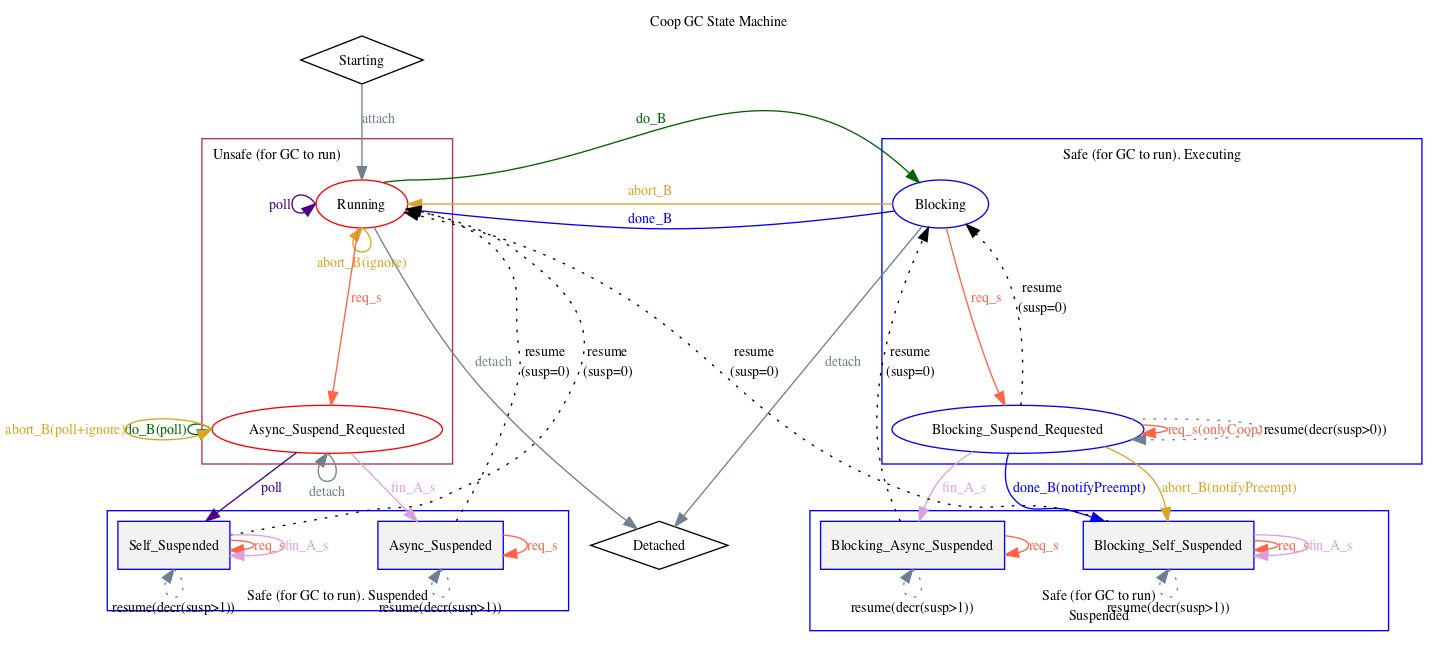
### State machine states and transitions
The hybrid cooperative suspend mechanism works like this:
- when a thread is executing in GC Unsafe mode, we use cooperative suspend and expect
the thread to periodically checkpoint its execution (as in the ordinary full
coop mode).
- when a thread is executing in GC Safe mode, we use a preemptive signal-based
suspend. This is new - previously in full coop we would allow `BLOCKING`
threads to continue executing and only suspend them when they wanted to go
from GC Safe to GC Unsafe (via the `BLOCKING_SELF_SUSPENDED` state).
There are two new states and one updated transition - the transition will
service both running and blocking threads: The idea is that suspend mechanism
is determined by the suspend initiator, and is not embodied in the the state
machine. The state machine just has to return distinctive enough values from
the transitions for the initiator to select a policy.
Resume mechanism is determined by the state that a thread finds itself in when
it is resumed, and the original suspend policy.
The primary differences between suspend mechanisms are: the preemptive
suspend is two phase - the `finish_async_suspension` does not
apply for cooperative suspend; the cooperative policy uses the `poll` transition when the thread is running.
We renamed `mono_threads_transition_request_async_suspension` to `mono_threads_transition_request_suspension`.
- It must be called by a suspend initiator on a victim thread that is not
itself.
- There can only be one suspend initiator for a victim at a time - if the
suspend initiator initiates a suspension it must follow through with the
whole protocol.
- If a victim is `RUNNING` we transition it to `ASYNC_SUSPEND_REQUSTED` and return
`ReqSuspendInitSuspendRunning` which signals that the caller must initiate
suspension for a running thread. (Same as the old `AsyncSuspendInitSuspend`).
- If a victim is `BLOCKING` we transition it to `BLOCKING_SUSPEND_REQUESTED`.
Note that this is different from the old `request_async_suspension` which just
incremented the suspend count and returned `AsyncSuspendBlocking`. Now we
return `ReqSuspendInitSuspendBlocking`. The return of
`ReqSuspendInitSuspendBlocking` means the initiator may signal the victim and
must wait to be notified of the suspension (in preemptive suspend it will be
notified by the signal handler, in cooperative when the blocking thread
attempts to exit from blocking mode).
- In `BLOCKING_SUSPEND_REQUESTED` we
may increment the suspend count. This is slightly too lax if we're going to
be using preemptive suspend on blocking threads: in that case we're in the
middle of a two-phase suspend and since there is only one suspend initiator,
we wouldn't expect another suspend to be initiated until we have a chance to
finish suspending. We leave it to the suspend initiator to rule out by returning
`ReqSuspendAlreadySuspendedBlocking` from this state.
- In all the not executing states (`SELF_SUSPENDED`, `ASYNC_SUSPENDED`,
`BLOCKING_SELF_SUSPENDED`, `BLOCKING_ASYNC_SUSPENDED`) we just
increment the suspend count.
- All other transitions are illegal.
- Note that `BLOCKING` must always have a suspend count of 0 and
`BLOCKING_SUSPEND_REQUESTED` must have suspend_count > 0.
We add two new states:
- `STATE_BLOCKING_SUSPEND_REQUESTED` - this is a new state that indicates that a
suspend initiator wants to suspend this victim thread.
- The thread is still executing in this state.
- We only transition into this state with
`mono_threads_transition_request_suspension`.
- The only legal transitions out from this state are:
- `resume` - decrements the `suspend_count`. If the `suspend_count` becomes 0 we
go back to `BLOCKING`, otherwise we stay in `BLOCKING_SUSPEND_REQUESTED`.
- `finish_async_suspension` (executed by the suspend signal handler to
finish the two phase preemptive suspend request and notify the suspend initiator),
- `done_blocking` and `abort_blocking`. It means that the a
suspend initiator requested a suspend but we got to done (or abort)
blocking before the signal was delivered. We return `NotifyAndWait` and the
caller is supposed to send a notification to the suspend initiator and
wait for a resume(with suspend count == 0) which will return to
`RUNNING` (the victim thread goes to `STATE_BLOCKING_SELF_SUSPENDED`).
- `STATE_BLOCKING_ASYNC_SUSPENDED`
- The thread is not executing in this state (it is waiting for a `resume`).
- a thread transitions into this state from `STATE_BLOCKING_SUSPEND_REQUESTED`
on a `finish_async_suspension` transition (see above).
- on a `resume` transition we decrement the suspend count. if it's still
positive we stay in this state. if it's 0 the thread transitions out of
this state. Unlike other resume transitions, in this case the thread goes
back to `BLOCKING` and resumes executing in GC Safe mode. The resume caller
must notify the resume initiator (ie this is a `ResumeInitAsyncResume`).
- on a `request_suspension` we stay in this state and just increment the
suspend count.
- all other transitions from this state are illegal.
We add two new return values for `abort_blocking` and `done_blocking`:
- `DoneBlockingNotifyAndWait` and `AbortBlockingNotifyAndWait`. Similar to
`SelfSuspendNotifyAndWait` - there was a race between the second phase of a
preemptive suspend and another operation (in that case a poll, in this case a
done or abort blocking) and the other operation won, so its caller should
notify the suspend initiator. Since the thread is now suspended, the caller
should wait for the resume signal.
We add new results for `request_initiate_suspension` `MonoRequestSuspendResult`
(formerly `MonoRequestAsyncSuspendResult`):
- `ReqSuspendAlreadySuspended` means the thread is not executing and we just
incremented its suspend count and there's nothing else for the suspend
initiator to do. (The old `AsyncSuspendAlreadySuspended`)
- `ReqSuspendAlreadySuspendedBlocking` means the thread is in
`BLOCKING_SUSPEND_REQUESTED` and we initiated another suspend request. This
should only happen with full cooperative suspend - with hybrid suspend we
will use a two phase preemptive suspend on a blocking thread and since only
a single suspend initiator is active, this state should not be visible to
another suspend initiator.
- `ReqSuspendInitSuspendRunning` - Thread is executing in GC Unsafe mode and the
caller should suspend it. This is the old `AsyncSuspendInitSuspend`. In
full preemptive suspend this is the only suspend initiation action and the caller
should begin the preemptive suspend procedure. In full coop we expect the
victim thread to reach a safepoint and poll to finish suspending.
- `ReqSuspendInitSuspendBlocking` - Thread is executing in GC Safe mode and
the caller should initiate a suspend. In full coop the caller has nothing
to do - a thread executing in blocking mode is assumed to be suspended. In
hybrid suspend, the caller has to initiate a preemptive suspend.
### Suspend initiator, signal handler, self suspender
Basically we call `mono_threads_transition_request_suspension` instead of `mono_threads_transition_request_async_suspension`.
Then if it says to suspend a running thread we call `begin_suspend_for_running_thread`, if it says initiate a suspension of a blocking thread, we call `begin_suspend_for_blocking_thread`, and if it says do nothing we do nothing.
**Questions**
1. We have an assumption in `safe_interrupt_thread` that we can return from a self interrupt if we're using coop suspend. I'm not sure if that makes sense for hybrid suspend, and not clear what to do about it.
2. In `mono_thread_info_safe_suspend_and_run` we expect that the callback won't return `KeepSuspended` if coop is enabled. I'm not sure what this means for hybrid.
3. A bunch of tests like `monitor-abort` and `appdomain-threadpool-unload` are failing if I enable hybrid suspend. Don't know why yet.
* fix ThreadPool.SetMinThreads fails if ThreadPool.GetMaxThreads was not called before #7988
* check mono_lazy_initialize in ves_icall_System_Threading_ThreadPool_SetMaxThreadsNative first
[console-unix] retry `tcsetattr` if it was interrupted by signal
if configuring the terminal failed, we still try to continue (see
a3ce2f008b ) and therefore succedings
`read`s can fail.
Fixes https://bugzilla.xamarin.com/show_bug.cgi?id=26983
Change begin_cooperative_suspend and begin_preemptive_suspend to return one of
three results: suspend fail, suspend succeeded using cooperative suspend,
suspend succeeded using preemptive suspend.
This is used by check_async_suspend to decide whether to check the
MonoThreadInfo for the result of a suspend. (If a thread is suspended
cooperatively, it doesn't make sense to check).
Fixes sporadic failures in mono/tests/monitor-abort.exe
When the environment variable is set, Mono will use cooperative safepoint
suspend for threads running in GC Unsafe mode (running managed code or native
runtime code), and preemptive suspend for threads running in GC Safe
mode (running native embedder or P/Invoke code, or blocking system calls)
The environment variable is visible through
mono_threads_is_hybrid_suspension_enabled ().
This commit just adds the env var, it doesn't turn on hybrid coop suspend.
The hybrid cooperative suspend mechanism works like this:
- when a thread is executing in GC Unsafe mode, we use cooperative suspend and expect
the thread to periodically checkpoint its execution (as in the ordinary full
coop mode).
- when a thread is executing in GC Safe mode, we use a preemptive signal-based
suspend. This is new - previously in full coop we would allow BLOCKING
threads to continue executing and only suspend them when they wanted to go
from GC Safe to GC Unsafe (via the BLOCKING_SELF_SUSPENDED state).
There are two new states and one updated transition - the transition will
service both running and blocking threads: The idea is that suspend mechanism
is determined by the suspend initiator, and is not embodied in the the state
machine. The state machine just has to return distinctive enough values from
the transitions for the initiator to select a policy.
Resume mechanism is determined by the state that a thread finds itself in when
it is resumed, and the original suspend policy.
The primary differences between suspend mechanisms are: the preemptive
suspend is two phase - the finish_async_suspension transition only does not
apply for cooperative suspend; the cooperative policy uses the poll transition
when the thread is running.
We renamed mono_threads_transition_request_async_suspension to mono_threads_transition_request_suspension.
- It must be called by a suspend initiator on a victim thread that is not
itself.
- There can only be one suspend initiator for a victim at a time - if the
suspend initiator initiates a suspension it must follow through with the
whole protocol.
- If a victim is RUNNING we transition it to ASYNC_SUSPEND_REQUSTED and return
ReqSuspendInitSuspendRunning which signals that the caller must initiate
suspension for a running thread. (Same as the old AsyncSuspendInitSuspend).
- If a victim is BLOCKING we transition it to BLOCKING_SUSPEND_REQUESTED.
Note that this is different from the old request_async_suspension which just
incremented the suspend count and returned AsyncSuspendBlocking. Now we
return ReqSuspendInitSuspendBlocking. The return of
ReqSuspendInitSuspendBlocking means the initiator may signal the victim and
must wait to be notified of the suspension (in preemptive suspend it will be
notified by the signal handler, in cooperative when the blocking thread
attempts to exit from blocking mode).
- In BLOCKING_SUSPEND_REQUESTED we may increment the suspend count. This is
slightly too lax if we're going to be using preemptive suspend on blocking
threads: in that case we're in the middle of a two-phase suspend and since
there is only one suspend initiator, we wouldn't expect another suspend to
be initiated until we have a chance to finish suspending. We leave it to
the suspend initiator to rule out by returning
ReqSuspendAlreadySuspendedBlocking from this state.
- In all the not executing states (SELF_SUSPENDED, ASYNC_SUSPENDED,
BLOCKING_SELF_SUSPENDED, BLOCKING_ASYNC_SUSPENDED) we just increment the
suspend count.
- All other transitions are illegal.
- Note that BLOCKING must always have a suspend count of 0 and
BLOCKING_SUSPEND_REQUESTED must have suspend_count > 0.
We add two new states:
- STATE_BLOCKING_SUSPEND_REQUESTED - this is a new state that indicates that a
suspend initiator wants to suspend this victim thread.
- The thread is still executing in this state.
- We only transition into this state with
mono_threads_transition_request_suspension.
- The only legal transitions out from this state are:
- resume - decrements the suspend_count. If the suspend_count becomes 0 we
go back to BLOCKING, otherwise we stay in BLOCKING_SUSPEND_REQUESTED.
- finish_async_suspension (executed by the suspend signal handler to
finish the two phase preemptive suspend request and notify the suspend initiator),
- done_blocking and abort_blocking. It means that the a
suspend initiator requested a suspend but we got to done (or abort)
blocking before the signal was delivered. We return NotifyAndWait and the
caller is supposed to send a notification to the suspend initiator and
wait for a resume(with suspend count == 0) which will return to
RUNNING (the victim thread goes to STATE_BLOCKING_SELF_SUSPENDED).
- STATE_BLOCKING_ASYNC_SUSPENDED
- The thread is not executing in this state (it is waiting for a resume).
- a thread transitions into this state from STATE_BLOCKING_SUSPEND_REQUESTED
on a finish_async_suspension transition (see above).
- on a resume transition we decrement the suspend count. if it's still
positive we stay in this state. if it's 0 the thread transitions out of
this state. Unlike other resume transitions, in this case the thread goes
back to BLOCKING and resumes executing in GC Safe mode. The resume caller
must notify the resume initiator (ie this is a ResumeInitAsyncResume).
- on a request_suspension we stay in this state and just increment the
suspend count.
- all other transitions from this state are illegal.
We add two new return values for abort_blocking and done_blocking:
- DoneBlockingNotifyAndWait and AbortBlockingNotifyAndWait. Similar to
SelfSuspendNotifyAndWait - there was a race between the second phase of a
preemptive suspend and another operation (in that case a poll, in this case a
done or abort blocking) and the other operation won, so its caller should
notify the suspend initiator. Since the thread is now suspended, the caller
should wait for the resume signal.
We add new results for request_suspension MonoRequestSuspendResult
(formerly MonoRequestAsyncSuspendResult):
- ReqSuspendAlreadySuspended means the thread is not executing and we just
incremented its suspend count and there's nothing else for the suspend
initiator to do. (The old AsyncSuspendAlreadySuspended)
- ReqSuspendAlreadySuspendedBlocking means the thread is in
BLOCKING_SUSPEND_REQUESTED and we initiated another suspend request. This
should only happen with full cooperative suspend - with hybrid suspend we
will use a two phase preemptive suspend on a blocking thread and since only
a single suspend initiator is active, this state should not be visible to
another suspend initiator.
- ReqSuspendInitSuspendRunning - Thread is executing in GC Unsafe mode and the
caller should suspend it. This is the old AsyncSuspendInitSuspend. In
full preemptive suspend this is the only suspend initiation action and the caller
should begin the preemptive suspend procedure. In full coop we expect the
victim thread to reach a safepoint and poll to finish suspending.
- ReqSuspendInitSuspendBlocking - Thread is executing in GC Safe mode and
the caller should initiate a suspend. In full coop the caller has nothing
to do - a thread executing in blocking mode is assumed to be suspended. In
hybrid suspend, the caller has to initiate a preemptive suspend.
* [sdks] New SDK target: soft debugger + non-nunit exe
This adds support for building an arbitrary .exe (dtest-app is hardcoded
now, but changing that and setting the arguments is another line or two,
to bu customized to the app being bound)
When an environment variable is set, the runtime will wait for the
managed debugger. This enables the desktop to debug the deployed .exe.
This will be used for the Mono.Debugger.Soft tests, but is useful for
isolated reproductions with android bugs.
An unmanaged debugger versions of the managed debugger is coming in
another PR.
* [runtime] Provide argument to dtest-app when running remotely
* [runtime] Fix case of VMDisconnectionException when getting Process of remote host that has disconnected
* [runtime] Script monodroid desktop debugger agent
* [runtime] Use g_warning in debugger agent
* [sdks] Ship PDBs on android
* [sdks] Add Android target to run debugger tests
* [sdks] Add desktop profile target for debugger tests
* [sdks] Disable debugger tests on mobile that use unsupported apis
* [sdks] Add monodroid test profile to android sdks
* [runtime] Allow dtest-app to be built on non-debugger-client profiles
* [runtime] Allow dtest-app building on mobile profiles
* [bcl] Mark some some code with DISABLE_COM which depends on icalls which are disabled in the runtime when --enable-minimal=com is used.
* [bcl] Fix compilation of System.Runtime.InteropServices.WindowsRuntime.dll.
* .
When we tried switching mono-project.com to enforce HTTPS these tests
started failing on systems without working SSL configuration.
Use a different domain which is guaranteed to be available over HTTP instead.
Note that eventually, the length will depend on stack_usage
difference between caller and callee, though for arm64 it does not currently.
This should fix https://github.com/mono/mono/issues/8112.
* [jit] Add a MONO_ARCH_FLOAT32_SUPPORTED arch-specific define, use it to disable float32 on platforms which don't support it.
* [amd64] Fix r4fp support for the ATOMIC_LOAD/STORE_R4 opcodes.
* [jit] Disable a unused test method with invalid IL.
* [jit] Handle r4->u conversion correctly in float32 mode.
* [amd64] Fix some OP_R<cmp> opcodes.
If the runtime is configured using --enable-minimal=soft_debug, the debugger code will be compiled into a separate
libmono-dbg.a library which needs to be linked into the app. The debugger needs to be registered with the runtime by
calling mono_debugger_agent_init () before runtime initialization.
* [llvm] Add intrinsics support for some of the new MathF icalls when using llvm+float32.
* [jit] Use m_class_get_name ().
* [llvm] Fix the signature of the llvm instrinsic used by OP_ABSF.
* [llvm] Use llvm.fabs only on amd64, it doesn't seem to be supported on some platforms.
* [ci] Update csproj files during PRs
Similar to how API diff is done.
Replace EXTERNAL_DRAWING_FACADE in csproj in genproj
It'd embed the absolute path in the csproj, but we want the variable instead.
* [csproj] Update project files
Custom modifiers are an odd feature of .net which allow types to
be tagged. These tags are semantically relevant. A method with a
modifier should not override a method without a modifier, for
instance (github bug #6936).
We don't put enough information into the modifier to uniquely find the
Image associated with the token we have in the type. Modifiers from
different referring assemblies will have different tokens to refer to
the same modifier class, making it important to resolve the tokens to
MonoClass pointers at runtime. Pointer equality of these classes is the
way to determine two custom modifiers the same, or unique.
We cannot resolve the image just from the MonoType because it is
possible to put modifiers on primitive, builtin types. These builtin
types lack any filled-out pointers in the data block, meaning we have
zero metadata associated with our floating token.
Other places in the codebase fixed this by passing around MonoImages,
but adding a MonoImage argument to our type comparison function for
this single bug would be a very poor decision with much code churn all
throughout the runtime.
The bug above resolves to two I4 types, one of which has a modifier, one
of which does not.
In order to pass this MonoImage around, we need to put a reference to it
into something reachable from the MonoType. We can't put it in the
custom module type because that is exported. It is part of the public
API.
MonoTypes do not adhere to pointer equality, and custom modules are structs
baked directly into the MonoType. We need therefore to make MonoType
point to a MonoCustomModInternal, a new type. This type embeds the
public type as a struct and carries around the image as another element
in the struct.
All public interfaces still see the same metadata endpoints for parsing the
modules, including the icalls. It is only our type comparison code that
accesses our new field.
This fixes https://github.com/mono/mono/issues/8074.
I see this 100%. Why others do not? I usually skip aot so usually I don't see it. Linux Ubuntu 1604 and
1710 tested. mono-devel package is installed, which is probably not relevant.
git clean -xddf (or new git clone)
./configure --with-runtime_preset=fullaot likely also with others (hybridaot)
make
Many errors like:
MONO_PATH="./../../class/lib/build:$MONO_PATH" /s/mono/runtime/mono-wrapper ./../../class/lib/build/sn.exe
-q -R ../../class/lib/testing_aot_full/mscorlib.dll ./../../class/mono.snk Couldn't sign the assembly
../../class/lib/testing_aot_full/mscorlib.dll with this key pair. Public key of assembly did not match
signing public key. ../../build/library.make:342: recipe for target
'../../class/lib/testing_aot_full/mscorlib.dll' failed
If you run make V=1 you see the sn command.
You can see the installed sn works ok. Remove the -Q for quiet and you see a warning about missing
machine.config. Run with ptrace and you see it looking for 4.5/machine.config. Look in the tree and you
see 1.1 and 2.0. Copy the 2.0 to 4.5 and problem goes away. And can be edited down a bunch. Actual fix is
to move symlink of the file to outside a conditional.
Maybe people aren't using fullaot or git clean? Repro is 100% for me.
I was going to bisect, but it was occuring as far back as September 2017 so I did not.
.
* [sdks] Add support for building llvm unless the USE_PREBUILT_LLVM Make.config var is set.
* [sdks] Use prebuilt llvm binaries on ios CI.
* [sdks] Use the IGNORE_PACKAGE_LLVM variable to enable the building of llvm.
* [runtime] Handle interpreter-related frames in async stack walks.
* [profiler] Fix exception clause reporting.
This fixes three separate issues:
* Finally clauses in the non-exceptional case were not reported because we
implement these by simply calling them from managed code, as opposed to the
exceptional case where we call them from runtime C code.
* The catch portion of a try-filter-catch clause was being incorrectly reported
as a filter.
* Actual exception filters were not being reported at all.
Because we have to instrument JIT'd code to report non-exceptional finally
clauses, a new mono_profiler_enable_clauses () function has been introduced
which profiler API users must call in order to get exception clause events, in
a similar fashion to mono_profiler_enable_allocations (). Since this is a
breaking change, the profiler API version has been bumped.
Fixes#7525.
* [profiler] Remove the iomap_report event and associated code.
The IOMap profiler no longer exists, so we no longer need to expose this
somewhat hacky event.
* [profiler] Replace the old gc_event with gc_event2.
* [coop] Squash the thread state machine state numbering
In
https://github.com/mono/mono/commit/9767b8a55ec8be3fc46055d7a1e21b6894fd0fc5
we removed STATE_SELF_SUSPEND_REQUESTED
but left a hole in the state numbering, as a result, `state_name()` was off by
one (and falling off the end of the array).
* [coop] Renamed STATE_BLOCKING_AND_SUSPENDED -> STATE_BLOCKING_SELF_SUSPENDED
Noticed this while looking at Jenkins logs today:
```
15:00:56 /mnt/jenkins/workspace/test-mono-pull-request-amd64/mcs/class/lib/net_4_x/mscorlib.dll
15:00:56 cant resolve internal call to "System.MathF::ModF(single,single*)" (tested without signature also)
```
We need to use `single` in the icall def instead of `float`.
It was introduced by https://github.com/mono/mono/pull/7941
Using `Task.Delay (timeout)` has the potential of possibly allocating and holding large
chunks of memory throughout the timeout period. While this is not strictly speaking a
memory leak because those objects will eventually be disposed and garbage collected, it
can cause memory usage of apps to grow quite significantly in the short run.
The default timeout values are as follows:
* `HttpWebRequest.ReadWriteTimeout`: 5 minutes.
* `HttpWebRequest.Timeout`: 100 seconds.
* `ServicePointManager.MaxServicePointIdleTime`: 100 seconds.
And these values can be increased by the user. This means that we're potentially holding
hundreds, maybe even thousands of timeout objects in memory for 5+ minutes.
This has now been fixed by using the `Task.Delay(int,CancellationToken)` constructor.
Note that disposing a `CancellationTokenSource` will not cancel it, so the following code
will still leak:
using (var cts = new CancellationTokenSource ()) {
Task.Delay (TimeSpan.FromDays (3), cts.Token);
// Work
}
To actually make the `Task.Delay` instance go away when we're done with it, we need to
use this pattern:
var cts = new CancellationTokenSource ();
try {
Task.Delay (TimeSpan.FromDays (3), cts.Token);
// Work
} finally {
cts.Cancel ();
cts.Dispose ();
}
We also cannot use `CancellationToken.CancelAfter()` for timeouts because unfortunately
some of the underlying framework code that we're using does not honor cancellation
requests - like for instance `NetworkStream`.
This is a partial fix for #7356. While this commit significantly improves the problem,
there may be other unrelated issues left that needs to be investigated.
Output formatting is now delegate to a `Formatter` subclass. The default
one remains HTML with `HtmlFormatter` so any script should not see any
difference.
The output file is largely identical, except a few whitespace changes
that could not easily be avoided and how modified base types were
reported, since that was different from the rest.
The big change is the `--md` option which can output markdown, which
is the format to use from docs.microsoft.com. There are less options
available, e.g. colors, so additions are rendered using the `csharp`
blocks, while modification are rendered as a `diff` block.
Each assembly output is made to be easy to re-assemble into a single
document if needed, e.g. https://github.com/xamarin/xamarin-macios/pull/3814
* [coop] Include function names in coop state change assertions
i.e. better reporting here:
https://jenkins.mono-project.com/job/test-mono-pull-request-coop/2298/parsed_console/log.html
***** MonoTests.System.Runtime.Remoting.RemotingServicesTest
***** MonoTests.System.Runtime.Remoting.RemotingServicesTest.Bug46473
Assertion failure in thread 0x7f21a504b740 due to: Cannot transition thread 0x7f21a504b740 from STATE_BLOCKING with DO_BLOCKING
Last 3 state transitions: (most recent first)
[DO_BLOCKING] RUNNING -> STATE_BLOCKING (0) 0 at:
at /mnt/jenkins/workspace/test-mono-pull-request-coop/mono/mini/mono(+0x2ef31a) [0x560336a6f31a]
at /mnt/jenkins/workspace/test-mono-pull-request-coop/mono/mini/mono(+0x2eb477) [0x560336a6b477]
at /mnt/jenkins/workspace/test-mono-pull-request-coop/mono/mini/mono(+0x2ec7a2) [0x560336a6c7a2]
at /mnt/jenkins/workspace/test-mono-pull-request-coop/mono/mini/mono(+0x2ec7e6) [0x560336a6c7e6]
This will provide one function instead of 0 or n, and could be expanded to include more.
This bloats shipping binary some (under condfigure only) which can be addressed with
an #if that conditionally turns the strings to null or empty. And slight code bloat.
Note that JIT and products and test use all this stuff and are left compatible and unchanged.
Previously:
foo(gpointer *stackdata)
{ ...
}
stackdata pointing to uninitialized, and not even size-specified
is now:
foo_internal(MonoStackData *stackdata)
{
...
}
foo(gpointer* stackpointer)
{
MonoStackData stackData = { &stackdata, __func__ }; // define MONO_STACKDATA
stackdata.stackpointer = stackpointer; // replacing &stackdata
foo_internal(&stackdata);
}
with __func__ being a known-inaccurate standin for the caller.
If products/JIT/test evolve, flags to indicate which fields are present are likely in order.
Currently only the top function is printed, but we can likely store them longer.
As well running the debugger will help.
backtrace library could also be expanded. Currently it finds symbols on Mac but not Linux.
* [Tailcall] Disable tailcall-virt.exe tailcall/fsharp.exe per-arch instead of !AMD64
so we can whittle away at it.
* [Tailcall, arm64, jit] Make mono_arm_emit_destroy_frame flexible
as to if ip0 or ip1 (or both) is temporary. This isn't strictly necessary as caller
can carefully chose the correct one, i.e. ip0.
* [Tailcall jit arm64] Add virtual tailcall support to ARM64 (OP_TAILCALL_MEMBASE).
It could be either "interleaved" with regular tailcall support as done here,
or split up into a separate case. The level of code sharing with interleaving
is not huge.
* [Tailcall] Spell out 'membase' as 'tailcall_membase' for clarity.
Remove extra "shadowed local" MonoCallInst *call and use
the other one. It achieves the same thing in this case
and helps debugging experience. Alternative would be
to rename the second one to "tailcall".
* [Tailcall] x86 tailcall_membase support (i.e. for virtual now, interface later)
* [Tailcall] Be sure not to tailcall interface calls on ARM.
* [Tailcall] More debugprinting.
* [Tailcall] arm64: allow floating point through (but only full registers)
arm, x86, amd64: require caller and callee return storage to match (arm64 already did)
Cleanup and debugprint.
* [Tailcall test] Always get hugeint (recursion depth) via function call,
so we can edit it one place.)
* [Tailcall] Add a FIXME for returning structs that can be made to work.
* [Tailcall test] Turn the F# test into three variations:
deeptail same as original -- failure mode is stack overflow
shallowtail which tailcalls but not to great depth -- it won't stack overflow
and so it should have no other failure, but make sure -- for example
this might still struggle on arm and we might split it up further
shallownotail which is really should be nothing special
In this commit, all three are the same -- copy w/o edit.
* [Tailcall test] Make shallow in two tests and remove tail in one.
* [Tailcall test] Disable deeptail TailCallLoopGenericClass<DateTime> for all architectures.
It fails on x86 and arm64. It passes on amd64. arm tbd.
* [Tailcall test] Enable F# tests for x86 and arm64 (three internally are disabled for all architectures, one of which passes for amd64).
* [Tailcall test] Every configuration should be able to run the shallow/notail F#/tailcall tests.
They don't depend on tailcall, but either correctness w/ or w/o tailcall,
and if they do fail, it is not due to stack overflow.
* [Tailcall test] Fix .assembly directive to make some tailcall tests AOT compatible.
* [Tailcall] Dial back debugprint bloat after merge.
it won't be scanned by the GC, defer string allocation to execution-time instead.
this fixes a GC crash when running mini regression suite on iOS/arm64.
OS: Ubuntu 18.03
CMake: 3.10
For some reason cmake fails to detect any make program (be it ninja or make)
when cross-compiling for Android in XA. It happens despite the programs being in
$PATH and working correctly. The effect is that CMAKE_MAKE_PROGRAM is set to
"not found" in CMakeCache.txt and configuration fails as follows:
Call Stack (most recent call first):
external/mono/external/boringssl/util/android-cmake/android.toolchain.cmake:1140 (CMAKE_FORCE_CXX_COMPILER)
external/mono/sdks/builds/android-armeabi-v7a-debug/mono/btls/build-shared/CMakeFiles/3.10.2/CMakeSystem.cmake:6 (include)
CMakeLists.txt:3 (project)
CMake Error: CMake was unable to find a build program corresponding to "Ninja". CMAKE_MAKE_PROGRAM is not set. You probably need to select a different build tool.
-- Configuring incomplete, errors occurred!
This commit does not fix the issue, per se, but it works around it by finding
the first ninja/make (as configured) executable in $PATH and setting the
CMAKE_MAKE_PROGRAM to full path of the executable. I haven't spent too much time
investigating *why* cmake fails to find the executable (I merely ran it with
--trace-expand --debug-output which revealed nothing of consequence) but this
workaround should be safe for any version of CMake and any OS we use makefiles
on.
* [gc] Silently ignore mono_gchandle_free(0) so callers do not have to check.
* [threads] Take advantage of mono_gchandle_free(0) being nop (a few extra instructions
in dynamic path for when it is 0, same path length if it is not 0).
* [threads] Restore one if, it isn't clearly correct otherwise.
This pull request brings support to Mono's class libraries for the new `System.MathF` type which includes operations for single-floating point.
This is needed to run some new applications like:
https://github.com/aras-p/ToyPathTracer
With this change, it is possible to run this unmodified. With this support, and the `-O=float32` option, it is possible to improve the performance from 6.3Mrays/sec to 7.8Mrays/sec on a Mac.
Oddly, this seems to be faster than .NET Core 2.1.4, which is at 4.2Mrays/sec.
* Bump API snapshot submodule
* [wasm][corlib] Disable some tests that don't work with WASM.
* [wasm][corlib] Disable IO test that requires threading.
* [wasm] Disable parallelism when building the wasm runtimes. Fixes CI build.
* [wasm] The incremental test runner can now skip tests in bulk.
* [wasm] Address reviewer feedback.
Current build uses `tar` to extract ZIP archives. This works with BSD
tar but not with GNU tar, alas. Tar was used in order to strip the root
directory of Android archive while moving files into place. This commit
replaces `tar` with a call to a shell script (because doing what it does
using Make defines is an exercise in pain) which works both on macOS/BSD
and on Linux.
* [Tailcall] Dial back single -v output, and enable under MONO_DEBUG=tailcall, and -v -v.
* [Tailcall] MONO_LOG_LEVEL=debug MONO_LOG_MASK=tailcall and mono_trace instead of mono -v -v and g_print
This fixes `test_0_simple_double_casts` on iOS/arm64.
According to the C standard (section [conv.fpint]), the behaviour of
such a cast is undefined if the truncated value doesn't fit into the
destination type.
```c
unsigned char __attribute__ ((noinline)) convr8u1 (double i)
{
return (unsigned char) i;
}
```
for arm64, `clang -O0` produces:
```
_convr8u1:
100006848: ff 43 00 d1 sub sp, sp, #16
10000684c: e0 07 00 fd str d0, [sp, #8]
100006850: e0 07 40 fd ldr d0, [sp, #8]
100006854: 08 00 78 1e fcvtzs w8, d0
100006858: 00 1d 00 53 uxtb w0, w8
10000685c: ff 43 00 91 add sp, sp, #16
100006860: c0 03 5f d6 ret
```
while `clang -O2` produces:
```
_convr8u1:
100006ae8: 00 00 78 1e fcvtzs w0, d0
100006aec: c0 03 5f d6 ret
```
which is fine according the standard: Any value < 256 gets casted just
fine, but for example `convr8u1 ((double) 0xffff)` would end up with
`0xffff` in `w0`.
We workaround this behaviour by casting to a 32bit int first, the
resulting code looks like this then:
```
_convr8u1:
100006ae4: 08 00 78 1e fcvtzs w8, d0
100006ae8: 00 1d 00 12 and w0, w8, #0xff
100006aec: c0 03 5f d6 ret
```
* [Tailcall] Require an exact match on return type. Sometimes this makes sense (float<=>double), sometimes
it is a little overly restrictive (integer truncation, I <=> I[48])
* [Tailcall] Disable CoreCLR tests that have mismatched return types.
[mini] Introduce MonoEEFeatures with a single feature use_aot_trampolines.
MonoEEFeatures is meant to replace the mode flag soup with have.
Each feature is supposed to be checked alone and descriptive enough of the underlying behavior.
use_aot_trampolines is a good example because the inter_aot_llvmonly mode could set it to false and
skip all the trampoline engine nonsense as trampolines are C functions.
Contributes to #7885
* [wasm] Switch wasm interp to not set use_aot_trampolines.
This allows the regular "JIT" tramp path be used instead of hacking our way around the AOT runtime.
* [mini] Introduce MonoEEMode to let us enumerate non-aot execution modes.
This lets us have all code setting up mono_ee_features in a single place.
* [Coop] Opportunistically remove some raw pointers.
Replace some uses of mono_thread_interruption_checkpoint with
mono_thread_interruption_checkpoint_void or mono_thread_interruption_checkpoint_bool.
* [Coop] Remove some more raw pointers opportunistically -- mono_thread_execute_interruption to mono_thread_execute_interruption_void.
* Fix warnings from old bad merge.
* Add another static.
* [coop] Remove more raw pointers.
* [sdks] Add provisioning for Android SDK and NDK
This will also be used by XA
* Add missing backslash to mxe.mk
* Only grab bin/autopoint
* [sdks] Use provisioning for MXE
We want to treat MXE the same way we do Android SDK and NDK because it only rarely changes, and it's very long to build it.
* WCF: ChannelDispatcher/ListenerLoopManager.Setup validate InstanceProvider, not InstanceContextProvider
- the creation of endpoints requires an instance provider or a default constructor
- InstanceProvider vs InstanceContextProvider was obviously a typo
* include InstanceContextProvider for validation as before
- two unittests failed due InstanceProvider is null and ed.DispatchRuntime has not type set
- comment for the validation is not useful anyway (It is tested at Open(), but strangely it is not instantiated at this point.)
* [Facades] Add System.Memory facade to mobile profiles
Contains only the types we have right now.
Fixes https://github.com/mono/mono/issues/7610
* Bump API snapshot submodule
In 38a348c991 we got rid of
mono_threads_transition_reqest_self_suspension. So there is now no way to
enter into STATE_SELF_SUSPEND_REQUESTED, so we no longer need to have cases for
transitioning out of it.
It's done by ifdef'ing WASM because I don't see a way to change Environment.Platform / Environment.OSVersion without touching the public API.
Right now OSDescription is being used to return the execution environment. Once we properly support node and other non-web embeddings, it will be adjusted to do so.
* [runtime] Fix class visibility check for protected nested classes. Fixes#7657.
A nested class that has protected access must be checked using the same inheritance based rules as members.
The existing code ignores that and does a plain visibility check that is only amendable for public/internal nested types.
* [runtime] Add regression test for nested famility visibility.
* [runtime] Add a --disable-btl-lib configure option to disable the building of the btls lib, but compile the managed code with btls support.
* Disable building btls/ and support/ on the bcl build, they are not needed.
* [Tailcall] Copy some tests from CoreCLR.
* [Tailcall] Copy and build some tests from CoreCLR.
* [Tailcall] Add mono --test-tailcall-require switch
that asserts that every tail. is honored.
Add some tailcall output under -v.
* [Tailcall] Switch tests/coreclr/tailcall to tests/tailcall/coreclr
on the theory that this is where additioanl tailcall tests will go,
not that is the coreclr test area.
Also remove leading "./" which did afford easier search/replace
but will likely be seen as noise, and might break out of tree builds.
* [Tailcall] update readme
* [Tailcall] Tweak logging and first working Makefile, w/o disabled tests.
Next step is try to restore parallelism.
* [Tailcall] Add indent and fix check-tailcall to be parallel and incremental.
* [Tailcall] Out of tree builds just need mkdir.
* [Tailcall] Remove accidental content.
* [Tailcall] Undo fix for out of tree builds.
* [Tailcall] Use environment variable MONO_DEBUG in place of command line parameter despite
environment variables having problems and being banned in other contexts.
Accept and ignore empty MONO_DEBUG option so that ",foo" can be appended without
first checking for empty -- without having to learn how in another language.
Use g_print instead of printf in new code, i.e. for Android debugger.
Remove newlines to restore unreadability/unmergability.
Make running tailcall tests not incremental by default but leave I= to make it incremental.
Add comments indicating "tailcalllog" is a public interface, not to be changed
without changing its users.
* [Tailcall] Resolve a recent "FIXME".
* [Tailcall] Compile but do not run the C# tests.
* [Tailcall] Split disabled compile from disabled run, and compile the last of the tests.
Disable compile remains, because one of the tests contains 3 files, and putting
the three sources in the sources variable (for distribution) implies building them each separately.
Disable compile is used to remove two of them from compiling independently
and then another dependency rule makes them compile together.
* [Tailcall] Follow convention without incrementality and less verification.
* [Tailcall] Disable new failing tests on x86/arm/arm64 and Linux/amd64.
* [Tailcall] Disable more tests for x86 and sort the lists.
* [Tailcall] Move from .NET Standard to mscorlib see if that works better.
* [Tailcall] Add missing build dependency.
* [Tailcall] Do not compile tailcall/coreclr/JIT/opt/Tailcall/TailcallVerifyWithPrefix.exe for
FullAOT. Compiling it fails an assert where it is supposed to raise an exception. Fix later.
* [Tailcall] For now, do not run any CoreCLR tailcall tests with FullAOT.
--compile-all fails an assert there. Instead we have to find what can run, and don't use --compile-all.
* [Tailcall] Disable all CoreCLR tests under FullAOT. Some fail to tailcall.
Many work, w/o assertion failure and printing success, but none exit with 0 exit code.
* [Tailcall] Add clarifying comment.
* [Tailcall] Add two opportunistic tail. prefixes.
add some OpenBSD patches
Hi,
A few trivial additions of OpenBSD to ifdefs, plus the change of the abort signal to SIGUSR1 which fixes the SIGABRT problem (other compilation problems remain). SIGTTIN is broadcast to the process group which leads to the SIGABRT (at least on OpenBSD).
The original design review is here: dotnet/corefx#22866 . To summarize, this adds a new flag to `BindingFlags` called `DoNotWrapExceptions`. When this flag is used to invoke a method using reflection, any exceptions thrown are not wrapped with a `TargetInvocationException`.
It has already been implemented in some other version of .NET:
- dotnet/corert#4437
- dotnet/coreclr#13767
I would be delighted if this handy feature was also available in Mono.
I have in part based my changes on the CoreCLR implementation. There all already tests for this feature in corefx, so I have added those to the corlib_xtest.dll.sources file.
I have a couple of concerns about my implementation:
- I notice that `DynamicMethod.Invoke` was ignoring the BindingFlags and other arguments. I changed this method to pass along all the arguments. For what it's worth, it appears that [CoreCLR respects](https://github.com/dotnet/coreclr/blob/master/src/mscorlib/src/System/Reflection/Emit/DynamicMethod.cs#L488) these arguments.
* [sdks] Pass LLVM_SRC from XA to use `xamarin-android/external/llvm`
We do not clone to `$(LLVM_SRC)` because this is up to XA.
* [sdks] Pass IGNORE_PACKAGE_MXE from XA
This is to avoid rebuilding MXE while XA already took care of it.
* [sdks] Only checkout specific MXE and LLVM commit when cloning
It is enough to check for iconv
dependencies once in the eglib/configure
- just use the generated libtool
library file to automatically
add additional dependencies (if any).
While here, make sue libeglib.a
has libraries returned by LTLIBTOOL
as a libtool dependency.
* [genproj] Move obj to common folder and remove unnecessary properties
We now default to mcs/class/obj instead of writing to the assembly folder.
* [genproj] Fix jay path on Unix
* [genproj] Fix IntermediateOutputPath for Facades
* Add some PerformanceCounter test code from reference source and MSDN,
combined and lightly edited per local conventions.
* Restructure PerformanceCounter code for type safety and fix incorrect typing.
* [monograph] Don't link duplicate copies of metadata and utils
Monograph builds against mono/mini/($LIBMONO_LA) (aka libmonosgen-2.0.la), so
the only pieces it would pick up from staticlly linking the extra libs are
non-API functions (such as the MonoClass getters), but at the cost of linking
errors due to duplicate symbols.
Also replace calls to MonoClass getters by mono API functions.
* [ilgen] Fixup MonoClass getter usage
Followup for e610e443cd
* [boehm] Fix a few direct MonoClass accesses
* [monograph] Statically link against the mono runtime
Dynamically linking but using some symbols (such as mono_read32) on some
platforms that are hidden in the library means that we had to statically link
against the runtime anyway, which then caused build issues.
* [monograph] Fix runtime crash on startup
```
mono_os_mutex_lock: pthread_mutex_lock failed with "Invalid argument" (22)
```
* [msvc] Fix monograph build
* [runtime] Rework how the native-to-managed eh callback is called.
Instead of catching all exceptions in the native-to-managed wrapper and calling the callback from the catch clause, call it directly from the EH code. The
previous approach caught all exceptions, which messed up debugging, since the debugger wouldn't break on uncaught exceptions raised from native-to-managed
callbacks.
* [coop] Enable tests bug-58782-plain-throw and bug-58782-capture-and-throw for PRs
* [mini] Installed native-to-managed exception handling callback from second pass.
The constraints are:
1. We must allow managed exceptions to be caught and finally blocks must run
2. We must not call the unmanaged exception handler if the first unwinding pass
detects that there is a native-to-managed wrapper and a callback is
installed that will handle managed exceptions (by unwinding the native code
and either re-raising the managed exception or otherwise dealing with it).
So we change the return value of handle_exception_first_pass to be:
- MONO_FIRST_PASS_HANDLED - caught by a managed frame (with a matching filter if one was present).
- MONO_FIRST_PASS_CALLBACK_TO_NATIVE - there's a native-to-managed wrapper and a ftnptr_eh_callback is installed.
- MONO_FIRST_PASS_UNHANDLED - first pass unwound all the way and there was no wrapper or there was no callback installed.
In mono_handle_exception_internal, we treat MONO_FIRST_PASS_CALLBACK_TO_NATIVE
as handled and unwind the managed stack, invoking finally clauses as we go,
until we reach the managed-to-native frame, at which point we invoke the callback.
* [test] Test for mono_install_ftnptr_eh_callback
* [test] AOT-friendly test for mono_install_ftnptr_eh_callback
* [sre-save] Remove type_token assignment in mono_image_fill_export_table
In 9725d50c87 we added the `g_error`, that should
fire if the MonoClass:type_token and the TypeBuilder token ever disagree. As a
result, this assignment is strictly redundant.
* [pedump] Use MonoClass getters
* [monograph] Use MonoClass getters
* [mini] Use MonoClass getters in a few more places
Catch up with recent commits.
In 9725d50c87 we added the `g_error`, that should
fire if the MonoClass:type_token and the TypeBuilder token ever disagree. As a
result, this assignment is strictly redundant.
Adopts a linked list of MonoW32HandleSlot (based on feedback from Rolf Kvinge). This allows for an unlimited amount of handles to be allocated, as well as for a lower cost to allocate only 1 handle across the process.
Fixes https://github.com/mono/mono/issues/7460
This implements a simple deduplication of source files in the .csproj's.
A postprocessing step opens the files and grabs all ItemGroups with sources
and then does an intersection. It then moves files that are common
across all platforms into a separate ItemGroup.
* Fix warning: Add static.
* Fix warning: Remove unused function from a recent incorrect merge/rebase.
* Fix warning(s): Cast away const.
* Add static to avoid global link-namespace pollution.
* Add const on input strings.
* (void) and () are not the same in C, overwhelmingly you want (void)
{0} does not portably zero unions, so favor memset
braces at start of function go on their own line
space before parens on function calls
spaces around binary operators
favor memset (x, 0, sizeof(x)) instead of memset (x, 0, sizeof(type))
favor TRUE/FALSE over true/false unless/until we switch to C++
This batch of commits makes further updates to our support for building the BCL using msbuild (Visual Studio, to be specific).
* Generates a single sln and set of csproj files with support for all of our build profiles (orbis, monodroid, net_4_x, etc)
* Project configuration selector (in VS or as parameter to msbuild) can be used to select which profile to build
* Includes partial dependency information so that culevel and jay are compiled before the rest of the sln (this keeps pre/post events from from failing on first build)
As of this rev things are working pretty good, but a lot of the measures I took here are temporary so I'd appreciate thoughts on how to go about them. The hard-coded System.Web -> Culevel dependency feels gross, for example - I kind of want to go through and build an automatic solution for it but I'm not sure it's necessary.
Implements #6858
---
* Checkpoint: Generate single .csproj file with conditional item/property groups
* Checkpoint: Updates to csproj and sln generation to support building specific profiles
* Move targets file in csproj template so that it isn't evaluated before all properties are set
* Checkpoint profile fallback (use net_4_x if project does not have appropriate profile)
* Use in-process cache for project guids to fix bug where many guids were being generated. Fix profile fallback.
* Clean up unnecessary debug writelines
* genproj error fixes
* Remove duplicate gacutil entry from makefile to fix order.xml corruption. Cleaner project names in msbuild sln. Compile genproj before generating inputs.
* Delete genproj.exe at beginning of update-solution-files because otherwise syntax errors will cause an old version to be used silently
Cleaner messages from genproj
* Hard-code the guid for culevel and add it as a dependency for system.web
* Bug fixes
* sln files are sensitive to whitespace format
* Don't generate pointless solution configurations if we have no information for them
* Updates based on PR feedback
Contributes to #7682
Fixes https://bugzilla.xamarin.com/show_bug.cgi?id=12850
FtpWebRequest used to work incorrectly with sub directories.
Let's say we have a following FTP structure
```
myserver
├── file1
└── subdir
└── file2
└── file3
```
Old behavior:
### 1) For `ftp://myserver/subdir/` printed:
```
file2
file3
```
Expected:
```
file2
file3
```
### 2) For `ftp://myserver/subdir` printed:
```
file1
subdir
```
Expected:
```
subdir/file2
subdir/file3
```
### 3) For `ftp://myserver/subdir/file2` printed:
```
file2
file3
```
Expected:
```
file2
```
With the fix in this PR it works as expected (matches netfx and netcore behaviors).
* [mini] Don't wait for other threads to finish JITing if the current thread is running a cctor.
This eliminates a possible source of deadlocks found during AOT runs of Roslyn.
* [mini] Introduce a 1s timeout to JIT job control to ensure we don't simply deadlock in case of execution dependency bugs.
* [mini] fix spelling5DD
* [metadata] Use getters in a few ilgen files
* [mini] Use MonoClass getters in several files
* [mini] Use MonoClass getters in mini-generic-sharing.c
* [debugger-agent] Use MonoClass getters
* [monodis] Use MonoClass getters in get.c
* [Tailcall] Add but do not use the F# tailcall test suite.
* [Tailcall] Compute inst_tailcall much earlier, it is cheap, and it will be used more and earlier.
* [Tailcall] Compute supported_tail_call and tail_call earlier.
* [Tailcall] Fix virtual generic methods that F# test TailCallLoopGenericClassAndMethodAbstractClass<byte>.Method3<byte> uses.
There is a general problem of customized code paths missing pieces.
This fixes just part of it.
* [Tailcall] Use common code for removing ret after tailcall, and not handling return value.
* [Tailcall] Cleanup.
* [Tailcall] Short circuit looking at parameters for has_vtargs.
* [Tailcall] Tailcalls presumably do not need sequence points, or anything, after them.
* [Tailcall] Fewer labels, more booleans, move existing label up, with additional booleans
controlling its behavior -- intent is to tease one altered behavior (tailcall of
virtual generic) and one existing and one new sharing of common code (remove_ret).
Longer term might have more tailcall handling.
* [Tailcall] F# tests closer to original.
* [Tailcall] Add the F# tests in blob form.
comment out the two failing tests
fsharpc --standalone --optimize- fsharp.fs
monolinker fsharp.exe to trim a little
change resource-using code to use constant strings
* [Tailcall] CI fails roughly where local passes.
* [Tailcall] Merge fsharp.fs into fshar.il as a comment.
* [Tailcall] Cleanup, remove unused labels, etc.
* [Tailcall] Cleanup test code some.
* [Tailcall] Cleanup.
* [Tailcall] Try harder to disable fsharp for AOT due to CI failures.
The only user was Xamarin.iOS in a weird way: The define is only set for
device builds where the icall table is excluded anyway. For the cross
compiler however, the define isn't set, and therefore those icalls can
be resolved by the AOT compiler.
With the interpreter now, this define actually had an effect: The
guarded icalls weren't inclueded in `libmono-icall-table.a`.
* [mkbundle] Automatically bundle config files and machine.config files for the simple/cross compiler scenario, fixes one of the missing issues for #6230
* Remove debug writeline
* Remove outdated information
* Bump API snapshot submodule
* [interp] Handle mono_handle_exception () returning a ctx which refers to JITted code by restoring the context.
* [aot] Clear the pinvoke flag from the interp_in wrapper signatures, so they get an lmf in mini_get_interp_in_wrapper (), this is needed for mixed-mode exception handling.
* [aot] Change the semantics of the 'interp' option, use it only to emit additional interp wrappers etc. instead of disabling code generation as well.
* [aot] Emit more interp-in/interp-out wrappers when using --aot=full,interp.
* Add a --interp=interp-only= command line option, used for testing.
In full-aot+interp mode, prefer full-aot code instead of interp code, except for methods in the classes listed
in the interp-only option.
Use normal runtime invokes in full-aot+interp mode.
* [interp] Prefer AOTed code when making calls out of interpreted code in full-aot mode.
* [aot] When running with --aot=interp, preserve the previous behavior of only emitting interp wrappers and trampolines.
* Revert "[Tailcall] Quick fix for building F#. Do not tailcall any method with a vtable_arg. (#7609)"
This reverts commit 8ceead93e3.
* [Tailcall] Correct fix for regression from change b4ee86154f.
Regression test not yet available.
* extra brace
* [Tailcall] Add FIXME for tail. not followed by ret. Correct behavior is to raise an exception, not fail an assert.
* [Tailcall] Add disabled debug code to break when compile a tailcall and/or execute a tailcall.
* [Tailcall] Add disabled debug code to try to tailcall any call followed by a ret.
This might be reasonable in the future, as well as a little data flow
analysis skipping nops and branches, as csc w/o -optimize outputs.
* [Tailcall] Add more tailcall tests, i.e. that would
have caught recent regression.
* [Tailcall] Replace #if 0 with MONO_DEBUG=tailcall_break_compile,tailcall_break_run,tailcall_try_all,tailcall_log,
tailcall_all. Consider MONO_TAILCALL_DEBUG instead.
* Revert "[Tailcall] Replace #if 0 with MONO_DEBUG=tailcall_break_compile,tailcall_break_run,tailcall_try_all,tailcall_log,"
This reverts commit 796d9490f672625189dfac47ff24b05f3fb65cbe.
* [Tailcall] Replace #if 0 with ifdefs:
define DEBUG_TAILCALL_BREAK_COMPILE breakpoint in method-to-ir
define DEBUG_TAILCALL_BREAK_RUN 1 codegen outputs breakpoint
define DEBUG_TAILCALL_TRY_ALL 1 consider any call followed by ret, can expand later
define DEBUG_TAILCALL 1 low volume logging under -v instead of -v -v
* [Tailcall] Dial back tailcalls on ARM32, where there is no
volatile non-parameter register in the ABI, in which to pass
an extra parameter. (Why not just pass as a regular first/last parameter?)
* [Tailcall] Dial back untested architectures MIPS S390x PowerPC SPARC.
* [Tailcall] Copy tailcall-generic-cast-il.il to tailcall-generic-cast-nocrash-il.il and tailcall-generic-cast-conservestack-il.il
All platforms should be able to run it without crash,
but only some can run it and conserve stack.
* [Tailcall] Finish splitting tailcall-generic-cast into nocrash and conservestack variations.
All platforms can run nocrash, only some conservestack.
* [Tailcall] Nested if and ifdef in certain order do not render well in some editors, so just use if.
* [Tailcall] Fix typo.
* [Tailcall] Disable tailcall-mrgctx.exe and tailcall-rgctxa.exe on ARM32 MIPS PowerPC due to MONO_ARCH_HAVE_VOLATILE_NON_PARAM_REGISTER=0 SPARC has no disabling.
ARM32 is very difficult to fix, maybe not possible.
The other architectures are not tested, so the progress is not enabled.
$(Q) sed -e "/@diffdata@/r temp.patch" -e "/@diffdata@/d" -e "s/@title@/Public API Diff/g" -e "s/@description@/If the changes are intentional, run <code>make -C mcs mono-api-diff<\/code> locally and commit changes in external\/api-snapshot./g" diff.html.in > apidiff/index.html
$(Q)if[ -s temp.patch ];thenecho"Error: Found public API differences, see mcs/apidiff/index.html. If the changes are intentional, please go to external/api-snapshot and commit them."; rm -f temp.patch;exit 1;elseecho"No differences found."; rm -f temp.patch;fi
mono-csproj-diff:
@echo "Generating csproj diff..."
$(Q) git add -A "*.csproj"$(topdir)../bcl.sln
$(Q) git diff --no-renames HEAD "*.csproj"$(topdir)../bcl.sln > $(abspath $(topdir))/temp.patch
The new makefiles try to abstract building on Windows and Linux. They
try to provide a consistent set of ways to express the things that our
build system needs to let us do, specifically:
* Build recursively
* Build libraries and executables easily
* Let developers use different runtimes and class libaries
* Make distributions easily
* Provide a framework for testing
* Build platform-independently whenever possible
* Generate, update, and build monodoc documentation.
* Build recursively
* Build libraries and executables easily
* Let developers use different runtimes and class libaries
* Make distributions easily
* Provide a framework for testing
* Build platform-independently whenever possible
* Generate, update, and build monodoc documentation.
** Makefile structure
Makefile structure
==================
A general makefile looks like this:
========================================
```
thisdir = class/Mono.My.Library
SUBDIRS =
include ../../build/rules.make
@@ -50,59 +50,60 @@ doc-update-local:
my_test_program.exe: my_test_source.cs
$(CSCOMPILE) /target:exe /out:$@ $<
========================================
```
Each makefile follows the same pattern: it does some setup, includes
the standard make rules, and provides rules for eight standard targets:
all, install, test, run-test, clean, dist, and doc-update.
`all`, `install`, `test`, `run-test`, `clean`, `dist`, and `doc-update`.
"Some setup" is defining two variables: $(thisdir) and
$(SUBDIRS). $(thisdir) is the directory that the makefile lives in,
relative to the top directory (ie, class/corlib) and $(SUBDIRS)
"Some setup" is defining two variables: `$(thisdir)` and
`$(SUBDIRS)`. `$(thisdir)` is the directory that the makefile lives in,
relative to the top directory (ie, `class/corlib`) and `$(SUBDIRS)`
defines the subdirectories that should be built in.
The eight targets do the following:
* all-local builds whatever someone would expect to be built
when they just type 'make'. Most likely Foo.dll or Foo.exe
*`all-local` builds whatever someone would expect to be built
when they just type `make'` Most likely `Foo.dll` or `Foo.exe`
* install-local installs whatever got built by all-local.
*`install-local` installs whatever got built by `all-local`.
* test-local _builds_ the test programs or libraries but does
_not_ run them.
*`test-local`_builds_ the test programs or libraries but does
_not_ run them.
* run-test-local actually runs the tests. It shouldn't
necessarily exit in an error if the test fails, but should make that
situation obvious. It should only run tests that take care of
themselves automatically; interactive tests should have an individual
target. The idea is that 'make run-test' from the toplevel should be
able to proceed unsupervised and test everything that can be tested in
such a manner.
*`run-test-local` actually runs the tests. It shouldn't
necessarily exit in an error if the test fails, but should make that
situation obvious. It should only run tests that take care of
themselves automatically; interactive tests should have an individual
target. The idea is that `make run-test` from the toplevel should be
able to proceed unsupervised and test everything that can be tested in
such a manner.
* run-test-ondotnet-local is a variant of run-test-local. It is used only to validate if our tests themselves works fine under Microsoft runtime (on Windows). Basically, in this target, we should not use $(TEST_RUNTIME) to test our libraries.
*`run-xunit-test-local` this is a variation of the above, but it runs the
tests that were built with Xunit instead of NUnit.
*clean-local removes built files; 'make clean' should leave
only files that go into a distribution tarball. (But it is not necessarily
true that all files that go into a tarball need to be left after a make clean.)
*`run-test-ondotnet-local` is a variant of `run-test-local`. It is used only to validate if our tests themselves works fine under Microsoft runtime (on Windows). Basically, in this target, we should not use $(TEST_RUNTIME) to test our libraries.
*dist-local copies files into the distribution tree, which is
given by the variable $(distdir). dist-local always depends on the
target 'dist-default'. See ** 'make dist' below.
*`clean-local` removes built files; `make clean` should leave
only files that go into a distribution tarball. (But it is not
necessarily true that all files that go into a tarball need to be left
after a make clean.)
*doc-update-local should generate or update monodoc documentation,
if appropriate. This is usually only appropriate for libraries. It's
defined as a standard target so that it can easily be run recursively
across all libraries within the module.
*`dist-local` copies files into the distribution tree, which is
given by the variable `$(distdir)`. `dist-local` always depends on the
target `dist-default`. See **`make dist` below.
*`doc-update-local` should generate or update monodoc documentation,
if appropriate. This is usually only appropriate for libraries. It's
defined as a standard target so that it can easily be run recursively
across all libraries within the module.
** Build configuration
Build configuration
===================
In general, MCS needs to be able to build relying only on the
existence of a runtime and core libraries (corlib, System,
System.Xml). So there shouldn't be any checking for libraries or
existence of a runtime and core libraries (`mscorlib`, `System`,
`System.Xml`). So there shouldn't be any checking for libraries or
whatnot; MCS should be able to build out of the box. We try to keep
platform detection and feature testing (ie, for HP/UX echo) inside
the makefiles; right now, there's no configuration script, and it'd
@@ -115,41 +116,37 @@ customize their builds to suit their needs. To allow this, the
Makefile rules are set up to allow people to override pretty much any
important variable.
Configuration variables are given defaults in `config-default.make';
`rules.make' optionally includes `$(topdir)/build/config.make', so you
Configuration variables are given defaults in `config-default.make`;
`rules.make` optionally includes `$(topdir)/build/config.make`, so you
can customize your build without CVS trying to commit your modified
`config-default.make' all the time. Platform-specific variables are
defined in `$(topdir)/build/platforms/$(BUILD_PLATFORM).make', where
$(BUILD_PLATFORM) is detected in config-default.make. (Currently, the only
choices are linux.make and win32.make.)
`config-default.make` all the time. Platform-specific variables are
defined in `$(topdir)/build/platforms/$(BUILD_PLATFORM).make`, where
`$(BUILD_PLATFORM)` is detected in `config-default.make`. (Currently, the only
choices are `linux.make` and `win32.make`)
The best way to learn what the configuration variables are is to read
`config.make' and `platform.make'. There aren't too many and hopefully
`config.make` and `platform.make`. There aren't too many and hopefully
they should be self-explanatory; see the numerous examples below for
more information if you're confused.
** Recommendations for platform specifics
Recommendations for platform specifics
--------------------------------------
If you find yourself needing a platform-specific customization, try
and express it in terms of a feature, rather than a platform test. In
other words, this is good:
========================================
```
run-test-local: my-test.exe
ifdef PLATFORM_NEEDS_CRAZY_CRAP
crazy-crap
endif
$(RUNTIME) my-test.exe
========================================
```
and this is bad:
========================================
```
run-test-local: my-test.exe
ifdef WINDOWS
crazy-crap
@@ -159,7 +156,7 @@ ifdef AMIGA
endif
endif
$(RUNTIME) my-test.exe
========================================
```
The latter accumulates and gets unpleasant and it sucks. Granted,
right now we only have two platforms, so it's not a big deal, but it's
@@ -168,88 +165,79 @@ do the various corlib building hacks for examples of how we've done
platform-specificity. It certainly isn't pretty, but at least it's a
little structured.
Saving effort
=============
** Saving effort
The point of the build system is to abstract things and take
The point of the build system is to abstract things and take
care of all the easy stuff. So if you find yourself writing a
Makefile, know that there's probably already infrastructure to do what
you want. Here are all the common cases I can think of ...
you want. Here are all the common cases I can think of.
Compiling C# code? use:
-----------------------
* Compiling C# code? use:
========================================
```
my-program.exe: my-source.cs
$(CSCOMPILE) /target:exe /out:$@ $^
========================================
```
or
or
========================================
```
my-lib.dll: my-source.cs
$(CSCOMPILE) /target:library /out:$@ $^
========================================
```
Note the '$@' and '$^' variables. The former means "the name of the
Note the `$@` and `$^` variables. The former means "the name of the
file that I am trying to make" and the latter means "all the
dependencies of the file I am trying to make." USE THESE VARIABLES
AGGRESSIVELY. Say that you add a new source to your program:
========================================
```
my-program.exe: my-source.cs my-new-source.cs
$(CSCOMPILE) /target:exe /out:$@ $^
========================================
```
Because of the $^ variable, you don't need to remember to add another
file to the command line. Similarly, if you rename your program, you
won't need to remember to change the rule:
========================================
```
MonoVaporizer.exe: my-source.cs my-new-source.cs
$(CSCOMPILE) /target:exe /out:$@ $^
========================================
```
will still work. Another useful variable is $<, which means "the first
dependency of whatever I'm building." If you order your dependencies
carefully it can be extremely useful.
Just building an executable?
----------------------------
Then use:
* Just building an executable? use:
========================================
```
PROGRAM = myprogram.exe
LOCAL_MCS_FLAGS = /r:System.Xml.dll
include ../build/executable.make
========================================
```
executable.make builds a program in the current directory. Its name is
held in $(PROGRAM), and its sources are listed in the file
$(PROGRAM).sources. It might seem to make more sense to just list the
held in `$(PROGRAM)`, and its sources are listed in the file
`$(PROGRAM).sources`. It might seem to make more sense to just list the
program's sources in the Makefile, but when we build on Windows we
need to change slashes around, which is much easier to do if the
sources are listed in a file. The variable $(LOCAL_MCS_FLAGS) changes
the flags given to the compiler; it is included in $(CSCOMPILE) so you
sources are listed in a file. The variable `$(LOCAL_MCS_FLAGS)` changes
the flags given to the compiler; it is included in `$(CSCOMPILE)` so you
don't need to worry about it.
executable.make does a lot for you: it builds the program in 'make
all-local', installs the program in $(prefix)/bin, distributes the
`executable.make` does a lot for you: it builds the program in 'make
all-local', installs the program in `$(prefix)/bin`, distributes the
sources, and defines empty test targets. Now, if your program has a
if [ ! -f "TestResult-$(PROFILE).xml" ]; then echo "<?xml version='1.0' encoding='utf-8'?><test-results failures='1' total='1' not-run='0' name='bcl-tests' date='$$(date +%F)' time='$$(date +%T)'><test-suite name='$(strip $(test_assemblies))' success='False' time='0'><results><test-case name='crash' executed='True' success='False' time='0'><failure><message>The test runner didn't produce a test result XML, probably due to a crash of the runtime. Check the log for more details.</message><stack-trace></stack-trace></failure></test-case></results></test-suite></test-results>" > TestResult-$(PROFILE).xml; fi; \
if [ ! -f "TestResult-$(PROFILE).xml" ]; then echo "<?xml version='1.0' encoding='utf-8'?><test-results failures='1' total='1' not-run='0' name='bcl-tests' date='$$(date +%F)' time='$$(date +%T)'><test-suite name='$(strip $(test_assemblies))' success='False' time='0'><results><test-case name='$(notdir $(strip $(test_assemblies))).crash' executed='True' success='False' time='0'><failure><message>The test runner didn't produce a test result XML, probably due to a crash of the runtime. Check the log for more details.</message><stack-trace></stack-trace></failure></test-case></results></test-suite></test-results>" > TestResult-$(PROFILE).xml; fi; \
$$ok
## Instructs compiler to compile to target .net execution, it can be usefull in rare cases when runtime detection is not possible
<!-- WARNING: this file is autogenerated, don't modify it. Edit the .sources file of the corresponding assembly instead if you want to add/remove C# source files. -->
<!-- WARNING: this file is autogenerated, don't modify it. Edit the .sources file of the corresponding assembly instead if you want to add/remove C# source files. -->
<!-- WARNING: this file is autogenerated, don't modify it. Edit the .sources file of the corresponding assembly instead if you want to add/remove C# source files. -->
<!-- WARNING: this file is autogenerated, don't modify it. Edit the .sources file of the corresponding assembly instead if you want to add/remove C# source files. -->
<!-- WARNING: this file is autogenerated, don't modify it. Edit the .sources file of the corresponding assembly instead if you want to add/remove C# source files. -->
<!-- WARNING: this file is autogenerated, don't modify it. Edit the .sources file of the corresponding assembly instead if you want to add/remove C# source files. -->
<!-- WARNING: this file is autogenerated, don't modify it. Edit the .sources file of the corresponding assembly instead if you want to add/remove C# source files. -->
<!-- WARNING: this file is autogenerated, don't modify it. Edit the .sources file of the corresponding assembly instead if you want to add/remove C# source files. -->
<!-- WARNING: this file is autogenerated, don't modify it. Edit the .sources file of the corresponding assembly instead if you want to add/remove C# source files. -->
<!-- WARNING: this file is autogenerated, don't modify it. Edit the .sources file of the corresponding assembly instead if you want to add/remove C# source files. -->
<!-- WARNING: this file is autogenerated, don't modify it. Edit the .sources file of the corresponding assembly instead if you want to add/remove C# source files. -->
<!-- WARNING: this file is autogenerated, don't modify it. Edit the .sources file of the corresponding assembly instead if you want to add/remove C# source files. -->
<!-- WARNING: this file is autogenerated, don't modify it. Edit the .sources file of the corresponding assembly instead if you want to add/remove C# source files. -->
<!-- WARNING: this file is autogenerated, don't modify it. Edit the .sources file of the corresponding assembly instead if you want to add/remove C# source files. -->
<!-- WARNING: this file is autogenerated, don't modify it. Edit the .sources file of the corresponding assembly instead if you want to add/remove C# source files. -->
<!-- WARNING: this file is autogenerated, don't modify it. Edit the .sources file of the corresponding assembly instead if you want to add/remove C# source files. -->
<!-- WARNING: this file is autogenerated, don't modify it. Edit the .sources file of the corresponding assembly instead if you want to add/remove C# source files. -->
<!-- WARNING: this file is autogenerated, don't modify it. Edit the .sources file of the corresponding assembly instead if you want to add/remove C# source files. -->
<!-- WARNING: this file is autogenerated, don't modify it. Edit the .sources file of the corresponding assembly instead if you want to add/remove C# source files. -->
<!-- WARNING: this file is autogenerated, don't modify it. Edit the .sources file of the corresponding assembly instead if you want to add/remove C# source files. -->
<!-- WARNING: this file is autogenerated, don't modify it. Edit the .sources file of the corresponding assembly instead if you want to add/remove C# source files. -->
<!-- WARNING: this file is autogenerated, don't modify it. Edit the .sources file of the corresponding assembly instead if you want to add/remove C# source files. -->
<!-- WARNING: this file is autogenerated, don't modify it. Edit the .sources file of the corresponding assembly instead if you want to add/remove C# source files. -->
<!-- WARNING: this file is autogenerated, don't modify it. Edit the .sources file of the corresponding assembly instead if you want to add/remove C# source files. -->
<!-- WARNING: this file is autogenerated, don't modify it. Edit the .sources file of the corresponding assembly instead if you want to add/remove C# source files. -->
<!-- WARNING: this file is autogenerated, don't modify it. Edit the .sources file of the corresponding assembly instead if you want to add/remove C# source files. -->
<!-- WARNING: this file is autogenerated, don't modify it. Edit the .sources file of the corresponding assembly instead if you want to add/remove C# source files. -->
<!-- WARNING: this file is autogenerated, don't modify it. Edit the .sources file of the corresponding assembly instead if you want to add/remove C# source files. -->
<!-- WARNING: this file is autogenerated, don't modify it. Edit the .sources file of the corresponding assembly instead if you want to add/remove C# source files. -->
<!-- WARNING: this file is autogenerated, don't modify it. Edit the .sources file of the corresponding assembly instead if you want to add/remove C# source files. -->
<!-- WARNING: this file is autogenerated, don't modify it. Edit the .sources file of the corresponding assembly instead if you want to add/remove C# source files. -->
<!-- WARNING: this file is autogenerated, don't modify it. Edit the .sources file of the corresponding assembly instead if you want to add/remove C# source files. -->
<!-- WARNING: this file is autogenerated, don't modify it. Edit the .sources file of the corresponding assembly instead if you want to add/remove C# source files. -->
<!-- WARNING: this file is autogenerated, don't modify it. Edit the .sources file of the corresponding assembly instead if you want to add/remove C# source files. -->
<!-- WARNING: this file is autogenerated, don't modify it. Edit the .sources file of the corresponding assembly instead if you want to add/remove C# source files. -->
<!-- WARNING: this file is autogenerated, don't modify it. Edit the .sources file of the corresponding assembly instead if you want to add/remove C# source files. -->
<!-- WARNING: this file is autogenerated, don't modify it. Edit the .sources file of the corresponding assembly instead if you want to add/remove C# source files. -->
<!-- WARNING: this file is autogenerated, don't modify it. Edit the .sources file of the corresponding assembly instead if you want to add/remove C# source files. -->
<!-- WARNING: this file is autogenerated, don't modify it. Edit the .sources file of the corresponding assembly instead if you want to add/remove C# source files. -->
<!-- WARNING: this file is autogenerated, don't modify it. Edit the .sources file of the corresponding assembly instead if you want to add/remove C# source files. -->
<!-- WARNING: this file is autogenerated, don't modify it. Edit the .sources file of the corresponding assembly instead if you want to add/remove C# source files. -->
<!-- WARNING: this file is autogenerated, don't modify it. Edit the .sources file of the corresponding assembly instead if you want to add/remove C# source files. -->
<!-- WARNING: this file is autogenerated, don't modify it. Edit the .sources file of the corresponding assembly instead if you want to add/remove C# source files. -->
<!-- WARNING: this file is autogenerated, don't modify it. Edit the .sources file of the corresponding assembly instead if you want to add/remove C# source files. -->
Loaded 100 of 1968 files, more files were not shown because too many files have changed in this diff.
Show more
Reference in new issue
Block a user
Blocking a user prevents them from interacting with repositories, such as opening or commenting on pull requests or issues. Learn more about blocking a user.
 Jo Shields


