 Shaojin Wen
0c1b42fa31
* test(managed-agent): gate the B3a finished-before-commit crash window

Package the recovery-matrix B3a row: crash the replacement Harness after its post-tool main stream records the durable Finished marker but before the assistant output commits. A test-gated hook (QWEN_E2E_CRASH_BEFORE_ASSISTANT_COMMIT, set only on the crashing generation, never in production) holds the turn in that window; the runner asserts the barrier landed, kills the generation, and requires the next one to reissue the saved request deep-equal and project one terminal with the recovered answer rather than compensate an already-committed output. Adds the failover arm, CI step and ceiling (25 arms), contract pins, the serve env-guard allowance, and bilingual design/README updates.

* test(managed-agent): harden the B3a arm barrier, hold and contract pins

Address review R1-1..R1-4: assert the durable crash precondition (the approved execution SETTLED) from MySQL before the SIGKILL like the sibling crash arms, instead of trusting the hook log alone; wire the test-gated hold to the Turn abort signal so a leaked flag cannot park a real Session uncancellably; pin the crashing/recovery generation call sites and the parameter default rather than bare identifiers; and pin the combined deep-equal parity gate so reverting it to after-result-only reds the fast-tier contract suite.

* test(managed-agent): assert the B3a crash window from the durable journal

The finished-before-commit barrier proved only that the approved execution
settled (executionAtCrash=SETTLED) and that the hook printed its log line. It
did not read the post-tool main model attempt's durable Finished marker, so a
hold moved above the model layer's usage-only output_committed commit could
crash with no durable Finished marker and still pass every downstream check
(the recovery reader also accepts a saved request whose attempt is started).

Before the SIGKILL, read the same journal the recovery reads
(ma_session_journal_tx) and assert findHostedCommittedModelOutput's own
discriminator: the latest <promptId>:main: model.attempt is output_committed
and no assistant message.committed follows it. Retain the attempt identity and
sequence in approval-crash-barrier.json. Add a window-shaped fast-tier contract
pin for the new assertion, keeping the existing pins.

Verified on real MySQL/Spring/Broker: head green (attempt retained, parity
equal); moving the hold above output_committed reds at the new pre-crash
assertion; removing the hook still reds at the barrier timeout; moving the hook
after the assistant commit now reds at the new post-commit assertion.

* test(cli): cover the finished-before-commit hold's abort release

The QWEN_E2E_CRASH_BEFORE_ASSISTANT_COMMIT hold's abort wiring had no test that reds without it: the env-guard only counts AST reads, the meta-tests grep source text, and the packaged arm SIGKILLs the pending generation, so no lane exercised the release path. Arm the module-scope switch via a vi.hoisted env stub set before the static import under a dedicated Session id, then drive a real turn into the hold and assert the abort settles it cancelled with no assistant message.committed; a non-matching-id case pins that the hold never fires. Removing the release/addEventListener wiring makes the matching case time out. Test-only; the single env read and the hold's park-until-killed behaviour are unchanged.

* test(managed-agent): pin the B3a hold id-guard and window arming

R4-1: run the non-matching finished-before-commit hold case before the
abort case so the module-scope one-way latch is still unset, letting the
session-id comparison (not a spent latch) suppress the hold. Deleting the
id conjunct now reds the non-matching case.

R4-2: pin the finishedBeforeCommitWindow arming ternary condition, so
narrowing its guard can no longer silently delete the arm's only
durable-window check while the scripts suite stays green.

* test(managed-agent): exercise the B3a window helper on injected journal rows

Address the round-5 deferred suggestion: finishedBeforeCommitWindow had only source-spelling pins. Add a behavioural test that injects runMysql through the existing load() machinery and asserts the latest-attempt selection and both throw branches on journal rows (the output_committed window holds; a started or newer-started latest attempt reds before the Finished marker; a following assistant commit reds after it; role/prompt/sequence filters hold). Witness: mutating the latest-attempt index to mainAttempts[0] — a change the source pins survive — reds the behavioural test.


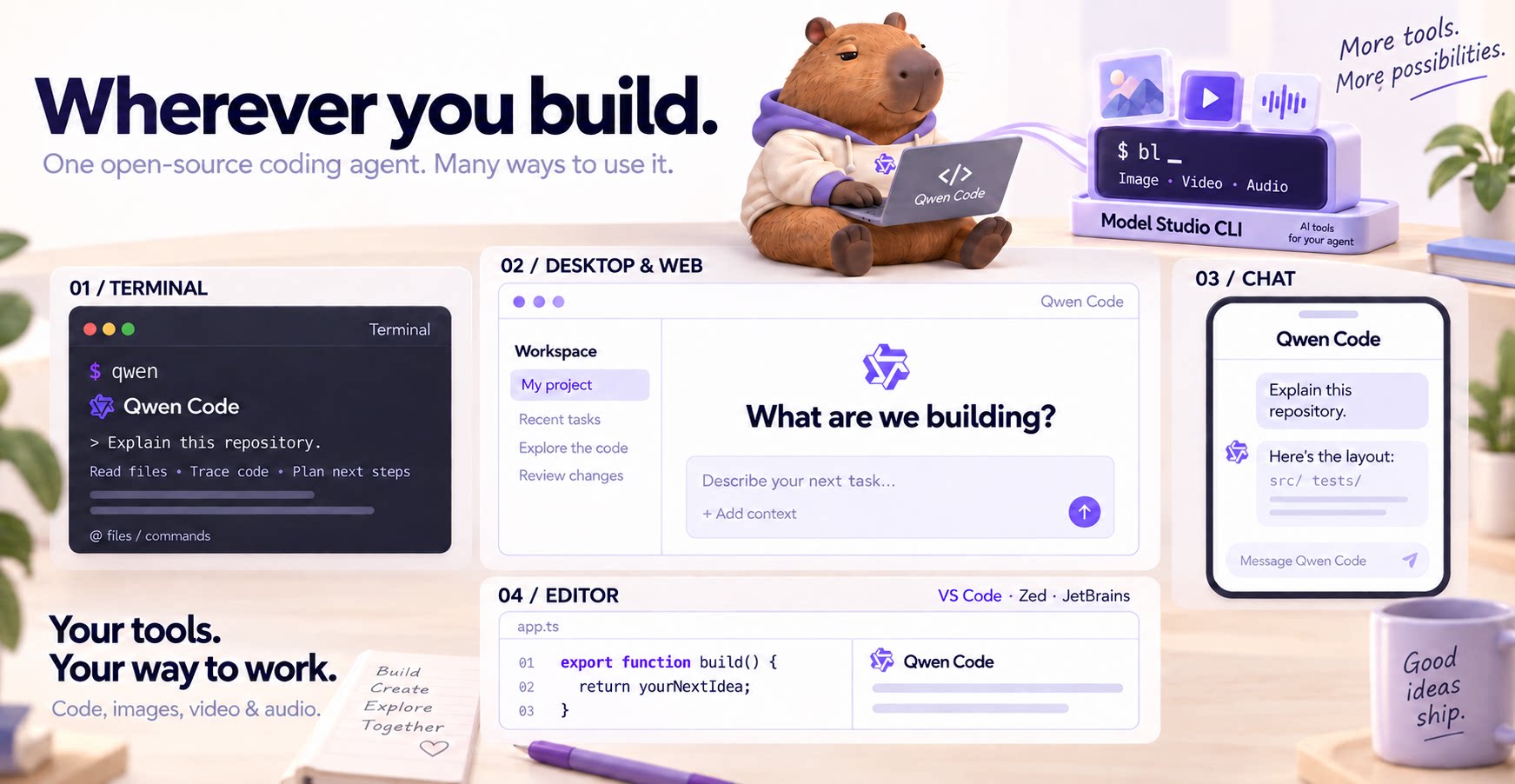
The open-source AI coding agent for your terminal, editor, desktop, browser, and chat.
中文 | Deutsch | français | 日本語 | Русский | Português (Brasil) | 한국어
Why Qwen Code?
- Agentic out of the box — Auto-Memory, Auto-Skills, SubAgents, Agent Teams, and MCP. Dynamic workflows, zero setup.
- Open-source, inside and out — The framework and the Qwen models are open-source. They evolve together. No vendor lock-in.
- Multi-protocol — Supports OpenAI, Anthropic, Gemini, and Qwen APIs. Any third-party provider or local model (Ollama / vLLM). Switch at runtime.
- Beyond the terminal — IDE plugins, Desktop app, Web UI, SDKs, and chat integrations (Telegram / DingTalk / WeChat / Feishu).
Tip
Qwen Code is actively iterating on itself — using its own agent and models to file issues, submit PRs, review code, and run tests. Powered by the community, driven by AI.
Installation
Linux / macOS:
curl -fsSL https://qwen-code-assets.oss-cn-hangzhou.aliyuncs.com/installation/install-qwen-standalone.sh | bash
Windows:
irm https://qwen-code-assets.oss-cn-hangzhou.aliyuncs.com/installation/install-qwen-standalone.ps1 | iex
Restart your terminal after installation to ensure environment variables take effect.
NPM / Homebrew
NPM (requires Node.js 22+):
npm install -g @qwen-code/qwen-code@latest
Homebrew (macOS / Linux):
brew install qwen-code
Quick Start
Open a terminal in your project and start Qwen Code:
cd /path/to/your-project
qwen
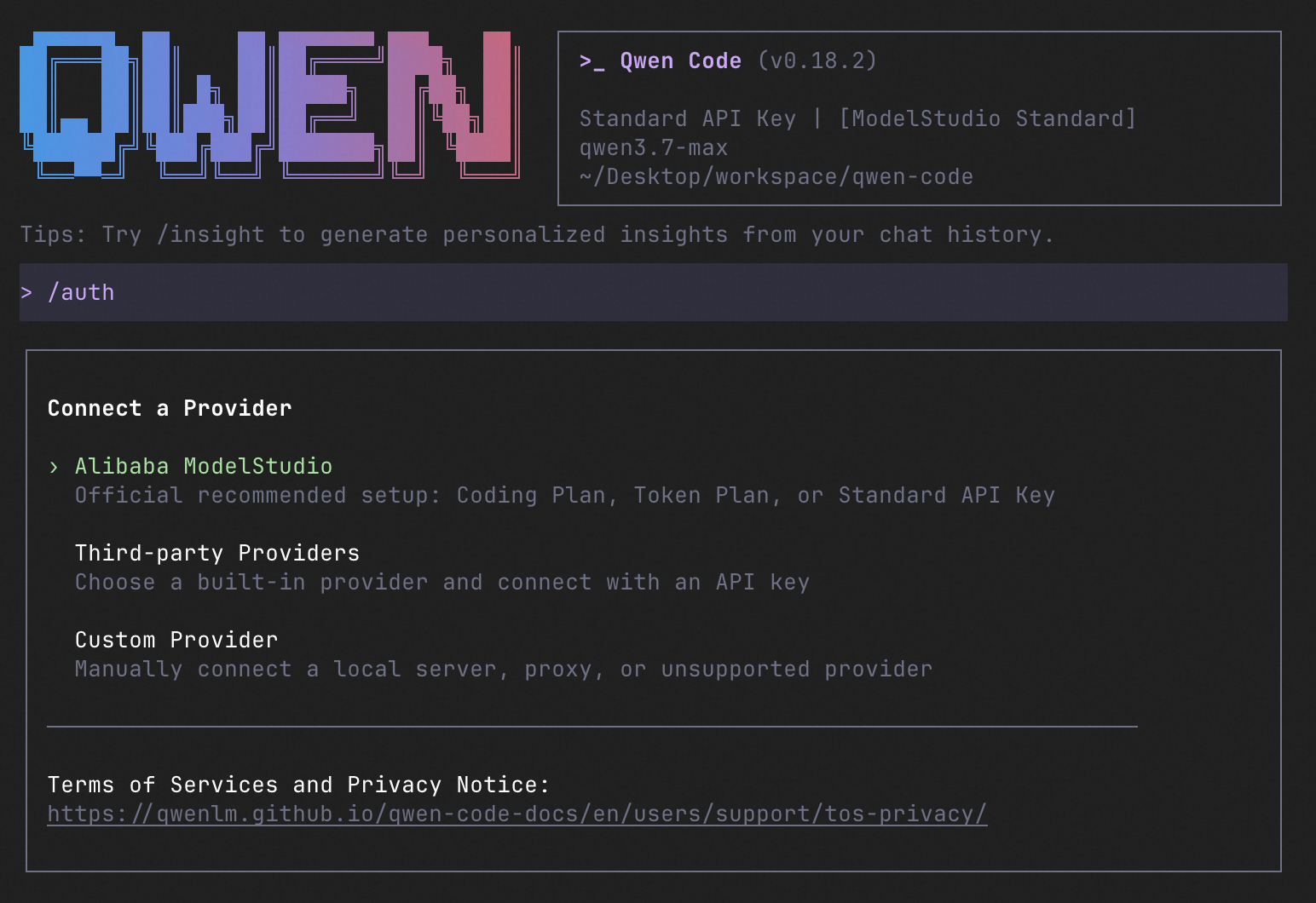
Inside the session, run /auth to configure your provider and API key. Then try:
Explain this repository and show me where to start.
See the Authentication Guide and Settings Reference for detailed setup.
See the terminal interface
How to Use Qwen Code
Choose the interface that fits your workflow:
| Interface | Get started |
|---|---|
| Terminal | Run qwen in your project — see Quick Start. |
| Desktop | Download Qwen Code Desktop for macOS, Windows, and Linux. |
| Web | Run qwen serve --open to open the Web UI in your browser. (experimental) |
| Editor | Set up VS Code, Zed, or JetBrains. |
| Chat | Connect Telegram, DingTalk, WeChat, or Feishu, then run qwen channel start. |
For automation and custom integrations:
- Headless — Run
qwen -p "..."in scripts, CI/CD, or batch jobs. - SDKs — Build with TypeScript, Python, or Java.
- Daemon — Run
qwen serveto connect clients over HTTP + SSE (ACP). (experimental) Daemon guide. - Computer Use — Set up native MCP tools or Node REPL + SDK in Qwen Code, Claude Code, or Codex.
SDK example (Python)
import asyncio

from qwen_code_sdk import is_sdk_result_message, query


async def main() -> None:
    result = query(
        "Summarize the repository layout.",
        {
            "cwd": "/path/to/project",
            "path_to_qwen_executable": "qwen",
        },
    )

    async for message in result:
        if is_sdk_result_message(message):
            print(message["result"])


asyncio.run(main())
Capabilities
If you know Claude Code, you already know Qwen Code — and then some. We've put significant effort into bringing Qwen Code to feature parity with Claude Code, improving both breadth and reliability across the board.
| Feature | Qwen Code | Claude Code |
|---|---|---|
| SubAgents, Agent Teams, Dynamic Workflows | ✓ | ✓ |
| Auto-Memory, Auto-Skills, Hooks | ✓ | ✓ |
| Built-in Skills (/review, /batch, /loop, /bugfix…) | ✓ | ✓ |
| MCP, Plan Mode, LSP Integration | ✓ | ✓ |
| Auto Mode, Sandbox, Git Worktrees | ✓ | ✓ |
| Computer Use (desktop automation) | ✓ | ✓ |
| IDE Plugins (VS Code / JetBrains / Zed) | ✓ | ✓ |
| SDK | ✓ | ✓ |
| Headless Mode, Session Management | ✓ | ✓ |
| Open-source — model and framework | ✓ | — |
| Multi-protocol (OpenAI / Anthropic / Gemini / Qwen + any provider) | ✓ | — |
| Agent Arena (multi-model head-to-head on same task) | ✓ | — |
Daemon Mode — qwen serve (multi-client shared agent) |
✓ | — |
| IM Channels (Telegram / DingTalk / WeChat / Feishu) | ✓ | — |
Qwen Code Evaluation
On SWE-bench Verified, seven Qwen Code versions scored 76.40%–77.80% on average using the same Qwen 3.7 Max model (500 tasks, three trials per version).

Full results and evaluation configuration →
Ecosystem
-
Qwen Code Desktop — Official desktop app for macOS, Windows, and Linux
-
AionUi — A modern GUI for command-line AI tools including Qwen Code
-
Gemini CLI Desktop — A cross-platform desktop/web/mobile UI for Qwen Code
-
qwen-audio-agent — Realtime full-duplex voice frontend for Qwen Code over ACP — talk hands-free with barge-in and a local wake word
-
🦞 Qwen Code Claw — Let other agents (Claude, Codex, etc.) delegate coding tasks to Qwen Code via ACP. Paste this prompt into your agent:
Use Qwen Code as a coding agent. First, fetch and read this skill reference:
https://raw.githubusercontent.com/QwenLM/qwen-code/refs/heads/main/.qwen/skills/qwen-code-claw/SKILL.md
Then follow the instructions inside to install, authenticate, and use Qwen Code via acpx for all coding tasks.
- Aliyun Model Studio CLI — Official CLI for Aliyun's AI platform (
bailian-cli). Extends Qwen Code with image/video generation, knowledge retrieval, app orchestration, and model deployment
Privacy
See the Terms of Service and Privacy Notice, including Chrome extension and Browser Use data handling.
Contributing
Contributions are welcome! See CONTRIBUTING.md for guidelines.
Acknowledgments
This project was originally based on Google Gemini CLI v0.8.2. We gratefully acknowledge the Gemini CLI team's excellent work. Starting from Qwen Code v0.1, we stopped syncing with upstream and began independent development as a multi-protocol, multi-platform agent framework with deep integrations for Qwen models and beyond.