 2666e3552d
* fix(core): make persisted session pagination safe for equal mtimes

listSessions() ordered files by mtime alone and resumed the next page with a
strict `mtime < cursor`. An mtime is not unique — bulk copies, backup restores
and coarse-timestamp filesystems all produce ties — so a group of files sharing
an mtime that straddled a page boundary was dropped while hasMore still reported
progress, then the next page came back empty: 25 files at one mtime with size 5
showed 5 items in total.

Sort on (mtime desc, name asc) so the order is total, and let the cursor carry
that position: nextCursor is now `"<mtime>|<name>"`. A bare number is still
accepted with its existing strict `<` meaning, so callers holding a legacy
cursor keep working, and the daemon's opaque string cursor now passes the
composite form through instead of rejecting it as invalid.

Co-authored-by: Qwen-Coder <[email protected]>
Patrol-Run: qwen-issue-patrol/jmvwpo7jxrk

* fix(cli): carry the composite session cursor type through callers

listSessions() now hands back a "<mtime>|<name>" cursor so a page boundary
inside a group of equal mtimes does not drop sessions. The widened
`number | string` contract left the CLI callers that store or compare that
cursor typed as `number`, which is a type error in `tsc --build` even though
nothing changes at runtime.

Widen the three consumers to `number | string`: the daemon's persisted scan
cursor, the live coordinator's paging plus its loop guard, and the session
picker state used by both the ink and opentui pickers. No behaviour change.

Co-authored-by: Qwen-Coder <[email protected]>
Patrol-Run: qwen-issue-patrol/jmvwrtdc1rm

* fix(cli): route composite session cursors to the persisted listing

The persisted listing mints `"<mtime>|<name>"` cursors when a page ends
inside a group of files sharing an mtime, but the route still chose between
the persisted and the live listing path with a numeric-only predicate. A
composite cursor therefore fell through to the live path, whose parser only
accepts numbers, and the second page answered 400.

Export one predicate from session-list.ts carrying the same shape test the
cursor parser already applies, and use it for that routing decision.

Co-authored-by: Qwen-Coder <[email protected]>
Patrol-Run: qwen-issue-patrol/jmvwtyj3bro

* fix(session-list): keep composite cursors usable by ACP and VS Code clients

listSessions mints "<mtime>|<name>" cursors whenever a page ends inside a
group of files sharing an mtime, but two consumers still parsed every cursor
as a number: ACP session/list rejected page 2 with "not a valid numeric
cursor", and the VS Code companion turned the composite cursor into NaN so
hasMore read false and only page 1 was ever listed. A malformed "|name"
cursor also slipped through the persisted-cursor classifier and answered 200
with an empty page instead of invalid_cursor.

- acpAgent: accept and forward "<mtime>|<name>" cursors to listSessions
- session-list: require a non-empty mtime prefix before classifying a
  cursor as persisted
- vscode companion: pass the daemon cursor back verbatim, widen the cursor
  type and treat only a non-empty cursor as "append to the current page"

Tests: ACP composite passthrough + empty-prefix rejection, VS Code
getSessionListPaged composite nextCursor round trip.

Co-authored-by: Qwen-Coder <[email protected]>
Patrol-Run: qwen-pr-closeout/jmvxke6bm6i

* fix(vscode): keep composite session cursors type-safe in the companion

021698420c widened the companion's paged session cursor to number|string but
left AcpConnection.listSessions typed number-only, so the package build failed:
TS2345 at qwenAgentManager.ts:573 and TS2365 at :626.

- accept the daemon's "<mtime>|<name>" cursor in AcpConnection.listSessions,
  which already forwards String(cursor) to ACP
- derive the mtime floor from the cursor prefix in the file-system fallback;
  the previous comparison coerced the composite string to NaN and silently
  returned an empty page

Co-authored-by: Qwen-Coder <[email protected]>
Patrol-Run: qwen-pr-closeout/jmvxmjc316l

* fix(session): align persisted-cursor docs, error kind, and tie-break test

- test(core): feed readdir a non-name order so deleting the sort tie-break
  fails the equal-mtime pagination test (mutation-verified: 9/25 without it)
- fix(cli): report a persisted cursor as such instead of "numeric" in
  InvalidCursorError, matching the message ACP already uses
- docs(cli): describe the opaque persisted cursor in the serve protocol doc
- docs(core): drop the mtime-only-cursor rationale this change removed

Declined: folding the cursor codec into one validated helper across core and
the transports — a cross-package API change outside this PR's scope.

Co-authored-by: Qwen-Coder <[email protected]>
Patrol-Run: qwen-pr-closeout/jmvzvzfp79t

* docs(session): describe composite persisted cursors on every continuation page

`listSessions` mints `"<mtime>|<name>"` whenever a page has more results, so
the protocol text must not suggest a bare numeric response. The standalone
list route dispatches through the metadata parser, so its invalid-cursor test
should pin the metadata-kind message instead of the persisted one.

Co-authored-by: Qwen-Coder <[email protected]>
Patrol-Run: qwen-pr-closeout/jmw009r8j9z

* test(session): pin the composite persisted cursor shape and narrow its docs

R3-1: the cursor-contract sentence claimed the numeric-cursor input and the
"<mtime>|<name>" reply for every persisted-backed list, but view=organized and
the parentSessionId / sourceType filtered lists page through their own opaque
activity cursors and reject a numeric cursor with 400 invalid_cursor. Narrow
the subject to the legacy recent list and name the other cursor families.

R3-2: no assertion pinned the documented shape. Every persisted-path cursor
assertion was shape-agnostic, so a regression back to a bare numeric mtime
would have kept the suite green. Assert the shape on a page whose boundary
mtime is unique; mutating the mint site to String(lastProcessedMtime) turns
this assertion red.

Co-authored-by: Qwen-Coder <[email protected]>
Patrol-Run: qwen-pr-closeout/jmw04k2rma5

* docs(daemon): name the persisted list cursor in the SDK catalog guide

The batch-cursor sentence kept the legacy "numeric list cursors" wording while
the list route now mints the opaque `<mtime>|<name>` token, so an SDK
integrator parsing the returned cursor got `NaN` and a cursor they could not
send back. Match the protocol doc and point at the persisted list cursors.

Co-authored-by: Qwen-Coder <[email protected]>
Patrol-Run: qwen-pr-closeout/jmw1fplwqc0

---------

Co-authored-by: yiliang114 <[email protected]>
Co-authored-by: Qwen-Coder <[email protected]>


The open-source AI coding agent for your terminal, editor, desktop, browser, and chat.
中文 | Deutsch | français | 日本語 | Русский | Português (Brasil) | 한국어
Why Qwen Code?
- Agentic out of the box — Auto-Memory, Auto-Skills, SubAgents, Agent Teams, and MCP. Dynamic workflows, zero setup.
- Open-source, inside and out — The framework and the Qwen models are open-source. They evolve together. No vendor lock-in.
- Multi-protocol — Supports OpenAI, Anthropic, Gemini, and Qwen APIs. Any third-party provider or local model (Ollama / vLLM). Switch at runtime.
- Beyond the terminal — IDE plugins, Desktop app, Web UI, SDKs, and chat integrations (Telegram / DingTalk / WeChat / Feishu).
Tip
Qwen Code is actively iterating on itself — using its own agent and models to file issues, submit PRs, review code, and run tests. Powered by the community, driven by AI.
Installation
Linux / macOS:
curl -fsSL https://qwen-code-assets.oss-cn-hangzhou.aliyuncs.com/installation/install-qwen-standalone.sh | bash
Windows:
irm https://qwen-code-assets.oss-cn-hangzhou.aliyuncs.com/installation/install-qwen-standalone.ps1 | iex
Restart your terminal after installation to ensure environment variables take effect.
NPM / Homebrew
NPM (requires Node.js 22+):
npm install -g @qwen-code/qwen-code@latest
Homebrew (macOS / Linux):
brew install qwen-code
Quick Start
Open a terminal in your project and start Qwen Code:
cd /path/to/your-project
qwen
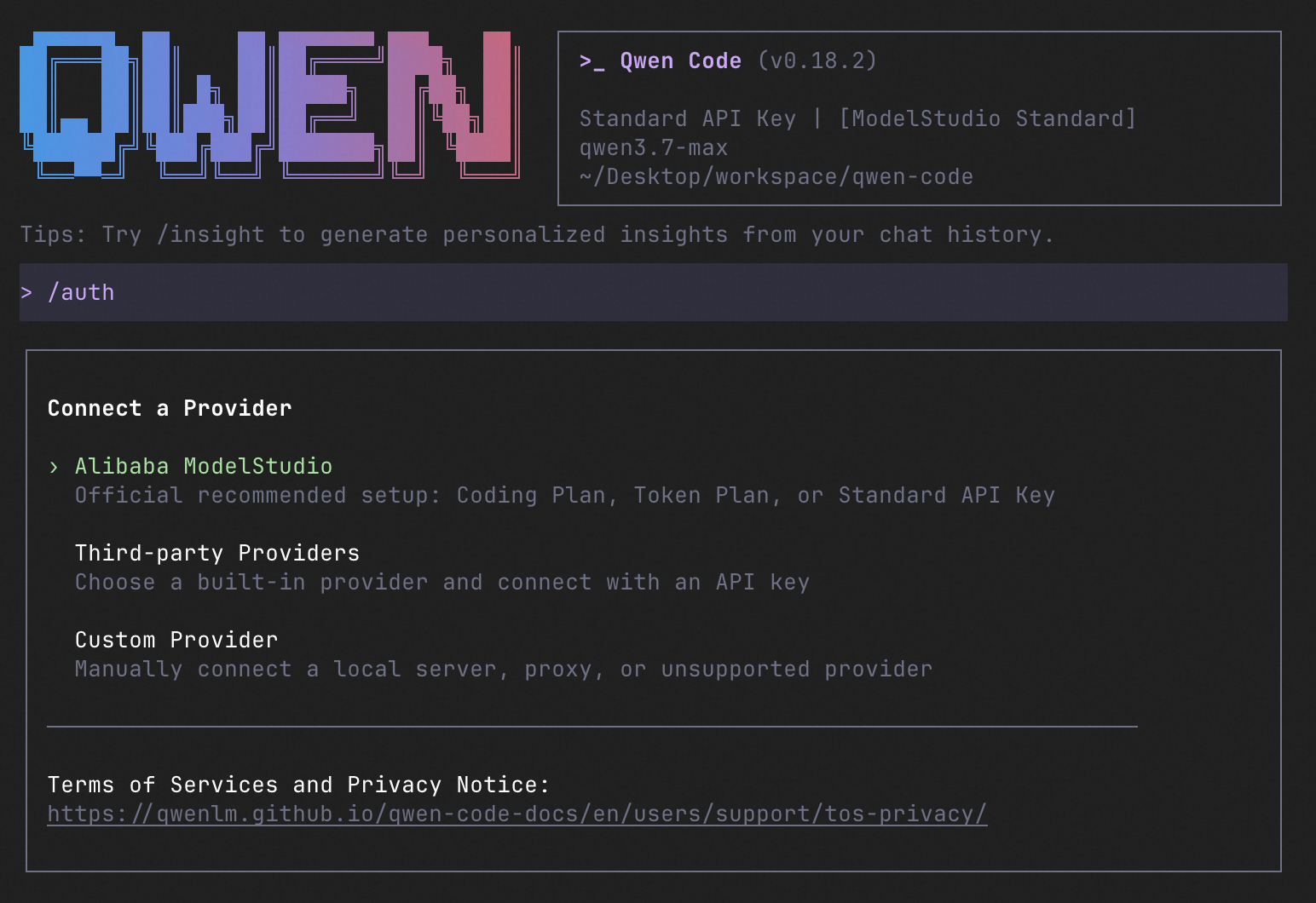
Inside the session, run /auth and choose Qwen Account with Subscription to sign in with your Plus or Pro subscription, or configure a provider with an API key. Then try:
Explain this repository and show me where to start.
See the Authentication Guide and Settings Reference for detailed setup.
See the terminal interface
How to Use Qwen Code
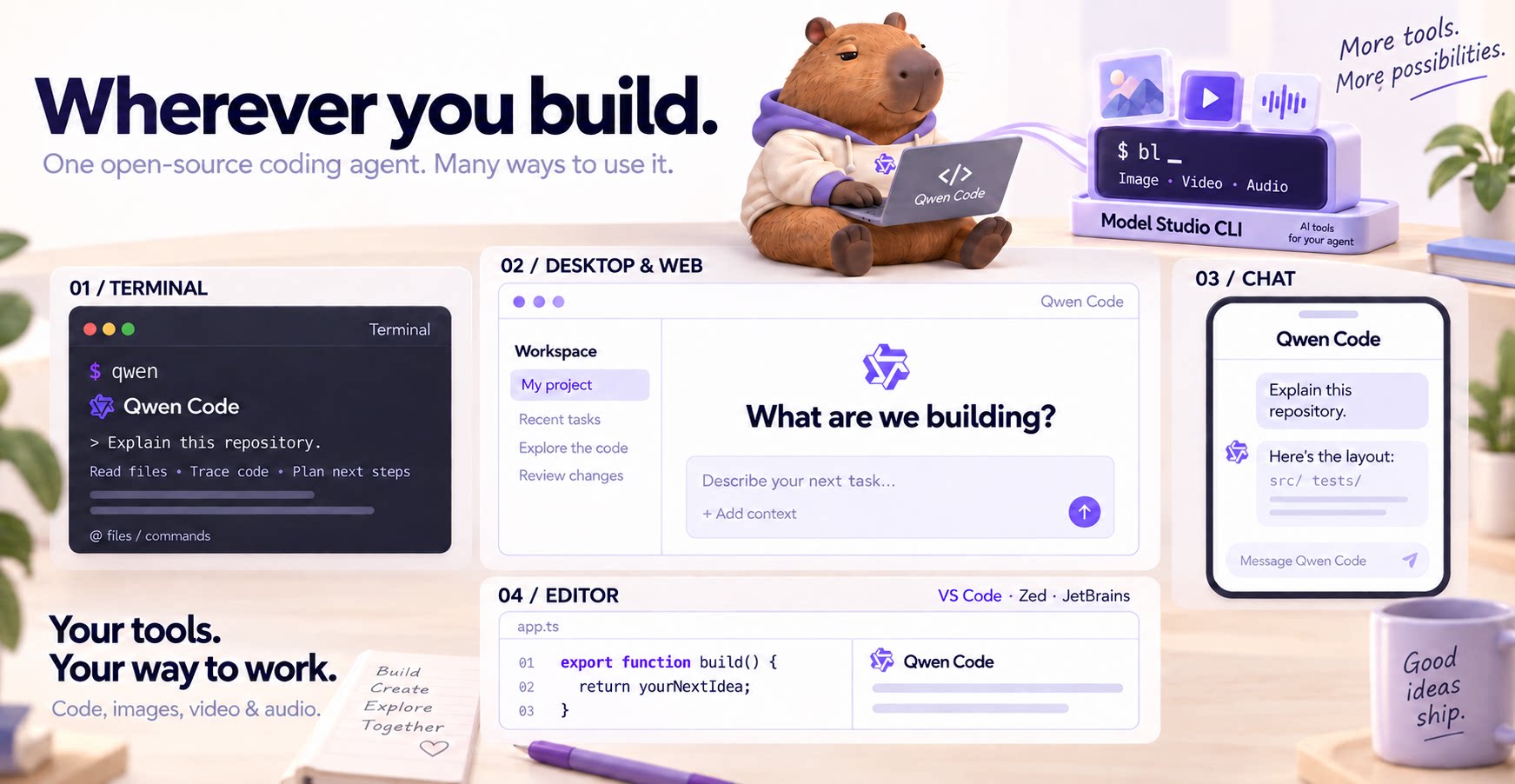
Choose the interface that fits your workflow:
| Interface | Get started |
|---|---|
| Terminal | Run qwen in your project — see Quick Start. |
| Desktop | Download Qwen Code Desktop for macOS, Windows, and Linux. |
| Web | Run qwen serve --open to open the Web UI in your browser. (experimental) |
| Editor | Set up VS Code, Zed, or JetBrains. |
| Chat | Connect Telegram, DingTalk, WeChat, or Feishu, then run qwen channel start. |
For automation and custom integrations:
- Headless — Run
qwen -p "..."in scripts, CI/CD, or batch jobs. - SDKs — Build with TypeScript, Python, or Java.
- Daemon — Run
qwen serveto connect clients over HTTP + SSE (ACP). (experimental) Daemon guide. - Computer Use — Set up native MCP tools or Node REPL + SDK in Qwen Code, Claude Code, or Codex.
SDK example (Python)
import asyncio

from qwen_code_sdk import is_sdk_result_message, query


async def main() -> None:
    result = query(
        "Summarize the repository layout.",
        {
            "cwd": "/path/to/project",
            "path_to_qwen_executable": "qwen",
        },
    )

    async for message in result:
        if is_sdk_result_message(message):
            print(message["result"])


asyncio.run(main())
Daemon Mode
Run Qwen Code as a long-lived service when you want browser, editor, SDK, and automation clients to share agent sessions without each starting a separate process. The daemon provides the built-in Web Shell and an HTTP + SSE API, supports multiple workspaces, and lets clients reconnect to active sessions.
Start it in the foreground and open the Web Shell:
qwen serve --open
The default address is http://127.0.0.1:4170. To run and manage it in the background instead:
qwen daemon start
qwen daemon status
qwen daemon logs -f
qwen daemon stop
By default, the daemon listens on loopback without bearer authentication; any local process that can reach it can use the full API, including code execution. On shared or untrusted hosts, set QWEN_SERVER_TOKEN and use --require-auth. See the Daemon guide for workspaces, authentication, remote access, and the API.
Capabilities
If you know Claude Code, you already know Qwen Code — and then some. We've put significant effort into bringing Qwen Code to feature parity with Claude Code, improving both breadth and reliability across the board.
| Feature | Qwen Code | Claude Code |
|---|---|---|
| SubAgents, Agent Teams, Dynamic Workflows | ✓ | ✓ |
| Auto-Memory, Auto-Skills, Hooks | ✓ | ✓ |
| Built-in Skills (/review, /batch, /loop, /bugfix…) | ✓ | ✓ |
| MCP, Plan Mode, LSP Integration | ✓ | ✓ |
| Auto Mode, Sandbox, Git Worktrees | ✓ | ✓ |
| Computer Use (desktop automation) | ✓ | ✓ |
| IDE Plugins (VS Code / JetBrains / Zed) | ✓ | ✓ |
| SDK | ✓ | ✓ |
| Headless Mode, Session Management | ✓ | ✓ |
| Open-source — model and framework | ✓ | — |
| Multi-protocol (OpenAI / Anthropic / Gemini / Qwen + any provider) | ✓ | — |
| Agent Arena (multi-model head-to-head on same task) | ✓ | — |
Daemon Mode — qwen serve (multi-client shared agent) |
✓ | — |
| IM Channels (Telegram / DingTalk / WeChat / Feishu) | ✓ | — |
Qwen Code Evaluation
On SWE-bench Verified, seven Qwen Code versions scored 76.40%–77.80% on average using the same Qwen 3.7 Max model (500 tasks, three trials per version).

Full results and evaluation configuration →
Ecosystem
-
Qwen Code Desktop — Official desktop app for macOS, Windows, and Linux
-
AionUi — A modern GUI for command-line AI tools including Qwen Code
-
Gemini CLI Desktop — A cross-platform desktop/web/mobile UI for Qwen Code
-
qwen-audio-agent — Realtime full-duplex voice frontend for Qwen Code over ACP — talk hands-free with barge-in and a local wake word
-
🦞 Qwen Code Claw — Let other agents (Claude, Codex, etc.) delegate coding tasks to Qwen Code via ACP. Paste this prompt into your agent:
Use Qwen Code as a coding agent. First, fetch and read this skill reference:
https://raw.githubusercontent.com/QwenLM/qwen-code/refs/heads/main/.qwen/skills/qwen-code-claw/SKILL.md
Then follow the instructions inside to install, authenticate, and use Qwen Code via acpx for all coding tasks.
- Aliyun Model Studio CLI — Official CLI for Aliyun's AI platform (
bailian-cli). Extends Qwen Code with image/video generation, knowledge retrieval, app orchestration, and model deployment
Privacy
See the Terms of Service and Privacy Notice, including Chrome extension and Browser Use data handling.
Contributing
Contributions are welcome! See CONTRIBUTING.md for guidelines.
Acknowledgments
This project was originally based on Google Gemini CLI v0.8.2. We gratefully acknowledge the Gemini CLI team's excellent work. Starting from Qwen Code v0.1, we stopped syncing with upstream and began independent development as a multi-protocol, multi-platform agent framework with deep integrations for Qwen models and beyond.