 易良andQwen-Coder
32f51a330b
* chore(web-shell): follow up #9812 review findings and deferred suggestions

Address the remaining review suggestions from the @qwen-code/webui
retirement (#9812) and the deferred items tracked in #11076:

- Fix the 01-architecture.md adapter diagram path (missing session/).
- Correct the followup-suggestions doc: generation fires on end_turn, and
  headless/SDK daemon clients should opt out to avoid the per-turn LLM cost.
- Pin playwright to 1.61.1 to restore version parity with @playwright/test.
- Restore file: scheme rejection coverage in Markdown.test.ts.
- Pin the historical sessionStorage key prefix with a literal assertion.
- Cover the legacy exported JSONL rejection and ChatRecord happy path.
- Restore the shell-substring classifier trap with a live path.
- Point useDaemonFollowupSuggestion docs at ChatEditor, not the deleted InputForm.
- Replace the theme-toggle timing-race assertion and exercise the
  unhandledrejection fail-closed path in the document browser gate.

Closes #11076

* fix(test): poll the theme class instead of a matcher vitest lacks

The browser gate imports expect from vitest and drives playwright's
Locator directly, so toHaveClass does not exist on the assertion and
typecheck:integration failed with TS2339 on this line. Poll the class
attribute through the same expect.poll idiom the neighbouring
assertions use, which keeps the retry the assertion was switched to
and needs no @playwright/test dependency.

Co-authored-by: Qwen-Coder <[email protected]>
Patrol-Run: qwen-pr-conflict/jmtooas8sln

* fix(test): assert the exported theme class exactly

`document-main.tsx` toggles `dark` and `light` on <html> mutually
exclusively and nothing else writes `documentElement` classes, so the
attribute is always exactly one of them. Matching `/light/` as an
unanchored substring would also accept `dark light`, which is the
theme-toggle breakage this poll exists to catch.

Co-authored-by: Qwen-Coder <[email protected]>
Patrol-Run: qwen-pr-closeout/jmtow5pgslz

* fix(test): realpath the exporter main check and pin its JSONL guard

Node realpath-resolves `import.meta.url` for the ESM main module but
leaves `process.argv[1]` as invoked, so comparing the raw spellings made
a symlinked invocation skip `main()` and exit 0 having written nothing —
a silent no-op the harness reads as success. Compare realpaths instead
and export the predicate so both directions are pinned.

Also extract the input gate into `assertRenderableJsonl` so the legacy
exported-JSONL rejection can be asserted directly: the previous tests
only pinned the two predicates feeding it, so deleting the guard and
losing the remediation hint kept every test green.

Co-authored-by: Qwen-Coder <[email protected]>
Patrol-Run: qwen-pr-closeout/jmtow5pgslz

* docs(followup): name the real ACP stop reasons, drop "unconditional"

The parenthetical this PR added named `interrupted` as a daemon stop
reason. The ACP `StopReason` union is
`end_turn | max_tokens | max_turn_requests | refusal | cancelled`, so
there is no `interrupted`; an interrupted turn reports `cancelled`. Name
the four suppressing values the union actually defines so an integrator
writing `stopReason === '...'` gets a branch that can fire.

"unconditional" was wider than the code and contradicted the condition
list on the same page: `Session.ts#maybeEmitFollowupSuggestion` returns
early on the stop reason, the todo stop guard,
`ui.enableFollowupSuggestions`, PLAN approval mode, a missing chat, and a
non-model last history entry. Point at those conditions instead; the cost
advice still holds because the `enableFollowupSuggestions === false`
return sits before `generatePromptSuggestion` is reached.

Co-authored-by: Qwen-Coder <[email protected]>
Patrol-Run: qwen-pr-closeout/jmtp6vibomd

* test(web-shell): drop the duplicate historical-key assertion

`persists under the literal historical key prefix`, added on this branch,
became a byte-equivalent twin of `writes under the historical WebUI key`,
which reached main with #11107 and arrived here through the merge at this
PR's head: same `persistStableClientId('client-a', 'session-a')`, same
literal `qwen-code-webui-client-id:session:session-a`, same expectation.
One fact was reported under two names, so a prefix rename reddened two
tests and an auditor could not tell which copy was load-bearing.

The surviving test's comment already carries the rename rationale, so
dropping the copy loses no coverage.

Verified with `cd packages/web-shell && npx vitest run
client/daemon/session/clientLifecycle.test.ts`: 19 passed before, 18
passed after. Mutating SESSION_CLIENT_ID_STORAGE_PREFIX to
`qwen-code-webshell-client-id:session:` after the dedupe still reddens
3 tests (15 passed), including the surviving `writes under the historical
WebUI key`; reverting the mutation returns to 18 passed.

Co-authored-by: Qwen-Coder <[email protected]>
Patrol-Run: qwen-pr-closeout/jmtp6vibomd

* test(integration): drop the unreachable unhandledrejection arm

The block this PR added after the CDN-failure loop could not reach the
`window.addEventListener('unhandledrejection', showLoadError)` handler its
comment claimed to exercise. `page.route('**/*', route =>
route.abort('blockedbyclient'))` fails the `<script id="transcript-renderer">`
load, the template's capture-phase `error` listener (document-index.html:45-56,
matching `event.target.id === 'transcript-renderer'`) calls `showLoadError()`
first, and `setContent(..., { waitUntil: 'load' })` only resolves after that
subresource has failed - so `data-render-complete='error'` and the alert text
were already in place before `page.evaluate` dispatched anything, and
showLoadError's one-shot guard (`if (document.body.dataset.renderComplete)
return;`, document-index.html:30) made the synthetic rejection a no-op. The
block was a strict duplicate of the loop's own `rendererBody === null`
iteration: identical all-abort route, identical two assertions.

Exercising the handler for real needs a renderer body that passes the
document's pinned SRI integrity and then rejects during boot; no body this gate
can serve passes SRI, so the arm cannot be made honest here. Deleting it
returns the file to origin/main's state for this test - the handler and its
missing coverage are both pre-existing on main (packages/web-templates is not
in this PR's diff), so no coverage this PR was responsible for is lost.

Verified: `npm run typecheck:integration` reports 0 errors in this file (6
remain, all in packages/** against generated/dist paths absent from an unbuilt
worktree: channels/feishu, cli/src/generated/git-commit.js,
web-templates/src/generated/*); `npx prettier --check` and `npx eslint` clean
on the file. The browser gate itself was not executed locally - it needs the
full build chain plus Chromium.

Co-authored-by: Qwen-Coder <[email protected]>
Patrol-Run: qwen-pr-closeout/jmtpfg5ewmp

* ci(review-context): route concurrent-runner changes to the helper-tests lane

This PR added
`integration-tests/concurrent-runner/export-html-from-chatrecord-jsonl.test.mjs`,
the first `node:test` file under `integration-tests/`, and wired it into CI
through the `HELPER_TESTS` env list in `.github/workflows/ci.yml`. The tracked
review-context manifest still mapped the whole `integration-tests/**` path to
`recommendedTests: ['integration-tests']`, whose vitest lane collects
`**/*.test.ts` only (`integration-tests/vitest.config.ts:21`), so a future PR
touching only the exporter and its `.mjs` test is told to run a lane that
cannot collect the file - the same silent drop `HELPER_TESTS` exists to
prevent.

Add a narrower rule for `integration-tests/concurrent-runner/**` recommending
`helper-tests`. Matching rules merge rather than first-match, so the lane list
for that directory becomes the union and every other `integration-tests/` path
is untouched. The pinned `expectedManifest` in
`manifest-repository-context.committed.test.ts` moves with it, which is what
that pin is for.

Verified through the real provider (tsx importing
`packages/cli/src/commands/review/lib/manifest-repository-context.ts`) because
the packages/cli vitest globalSetup gate refuses to run on this unbuilt
worktree:

  concurrent-runner .mjs           -> ["helper-tests","integration-tests"]
  concurrent-runner .js            -> ["helper-tests","integration-tests"]
  chat-transcript-document.test.ts -> ["integration-tests"] (unchanged)
  all 10 rules co-matching         -> non-null, 80 relatedPaths, and every
                                      `paths` probe matched some rule

Also checked the committed manifest deep-equals the test's pinned literal (10
rules on both sides), and that dropping the new rule breaks that equality, so
the pin is not tautological. `npx prettier --check` and `npx eslint` clean on
both files.

Co-authored-by: Qwen-Coder <[email protected]>
Patrol-Run: qwen-pr-closeout/jmtpfg5ewmp

* fix(deps): sync pnpm lockfile for Playwright pin

---------

Co-authored-by: Qwen-Coder <[email protected]>


The open-source AI coding agent that lives in your terminal.
中文 | Deutsch | français | 日本語 | Русский | Português (Brasil) | 한국어
Why Qwen Code?
- Agentic out of the box — Auto-Memory, Auto-Skills, SubAgents, Agent Teams, and MCP. Dynamic workflows, zero setup.
- Open-source, inside and out — The framework and the Qwen models are open-source. They evolve together. No vendor lock-in.
- Multi-protocol — Supports OpenAI, Anthropic, Gemini, and Qwen APIs. Any third-party provider or local model (Ollama / vLLM). Switch at runtime.
- Beyond the terminal — IDE plugins, Desktop app, daemon mode, SDKs, and IM bots (Telegram / DingTalk / WeChat / Feishu).
Tip
Qwen Code is actively iterating on itself — using its own agent and models to file issues, submit PRs, review code, and run tests. Powered by the community, driven by AI.
Installation
Linux / macOS:
curl -fsSL https://qwen-code-assets.oss-cn-hangzhou.aliyuncs.com/installation/install-qwen-standalone.sh | bash
Windows:
irm https://qwen-code-assets.oss-cn-hangzhou.aliyuncs.com/installation/install-qwen-standalone.ps1 | iex
Restart your terminal after installation to ensure environment variables take effect.
NPM / Homebrew
NPM (requires Node.js 22+):
npm install -g @qwen-code/qwen-code@latest
Homebrew (macOS / Linux):
brew install qwen-code
Quick Start
qwen          # Launch interactive terminal UI
# Inside the session:
/auth         # Configure your provider and API key
See the Authentication Guide and Settings Reference for detailed setup.
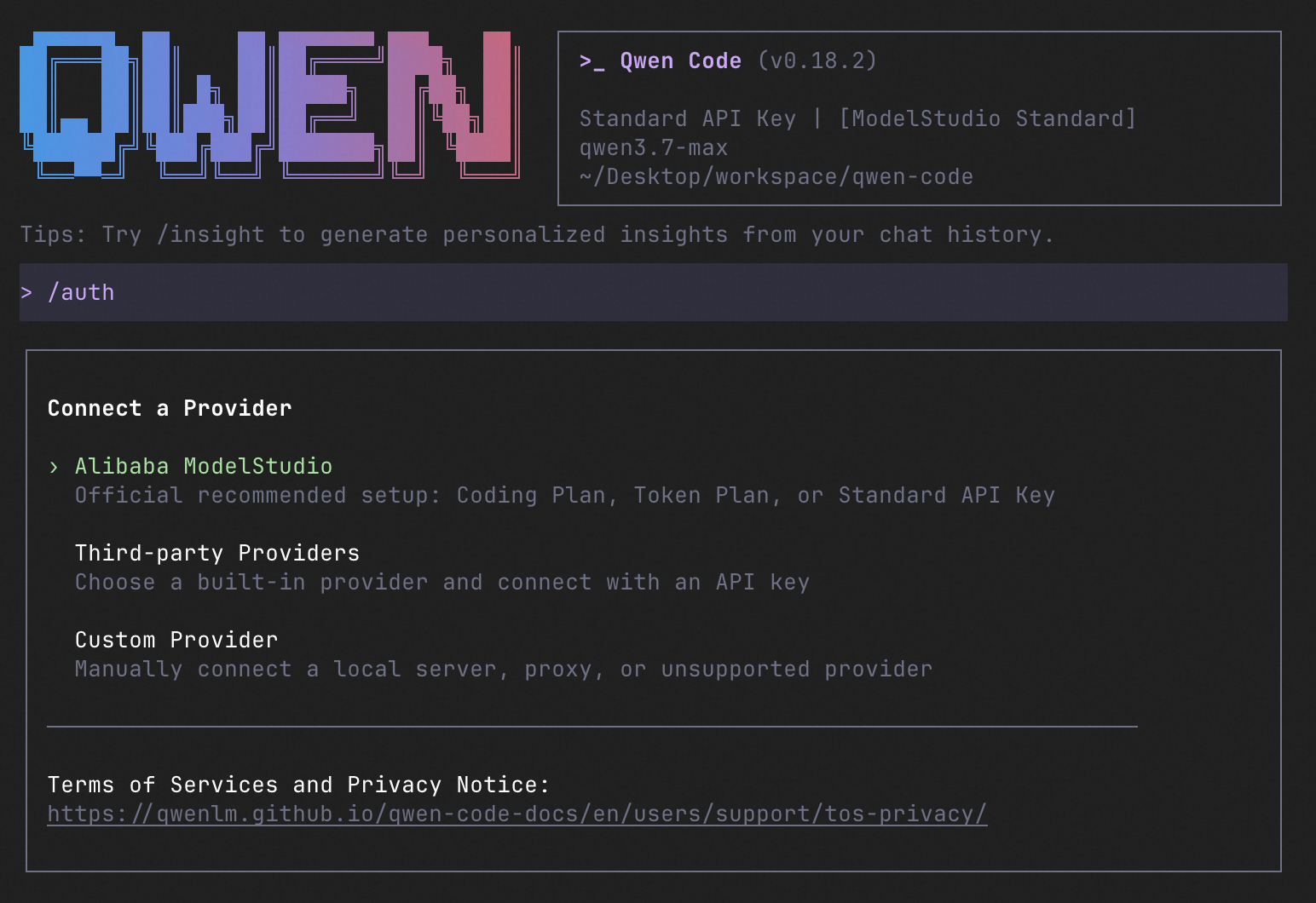
How to Use Qwen Code
| Mode | Command | Use Case |
|---|---|---|
| Interactive | qwen |
Terminal UI with rich rendering, @file references, slash commands |
| Headless | qwen -p "..." |
Scripts, CI/CD, batch processing — no UI |
| IDE | — | VS Code, Zed, JetBrains |
| Desktop | — | Qwen Code Desktop — GUI for macOS, Windows, Linux |
| Daemon | qwen serve |
Shared agent session over HTTP+SSE (ACP). Multiple clients, one agent. (experimental) Docs |
| SDK | — | TypeScript, Python, Java |
| IM Bot | qwen channel |
Connect to Telegram, DingTalk, WeChat, or Feishu |
SDK example (Python)
import asyncio

from qwen_code_sdk import is_sdk_result_message, query


async def main() -> None:
    result = query(
        "Summarize the repository layout.",
        {
            "cwd": "/path/to/project",
            "path_to_qwen_executable": "qwen",
        },
    )

    async for message in result:
        if is_sdk_result_message(message):
            print(message["result"])


asyncio.run(main())
Capabilities
If you know Claude Code, you already know Qwen Code — and then some. We've put significant effort into bringing Qwen Code to feature parity with Claude Code, improving both breadth and reliability across the board.
| Feature | Qwen Code | Claude Code |
|---|---|---|
| SubAgents, Agent Teams, Dynamic Workflows | ✓ | ✓ |
| Auto-Memory, Auto-Skills, Hooks | ✓ | ✓ |
| Built-in Skills (/review, /batch, /loop, /bugfix…) | ✓ | ✓ |
| MCP, Plan Mode, LSP Integration | ✓ | ✓ |
| Auto Mode, Sandbox, Git Worktrees | ✓ | ✓ |
| Computer Use (desktop automation) | ✓ | ✓ |
| IDE Plugins (VS Code / JetBrains / Zed) | ✓ | ✓ |
| SDK | ✓ | ✓ |
| Headless Mode, Session Management | ✓ | ✓ |
| Open-source — model and framework | ✓ | — |
| Multi-protocol (OpenAI / Anthropic / Gemini / Qwen + any provider) | ✓ | — |
| Agent Arena (multi-model head-to-head on same task) | ✓ | — |
Daemon Mode — qwen serve (multi-client shared agent) |
✓ | — |
| IM Channels (Telegram / DingTalk / WeChat / Feishu) | ✓ | — |
Qwen Code Evaluation
Evaluation Configuration
| Configuration | Value |
|---|---|
| Dataset | princeton-nlp/SWE-bench_Verified, 500 cases |
| Runs | 3 trials per version, 1,500 jobs per version; 7 Qwen Code versions |
| Model | Qwen 3.7 Max |
| Sampling | temperature=1, top_p=0.95 |
| Thinking / Reasoning | interleaved_thinking=true, thinking_type=adaptive, reasoning_effort=high |
| Context / Output Limits | context_1m=true, model_context_length=1,000,000, max_tokens=64,000, model_max_tokens=65,535 |
| Harness Limits | max_iterations=500, runtime_timeout_sec=7,200, agent_timeout_multiplier=3.0 |
Scores by Qwen Code Version
| Version | Avg Score | Pass Rate | pass@3 | pass^3 |
|---|---|---|---|---|
| 0.0.14 | 77.80% | 84.6% | 84.6% | 69.2% |
| 0.1.0 | 76.73% | 84.6% | 84.6% | 68.0% |
| 0.5.0 | 76.60% | 83.0% | 83.0% | 68.4% |
| 0.10.0 | 76.47% | 84.4% | 84.4% | 67.4% |
| 0.15.0 | 77.67% | 84.6% | 84.6% | 68.6% |
| 0.19.0 | 76.40% | 85.0% | 85.0% | 65.8% |
| 0.22.0 | 77.33% | 84.4% | 84.4% | 68.0% |
Avg Score Trend

Ecosystem
-
Qwen Code Desktop — Official desktop app for macOS, Windows, and Linux
-
AionUi — A modern GUI for command-line AI tools including Qwen Code
-
Gemini CLI Desktop — A cross-platform desktop/web/mobile UI for Qwen Code
-
🦞 Qwen Code Claw — Let other agents (Claude, Codex, etc.) delegate coding tasks to Qwen Code via ACP. Paste this prompt into your agent:
Use Qwen Code as a coding agent. First, fetch and read this skill reference:
https://raw.githubusercontent.com/QwenLM/qwen-code/refs/heads/main/.qwen/skills/qwen-code-claw/SKILL.md
Then follow the instructions inside to install, authenticate, and use Qwen Code via acpx for all coding tasks.
- Aliyun Model Studio CLI — Official CLI for Aliyun's AI platform (
bailian-cli). Extends Qwen Code with image/video generation, knowledge retrieval, app orchestration, and model deployment
Contributing
Contributions are welcome! See CONTRIBUTING.md for guidelines.
Acknowledgments
This project was originally based on Google Gemini CLI v0.8.2. We gratefully acknowledge the Gemini CLI team's excellent work. Starting from Qwen Code v0.1, we stopped syncing with upstream and began independent development as a multi-protocol, multi-platform agent framework with deep integrations for Qwen models and beyond.