 Shaojin Wen
7bc00a3a08
* feat(review): re-anchor on drift, run actionlint, account blockers, refuse retries

Four fixes from the 2026-10-31 audit of seven review run ledgers
(#15057, #15377, #15385, #15578, #15853, #15955, #15974):

- Head drift posts the completed review at the new head (the re-anchor
  protocol) instead of abandoning the round — the maintainer's ruling
  on #15578, never landed in the skill until now. The once-per-review
  bound and the COMMENT cap survive; the marker withholds its anchor.
- script-lint runs actionlint's workflow-level checks (syntax, context
  availability, action refs) and gates them as [lint] Criticals; only
  the embedded run: shell stays deferred. #15974's unloadable workflow
  (runner context in jobs.env) is the regression test, measured against
  actionlint 1.7.12.
- pr-context writes a blocker inventory; compose-review cross-checks it
  against the round's blockerRulings and caps at COMMENT when the walk
  skipped a blocker (#15974's missed review-level blocker).
- submit documents --dry-run as the only sanctioned probe and refuses a
  re-post at the commit already landed (already-posted-this-commit) —
  the retry that replied this round's own roots back to themselves
  (#15853). The receipt records lastCommitId.

Each fix carries its rule text, pin tests, and a DESIGN.md incident.

* fix(review): isolate actionlint config and refresh lint on re-anchor

Both Criticals from the #16001 review, reproduced against the exact PR
source and closed structurally:

- The newly active actionlint invocation auto-loaded the reviewed repo's
  .github/actionlint.yaml, so a PR-added ignore-all rule suppressed every
  workflow diagnostic — including the unloadable-workflow expression this
  linter was activated to catch. It now runs against a private mkdtemp
  neutral config via -config-file (measured to override the discovery),
  fails closed when no private config can be created, and carries exactly
  the two trusted compatibility exceptions the repo's own lint script
  runs (self-hosted runner labels, environment.deployment schema lag).
  The regression plants the ignore-all config in a real temporary git
  repository and proves the expression finding survives.

- The re-anchor protocol dropped fixed authored findings but left the
  lint gate regenerating its findings from the old-head report, so a
  lint blocker the delta fixed was republished against the new commit.
  The protocol gains a refresh step (scratch worktree at the new head,
  script-lint --diff rewriting the report bound to the new diff) and a
  lintDiffPath compose field that makes the gate — body and ledger
  marker alike — hash the new diff as its freshness basis. Executable
  regressions pin both directions: fixed blocker gone (COMMENT, absent
  from body and marker), still-standing blocker keeps gating
  (REQUEST_CHANGES). A malformed lintDiffPath fails closed.

* fix(review): base-tree actionlint config, empty-diff parse, lane provisioning

Three findings from the round-3 review of #16001, each reproduced
against the exact source and closed:

- The private {} config blocked PR-planted suppressions but also dropped
  the repo's maintainer-merged compatibility exceptions (ECS runner
  labels, concurrency.queue, the $/ self-repository action reference),
  turning correct release-workflow changes into bogus [lint] Criticals.
  The trust boundary is now the MERGE-BASE tree's .github/actionlint.yaml
  (hex-shape-guarded git show, copied into the private file, {} only when
  the base has none); the head copy is never read, and the two trusted
  -ignore constants ride on top exactly as scripts/lint.js runs them.
  Pinned with a two-commit repo and a real-binary run showing the base
  exception honored while the planted ignore-all stays blocked.

- An empty refresh diff (the new head reverted the PR's last change) was
  treated as a parse failure: the range selection fell back to the old
  plan's context-inclusive hunks and promoted a pre-existing finding into
  a blocker the gate accepted as fresh (the empty diff has a valid hash).
  diffParsed now separates parse success from range count; empty and
  deletions-only diffs classify everything pre-existing. The reviewer's
  exact scenario is an executable regression.

- The lanes that run the gate provisioned no linters, so the new
  uninstalled-capping fired on CI and the real-binary regressions were
  skipIf'd out of every run. The review job and the unit-test lane now
  install the pinned, SHA-256-verified actionlint/shellcheck through the
  repo's own installer and promote the job-scoped dirs onto GITHUB_PATH
  (unconditional, advisory, Windows excluded). The 335 workflow meta-test
  pins pass unchanged.

* fix(review): lint in the worktree cwd, guard lint.js entry, pin the sha fence

Three gaps from the scripted deep verification of #16001 (50/55
assertions, 17 mutants), two of them in the round-3 fixes themselves:

- F1: actionlint resolves the config's paths: entries against its cwd,
  and the runner spawned it in the session checkout, so every
  path-scoped base exception was inert while the global keys kept
  working — the split that hid behind the labels-only test. The runner
  now receives the worktree root and spawns inside it with PWD aligned.
  The real-binary suite gains the path-scoped fixture it was missing: a
  benign concurrency.queue edit that must lint clean, and an attack cell
  where the base exception suppresses the schema-lag finding while the
  planted head ignore-all still fails to hide the expression.

- F2: the provisioning steps imported scripts/lint.js, whose
  unconditional top-level main() ran a full lint pass on import and
  never reached the install loop, silently under continue-on-error.
  lint.js now runs its CLI only when it is the entry point
  (import.meta.url guard, argv[1]-safe for node -e imports), and both
  steps assert each installer produced its binary before promoting the
  dir, so a future no-op install fails visibly instead of degrading to
  skipped tests.

- M15: the option-injection fence was unobservable — git's own
  rejection of a malformed option matches the guard's refusal, so the
  guard's mutation survived. A spawn spy now pins the fence directly:
  non-hex merge base never spawns git; a hex-shaped nonexistent one
  does (positive control with the exact argv).

Also acknowledges the verification's correction: the bot review's
$/prepare-release-runner example does not exist at this head (the base
config entry is precautionary); the queue exception at line 485 is the
one reachable path-scoped case, and F1 is pinned on exactly that shape.


The open-source AI coding agent for your terminal, editor, desktop, browser, and chat.
中文 | Deutsch | français | 日本語 | Русский | Português (Brasil) | 한국어
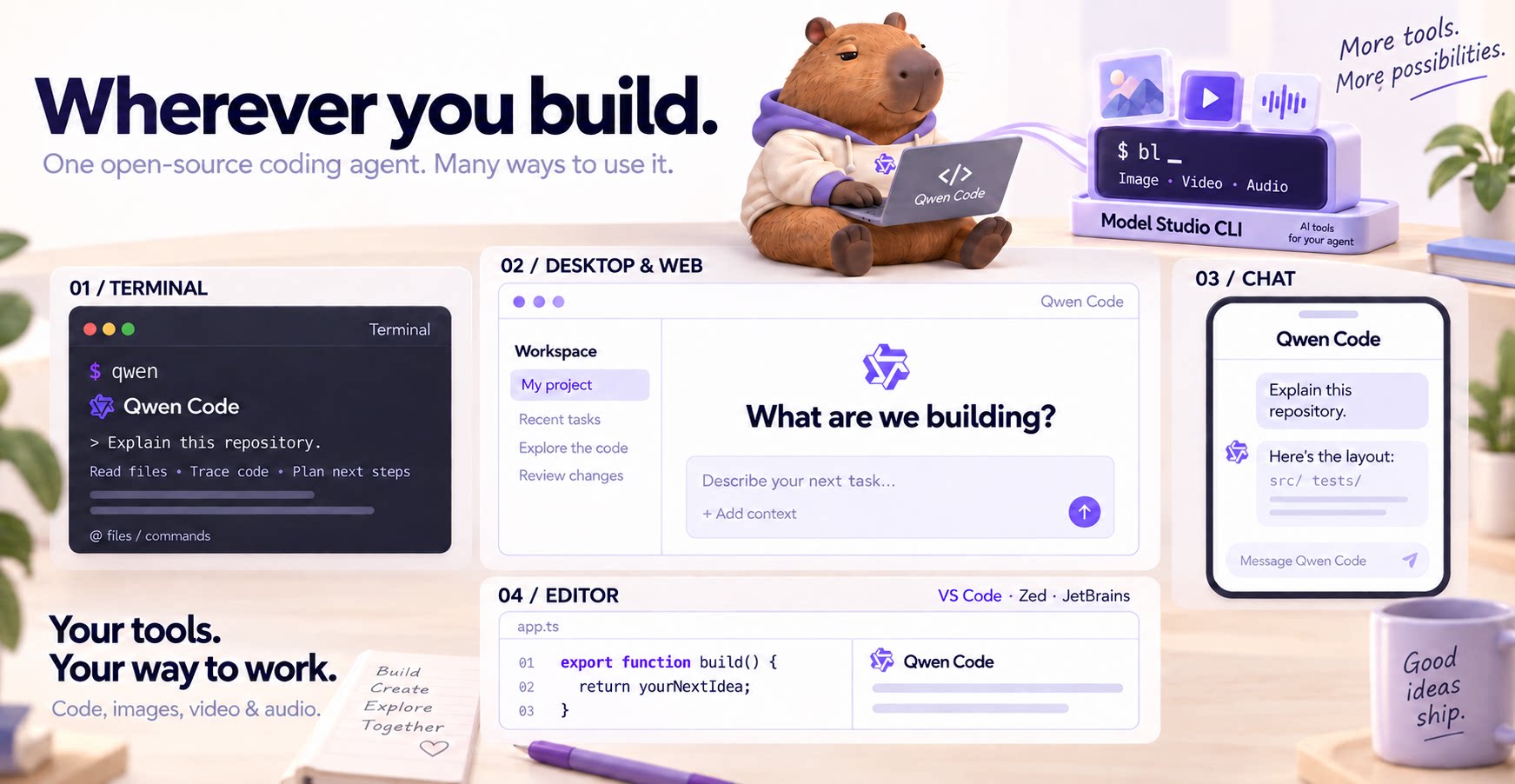
Why Qwen Code?
- Agentic out of the box — Auto-Memory, Auto-Skills, SubAgents, Agent Teams, and MCP. Dynamic workflows, zero setup.
- Open-source, inside and out — The framework and the Qwen models are open-source. They evolve together. No vendor lock-in.
- Multi-protocol — Supports OpenAI, Anthropic, Gemini, and Qwen APIs. Any third-party provider or local model (Ollama / vLLM). Switch at runtime.
- Beyond the terminal — IDE plugins, Desktop app, Web UI, SDKs, and chat integrations (Telegram / DingTalk / WeChat / Feishu).
Tip
Qwen Code is actively iterating on itself — using its own agent and models to file issues, submit PRs, review code, and run tests. Powered by the community, driven by AI.
Installation
Linux / macOS:
curl -fsSL https://qwen-code-assets.oss-cn-hangzhou.aliyuncs.com/installation/install-qwen-standalone.sh | bash
Windows:
irm https://qwen-code-assets.oss-cn-hangzhou.aliyuncs.com/installation/install-qwen-standalone.ps1 | iex
Restart your terminal after installation to ensure environment variables take effect.
NPM / Homebrew
NPM (requires Node.js 22+):
npm install -g @qwen-code/qwen-code@latest
Homebrew (macOS / Linux):
brew install qwen-code
Quick Start
Open a terminal in your project and start Qwen Code:
cd /path/to/your-project
qwen
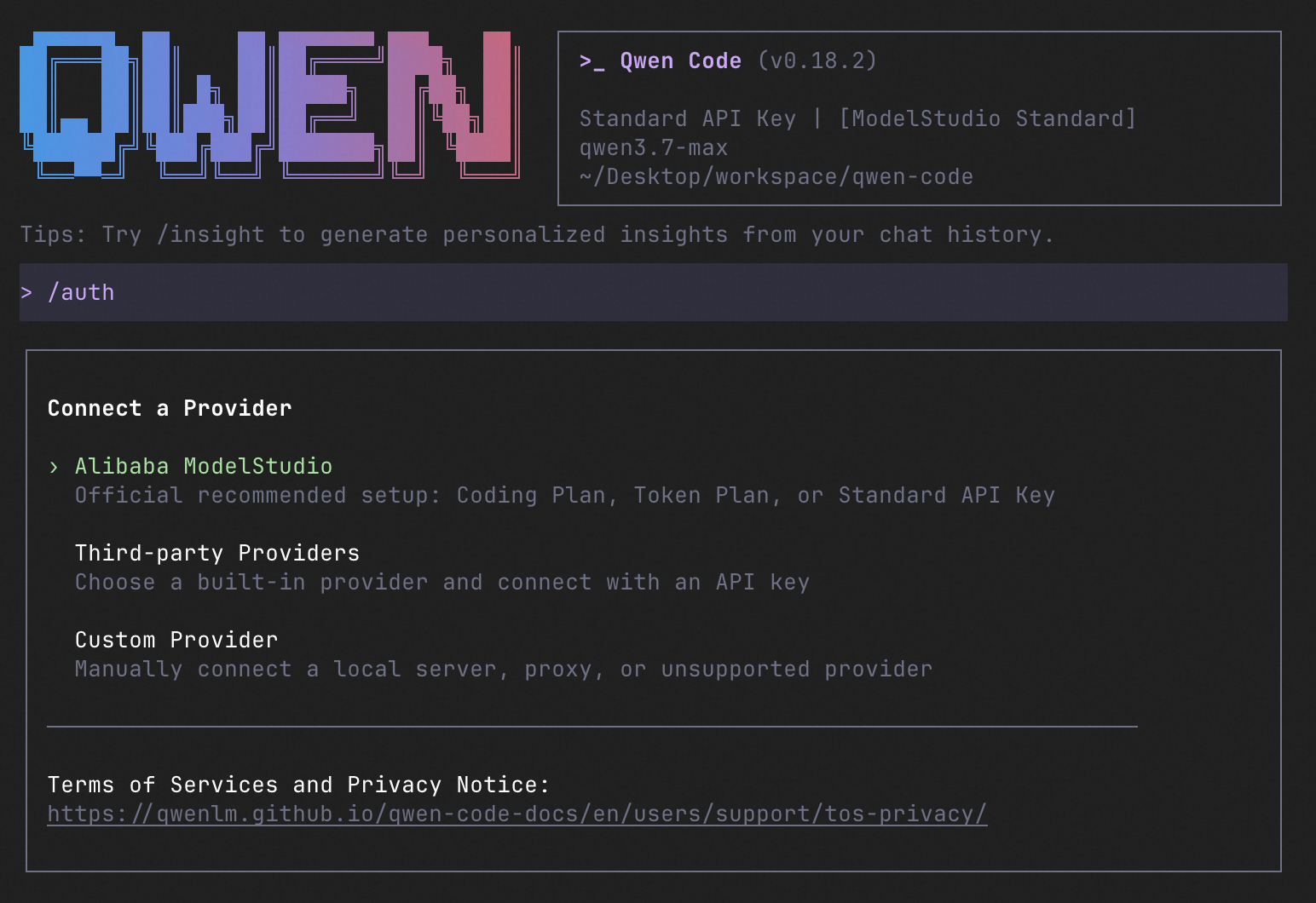
Inside the session, run /auth to configure your provider and API key. Then try:
Explain this repository and show me where to start.
See the Authentication Guide and Settings Reference for detailed setup.
See the terminal interface
How to Use Qwen Code
Choose the interface that fits your workflow:
| Interface | Get started |
|---|---|
| Terminal | Run qwen in your project — see Quick Start. |
| Desktop | Download Qwen Code Desktop for macOS, Windows, and Linux. |
| Web | Run qwen serve --open to open the Web UI in your browser. (experimental) |
| Editor | Set up VS Code, Zed, or JetBrains. |
| Chat | Connect Telegram, DingTalk, WeChat, or Feishu, then run qwen channel start. |
For automation and custom integrations:
- Headless — Run
qwen -p "..."in scripts, CI/CD, or batch jobs. - SDKs — Build with TypeScript, Python, or Java.
- Daemon — Run
qwen serveto connect clients over HTTP + SSE (ACP). (experimental) Daemon guide. - Computer Use — Set up native MCP tools or Node REPL + SDK in Qwen Code, Claude Code, or Codex.
SDK example (Python)
import asyncio

from qwen_code_sdk import is_sdk_result_message, query


async def main() -> None:
    result = query(
        "Summarize the repository layout.",
        {
            "cwd": "/path/to/project",
            "path_to_qwen_executable": "qwen",
        },
    )

    async for message in result:
        if is_sdk_result_message(message):
            print(message["result"])


asyncio.run(main())
Capabilities
If you know Claude Code, you already know Qwen Code — and then some. We've put significant effort into bringing Qwen Code to feature parity with Claude Code, improving both breadth and reliability across the board.
| Feature | Qwen Code | Claude Code |
|---|---|---|
| SubAgents, Agent Teams, Dynamic Workflows | ✓ | ✓ |
| Auto-Memory, Auto-Skills, Hooks | ✓ | ✓ |
| Built-in Skills (/review, /batch, /loop, /bugfix…) | ✓ | ✓ |
| MCP, Plan Mode, LSP Integration | ✓ | ✓ |
| Auto Mode, Sandbox, Git Worktrees | ✓ | ✓ |
| Computer Use (desktop automation) | ✓ | ✓ |
| IDE Plugins (VS Code / JetBrains / Zed) | ✓ | ✓ |
| SDK | ✓ | ✓ |
| Headless Mode, Session Management | ✓ | ✓ |
| Open-source — model and framework | ✓ | — |
| Multi-protocol (OpenAI / Anthropic / Gemini / Qwen + any provider) | ✓ | — |
| Agent Arena (multi-model head-to-head on same task) | ✓ | — |
Daemon Mode — qwen serve (multi-client shared agent) |
✓ | — |
| IM Channels (Telegram / DingTalk / WeChat / Feishu) | ✓ | — |
Qwen Code Evaluation
On SWE-bench Verified, seven Qwen Code versions scored 76.40%–77.80% on average using the same Qwen 3.7 Max model (500 tasks, three trials per version).

Full results and evaluation configuration →
Ecosystem
-
Qwen Code Desktop — Official desktop app for macOS, Windows, and Linux
-
AionUi — A modern GUI for command-line AI tools including Qwen Code
-
Gemini CLI Desktop — A cross-platform desktop/web/mobile UI for Qwen Code
-
qwen-audio-agent — Realtime full-duplex voice frontend for Qwen Code over ACP — talk hands-free with barge-in and a local wake word
-
🦞 Qwen Code Claw — Let other agents (Claude, Codex, etc.) delegate coding tasks to Qwen Code via ACP. Paste this prompt into your agent:
Use Qwen Code as a coding agent. First, fetch and read this skill reference:
https://raw.githubusercontent.com/QwenLM/qwen-code/refs/heads/main/.qwen/skills/qwen-code-claw/SKILL.md
Then follow the instructions inside to install, authenticate, and use Qwen Code via acpx for all coding tasks.
- Aliyun Model Studio CLI — Official CLI for Aliyun's AI platform (
bailian-cli). Extends Qwen Code with image/video generation, knowledge retrieval, app orchestration, and model deployment
Privacy
See the Terms of Service and Privacy Notice, including Chrome extension and Browser Use data handling.
Contributing
Contributions are welcome! See CONTRIBUTING.md for guidelines.
Acknowledgments
This project was originally based on Google Gemini CLI v0.8.2. We gratefully acknowledge the Gemini CLI team's excellent work. Starting from Qwen Code v0.1, we stopped syncing with upstream and began independent development as a multi-protocol, multi-platform agent framework with deep integrations for Qwen models and beyond.