 Heyang Wangandwangheyang
8666ab091f
* fix(cli): reject malformed hosted shell Unicode before admission

Prevent lone UTF-16 surrogates from reaching Workspace acquisition
or execution while preserving valid Unicode and durable history.

- Refuse whole batches before Hooks and native tool admission
- Stop malformed sequential Hook rewrites and restore safe refusals
- Suppress post-tool callbacks for live and replayed Unicode refusals
- Cover local/O2 persistence, same-turn correction, and Session reuse
- Document the admission design and local acceptance evidence

* fix(cli): preserve durable hosted shell Unicode refusals

Keep malformed Shell input refusals bounded and recoverable after
Hook rewrites without losing policy denials or the original store error.

- Normalize optional arguments and validate reduced refusal evidence
- Fold nested permission rewrites and bound assembled Hook receipts
- Read recovery resources concurrently while preserving event order
- Cover MCP and background guards, sibling denials and failed writes
- Stabilize Hook admission waits and verify the second Session alone

* fix(cli): keep hosted Unicode refusals replayable and batch-wide

Keep durable Unicode refusals correctable across terminal Hook
recovery and bounded receipts, without admitting sibling tools.

- Accept proven-unstarted Hooks while rejecting blocked evidence
- Preserve a fixed Unicode reason in byte-bounded Hook refusals
- Retain each sibling's own argument validation error
- Pin MCP admission, Hook handoff and continuation regression cases

* fix(cli): recover cancelled size-refused hook plans

Treat cancelled Hook plans as terminal when their durable evidence
proves a result or no dispatch, so Unicode batch refusals can replay.

- Preserve failure-closed checks for unresolved or contradictory evidence
- Cover bounded permission refusals and independent recovery guard failures
- Assert Java capture lanes and single successful dispatch in both sessions

* test(sdk-java): scope Unicode publication checks per session

Shared publication rows made the local gate depend on invocation order.
A global positive count also hid a missing secondary-session capture.

- Filter publication counts by the current tenant and each session
- Preserve local zero and o2 positive checks for both sessions

* test(sdk-java): verify hosted Unicode capture completion

Make local publication checks run against an available service,
and distinguish completed o2 captures from reservation rows.

- Register publication fixtures for both capture modes
- Require referenced and complete results in each o2 session

* test(sdk-java): align Unicode gate with managed schema

Keep the hosted Unicode oracle runnable after schema consolidation.
Use canonical tables without changing the per-session completion
and single-dispatch assertions.

- Query captures from ma_output_capture
- Query dispatch evidence from ma_tool_execution

* test(managed-agent): align Unicode gate with main contracts

Keep the hosted Unicode gate compatible with the server's updated
Checkstyle rules and object-store contract after the module move.

- Add braces around the missing-object fixture refusal
- Add braces around the local-mode empty-capture assertion
- Align the fixture with the current object-store validation method

* test(managed-agent): register native macOS workspace fixtures

The Hosted tool-turn fixture registered guarded workspaces only on
Linux, leaving corrected Shell calls unavailable on supported macOS
hosts after malformed input had been refused.

- Match fixture registration to the native storage guard platforms
- Exercise the existing physical checks for both supported host systems

Native macOS local/O2 tests and the non-Unicode workspace control pass
with the original assertions, physical guards and execution deadlines.

---------

Co-authored-by: wangheyang <[email protected]>


The open-source AI coding agent for your terminal, editor, desktop, browser, and chat.
中文 | Deutsch | français | 日本語 | Русский | Português (Brasil) | 한국어
Why Qwen Code?
- Agentic out of the box — Auto-Memory, Auto-Skills, SubAgents, Agent Teams, and MCP. Dynamic workflows, zero setup.
- Open-source, inside and out — The framework and the Qwen models are open-source. They evolve together. No vendor lock-in.
- Multi-protocol — Supports OpenAI, Anthropic, Gemini, and Qwen APIs. Any third-party provider or local model (Ollama / vLLM). Switch at runtime.
- Beyond the terminal — IDE plugins, Desktop app, Web UI, SDKs, and chat integrations (Telegram / DingTalk / WeChat / Feishu).
Tip
Qwen Code is actively iterating on itself — using its own agent and models to file issues, submit PRs, review code, and run tests. Powered by the community, driven by AI.
Installation
Linux / macOS:
curl -fsSL https://qwen-code-assets.oss-cn-hangzhou.aliyuncs.com/installation/install-qwen-standalone.sh | bash
Windows:
irm https://qwen-code-assets.oss-cn-hangzhou.aliyuncs.com/installation/install-qwen-standalone.ps1 | iex
Restart your terminal after installation to ensure environment variables take effect.
NPM / Homebrew
NPM (requires Node.js 22+):
npm install -g @qwen-code/qwen-code@latest
Homebrew (macOS / Linux):
brew install qwen-code
Quick Start
Open a terminal in your project and start Qwen Code:
cd /path/to/your-project
qwen
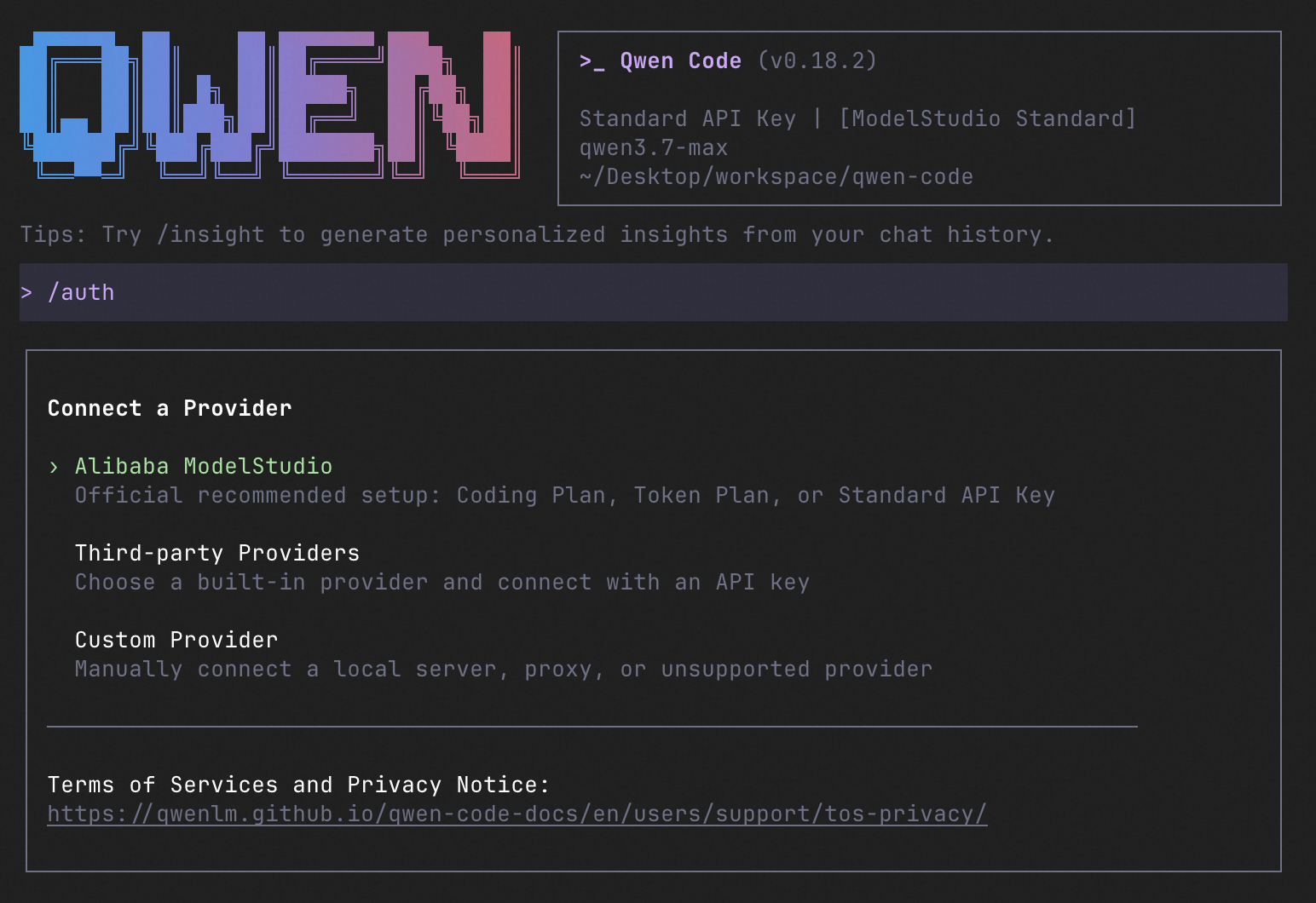
Inside the session, run /auth to configure your provider and API key. Then try:
Explain this repository and show me where to start.
See the Authentication Guide and Settings Reference for detailed setup.
See the terminal interface
How to Use Qwen Code
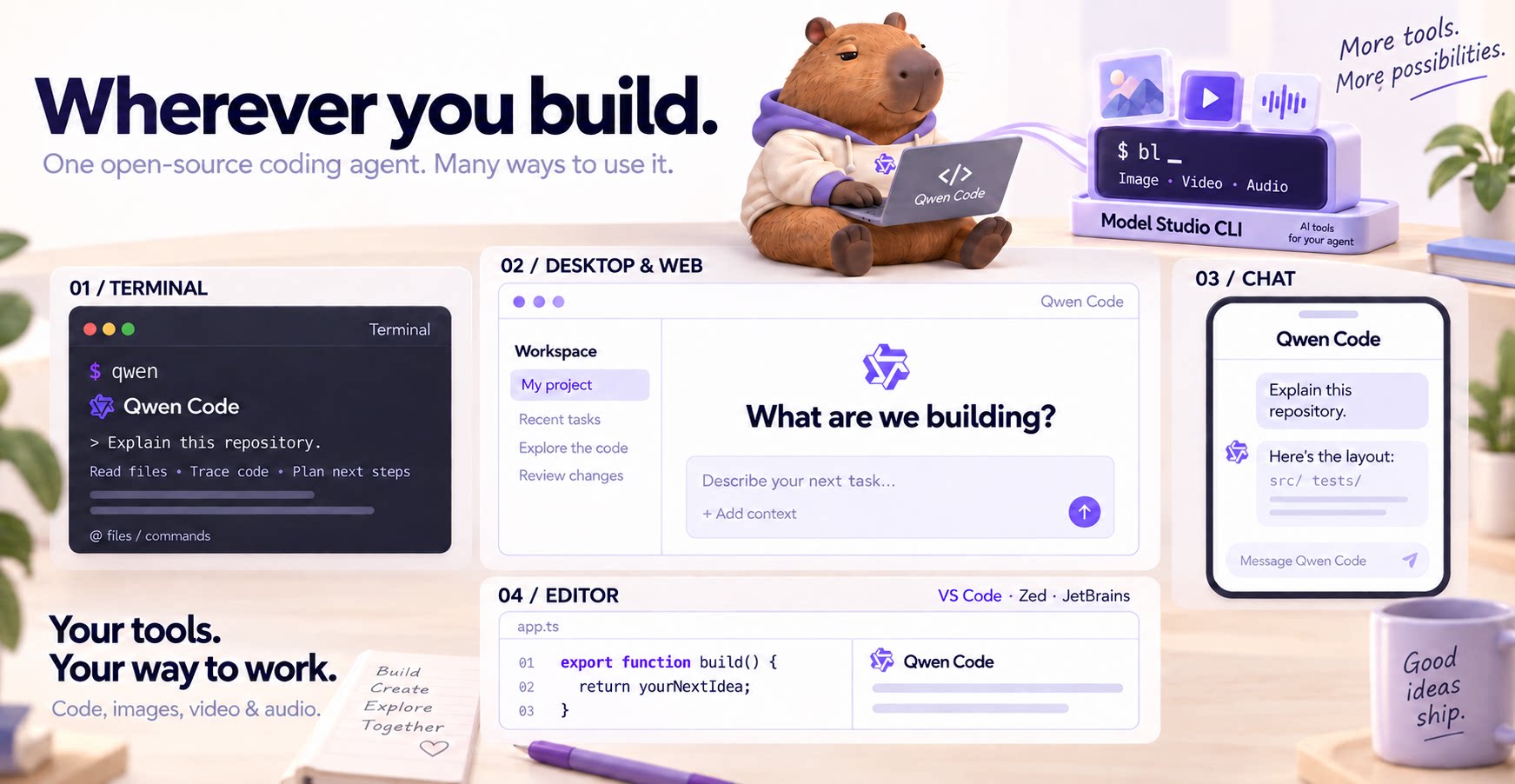
Choose the interface that fits your workflow:
| Interface | Get started |
|---|---|
| Terminal | Run qwen in your project — see Quick Start. |
| Desktop | Download Qwen Code Desktop for macOS, Windows, and Linux. |
| Web | Run qwen serve --open to open the Web UI in your browser. (experimental) |
| Editor | Set up VS Code, Zed, or JetBrains. |
| Chat | Connect Telegram, DingTalk, WeChat, or Feishu, then run qwen channel start. |
For automation and custom integrations:
- Headless — Run
qwen -p "..."in scripts, CI/CD, or batch jobs. - SDKs — Build with TypeScript, Python, or Java.
- Daemon — Run
qwen serveto connect clients over HTTP + SSE (ACP). (experimental) Daemon guide. - Computer Use — Set up native MCP tools or Node REPL + SDK in Qwen Code, Claude Code, or Codex.
SDK example (Python)
import asyncio

from qwen_code_sdk import is_sdk_result_message, query


async def main() -> None:
    result = query(
        "Summarize the repository layout.",
        {
            "cwd": "/path/to/project",
            "path_to_qwen_executable": "qwen",
        },
    )

    async for message in result:
        if is_sdk_result_message(message):
            print(message["result"])


asyncio.run(main())
Capabilities
If you know Claude Code, you already know Qwen Code — and then some. We've put significant effort into bringing Qwen Code to feature parity with Claude Code, improving both breadth and reliability across the board.
| Feature | Qwen Code | Claude Code |
|---|---|---|
| SubAgents, Agent Teams, Dynamic Workflows | ✓ | ✓ |
| Auto-Memory, Auto-Skills, Hooks | ✓ | ✓ |
| Built-in Skills (/review, /batch, /loop, /bugfix…) | ✓ | ✓ |
| MCP, Plan Mode, LSP Integration | ✓ | ✓ |
| Auto Mode, Sandbox, Git Worktrees | ✓ | ✓ |
| Computer Use (desktop automation) | ✓ | ✓ |
| IDE Plugins (VS Code / JetBrains / Zed) | ✓ | ✓ |
| SDK | ✓ | ✓ |
| Headless Mode, Session Management | ✓ | ✓ |
| Open-source — model and framework | ✓ | — |
| Multi-protocol (OpenAI / Anthropic / Gemini / Qwen + any provider) | ✓ | — |
| Agent Arena (multi-model head-to-head on same task) | ✓ | — |
Daemon Mode — qwen serve (multi-client shared agent) |
✓ | — |
| IM Channels (Telegram / DingTalk / WeChat / Feishu) | ✓ | — |
Qwen Code Evaluation
On SWE-bench Verified, seven Qwen Code versions scored 76.40%–77.80% on average using the same Qwen 3.7 Max model (500 tasks, three trials per version).

Full results and evaluation configuration →
Ecosystem
-
Qwen Code Desktop — Official desktop app for macOS, Windows, and Linux
-
AionUi — A modern GUI for command-line AI tools including Qwen Code
-
Gemini CLI Desktop — A cross-platform desktop/web/mobile UI for Qwen Code
-
qwen-audio-agent — Realtime full-duplex voice frontend for Qwen Code over ACP — talk hands-free with barge-in and a local wake word
-
🦞 Qwen Code Claw — Let other agents (Claude, Codex, etc.) delegate coding tasks to Qwen Code via ACP. Paste this prompt into your agent:
Use Qwen Code as a coding agent. First, fetch and read this skill reference:
https://raw.githubusercontent.com/QwenLM/qwen-code/refs/heads/main/.qwen/skills/qwen-code-claw/SKILL.md
Then follow the instructions inside to install, authenticate, and use Qwen Code via acpx for all coding tasks.
- Aliyun Model Studio CLI — Official CLI for Aliyun's AI platform (
bailian-cli). Extends Qwen Code with image/video generation, knowledge retrieval, app orchestration, and model deployment
Privacy
See the Terms of Service and Privacy Notice, including Chrome extension and Browser Use data handling.
Contributing
Contributions are welcome! See CONTRIBUTING.md for guidelines.
Acknowledgments
This project was originally based on Google Gemini CLI v0.8.2. We gratefully acknowledge the Gemini CLI team's excellent work. Starting from Qwen Code v0.1, we stopped syncing with upstream and began independent development as a multi-protocol, multi-platform agent framework with deep integrations for Qwen models and beyond.