 86f1338b86
* feat(serve): batch workspace session live-state snapshots

* test(serve): include batch live-state capability in integration baseline

* fix(serve): close review gaps in the batch session live-state route (#12513)

Index POST /sessions/live-state in the REST reference's persisted-catalog
row so the docs contract sees the protocol section, give the batch route the
single-workspace route's server-side records (routing-failure warn on
untrusted members, daemonLog error on unexpected bridge failures), make the
mid-batch disconnect guard observable with an AbortController and a
macrotask yield between members, and move the duplicated member-failure,
generation-currency, and bound literals into workspace-route-runtime for
both plural batch routes. Six tests pin the new witnesses.

Co-authored-by: Qwen-Coder <[email protected]>

* fix(serve): align live-state scope docs and pin batch route guards (#12513)

Co-authored-by: Qwen-Coder <[email protected]>

* test(cli): pin grouped REST doc rows against bare SDK names and column shifts

Co-authored-by: Qwen-Coder <[email protected]>

* test(cli): fail closed on grouped REST doc rows and ambiguous SDK qualifiers

Co-authored-by: Qwen-Coder <[email protected]>

* test(serve): pin documented live-state batch bounds against silent drift (#12513)

Co-authored-by: Qwen-Coder <[email protected]>

* test(cli): isolate the suite from the operator's settings home (#12513)

The autofix verification gate runs the packages/cli suite with the host's
real HOME on a machine shared with other jobs. A malformed
$HOME/.qwen/settings.json there (observed content: "X") makes every
operator-settings reader fail closed at once — readOperatorSettingsScopes
is designed to refuse a corrupted policy file — and one such file failed
408 tests across 15 files in the measured gate rejection.

Pin a private empty QWEN_HOME per test-file process in the suite setup
when the environment did not select one, following the file's existing
doctrine for operator-owned environment. Tests that exercise QWEN_HOME
set, stub, or delete it themselves. settings.test.ts keys every
user-settings and .env path off a mocked os.homedir, so it now deletes
an ambient QWEN_HOME explicitly; with any ambient value set, 13 of its
tests fail regardless of this change.

* test(cli): harden the QWEN_HOME suite pin and batch maxima test (#12513)

- Pin on truthiness so an ambient empty QWEN_HOME no longer falls
  through to $HOME/.qwen, matching every production reader.
- Sweep the pinned home from afterAll instead of an 'exit' listener
  that vitest workers never fire (51 leaked dirs on src/config -> 0).
- Restore QWEN_DEBUG_LOG_FILE around loadCliConfig tests so the debug
  logger's fire-and-forget writes stop racing the sweep.
- Witness that the suite never resolves settings from the ambient
  $HOME/.qwen, and assert member shape in the 20-selector maxima half
  so twenty failed members cannot read as twenty snapshots.

* test(cli): keep AppContainer store work off the pinned per-file QWEN_HOME (#12513)

* test(managed-agent): settle fresh group leaders before age-judged sweeps (#12513)

A just-forked process can read in ps with procps's negative-elapsed
wraparound (e.g. 441077234-00:18:40), which parsePsElapsed deliberately
leaves undatable. An undatable leader judges every worker/group identity
'unknown', so an unwitnessed sweep conservatively holds the live process
and rejects unproven — flaking the real-process sweep tests within
milliseconds of the spawn. settledGroupTable now also waits for the
leader's row to be datable, and the four sweep sites that judged a fresh
process without the guard use it.

* fix(cli): keep the QWEN_HOME test pin unconditional and alive for the process lifetime (#12513)

The conditional pin honored an ambient QWEN_HOME, so agent-gate vitest
runs read and wrote the operator's live settings home; the teardown
sweep then deleted the live pin while un-awaited extension-store work
was still reading it, turning Test (ubuntu-latest) red on ENOENT. Pin
unconditionally, keep the pin for the process lifetime, reap stale pins
by age at setup, await the floated extensions-list handler, and add
teardown, pin, reaper, and memory-only-contract witnesses.

Co-authored-by: Qwen-Coder <[email protected]>

* fix(cli): keep the QWEN_HOME teardown witness inside test-setup.ts (#12513)

The previous commit registered the pin teardown witness as a second
setupFiles entry in packages/cli/vitest.config.ts, which deterministic
verification rejects as CI/verification machinery outside the PR
footprint. Revert vitest.config.ts and fold the witness into
test-setup.ts itself: vitest runs root-level afterAll hooks in reverse
registration order, so the hook registered immediately after the pin
runs last among this file's root hooks and still turns every file red
if a teardown sweep of the live pin is reintroduced below it
(mutation-probed). The separate witness setup file is deleted.

Co-authored-by: Qwen-Coder <[email protected]>

Co-authored-by: Qwen-Coder <[email protected]>

* test(integration): raise the installed distribution case ceiling

The tui-parity installed-distribution darwin-x64 leg failed on the
npx-lifecycle-enabled no-relaunch-fallback case with "Test timed out in
120000ms" (run 40537979533, job 122316223603). The five preceding cases
averaged ~117s on that host, right at the ceiling: startup alone can
spend the whole 90s ready-prompt budget there (#15677) and the /about
retry window is another 90s, so 120s cannot contain a healthy case.

Raise the per-case ceiling to 240s and keep the budget helper's note in
sync.

---------

Co-authored-by: 西岐 <[email protected]>
Co-authored-by: qwen-code-dev-bot <[email protected]>
Co-authored-by: qwen-code-ci-bot <[email protected]>
Co-authored-by: Qwen-Coder <[email protected]>
Co-authored-by: qwen-code-dev-bot <[email protected]>
Co-authored-by: qwen-code-autofix <[email protected]>
Co-authored-by: qwen-code-autofix <qwen-code-autofix@localhost>
Co-authored-by: qwen-code-autofix[bot] <qwen-code-autofix[bot]@users.noreply.github.com>
Co-authored-by: Qwen Autofix <[email protected]>


The open-source AI coding agent for your terminal, editor, desktop, browser, and chat.
中文 | Deutsch | français | 日本語 | Русский | Português (Brasil) | 한국어
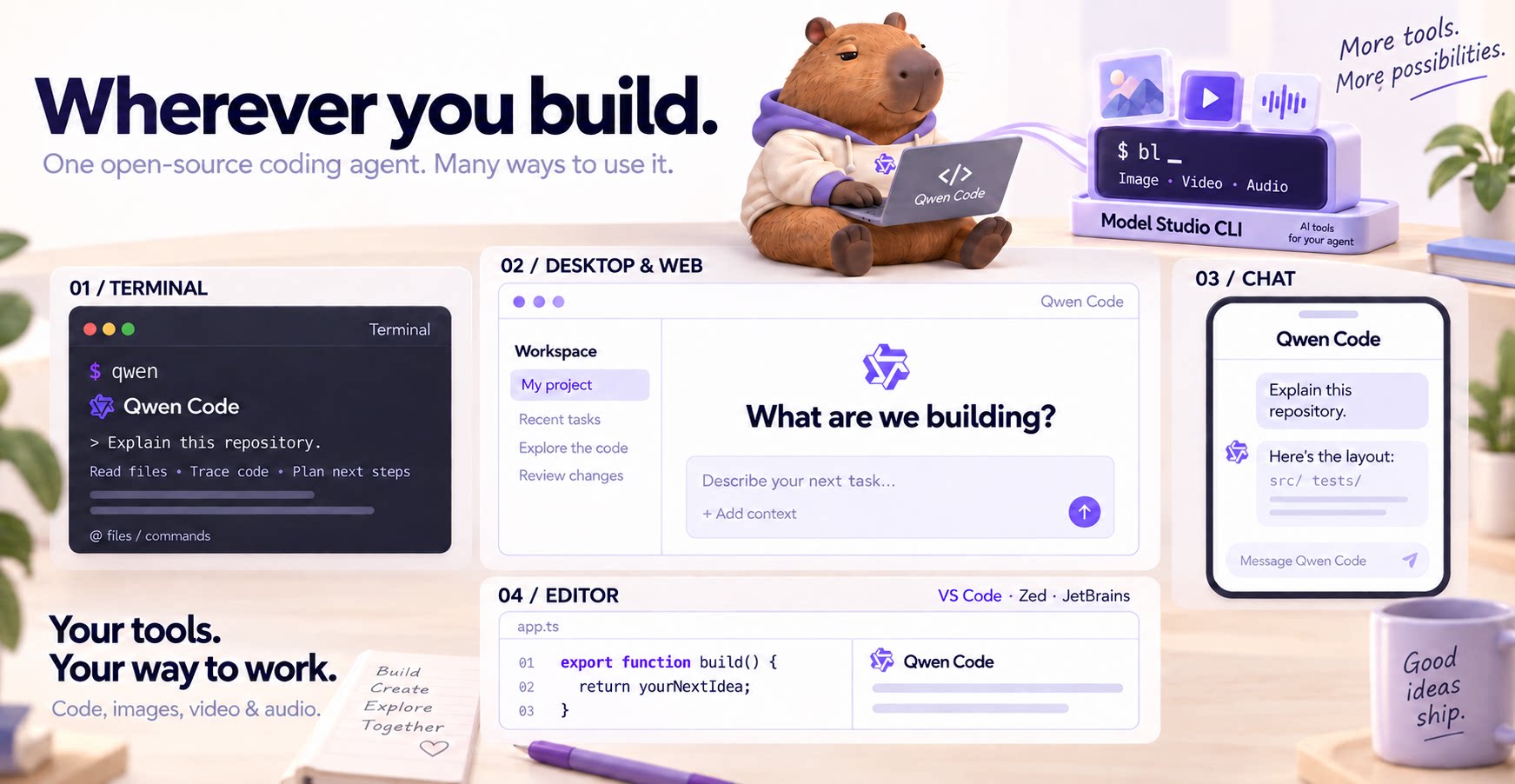
Why Qwen Code?
- Agentic out of the box — Auto-Memory, Auto-Skills, SubAgents, Agent Teams, and MCP. Dynamic workflows, zero setup.
- Open-source, inside and out — The framework and the Qwen models are open-source. They evolve together. No vendor lock-in.
- Multi-protocol — Supports OpenAI, Anthropic, Gemini, and Qwen APIs. Any third-party provider or local model (Ollama / vLLM). Switch at runtime.
- Beyond the terminal — IDE plugins, Desktop app, Web UI, SDKs, and chat integrations (Telegram / DingTalk / WeChat / Feishu).
Tip
Qwen Code is actively iterating on itself — using its own agent and models to file issues, submit PRs, review code, and run tests. Powered by the community, driven by AI.
Installation
Linux / macOS:
curl -fsSL https://qwen-code-assets.oss-cn-hangzhou.aliyuncs.com/installation/install-qwen-standalone.sh | bash
Windows:
irm https://qwen-code-assets.oss-cn-hangzhou.aliyuncs.com/installation/install-qwen-standalone.ps1 | iex
Restart your terminal after installation to ensure environment variables take effect.
NPM / Homebrew
NPM (requires Node.js 22+):
npm install -g @qwen-code/qwen-code@latest
Homebrew (macOS / Linux):
brew install qwen-code
Quick Start
Open a terminal in your project and start Qwen Code:
cd /path/to/your-project
qwen
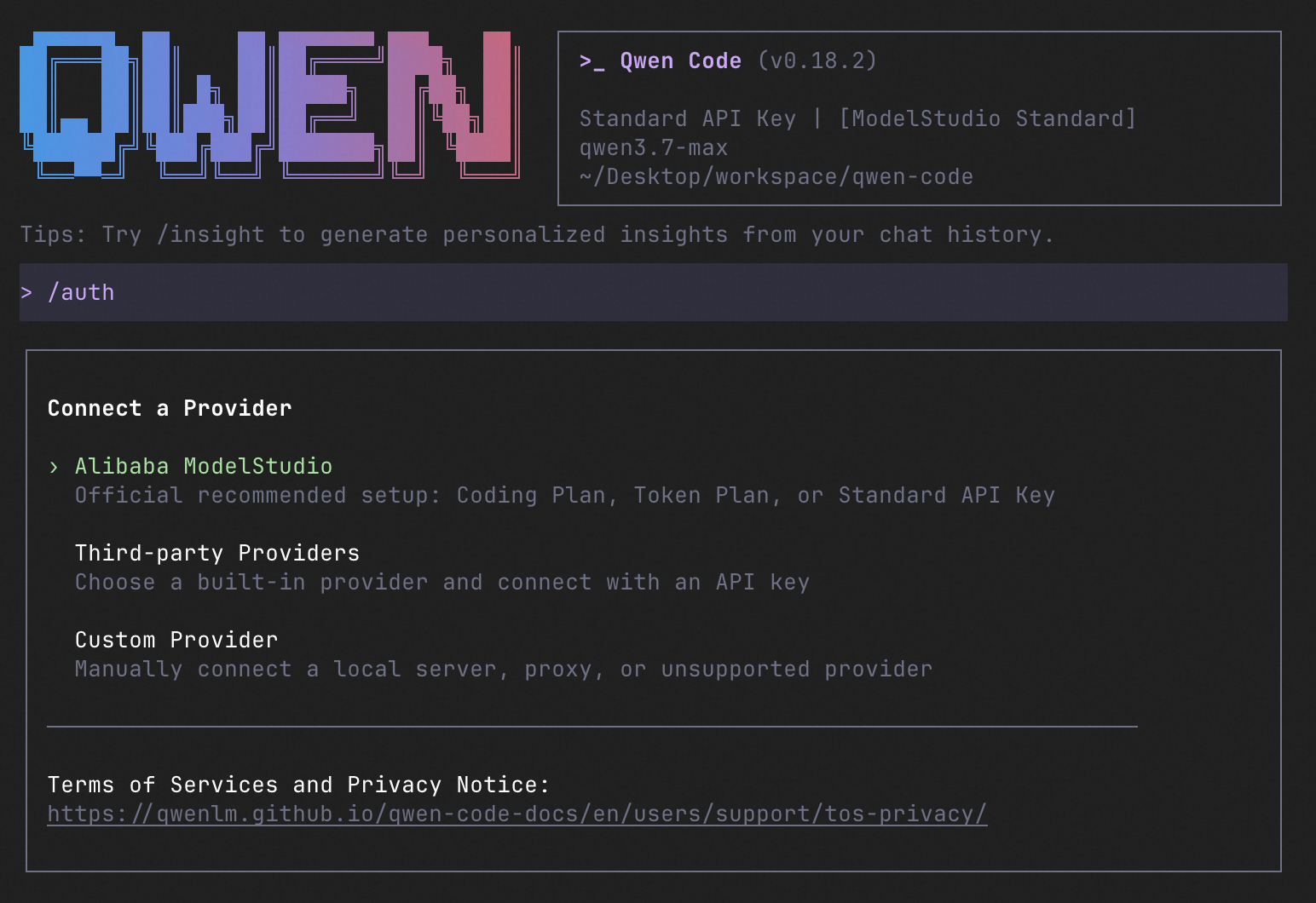
Inside the session, run /auth to configure your provider and API key. Then try:
Explain this repository and show me where to start.
See the Authentication Guide and Settings Reference for detailed setup.
See the terminal interface
How to Use Qwen Code
Choose the interface that fits your workflow:
| Interface | Get started |
|---|---|
| Terminal | Run qwen in your project — see Quick Start. |
| Desktop | Download Qwen Code Desktop for macOS, Windows, and Linux. |
| Web | Run qwen serve --open to open the Web UI in your browser. (experimental) |
| Editor | Set up VS Code, Zed, or JetBrains. |
| Chat | Connect Telegram, DingTalk, WeChat, or Feishu, then run qwen channel start. |
For automation and custom integrations:
- Headless — Run
qwen -p "..."in scripts, CI/CD, or batch jobs. - SDKs — Build with TypeScript, Python, or Java.
- Daemon — Run
qwen serveto connect clients over HTTP + SSE (ACP). (experimental) Daemon guide. - Computer Use — Set up native MCP tools or Node REPL + SDK in Qwen Code, Claude Code, or Codex.
SDK example (Python)
import asyncio

from qwen_code_sdk import is_sdk_result_message, query


async def main() -> None:
    result = query(
        "Summarize the repository layout.",
        {
            "cwd": "/path/to/project",
            "path_to_qwen_executable": "qwen",
        },
    )

    async for message in result:
        if is_sdk_result_message(message):
            print(message["result"])


asyncio.run(main())
Capabilities
If you know Claude Code, you already know Qwen Code — and then some. We've put significant effort into bringing Qwen Code to feature parity with Claude Code, improving both breadth and reliability across the board.
| Feature | Qwen Code | Claude Code |
|---|---|---|
| SubAgents, Agent Teams, Dynamic Workflows | ✓ | ✓ |
| Auto-Memory, Auto-Skills, Hooks | ✓ | ✓ |
| Built-in Skills (/review, /batch, /loop, /bugfix…) | ✓ | ✓ |
| MCP, Plan Mode, LSP Integration | ✓ | ✓ |
| Auto Mode, Sandbox, Git Worktrees | ✓ | ✓ |
| Computer Use (desktop automation) | ✓ | ✓ |
| IDE Plugins (VS Code / JetBrains / Zed) | ✓ | ✓ |
| SDK | ✓ | ✓ |
| Headless Mode, Session Management | ✓ | ✓ |
| Open-source — model and framework | ✓ | — |
| Multi-protocol (OpenAI / Anthropic / Gemini / Qwen + any provider) | ✓ | — |
| Agent Arena (multi-model head-to-head on same task) | ✓ | — |
Daemon Mode — qwen serve (multi-client shared agent) |
✓ | — |
| IM Channels (Telegram / DingTalk / WeChat / Feishu) | ✓ | — |
Qwen Code Evaluation
On SWE-bench Verified, seven Qwen Code versions scored 76.40%–77.80% on average using the same Qwen 3.7 Max model (500 tasks, three trials per version).

Full results and evaluation configuration →
Ecosystem
-
Qwen Code Desktop — Official desktop app for macOS, Windows, and Linux
-
AionUi — A modern GUI for command-line AI tools including Qwen Code
-
Gemini CLI Desktop — A cross-platform desktop/web/mobile UI for Qwen Code
-
qwen-audio-agent — Realtime full-duplex voice frontend for Qwen Code over ACP — talk hands-free with barge-in and a local wake word
-
🦞 Qwen Code Claw — Let other agents (Claude, Codex, etc.) delegate coding tasks to Qwen Code via ACP. Paste this prompt into your agent:
Use Qwen Code as a coding agent. First, fetch and read this skill reference:
https://raw.githubusercontent.com/QwenLM/qwen-code/refs/heads/main/.qwen/skills/qwen-code-claw/SKILL.md
Then follow the instructions inside to install, authenticate, and use Qwen Code via acpx for all coding tasks.
- Aliyun Model Studio CLI — Official CLI for Aliyun's AI platform (
bailian-cli). Extends Qwen Code with image/video generation, knowledge retrieval, app orchestration, and model deployment
Privacy
See the Terms of Service and Privacy Notice, including Chrome extension and Browser Use data handling.
Contributing
Contributions are welcome! See CONTRIBUTING.md for guidelines.
Acknowledgments
This project was originally based on Google Gemini CLI v0.8.2. We gratefully acknowledge the Gemini CLI team's excellent work. Starting from Qwen Code v0.1, we stopped syncing with upstream and began independent development as a multi-protocol, multi-platform agent framework with deep integrations for Qwen models and beyond.