 bb518cee86
* ci: host PR evidence outside Git

Co-authored-by: Qwen-Coder <[email protected]>

* ci: pin node and ossutil paths in privileged OSS uploads

The publish-verify evidence upload resolved `node` through a PATH
prefixed with $RUNNER_TEMP — the one directory PR code can write to
via the verify container's bind mount — so a planted fake `node`
there won interpreter resolution inside the step that holds
CI_BOT_PAT and the OSS config (PATH hijack). Resolve node under the
inherited clean PATH and run ossutil from a fresh job-private copy
of the sha256-verified binary installed above instead of resolving
either through $RUNNER_TEMP. Apply the same shape to
web-shell-visuals-publish.yml so the pattern cannot regress if that
job ever moves to a persistent pool.

Co-authored-by: Qwen-Coder <[email protected]>

* ci: make OSS setup best-effort and pair bucket/base-URL defaults

Mirror qwen-triage.yml in web-shell-visuals-publish.yml: mark the
ossutil install and credential-config steps continue-on-error so a
setup failure cannot abort the no-image marker-comment path (the
upload itself stays loud when images are present). In both
publishers, derive the default ALIYUN_OSS_PUBLIC_BASE_URL from
ALIYUN_OSS_BUCKET so overriding only one of the two vars cannot
post comment links that 404 against (or show stale objects from)
the other bucket. Re-record both workflow sizes in the baseline.

Co-authored-by: Qwen-Coder <[email protected]>

* ci: enrich evidence-upload warning with local preconditions

The single "Failed to upload evidence images" warning could not
distinguish its causes: the ossutil install and credential-config
steps run with continue-on-error and render green when they fail, so
a missing binary or config looks identical to a transient upload
blip or rotated keys. Probe both preconditions into the warning
(ossutil=ok/MISSING, config=ok/MISSING) so the investigator sees the
gap without trawling three steps of logs.

Co-authored-by: Qwen-Coder <[email protected]>

* test: enforce the uploader flag contract and pin the production arm

The evidence-hosting stub shifted --config away unvalidated, and every
harness run sets VERIFY_ASSETS_UPLOADER, so the production
`node "$uploader"` arm and its --config flag were never exercised:
dropping --config from the workflow kept every test green while the
real uploader exits 1 on it, silently degrading every /verify report
to text-only. Make the stub reject a missing/empty --bucket, --config
or --prefix, and pin the production invocation shape (inherited-PATH
node resolution plus all three ossutil flags). Mutation-probed: with
--config removed from the workflow both tests now fail.

Co-authored-by: Qwen-Coder <[email protected]>

* test: pin the ossutil credential lifecycle in both publishers

Nothing pinned the credential lifecycle this PR adds — the
sha256-checked ossutil install, the credential-config step, and the
if:always() cleanup — so a future edit dropping any of them (or the
always() condition) would leave every test green while the OSS key
pair persists in $RUNNER_TEMP on the persistent ecs-qwen pool. Add
shape assertions for all three steps in qwen-triage.yml and
web-shell-visuals-publish.yml, mirroring the release/desktop wiring
pins in install-script.test.js and desktop-oss-workflow.test.js.

Co-authored-by: Qwen-Coder <[email protected]>

* docs: align assets-repo guidance with the self-targeting guard

The PR-review workflow now blanks a QWEN_REVIEW_ASSETS_REPO that equals
the repository under review, but the user doc, the bundled review skill,
and the parseAssetsRepo unset-error still recommended pointing it at the
repo under review — so a maintainer following the published guidance
landed in the "not set" refusal path, and the refusal message
re-recommended the exact value the guard had just rejected. Update all
three surfaces to the new contract: a dedicated external image-host
repository (or a fork/scratch repo), with unset or self-targeting
values deliberately degrading to prose and local artifact paths.

Co-authored-by: Qwen-Coder <qwen-coder @alibabacloud.com>

* test: execute the visuals hosting block against a stub uploader

The workflow-level assertions covered the OSS upload path with shape
regexes only, so a --prefix that drifts away from RAW_BASE (every
preview URL 404s) or a dropped --config line (the uploader hard-fails
before any comment posts) both left the suite green. Extract the
hosting block and run it against a stub uploader that mirrors the real
flag contract and records the upload destination, in the same pattern
as the verify path in scripts/tests/qwen-triage-workflow.test.js: the
images arm must land the staged files under
$STUB_ROOT/$ALIYUN_OSS_BUCKET/pr-assets/web-shell-visuals/<pr>/<sha>
with the exact --bucket/--config/--prefix wiring, and RAW_BASE must
equal that layout; the no-change arm must never invoke the uploader.

Co-authored-by: Qwen-Coder <qwen-coder @alibabacloud.com>

* fix(ci): gate ossutil consumers on verified install

Prevent the persistent publish runner from executing a stale binary under RUNNER_TEMP when the best-effort install step fails. Pin both the install outcome gate and the hardened PATH invocation in focused workflow tests.

Co-authored-by: Qwen-Coder <qwen-coder @alibabacloud.com>

Co-authored-by: Qwen-Coder <[email protected]>

* fix(ci): grant publisher checkout access

Co-authored-by: Qwen-Coder <qwen-coder @alibabacloud.com>

Co-authored-by: Qwen-Coder <[email protected]>

* test(ci): pin OSS publisher failure paths

Co-authored-by: Qwen-Coder <qwen-coder @alibabacloud.com>

Co-authored-by: Qwen-Coder <[email protected]>

* test(ci): exercise production OSS dispatch

Co-authored-by: Qwen-Coder <qwen-coder @alibabacloud.com>

Co-authored-by: Qwen-Coder <[email protected]>

* fix(ci): isolate OSS publisher on hosted runner

* fix(ci): sync size baseline and stale runner comments

Co-authored-by: Qwen-Coder <qwen-coder @alibabacloud.com>

* fix(ci): give each visuals publish a fresh OSS prefix

The web-shell prefix was pr-assets/web-shell-visuals/<pr>/<head-sha>, so a
re-run for the same head wrote back over the object keys the already-posted
comment referenced. GitHub serves comment images through a caching proxy, so
reviewers would keep seeing the previous run's screenshots at a URL whose
bytes had changed. The Git-backed design got cache-busting free from the
per-run commit SHA; add the run id back to restore it (the verify lane
already carries <run-id>-<attempt>).

Also:

- Resolve the destination as ALIYUN_OSS_PR_ASSETS_BUCKET -> ALIYUN_OSS_BUCKET
  -> qwen-code-assets in both publishers, with the public base URL derived
  from whichever wins. Unset, this is byte-for-byte today's behaviour; set,
  it moves untrusted PR-derived evidence off the bucket that also serves
  release, desktop, and live-host downloads without a workflow change.
- Sparse-check out /package.json alongside the uploader: it is ESM in a .js
  file, and package.json declares engines >= 22.0 while neither publisher
  pins a Node, so without the "type": "module" marker the uploader only
  parses on the Node versions that infer module syntax.
- Require the credential file, not just a green install outcome, before
  dispatching the /verify upload. The configure step is continue-on-error,
  so a missing or rotated secret otherwise cost three retry backoffs per
  image before degrading to the same text-only report.
- Drop the stale "runs on the persistent ECS pool" premise from the
  clear-stale-downloads step; publish-verify is on ubuntu-latest now.

* fix(ci): retry the ossutil download in both PR publishers

The release syncs download ossutil with no retry, which is fine there: a
red run is rerun by hand. Here the consequence differs. A CDN blip in the
web-shell publisher leaves no ossutil for the upload, and since the upload
aborts the step under set -e, the PR loses its preview comment entirely
rather than degrading; in the verify publisher it silently costs the report
its evidence images. Three retries with --retry-all-errors covers the
transient class without changing any success path.

Also reword the unset-QWEN_REVIEW_ASSETS_REPO refusal. It ended with a flat
claim about the PR-review workflow blanking a self-targeting designation,
which reads as a non sequitur to the far more common reader: someone running
the CLI locally who simply never set the variable. Keep the diagnostic — a
maintainer whose repository variable IS set needs it — but scope it to CI
and say why self-targeting is discouraged in the first place.

* fix(ci): include run attempt in the web-shell OSS asset prefix

The workflow_run id is stable across re-run attempts, so a maintainer
re-run of the visuals publish overwrote the exact object keys an
already-posted comment references (camo keeps rendering attempt-1
shots). Append run_attempt to the prefix, mirroring the verify lane,
and cover same-runId attempt-1-vs-attempt-2 in the hosting harness.

Co-authored-by: Qwen-Coder <qwen-coder @alibabacloud.com>

* fix(ci): close out PR evidence hosting review findings

- The web-shell visuals prefix gains the run attempt: a re-run keeps
  the run id and only increments the attempt, so the old prefix let a
  same-head re-run write back over the object keys an already-posted
  comment references (camo keeps serving the stale screenshots).
  Mirrors the verify lane <run-id>-<attempt>; the re-run test now
  models same-run attempt 1 vs 2, not just distinct run ids.
- The QWEN_REVIEW_ASSETS_REPO self-targeting guard now trims and
  compares case-insensitively before the CLI reads the value, so
  padded or case-shifted self-references degrade like an unset one.
- Both publisher checkouts pin ref: github.sha (the default-branch
  head on their events) instead of relying on default resolution.
- The ossutil download retry budget fits the 10-minute job cap in
  both publishers (~6.1 min worst case; was ~20 min).
- Upload attempts are bounded via OSS_UPLOAD_ATTEMPT_TIMEOUT_MS so a
  stalled ossutil degrades to the text-only report / re-triggerable
  publish instead of burning the job cap; release syncs stay
  unbounded (the knob is opt-in).
- Fix the serving-model comment (the extension allowlist, not the
  magic bytes, is what pins the served Content-Type) and pin what
  earlier suites left unpinned: sparse-checkout lists, bucket-to-URL
  derivation, curl retry flags, persist-credentials, and the ossutil
  isolation lines. Both uploader stubs now require the --config file
  to exist, so config drift turns the harnesses red.
- runHostingBlock tears down its mkdtemp fixture instead of leaking
  it on every call.

# Conflicts:
#	.github/scripts/web-shell-visuals-publish.test.mjs
#	.github/workflows/web-shell-visuals-publish.yml
#	docs/design/2026-08-25-pr-evidence-oss-hosting.md

* fix(ci): gate visuals-publish Configure step on ossutil install outcome

The Install ossutil step keeps continue-on-error: true so a failed install must not block the no-image marker-comment path, but the unguarded Configure Aliyun OSS credentials step still ran and failed confusingly on the missing binary. Give the install step the install-ossutil id and gate Configure on its success outcome, matching the qwen-triage.yml twins.

Co-authored-by: Qwen-Coder <[email protected]>

---------

Co-authored-by: Qwen-Coder <[email protected]>
Co-authored-by: Qwen-Coder <qwen-coder @alibabacloud.com>
Co-authored-by: Shaojin Wen <[email protected]>


The open-source AI coding agent that lives in your terminal.
中文 | Deutsch | français | 日本語 | Русский | Português (Brasil) | 한국어
Why Qwen Code?
- Agentic out of the box — Auto-Memory, Auto-Skills, SubAgents, Agent Teams, and MCP. Dynamic workflows, zero setup.
- Open-source, inside and out — The framework and the Qwen models are open-source. They evolve together. No vendor lock-in.
- Multi-protocol — Supports OpenAI, Anthropic, Gemini, and Qwen APIs. Any third-party provider or local model (Ollama / vLLM). Switch at runtime.
- Beyond the terminal — IDE plugins, Desktop app, daemon mode, SDKs, and IM bots (Telegram / DingTalk / WeChat / Feishu).
Tip
Qwen Code is actively iterating on itself — using its own agent and models to file issues, submit PRs, review code, and run tests. Powered by the community, driven by AI.
Installation
Linux / macOS:
curl -fsSL https://qwen-code-assets.oss-cn-hangzhou.aliyuncs.com/installation/install-qwen-standalone.sh | bash
Windows:
irm https://qwen-code-assets.oss-cn-hangzhou.aliyuncs.com/installation/install-qwen-standalone.ps1 | iex
Restart your terminal after installation to ensure environment variables take effect.
NPM / Homebrew
NPM (requires Node.js 22+):
npm install -g @qwen-code/qwen-code@latest
Homebrew (macOS / Linux):
brew install qwen-code
Quick Start
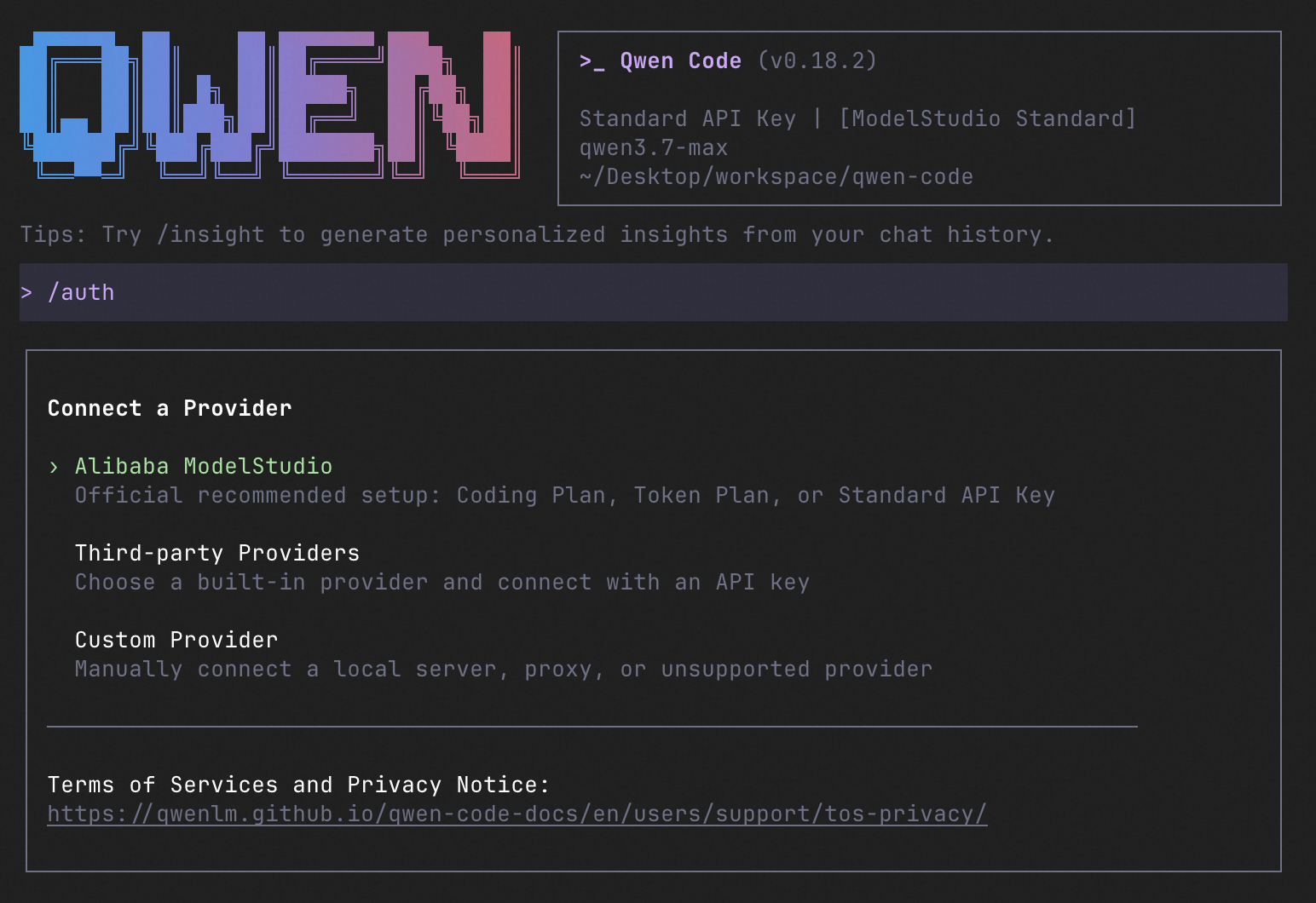
qwen          # Launch interactive terminal UI
# Inside the session:
/auth         # Configure your provider and API key
See the Authentication Guide and Settings Reference for detailed setup.
How to Use Qwen Code
| Mode | Command | Use Case |
|---|---|---|
| Interactive | qwen |
Terminal UI with rich rendering, @file references, slash commands |
| Headless | qwen -p "..." |
Scripts, CI/CD, batch processing — no UI |
| IDE | — | VS Code, Zed, JetBrains |
| Desktop | — | Qwen Code Desktop — GUI for macOS, Windows, Linux |
| Daemon | qwen serve |
Shared agent session over HTTP+SSE (ACP). Multiple clients, one agent. (experimental) Docs |
| SDK | — | TypeScript, Python, Java |
| IM Bot | qwen channel |
Connect to Telegram, DingTalk, WeChat, or Feishu |
SDK example (Python)
import asyncio

from qwen_code_sdk import is_sdk_result_message, query


async def main() -> None:
    result = query(
        "Summarize the repository layout.",
        {
            "cwd": "/path/to/project",
            "path_to_qwen_executable": "qwen",
        },
    )

    async for message in result:
        if is_sdk_result_message(message):
            print(message["result"])


asyncio.run(main())
Capabilities
If you know Claude Code, you already know Qwen Code — and then some. We've put significant effort into bringing Qwen Code to feature parity with Claude Code, improving both breadth and reliability across the board.
| Feature | Qwen Code | Claude Code |
|---|---|---|
| SubAgents, Agent Teams, Dynamic Workflows | ✓ | ✓ |
| Auto-Memory, Auto-Skills, Hooks | ✓ | ✓ |
| Built-in Skills (/review, /batch, /loop, /bugfix…) | ✓ | ✓ |
| MCP, Plan Mode, LSP Integration | ✓ | ✓ |
| Auto Mode, Sandbox, Git Worktrees | ✓ | ✓ |
| Computer Use (desktop automation) | ✓ | ✓ |
| IDE Plugins (VS Code / JetBrains / Zed) | ✓ | ✓ |
| SDK | ✓ | ✓ |
| Headless Mode, Session Management | ✓ | ✓ |
| Open-source — model and framework | ✓ | — |
| Multi-protocol (OpenAI / Anthropic / Gemini / Qwen + any provider) | ✓ | — |
| Agent Arena (multi-model head-to-head on same task) | ✓ | — |
Daemon Mode — qwen serve (multi-client shared agent) |
✓ | — |
| IM Channels (Telegram / DingTalk / WeChat / Feishu) | ✓ | — |
Ecosystem
-
Qwen Code Desktop — Official desktop app for macOS, Windows, and Linux
-
AionUi — A modern GUI for command-line AI tools including Qwen Code
-
Gemini CLI Desktop — A cross-platform desktop/web/mobile UI for Qwen Code
-
🦞 Qwen Code Claw — Let other agents (Claude, Codex, etc.) delegate coding tasks to Qwen Code via ACP. Paste this prompt into your agent:
Use Qwen Code as a coding agent. First, fetch and read this skill reference:
https://raw.githubusercontent.com/QwenLM/qwen-code/refs/heads/main/.qwen/skills/qwen-code-claw/SKILL.md
Then follow the instructions inside to install, authenticate, and use Qwen Code via acpx for all coding tasks.
- Aliyun Model Studio CLI — Official CLI for Aliyun's AI platform (
bailian-cli). Extends Qwen Code with image/video generation, knowledge retrieval, app orchestration, and model deployment
Contributing
Contributions are welcome! See CONTRIBUTING.md for guidelines.
Acknowledgments
This project was originally based on Google Gemini CLI v0.8.2. We gratefully acknowledge the Gemini CLI team's excellent work. Starting from Qwen Code v0.1, we stopped syncing with upstream and began independent development as a multi-protocol, multi-platform agent framework with deep integrations for Qwen models and beyond.