 ChiGao
be585888f8
* fix(serve): fix event_stream_resync_required for poll-based SSE clients

Two root causes were identified from production trace data:

**Root cause 1 (72% of incidents): ring_evicted**
Agentic coding sessions generate 25 000+ events per turn, exhausting
the default ring size of 8 000. When the ring fills, the oldest events
are evicted and a reconnecting client receives `ring_evicted`, forcing
a full resync. Raise `DEFAULT_RING_SIZE` from 8 000 to 32 000 to
provide adequate headroom (~1–2 MB RAM per session at typical event
sizes).

**Root cause 2 (13% of incidents): epoch_reset / session_rebuilt**
Poll-based SSE clients (e.g. DataAgent CLI) disconnect for up to 12 s
between polls. When the last client detaches immediately after a prompt
settles, the daemon closes the session through `last_client_detached`.
The next poll reconnects, restores a new session with a fresh EventBus
epoch, and the old `Last-Event-ID` becomes invalid, triggering resync.

Add `sessionPromptSettledCloseGraceMs` (default 0, preserving existing
behavior for all library consumers). When set > 0, a deferred timer
replaces the immediate `last_client_detached` close after a prompt
result. A reconnecting poll client calls `subscribeEvents`, which clears
the timer and keeps the session alive. Web clients with persistent SSE
connections are completely unaffected — their `clientIds.size` stays > 0
so `entryIsAutoCloseCandidate` never fires.

`qwen serve` exposes `--session-prompt-settled-close-grace-ms` to let
operators tune the window. The DataAgent CLI sets 60 000 ms (60 s) to
comfortably cover its 12 s poll gap with margin.

Fixes: ring_evicted and epoch_reset resync incidents for CLI polling
clients. No behavior change for default-config or web shell deployments.

* fix(serve): address review criticals — timer overwrite and grace-hold consumed on first reconnect

R1-1: schedulePromptSettledClose now clears any pending timer before arming a
new one, so two prompt settles inside one grace window no longer leak the first
timer and close the session at the first settle's deadline.

R1-3: subscribeEvents now calls cancelPromptSettledTimer (timer only) instead
of clearPromptSettledClose (timer + stamp), so the promptSettledAt hold in
entryIsAutoCloseCandidate survives the subscribe → drain → detach cycle.
detachClient calls rearmPromptSettledClose after maybeCloseIdleSession to
reschedule the close for the remaining grace window once the last subscriber
drops.

Also fixes two doc mismatches in bridgeOptions.ts: removes the false claim
that qwen serve sets 60_000 (the default is 0, it is opt-in via flag) and
corrects the scope note — the hold gates every automatic close path, not just
prompt_settled.

* fix(serve): narrow PR to prompt-settled grace and revert default ring-size bump

Per review feedback, scope the change to the opt-in prompt-settled close
grace window and its lifecycle edge cases:

- Revert the global DEFAULT_RING_SIZE change from 32,000 back to 8,000;
  keep only the --event-ring-size option for operators who need it.
- Fix deferred-close handling around subscribeEvents, detachClient,
  closeSession, and killSession so the grace window survives reconnect
  churn and refused closes without orphaning timers.
- Add DAEMON-005 regression tests for the above lifecycle edge cases.
- Expose sessionPromptSettledCloseGraceMs in SDK daemon-status types and
  document the new CLI flag.

Refs: #10344

* fix(cli): tolerate yargs line wrap when checking IPv4 help text

The new --session-prompt-settled-close-grace-ms flag widens yargs' option
column, causing the --hostname description to wrap 127.0.0.0/8 across lines.
Strip whitespace before the substring assertion so the test stays robust.


The open-source AI coding agent that lives in your terminal.
中文 | Deutsch | français | 日本語 | Русский | Português (Brasil) | 한국어
Why Qwen Code?
- Agentic out of the box — Auto-Memory, Auto-Skills, SubAgents, Agent Teams, and MCP. Dynamic workflows, zero setup.
- Open-source, inside and out — The framework and the Qwen models are open-source. They evolve together. No vendor lock-in.
- Multi-protocol — Supports OpenAI, Anthropic, Gemini, and Qwen APIs. Any third-party provider or local model (Ollama / vLLM). Switch at runtime.
- Beyond the terminal — IDE plugins, Desktop app, daemon mode, SDKs, and IM bots (Telegram / DingTalk / WeChat / Feishu).
Tip
Qwen Code is actively iterating on itself — using its own agent and models to file issues, submit PRs, review code, and run tests. Powered by the community, driven by AI.
Installation
Linux / macOS:
curl -fsSL https://qwen-code-assets.oss-cn-hangzhou.aliyuncs.com/installation/install-qwen-standalone.sh | bash
Windows:
irm https://qwen-code-assets.oss-cn-hangzhou.aliyuncs.com/installation/install-qwen-standalone.ps1 | iex
Restart your terminal after installation to ensure environment variables take effect.
NPM / Homebrew
NPM (requires Node.js 22+):
npm install -g @qwen-code/qwen-code@latest
Homebrew (macOS / Linux):
brew install qwen-code
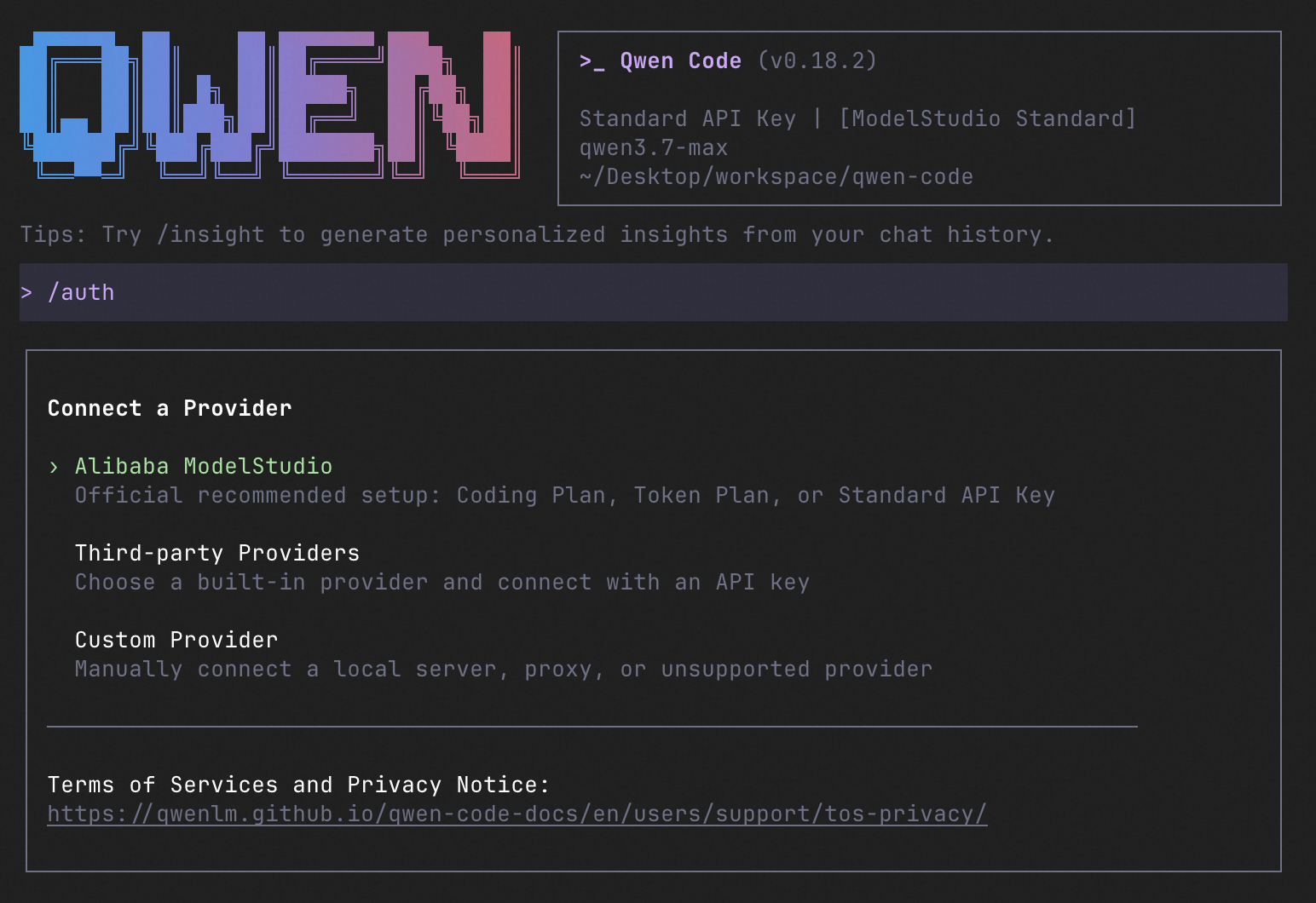
Quick Start
qwen          # Launch interactive terminal UI
# Inside the session:
/auth         # Configure your provider and API key
See the Authentication Guide and Settings Reference for detailed setup.
How to Use Qwen Code
| Mode | Command | Use Case |
|---|---|---|
| Interactive | qwen |
Terminal UI with rich rendering, @file references, slash commands |
| Headless | qwen -p "..." |
Scripts, CI/CD, batch processing — no UI |
| IDE | — | VS Code, Zed, JetBrains |
| Desktop | — | Qwen Code Desktop — GUI for macOS, Windows, Linux |
| Daemon | qwen serve |
Shared agent session over HTTP+SSE (ACP). Multiple clients, one agent. (experimental) Docs |
| SDK | — | TypeScript, Python, Java |
| IM Bot | qwen channel |
Connect to Telegram, DingTalk, WeChat, or Feishu |
SDK example (Python)
import asyncio

from qwen_code_sdk import is_sdk_result_message, query


async def main() -> None:
    result = query(
        "Summarize the repository layout.",
        {
            "cwd": "/path/to/project",
            "path_to_qwen_executable": "qwen",
        },
    )

    async for message in result:
        if is_sdk_result_message(message):
            print(message["result"])


asyncio.run(main())
Capabilities
If you know Claude Code, you already know Qwen Code — and then some. We've put significant effort into bringing Qwen Code to feature parity with Claude Code, improving both breadth and reliability across the board.
| Feature | Qwen Code | Claude Code |
|---|---|---|
| SubAgents, Agent Teams, Dynamic Workflows | ✓ | ✓ |
| Auto-Memory, Auto-Skills, Hooks | ✓ | ✓ |
| Built-in Skills (/review, /batch, /loop, /bugfix…) | ✓ | ✓ |
| MCP, Plan Mode, LSP Integration | ✓ | ✓ |
| Auto Mode, Sandbox, Git Worktrees | ✓ | ✓ |
| Computer Use (desktop automation) | ✓ | ✓ |
| IDE Plugins (VS Code / JetBrains / Zed) | ✓ | ✓ |
| SDK | ✓ | ✓ |
| Headless Mode, Session Management | ✓ | ✓ |
| Open-source — model and framework | ✓ | — |
| Multi-protocol (OpenAI / Anthropic / Gemini / Qwen + any provider) | ✓ | — |
| Agent Arena (multi-model head-to-head on same task) | ✓ | — |
Daemon Mode — qwen serve (multi-client shared agent) |
✓ | — |
| IM Channels (Telegram / DingTalk / WeChat / Feishu) | ✓ | — |
Ecosystem
-
Qwen Code Desktop — Official desktop app for macOS, Windows, and Linux
-
AionUi — A modern GUI for command-line AI tools including Qwen Code
-
Gemini CLI Desktop — A cross-platform desktop/web/mobile UI for Qwen Code
-
🦞 Qwen Code Claw — Let other agents (Claude, Codex, etc.) delegate coding tasks to Qwen Code via ACP. Paste this prompt into your agent:
Use Qwen Code as a coding agent. First, fetch and read this skill reference:
https://raw.githubusercontent.com/QwenLM/qwen-code/refs/heads/main/.qwen/skills/qwen-code-claw/SKILL.md
Then follow the instructions inside to install, authenticate, and use Qwen Code via acpx for all coding tasks.
- Aliyun Model Studio CLI — Official CLI for Aliyun's AI platform (
bailian-cli). Extends Qwen Code with image/video generation, knowledge retrieval, app orchestration, and model deployment
Contributing
Contributions are welcome! See CONTRIBUTING.md for guidelines.
Acknowledgments
This project was originally based on Google Gemini CLI v0.8.2. We gratefully acknowledge the Gemini CLI team's excellent work. Starting from Qwen Code v0.1, we stopped syncing with upstream and began independent development as a multi-protocol, multi-platform agent framework with deep integrations for Qwen models and beyond.