 ca7d487ce9
* ci: route Lint & Static to ECS for every pull request

* ci: isolate HOME and complete routing pins for lint_and_static

- lint_and_static admits untrusted forks to the shared pool, so pin a
  job-level HOME/USERPROFILE under runner.temp and create it before the
  first write (git safe.directory, npm config).
- Derive the classifier output from each job's own runs-on in the ceiling
  helper, so a timeout pointed at the wrong output throws instead of
  being substituted; parameterise runnerOn the same way.
- Pin test's own runs-on to ubuntu_runner and add the HOME-isolation
  guard for every lane routed past the association gate.
- Correct the qwen-autofix premise and the integration_no_ak comment,
  and record the routing decision in a bilingual design note.

Co-authored-by: Qwen-Coder <[email protected]>
Patrol-Run: qwen-pr-closeout/jmvvwdojb45

* fix(ci): isolate lint lane HOME and restore routing guard strength

Resolve R1-1 (Critical): per-job HOME for lint_and_static so untrusted
fork code cannot plant git/npm config a later trusted job inherits;
shared warm caches re-pointed via getent + XDG_DATA_HOME/COREPACK_HOME.
Resolve R1-2: timeout ceilings derive the output name from each job's
own runs-on. Resolve R1-3: explicit ubuntu_runner pin for test.

* docs(ci): record lint ECS fork-routing design and correct stale premises

Resolve R1-5: bilingual design record (container tradeoff, acceptance,
residual risks), qwen-autofix.md section 38 premise, no_ak scoping comment.

* fix(ci): publish run-unique isolated HOME from step env, not job env

Resolve P1/R1-1: jobs.<job_id>.env cannot read the runner context, so the
workflow failed GitHub validation entirely; publish HOME/USERPROFILE via
GITHUB_ENV from the first step instead. Resolve R2-1: RUNNER_TEMP survives
across jobs on this pool, so the path is run-unique, cleared before create,
and reclaimed by an always() step before the failure collector. Resolve
R2-3: share content-verified linter/corepack caches via RUNNER_TOOL_CACHE.
Resolve R2-5: move the HOME guard into the PR-gated routing battery with a
single-lane set pin; resolve wenshao R2-4 with one fleet ladder for both
outputs. Witness: actionlint 1.7.12 exits clean on ci.yml; six mutations
each red the matching guard.

* docs(ci): correct lint routing record per round-2 review

Supersede link points at qwen-autofix.md section 38 (R2-4); read-only token
and HOME-relative write class stated precisely (R2-2); residual risks are
examples not a census, naming web_shell_e2e_smoke and other PAT pool jobs
(wenshao R2-3); association gate recorded as throughput policy, not an
enforceable boundary (R2-6); dispatch-over-fleet priority and per-lane
hosted ceilings (P3); cache cost list and PR-gated test placement updated.

* chore(ci): bump ci.yml size ratchet for merged tmpdir routing and HOME isolation

Growth is real: #15979's helper-test tmpdir routing arrived via the main
merge the freshness gate required, plus this PR's run-unique HOME
mechanism. 156377 -> 161281 bytes.

* fix(ci): keep COREPACK_HOME per-run; shared cache is a poisoning channel

Corepack does not re-verify extracted entries on cache hit (reproduced
locally on 0.36.0 with the repo's pnpm pin: tampered entry executes with
the recorded hash unchanged, network disabled). Move COREPACK_HOME inside
the run-unique HOME; XDG_CACHE_HOME stays shared because lint.js
SHA-256-verifies linter archives on every hit. Guard and bilingual record
updated; shared-corepack mutation reds the guard.

---------

Co-authored-by: Qwen-Coder <[email protected]>
Co-authored-by: Shaojin Wen <[email protected]>


The open-source AI coding agent for your terminal, editor, desktop, browser, and chat.
中文 | Deutsch | français | 日本語 | Русский | Português (Brasil) | 한국어
Why Qwen Code?
- Agentic out of the box — Auto-Memory, Auto-Skills, SubAgents, Agent Teams, and MCP. Dynamic workflows, zero setup.
- Open-source, inside and out — The framework and the Qwen models are open-source. They evolve together. No vendor lock-in.
- Multi-protocol — Supports OpenAI, Anthropic, Gemini, and Qwen APIs. Any third-party provider or local model (Ollama / vLLM). Switch at runtime.
- Beyond the terminal — IDE plugins, Desktop app, Web UI, SDKs, and chat integrations (Telegram / DingTalk / WeChat / Feishu).
Tip
Qwen Code is actively iterating on itself — using its own agent and models to file issues, submit PRs, review code, and run tests. Powered by the community, driven by AI.
Installation
Linux / macOS:
curl -fsSL https://qwen-code-assets.oss-cn-hangzhou.aliyuncs.com/installation/install-qwen-standalone.sh | bash
Windows:
irm https://qwen-code-assets.oss-cn-hangzhou.aliyuncs.com/installation/install-qwen-standalone.ps1 | iex
Restart your terminal after installation to ensure environment variables take effect.
NPM / Homebrew
NPM (requires Node.js 22+):
npm install -g @qwen-code/qwen-code@latest
Homebrew (macOS / Linux):
brew install qwen-code
Quick Start
Open a terminal in your project and start Qwen Code:
cd /path/to/your-project
qwen
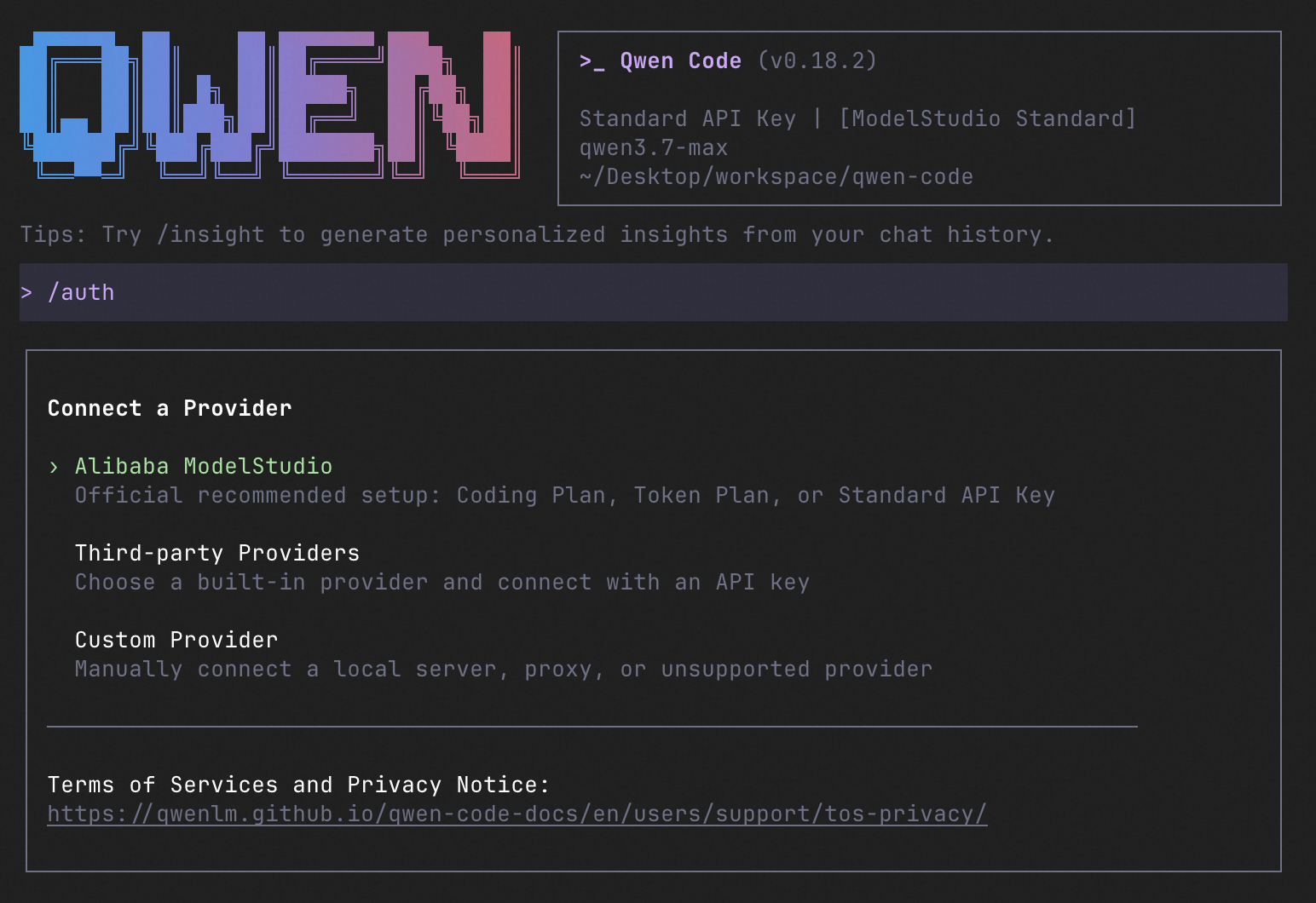
Inside the session, run /auth to configure your provider and API key. Then try:
Explain this repository and show me where to start.
See the Authentication Guide and Settings Reference for detailed setup.
See the terminal interface
How to Use Qwen Code
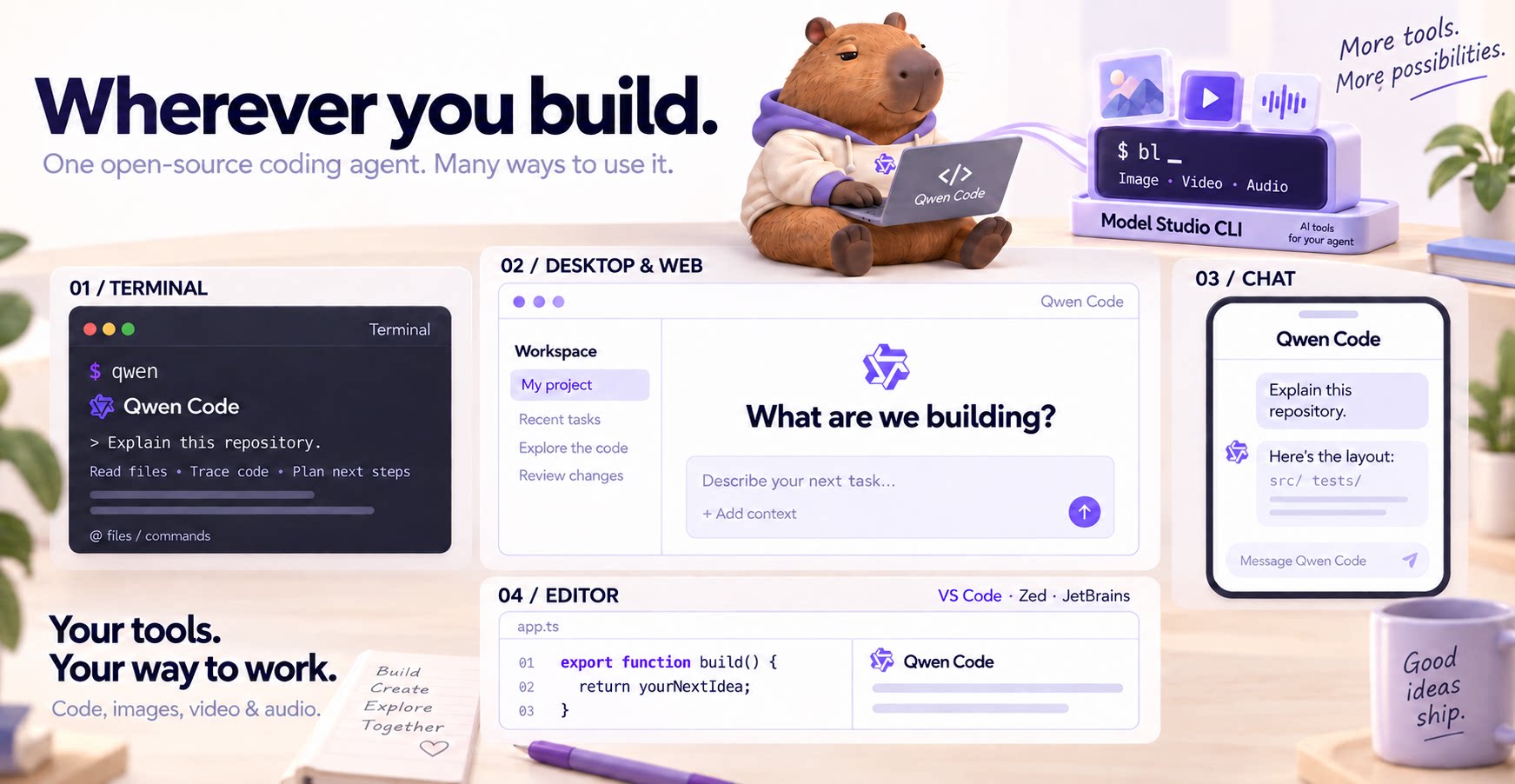
Choose the interface that fits your workflow:
| Interface | Get started |
|---|---|
| Terminal | Run qwen in your project — see Quick Start. |
| Desktop | Download Qwen Code Desktop for macOS, Windows, and Linux. |
| Web | Run qwen serve --open to open the Web UI in your browser. (experimental) |
| Editor | Set up VS Code, Zed, or JetBrains. |
| Chat | Connect Telegram, DingTalk, WeChat, or Feishu, then run qwen channel start. |
For automation and custom integrations:
- Headless — Run
qwen -p "..."in scripts, CI/CD, or batch jobs. - SDKs — Build with TypeScript, Python, or Java.
- Daemon — Run
qwen serveto connect clients over HTTP + SSE (ACP). (experimental) Daemon guide. - Computer Use — Set up native MCP tools or Node REPL + SDK in Qwen Code, Claude Code, or Codex.
SDK example (Python)
import asyncio

from qwen_code_sdk import is_sdk_result_message, query


async def main() -> None:
    result = query(
        "Summarize the repository layout.",
        {
            "cwd": "/path/to/project",
            "path_to_qwen_executable": "qwen",
        },
    )

    async for message in result:
        if is_sdk_result_message(message):
            print(message["result"])


asyncio.run(main())
Capabilities
If you know Claude Code, you already know Qwen Code — and then some. We've put significant effort into bringing Qwen Code to feature parity with Claude Code, improving both breadth and reliability across the board.
| Feature | Qwen Code | Claude Code |
|---|---|---|
| SubAgents, Agent Teams, Dynamic Workflows | ✓ | ✓ |
| Auto-Memory, Auto-Skills, Hooks | ✓ | ✓ |
| Built-in Skills (/review, /batch, /loop, /bugfix…) | ✓ | ✓ |
| MCP, Plan Mode, LSP Integration | ✓ | ✓ |
| Auto Mode, Sandbox, Git Worktrees | ✓ | ✓ |
| Computer Use (desktop automation) | ✓ | ✓ |
| IDE Plugins (VS Code / JetBrains / Zed) | ✓ | ✓ |
| SDK | ✓ | ✓ |
| Headless Mode, Session Management | ✓ | ✓ |
| Open-source — model and framework | ✓ | — |
| Multi-protocol (OpenAI / Anthropic / Gemini / Qwen + any provider) | ✓ | — |
| Agent Arena (multi-model head-to-head on same task) | ✓ | — |
Daemon Mode — qwen serve (multi-client shared agent) |
✓ | — |
| IM Channels (Telegram / DingTalk / WeChat / Feishu) | ✓ | — |
Qwen Code Evaluation
On SWE-bench Verified, seven Qwen Code versions scored 76.40%–77.80% on average using the same Qwen 3.7 Max model (500 tasks, three trials per version).

Full results and evaluation configuration →
Ecosystem
-
Qwen Code Desktop — Official desktop app for macOS, Windows, and Linux
-
AionUi — A modern GUI for command-line AI tools including Qwen Code
-
Gemini CLI Desktop — A cross-platform desktop/web/mobile UI for Qwen Code
-
qwen-audio-agent — Realtime full-duplex voice frontend for Qwen Code over ACP — talk hands-free with barge-in and a local wake word
-
🦞 Qwen Code Claw — Let other agents (Claude, Codex, etc.) delegate coding tasks to Qwen Code via ACP. Paste this prompt into your agent:
Use Qwen Code as a coding agent. First, fetch and read this skill reference:
https://raw.githubusercontent.com/QwenLM/qwen-code/refs/heads/main/.qwen/skills/qwen-code-claw/SKILL.md
Then follow the instructions inside to install, authenticate, and use Qwen Code via acpx for all coding tasks.
- Aliyun Model Studio CLI — Official CLI for Aliyun's AI platform (
bailian-cli). Extends Qwen Code with image/video generation, knowledge retrieval, app orchestration, and model deployment
Privacy
See the Terms of Service and Privacy Notice, including Chrome extension and Browser Use data handling.
Contributing
Contributions are welcome! See CONTRIBUTING.md for guidelines.
Acknowledgments
This project was originally based on Google Gemini CLI v0.8.2. We gratefully acknowledge the Gemini CLI team's excellent work. Starting from Qwen Code v0.1, we stopped syncing with upstream and began independent development as a multi-protocol, multi-platform agent framework with deep integrations for Qwen models and beyond.