 Shaojin WenandQwen-Coder
cf29f90062
* fix(ci): route the review/resolve permission gate to the ECS pool

The authorize job gates every @qwen-code /review and /resolve command, but its
ECS routing required github.event.pull_request, which issue_comment and
workflow_dispatch payloads do not carry. Every command therefore fell through
to ubuntu-latest, and the gate sat in the hosted queue for hours (PR #15286:
3h10m for a 4-second job) while the ECS pool was idle.

Route issue_comment and workflow_dispatch to the persistent ECS pool, matching
qwen-autofix.yml's route/review-scan pattern for PAT-bearing API-only steps.
authorize runs no agent, checks out nothing, and processes no PR content, so
this does not widen the fork attack surface. PR-payload events keep the
same-repo fork guard; the hosted fallback and ECS kill switch are unchanged.

resolve-pr and publish-resolution stay on hosted by design (ephemerality); this
removes the gate wait only.

* fix(ci): harden the authorize ECS-routing pins and risk docs

Address review feedback on the gate routing change:
- Pin the checkout-free invariant the ECS routing depends on: a uses: step on
  authorize would execute contributor-authored files on the persistent pool
  with CI_BOT_PAT in the step env while the expression pin stayed green (R1-1).
  Scoped to authorize; mutation-witnessed (adding actions/checkout reds it).
- Record the trigger-set widening in the design-doc Risks (both languages):
  issue_comment makes the gate fireable by any GitHub user on a fork PR, and
  the should_review authorization fact is now produced on the shared host and
  consumed downstream without re-deriving (R1-2).
- Correct the precedent wording: route loads only the read-only github.token;
  review-scan is the job that loads CI_DEV_BOT_PAT on the pool.

* fix(ci): harden the shared-pool authorize gate against gh config reroute

Address the round-2 CHANGES_REQUESTED review (R2-1 Critical, R2-2):

R2-1: routing the gate to the persistent ecs-qwen pool moved its CI_BOT_PAT
gh api call onto a host with a shared, writable ~/.config/gh. A co-resident
survivor could plant http_unix_socket there, receive the PAT, and forge the
permission response downstream consumes as should_review. Prepend the same
pins as qwen-autofix.yml's route/review-scan — export GH_HOST=github.com plus
a private, guarded GH_CONFIG_DIR (a failed mktemp exits 1; the gate fails
closed). No `unset GH_TOKEN`: it is this step's only credential. Witnessed
with real gh 2.103.0: the as-written step leaks the PAT to a planted socket
and approves a stranger; the hardened step denies with the socket untouched.

R2-2: extend the checkout-free guard to the run: half — pin the step
inventory to the single permission step and forbid `${{` spliced into any run
body (event values must arrive via env:). Mutation-witnessed: removing the
preamble and adding a run-only second step each red the test.

Also correct the design-doc parity claim (both languages): the exposure
matches review-scan only WITH these gh pins; document the hardening.

* fix(ci): extend the ECS gate routing to triage and harden the gate pins

Two batches, verified together before push:

1. Extend the command-gate routing to qwen-triage.yml's authorize (the
   /triage, /tmux, /verify sibling blind spot): the same issue_comment /
   workflow_dispatch disjuncts, and — because that job has three steps that
   spend CI_BOT_PAT on gh — the same self-contained GH_HOST + guarded
   GH_CONFIG_DIR preamble on each, per the repo's per-step convention. Raise
   the recorded workflow size baseline to match the added hardening.

2. Address round-3 review (R2-2 fix-induced, R3-1): the gate pins tested
   substring presence only. Now evaluate the comment-stripped live lines and
   pin the guarded mktemp form + fail-closed shape, require GH_HOST /
   GH_CONFIG_DIR exported before the first gh api, and forbid executing
   repository code via relative paths or interpreters (the pool cwd is the
   reused $GITHUB_WORKSPACE). Applied to both the review and triage gate
   tests. Mutation-witnessed: an unguarded one-liner, a relocated preamble,
   and an appended `node ./…` line each red the tests.

Tests: qwen-pr-review-workflow.test.js 271, qwen-triage-workflow.test.mjs 131,
ci-runner-routing.test.mjs 103 — all pass; prettier + ESLint clean.

* fix(ci): supply RUNNER_TEMP to the triage gate replay tests; harden the gate pins

R4-1 (Critical): the new ${RUNNER_TEMP} gh-config preamble is the first
RUNNER_TEMP reference in the triage permission step, and three replay
harnesses in scripts/tests/qwen-triage-workflow.test.js execute that body
verbatim without setting RUNNER_TEMP — off-CI (npm run test:scripts) the
fail-closed guard exits 1 before writing should_run. Set RUNNER_TEMP to each
harness's existing mkdtempSync dir (the :1773 precedent); the workflow's
fail-closed guard is unchanged. Verified: the file is red under
`env -u RUNNER_TEMP` before and 203/203 green after; dropping the line reds it
again. (The review named two harnesses; running the full file surfaced a third.)

Also clear the round-4 deferred notes:
- R4-2: the /verify ack comment no longer promises a receipt "even when the
  sandbox lane is backed up" — the gate now also queues with the pool.
- R4-3/R4-4: the triage routing pin is now an exact expression equality, the
  step inventory is pinned, and PAT-bearing steps are identified by env
  GH_TOKEN rather than gh subcommand spelling.
- R3-1: tighten the no-repository-code deny-list (quote boundaries +
  interpreter as a word) so `bash -c './x.sh'` no longer slips past;
  mutation-witnessed in both the review and triage gate tests.

Tests: triage vitest 203 (off-CI), triage .mjs 131, review vitest 271,
ci-runner-routing 103 — all pass; prettier + ESLint clean; size gate green.

* fix(ci): correct the gate-routing narrative; close the round-5 verify gaps

R5-1 / F1 (narrative): the motivating incident is a /resolve, whose
end-to-end latency this PR does not change — resolve-pr stays on
ubuntu-latest, so only the gate wait is removed. State this in both
design-doc languages and the pinning test comment; the saving lands on
/review, /triage, /tmux, /verify (pool-routed downstream). Correct the
"cancelled without ever running" sentence to the run's timeline (resolve-pr
started when the gate finished and was cancelled ~29m36s later).

S1: the no-repository-code deny-list missed absolute-path interpreters
(/usr/bin/node x.js) and versioned Python (python3.11 x.py); widen the regex
(optional path prefix + python[0-9.]*) in both gate tests. Mutation-witnessed:
both previously-surviving mutants now red, clean tree green.

S2: each hardened gh step minted a $RUNNER_TEMP/*gh-config.* dir that nothing
removed; add trap 'rm -rf "$GH_CONFIG_DIR"' EXIT to all four steps (RUNNER_TEMP
survives between jobs on the pool).

S3: record the exact final workflow sizes in .size-baseline.

Tests: triage vitest 203 (off-CI, RUNNER_TEMP unset), review vitest 271,
triage .mjs 131, ci-runner-routing 103 — all pass; prettier + ESLint clean;
size gate green.

* fix(ci): pin the no-repository-code invariant on every triage gate step

The triage gate meta-test applied the relative-path/interpreter denylist only to PAT-bearing steps, so a repository-code execution line added to the credential-free budget step survived the suite (witnessed by mutation). The no-repository-code invariant is a job-wide safety premise of the ECS routing: even a credential-free step that runs a planted file leaves a survivor on the persistent host. Pin it on every step's comment-stripped live lines, and align both design-doc versions with the widened coverage and the witnessed mutation set.

Co-authored-by: Qwen-Coder <[email protected]>

* docs(ci): correct the routing-matrix coverage claim for the triage gate

The validation plan said the triage gate is pinned by the triage meta-test AND the ci-runner-routing matrix, but the matrix never reads either authorize job (it pins the sibling pool jobs). State the actual coverage in both language versions.

Co-authored-by: Qwen-Coder <[email protected]>

---------

Co-authored-by: Qwen-Coder <[email protected]>


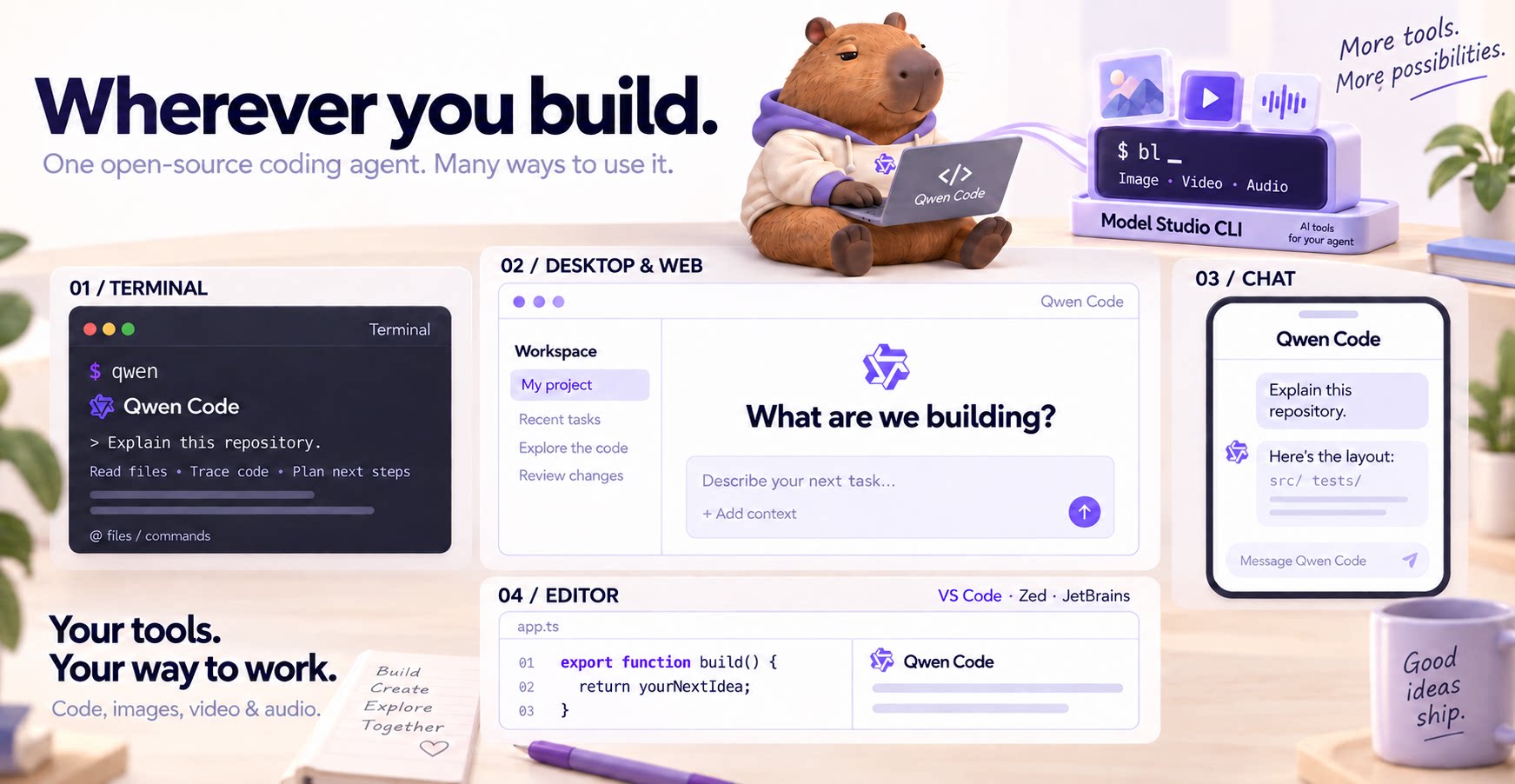
The open-source AI coding agent for your terminal, editor, desktop, browser, and chat.
中文 | Deutsch | français | 日本語 | Русский | Português (Brasil) | 한국어
Why Qwen Code?
- Agentic out of the box — Auto-Memory, Auto-Skills, SubAgents, Agent Teams, and MCP. Dynamic workflows, zero setup.
- Open-source, inside and out — The framework and the Qwen models are open-source. They evolve together. No vendor lock-in.
- Multi-protocol — Supports OpenAI, Anthropic, Gemini, and Qwen APIs. Any third-party provider or local model (Ollama / vLLM). Switch at runtime.
- Beyond the terminal — IDE plugins, Desktop app, Web UI, SDKs, and chat integrations (Telegram / DingTalk / WeChat / Feishu).
Tip
Qwen Code is actively iterating on itself — using its own agent and models to file issues, submit PRs, review code, and run tests. Powered by the community, driven by AI.
Installation
Linux / macOS:
curl -fsSL https://qwen-code-assets.oss-cn-hangzhou.aliyuncs.com/installation/install-qwen-standalone.sh | bash
Windows:
irm https://qwen-code-assets.oss-cn-hangzhou.aliyuncs.com/installation/install-qwen-standalone.ps1 | iex
Restart your terminal after installation to ensure environment variables take effect.
NPM / Homebrew
NPM (requires Node.js 22+):
npm install -g @qwen-code/qwen-code@latest
Homebrew (macOS / Linux):
brew install qwen-code
Quick Start
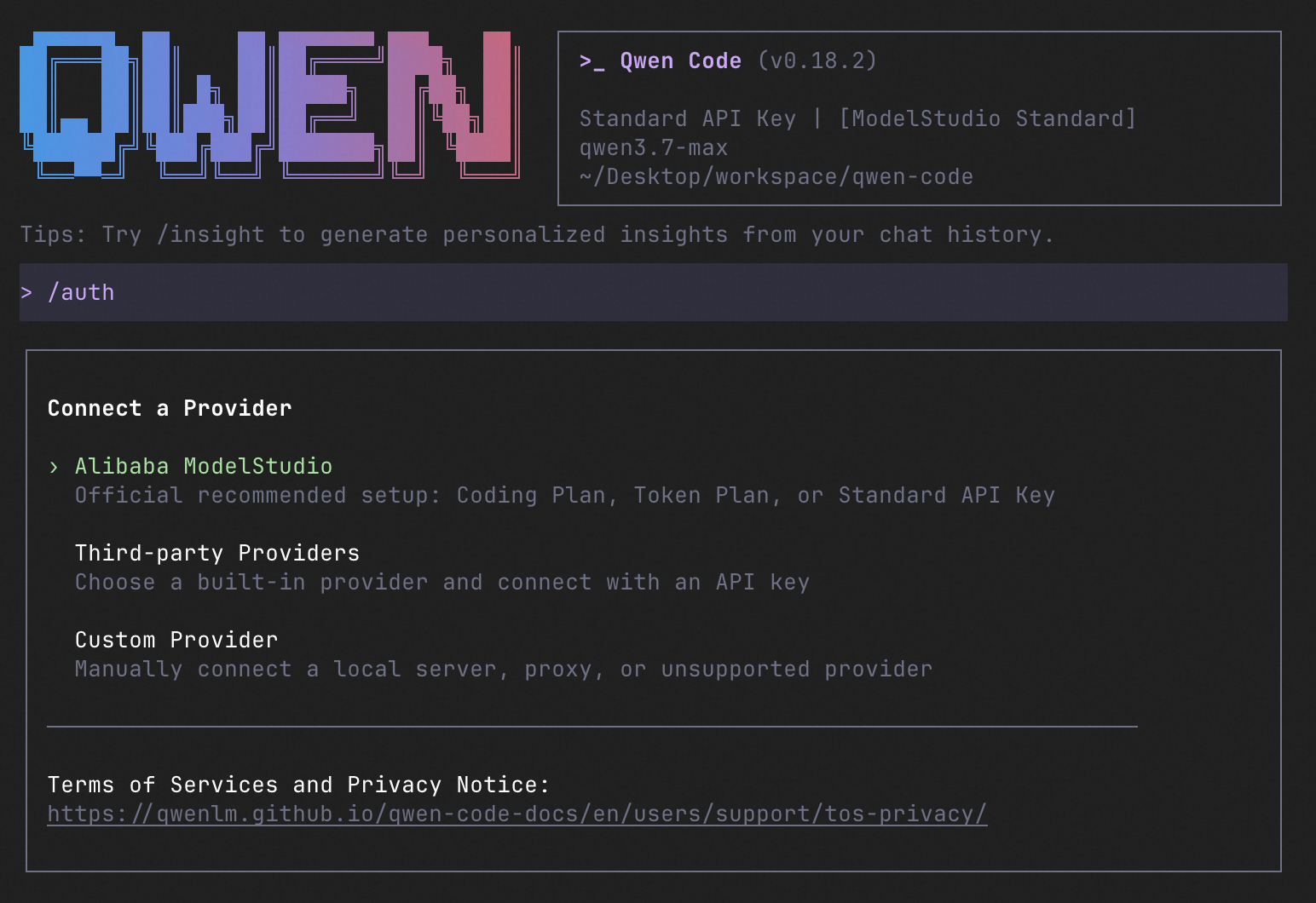
Open a terminal in your project and start Qwen Code:
cd /path/to/your-project
qwen
Inside the session, run /auth and choose Qwen Account with Subscription to sign in with your Plus or Pro subscription, or configure a provider with an API key. Then try:
Explain this repository and show me where to start.
See the Authentication Guide and Settings Reference for detailed setup.
See the terminal interface
How to Use Qwen Code
Choose the interface that fits your workflow:
| Interface | Get started |
|---|---|
| Terminal | Run qwen in your project — see Quick Start. |
| Desktop | Download Qwen Code Desktop for macOS, Windows, and Linux. |
| Web | Run qwen serve --open to open the Web UI in your browser. (experimental) |
| Editor | Set up VS Code, Zed, or JetBrains. |
| Chat | Connect Telegram, DingTalk, WeChat, or Feishu, then run qwen channel start. |
For automation and custom integrations:
- Headless — Run
qwen -p "..."in scripts, CI/CD, or batch jobs. - SDKs — Build with TypeScript, Python, or Java.
- Daemon — Run
qwen serveto connect clients over HTTP + SSE (ACP). (experimental) Daemon guide. - Computer Use — Set up native MCP tools or Node REPL + SDK in Qwen Code, Claude Code, or Codex.
SDK example (Python)
import asyncio

from qwen_code_sdk import is_sdk_result_message, query


async def main() -> None:
    result = query(
        "Summarize the repository layout.",
        {
            "cwd": "/path/to/project",
            "path_to_qwen_executable": "qwen",
        },
    )

    async for message in result:
        if is_sdk_result_message(message):
            print(message["result"])


asyncio.run(main())
Daemon Mode
Run Qwen Code as a long-lived service when you want browser, editor, SDK, and automation clients to share agent sessions without each starting a separate process. The daemon provides the built-in Web Shell and an HTTP + SSE API, supports multiple workspaces, and lets clients reconnect to active sessions.
Start it in the foreground and open the Web Shell:
qwen serve --open
The default address is http://127.0.0.1:4170. To run and manage it in the background instead:
qwen daemon start
qwen daemon status
qwen daemon logs -f
qwen daemon stop
By default, the daemon listens on loopback without bearer authentication; any local process that can reach it can use the full API, including code execution. On shared or untrusted hosts, set QWEN_SERVER_TOKEN and use --require-auth. See the Daemon guide for workspaces, authentication, remote access, and the API.
Capabilities
If you know Claude Code, you already know Qwen Code — and then some. We've put significant effort into bringing Qwen Code to feature parity with Claude Code, improving both breadth and reliability across the board.
| Feature | Qwen Code | Claude Code |
|---|---|---|
| SubAgents, Agent Teams, Dynamic Workflows | ✓ | ✓ |
| Auto-Memory, Auto-Skills, Hooks | ✓ | ✓ |
| Built-in Skills (/review, /batch, /loop, /bugfix…) | ✓ | ✓ |
| MCP, Plan Mode, LSP Integration | ✓ | ✓ |
| Auto Mode, Sandbox, Git Worktrees | ✓ | ✓ |
| Computer Use (desktop automation) | ✓ | ✓ |
| IDE Plugins (VS Code / JetBrains / Zed) | ✓ | ✓ |
| SDK | ✓ | ✓ |
| Headless Mode, Session Management | ✓ | ✓ |
| Open-source — model and framework | ✓ | — |
| Multi-protocol (OpenAI / Anthropic / Gemini / Qwen + any provider) | ✓ | — |
| Agent Arena (multi-model head-to-head on same task) | ✓ | — |
Daemon Mode — qwen serve (multi-client shared agent) |
✓ | — |
| IM Channels (Telegram / DingTalk / WeChat / Feishu) | ✓ | — |
Qwen Code Evaluation
On SWE-bench Verified, seven Qwen Code versions scored 76.40%–77.80% on average using the same Qwen 3.7 Max model (500 tasks, three trials per version).

Full results and evaluation configuration →
Ecosystem
-
Qwen Code Desktop — Official desktop app for macOS, Windows, and Linux
-
AionUi — A modern GUI for command-line AI tools including Qwen Code
-
Gemini CLI Desktop — A cross-platform desktop/web/mobile UI for Qwen Code
-
qwen-audio-agent — Realtime full-duplex voice frontend for Qwen Code over ACP — talk hands-free with barge-in and a local wake word
-
🦞 Qwen Code Claw — Let other agents (Claude, Codex, etc.) delegate coding tasks to Qwen Code via ACP. Paste this prompt into your agent:
Use Qwen Code as a coding agent. First, fetch and read this skill reference:
https://raw.githubusercontent.com/QwenLM/qwen-code/refs/heads/main/.qwen/skills/qwen-code-claw/SKILL.md
Then follow the instructions inside to install, authenticate, and use Qwen Code via acpx for all coding tasks.
- Aliyun Model Studio CLI — Official CLI for Aliyun's AI platform (
bailian-cli). Extends Qwen Code with image/video generation, knowledge retrieval, app orchestration, and model deployment
Privacy
See the Terms of Service and Privacy Notice, including Chrome extension and Browser Use data handling.
Contributing
Contributions are welcome! See CONTRIBUTING.md for guidelines.
Acknowledgments
This project was originally based on Google Gemini CLI v0.8.2. We gratefully acknowledge the Gemini CLI team's excellent work. Starting from Qwen Code v0.1, we stopped syncing with upstream and began independent development as a multi-protocol, multi-platform agent framework with deep integrations for Qwen models and beyond.