Compare commits
| Author | SHA1 | Date | |
|---|---|---|---|
 Brandon |
2f299dd1a1 | ||
|
Brandon
|
7e1072d6a9 |
No files matched your search
@@ -2,7 +2,7 @@ pkgbase = rustscan-bin
|
||||
pkgdesc = Faster Nmap Scanning with Rust
|
||||
pkgver = 1.1.0
|
||||
pkgrel = 1
|
||||
url = https://github.com/rustscan/rustscan
|
||||
url = https://github.com/brandonskerritt/rustscan
|
||||
arch = x86_64
|
||||
license = MIT
|
||||
depends = rustup
|
||||
|
||||
@@ -162,9 +162,7 @@
|
||||
"avatar_url": "https://avatars0.githubusercontent.com/u/47574893?v=4",
|
||||
"profile": "https://github.com/niklasmohrin",
|
||||
"contributions": [
|
||||
"doc",
|
||||
"code",
|
||||
"bug"
|
||||
"doc"
|
||||
]
|
||||
},
|
||||
{
|
||||
@@ -195,70 +193,6 @@
|
||||
"bug",
|
||||
"design"
|
||||
]
|
||||
},
|
||||
{
|
||||
"login": "dmitris",
|
||||
"name": "Dmitry Savintsev",
|
||||
"avatar_url": "https://avatars0.githubusercontent.com/u/31205?v=4",
|
||||
"profile": "https://github.com/dmitris",
|
||||
"contributions": [
|
||||
"code"
|
||||
]
|
||||
},
|
||||
{
|
||||
"login": "bofh69",
|
||||
"name": "Sebastian Andersson",
|
||||
"avatar_url": "https://avatars3.githubusercontent.com/u/1444315?v=4",
|
||||
"profile": "https://github.com/bofh69",
|
||||
"contributions": [
|
||||
"code"
|
||||
]
|
||||
},
|
||||
{
|
||||
"login": "mattcorbin",
|
||||
"name": "Matt Corbin",
|
||||
"avatar_url": "https://avatars3.githubusercontent.com/u/6537765?v=4",
|
||||
"profile": "https://github.com/mattcorbin",
|
||||
"contributions": [
|
||||
"code"
|
||||
]
|
||||
},
|
||||
{
|
||||
"login": "rootsploit",
|
||||
"name": "RootSploit",
|
||||
"avatar_url": "https://avatars2.githubusercontent.com/u/67270834?v=4",
|
||||
"profile": "http://rootsploit.com",
|
||||
"contributions": [
|
||||
"blog"
|
||||
]
|
||||
},
|
||||
{
|
||||
"login": "eiffel-fl",
|
||||
"name": "eiffel-fl",
|
||||
"avatar_url": "https://avatars2.githubusercontent.com/u/12171754?v=4",
|
||||
"profile": "https://github.com/eiffel-fl",
|
||||
"contributions": [
|
||||
"code"
|
||||
]
|
||||
},
|
||||
{
|
||||
"login": "u5surf",
|
||||
"name": "Y.Horie",
|
||||
"avatar_url": "https://avatars1.githubusercontent.com/u/14180225?v=4",
|
||||
"profile": "https://github.com/u5surf",
|
||||
"contributions": [
|
||||
"code"
|
||||
]
|
||||
},
|
||||
{
|
||||
"login": "okrplay",
|
||||
"name": "Oskar",
|
||||
"avatar_url": "https://avatars3.githubusercontent.com/u/32576280?v=4",
|
||||
"profile": "https://github.com/okrplay",
|
||||
"contributions": [
|
||||
"code",
|
||||
"test"
|
||||
]
|
||||
}
|
||||
],
|
||||
"contributorsPerLine": 7,
|
||||
|
||||
@@ -1 +1,4 @@
|
||||
github: bee-san
|
||||
patreon: brandonskerritt
|
||||
ko_fi: hacker
|
||||
custom: ["https://monzo.me/bee", "https://paypal.me/brandonskerritt"]
|
||||
@@ -1,29 +0,0 @@
|
||||
version: 2
|
||||
updates:
|
||||
- package-ecosystem: "github-actions"
|
||||
directory: "/"
|
||||
schedule:
|
||||
interval: "daily"
|
||||
- package-ecosystem: "docker"
|
||||
directory: "/"
|
||||
schedule:
|
||||
interval: "daily"
|
||||
- package-ecosystem: cargo
|
||||
directory: "/"
|
||||
schedule:
|
||||
interval: daily
|
||||
open-pull-requests-limit: 10
|
||||
ignore:
|
||||
- dependency-name: anyhow
|
||||
versions:
|
||||
- 1.0.38
|
||||
- 1.0.39
|
||||
- dependency-name: serde
|
||||
versions:
|
||||
- 1.0.123
|
||||
- dependency-name: futures
|
||||
versions:
|
||||
- 0.3.12
|
||||
- dependency-name: rlimit
|
||||
versions:
|
||||
- 0.5.3
|
||||
@@ -0,0 +1,10 @@
|
||||
name: Check Markdown links
|
||||
|
||||
on: push
|
||||
|
||||
jobs:
|
||||
markdown-link-check:
|
||||
runs-on: ubuntu-latest
|
||||
steps:
|
||||
- uses: actions/checkout@master
|
||||
- uses: gaurav-nelson/github-action-markdown-link-check@v1
|
||||
@@ -0,0 +1,55 @@
|
||||
on: [push, pull_request]
|
||||
|
||||
name: Continuous integration
|
||||
|
||||
jobs:
|
||||
check:
|
||||
name: Check
|
||||
runs-on: ubuntu-latest
|
||||
steps:
|
||||
- uses: actions/checkout@v2
|
||||
- uses: actions-rs/toolchain@v1
|
||||
with:
|
||||
profile: minimal
|
||||
toolchain: stable
|
||||
override: true
|
||||
- uses: actions-rs/cargo@v1
|
||||
with:
|
||||
command: check
|
||||
|
||||
test:
|
||||
name: Test Suite
|
||||
runs-on: ubuntu-latest
|
||||
steps:
|
||||
- uses: actions/checkout@v2
|
||||
- uses: actions-rs/toolchain@v1
|
||||
with:
|
||||
profile: minimal
|
||||
toolchain: stable
|
||||
override: true
|
||||
- uses: actions-rs/cargo@v1
|
||||
with:
|
||||
command: test
|
||||
|
||||
fmt:
|
||||
name: Rustfmt
|
||||
runs-on: ubuntu-latest
|
||||
steps:
|
||||
- uses: actions/checkout@v2
|
||||
- uses: actions-rs/toolchain@v1
|
||||
with:
|
||||
profile: minimal
|
||||
toolchain: stable
|
||||
override: true
|
||||
- run: rustup component add rustfmt
|
||||
- uses: actions-rs/cargo@v1
|
||||
with:
|
||||
command: fmt
|
||||
args: --all -- --check
|
||||
|
||||
links:
|
||||
name: markdown-link-check
|
||||
runs-on: ubuntu-latest
|
||||
steps:
|
||||
- uses: actions/checkout@master
|
||||
- uses: gaurav-nelson/github-action-markdown-link-check@v1
|
||||
@@ -1,92 +0,0 @@
|
||||
name: Build
|
||||
on:
|
||||
pull_request:
|
||||
push:
|
||||
branches:
|
||||
- master
|
||||
schedule:
|
||||
- cron: '00 01 * * *'
|
||||
|
||||
jobs:
|
||||
check:
|
||||
name: Check
|
||||
runs-on: ubuntu-latest
|
||||
steps:
|
||||
- name: Checkout sources
|
||||
uses: actions/checkout@v4
|
||||
|
||||
- name: Install stable toolchain
|
||||
uses: actions-rs/toolchain@v1
|
||||
with:
|
||||
profile: minimal
|
||||
toolchain: stable
|
||||
override: true
|
||||
|
||||
- uses: Swatinem/rust-cache@v2
|
||||
|
||||
- name: Run cargo check
|
||||
uses: actions-rs/cargo@v1
|
||||
with:
|
||||
command: check
|
||||
|
||||
test:
|
||||
name: Test Suite
|
||||
strategy:
|
||||
matrix:
|
||||
os: [ubuntu-latest, macos-latest, windows-latest]
|
||||
rust: [stable]
|
||||
runs-on: ${{ matrix.os }}
|
||||
steps:
|
||||
- name: Checkout sources
|
||||
uses: actions/checkout@v4
|
||||
|
||||
- name: Install stable toolchain
|
||||
uses: actions-rs/toolchain@v1
|
||||
with:
|
||||
profile: minimal
|
||||
toolchain: ${{ matrix.rust }}
|
||||
override: true
|
||||
|
||||
- uses: Swatinem/rust-cache@v2
|
||||
|
||||
- name: Run cargo test
|
||||
uses: actions-rs/cargo@v1
|
||||
with:
|
||||
command: test
|
||||
|
||||
lints:
|
||||
name: Lints
|
||||
runs-on: ubuntu-latest
|
||||
steps:
|
||||
- name: Checkout sources
|
||||
uses: actions/checkout@v4
|
||||
with:
|
||||
submodules: true
|
||||
|
||||
- name: Install stable toolchain
|
||||
uses: actions-rs/toolchain@v1
|
||||
with:
|
||||
profile: minimal
|
||||
toolchain: stable
|
||||
override: true
|
||||
components: rustfmt, clippy
|
||||
|
||||
- uses: Swatinem/rust-cache@v2
|
||||
|
||||
- name: Run cargo fmt
|
||||
uses: actions-rs/cargo@v1
|
||||
with:
|
||||
command: fmt
|
||||
args: --all -- --check
|
||||
|
||||
- name: Run cargo clippy
|
||||
uses: actions-rs/cargo@v1
|
||||
with:
|
||||
command: clippy
|
||||
args: -- -D warnings
|
||||
|
||||
- name: Run rustdoc lints
|
||||
uses: actions-rs/cargo@v1
|
||||
with:
|
||||
command: doc
|
||||
args: --workspace --all-features --no-deps --document-private-items
|
||||
@@ -1,38 +0,0 @@
|
||||
name: Publish Docker image
|
||||
|
||||
on:
|
||||
push:
|
||||
tags:
|
||||
- '[0-9]+.[0-9]+.[0-9]+'
|
||||
release:
|
||||
types: [published]
|
||||
|
||||
jobs:
|
||||
push_to_registry:
|
||||
name: Push Docker image to Docker Hub
|
||||
runs-on: ubuntu-latest
|
||||
steps:
|
||||
- name: Check out the repo
|
||||
uses: actions/checkout@v4
|
||||
|
||||
- name: Log in to Docker Hub
|
||||
if: github.event_name != 'pull_request'
|
||||
uses: docker/login-action@v3
|
||||
with:
|
||||
password: ${{ secrets.DOCKERHUB_USERNAME }}
|
||||
username: ${{ secrets.DOCKERHUB_TOKEN }}
|
||||
|
||||
- name: Extract metadata (tags, labels) for Docker
|
||||
id: meta
|
||||
uses: docker/metadata-action@v5
|
||||
with:
|
||||
images: rustscan/rustscan
|
||||
flavor: latest=true
|
||||
|
||||
- name: Build and push Docker image
|
||||
uses: docker/build-push-action@v5
|
||||
with:
|
||||
context: .
|
||||
push: ${{ contains(fromJson('["push", "release"]'), github.event_name) }} # Publish to docker registry only on push event or new release.
|
||||
tags: ${{ steps.meta.outputs.tags }}
|
||||
labels: ${{ steps.meta.outputs.labels }}
|
||||
@@ -16,4 +16,3 @@ jobs:
|
||||
- uses: gaurav-nelson/github-action-markdown-link-check@v1
|
||||
with:
|
||||
use-quiet-mode: 'yes'
|
||||
config-file: './.github/workflows/mlc_config.json'
|
||||
@@ -1,14 +0,0 @@
|
||||
{
|
||||
"_comment": "Config for markdown-link-check. Resolves issue #540.",
|
||||
"ignorePatterns": [
|
||||
{
|
||||
"pattern": "^https://github.com/RustScan/RustScan/workflows/Continuous%20integration/badge.svg"
|
||||
},
|
||||
{
|
||||
"pattern": "^https://crates.io/crates/rustscan/"
|
||||
},
|
||||
{
|
||||
"pattern": "^https://bees.substack.com/p/making-hacking-accessible"
|
||||
}
|
||||
]
|
||||
}
|
||||
@@ -1,245 +0,0 @@
|
||||
name: Release
|
||||
on:
|
||||
push:
|
||||
tags:
|
||||
- '[0-9]+.[0-9]+.[0-9]+'
|
||||
pull_request:
|
||||
branches:
|
||||
- master
|
||||
paths:
|
||||
- 'Cargo.toml'
|
||||
- 'Cargo.lock'
|
||||
- '.github/workflows/release.yml'
|
||||
|
||||
env:
|
||||
BIN_NAME: rustscan
|
||||
PROJECT_NAME: rustscan
|
||||
REPO_NAME: RustScan/RustScan
|
||||
# BREW_TAP: RustScan/homebrew-tap
|
||||
|
||||
jobs:
|
||||
dist:
|
||||
name: Dist
|
||||
runs-on: ${{ matrix.os }}
|
||||
strategy:
|
||||
fail-fast: false # don't fail other jobs if one fails
|
||||
matrix:
|
||||
build: [x86_64-linux, x86_64-macos, x86_64-windows] #, x86_64-win-gnu, win32-msvc
|
||||
include:
|
||||
- build: x86_64-linux
|
||||
os: ubuntu-20.04
|
||||
rust: stable
|
||||
target: x86_64-unknown-linux-gnu
|
||||
cross: false
|
||||
- build: x86_64-macos
|
||||
os: macos-latest
|
||||
rust: stable
|
||||
target: x86_64-apple-darwin
|
||||
cross: false
|
||||
- build: x86_64-windows
|
||||
os: windows-2019
|
||||
rust: stable
|
||||
target: x86_64-pc-windows-msvc
|
||||
cross: false
|
||||
# - build: aarch64-linux
|
||||
# os: ubuntu-20.04
|
||||
# rust: stable
|
||||
# target: aarch64-unknown-linux-gnu
|
||||
# - build: aarch64-macos
|
||||
# os: macos-latest
|
||||
# rust: stable
|
||||
# target: aarch64-apple-darwin
|
||||
# - build: x86_64-win-gnu
|
||||
# os: windows-2019
|
||||
# rust: stable-x86_64-gnu
|
||||
# target: x86_64-pc-windows-gnu
|
||||
# - build: win32-msvc
|
||||
# os: windows-2019
|
||||
# rust: stable
|
||||
# target: i686-pc-windows-msvc
|
||||
|
||||
steps:
|
||||
- name: Set Git config. (windows only)
|
||||
if: contains(matrix.build, 'windows') # Windows is missing some dependencies
|
||||
run: |
|
||||
git config --global pack.windowMemory "100m"
|
||||
git config --global pack.packSizeLimit "100m"
|
||||
git config --global pack.threads "1"
|
||||
git config --global pack.deltaCacheSize "512m"
|
||||
|
||||
- name: Install python 3.10 for windows
|
||||
if: contains(matrix.build, 'windows') # Windows is missing some dependencies
|
||||
uses: actions/setup-python@v5
|
||||
with:
|
||||
python-version: '3.10'
|
||||
|
||||
- name: Checkout sources
|
||||
uses: actions/checkout@v4
|
||||
with:
|
||||
submodules: true
|
||||
|
||||
- name: Install ${{ matrix.rust }} toolchain
|
||||
uses: actions-rs/toolchain@v1
|
||||
with:
|
||||
profile: minimal
|
||||
toolchain: ${{ matrix.rust }}
|
||||
target: ${{ matrix.target }}
|
||||
override: true
|
||||
|
||||
- name: Run cargo test
|
||||
uses: actions-rs/cargo@v1
|
||||
with:
|
||||
use-cross: ${{ matrix.cross }}
|
||||
command: test
|
||||
args: --release --locked --target ${{ matrix.target }}
|
||||
|
||||
- name: Build release binary
|
||||
uses: actions-rs/cargo@v1
|
||||
with:
|
||||
use-cross: ${{ matrix.cross }}
|
||||
command: build
|
||||
args: --release --locked --target ${{ matrix.target }}
|
||||
|
||||
- name: Calculate tag name
|
||||
if: contains(matrix.build, 'linux')
|
||||
run: |
|
||||
name=dev
|
||||
if [[ ${GITHUB_REF} =~ refs/tags/[0-9]+.[0-9]+.[0-9]+ ]]; then
|
||||
name=${GITHUB_REF#refs/tags/}
|
||||
fi
|
||||
echo ::set-output name=val::$name
|
||||
echo TAG=$name >> $GITHUB_ENV
|
||||
id: tagname
|
||||
|
||||
- name: Build deb package (linux only)
|
||||
if: contains(matrix.build, 'linux')
|
||||
run: |
|
||||
cargo install cargo-deb
|
||||
cargo deb --target ${{ matrix.target }} --deb-version ${TAG}
|
||||
|
||||
- name: Build archive
|
||||
shell: bash
|
||||
run: |
|
||||
mkdir dist
|
||||
if [[ "${{ matrix.build }}" =~ "windows" ]]; then
|
||||
cp "target/${{ matrix.target }}/release/$BIN_NAME.exe" "dist/"
|
||||
else
|
||||
cp "target/${{ matrix.target }}/release/$BIN_NAME" "dist/"
|
||||
fi
|
||||
|
||||
if [[ "${{ matrix.build }}" =~ "linux" ]]; then
|
||||
cp "target/${{ matrix.target }}/debian/rustscan_${TAG}_amd64.deb" "dist/"
|
||||
fi
|
||||
- uses: actions/[email protected]
|
||||
with:
|
||||
name: bins-${{ matrix.build }}
|
||||
path: dist
|
||||
|
||||
publish:
|
||||
name: Publish
|
||||
needs: [dist]
|
||||
if: contains(fromJson('["push", "schedule"]'), github.event_name) && startsWith(github.ref, 'refs/tags/')
|
||||
runs-on: ubuntu-latest
|
||||
steps:
|
||||
- name: Checkout sources
|
||||
uses: actions/checkout@v4
|
||||
with:
|
||||
submodules: false
|
||||
|
||||
- uses: actions/download-artifact@v4
|
||||
# with:
|
||||
# path: dist
|
||||
# - run: ls -al ./dist
|
||||
- run: ls -al bins-*
|
||||
|
||||
- name: Calculate tag name
|
||||
run: |
|
||||
name=dev
|
||||
if [[ ${GITHUB_REF} =~ refs/tags/[0-9]+.[0-9]+.[0-9]+ ]]; then
|
||||
name=${GITHUB_REF#refs/tags/}
|
||||
fi
|
||||
echo ::set-output name=val::$name
|
||||
echo TAG=$name >> $GITHUB_ENV
|
||||
id: tagname
|
||||
|
||||
- name: Build archive
|
||||
shell: bash
|
||||
run: |
|
||||
set -ex
|
||||
rm -rf tmp
|
||||
mkdir tmp
|
||||
mkdir dist
|
||||
for dir in bins-* ; do
|
||||
platform=${dir#"bins-"}
|
||||
unset exe
|
||||
if [[ $platform =~ "windows" ]]; then
|
||||
exe=".exe"
|
||||
fi
|
||||
pkgname=$PROJECT_NAME-$TAG-$platform
|
||||
mkdir tmp/$pkgname
|
||||
# cp LICENSE README.md tmp/$pkgname
|
||||
mv bins-$platform/$BIN_NAME$exe tmp/$pkgname
|
||||
chmod +x tmp/$pkgname/$BIN_NAME$exe
|
||||
|
||||
if [[ $platform =~ "linux" ]]; then
|
||||
mv "bins-$platform/rustscan_${TAG}_amd64.deb" dist/
|
||||
fi
|
||||
|
||||
if [ "$exe" = "" ]; then
|
||||
tar cJf dist/$pkgname.tar.xz -C tmp $pkgname
|
||||
else
|
||||
(cd tmp && 7z a -r ../dist/$pkgname.zip $pkgname)
|
||||
fi
|
||||
done
|
||||
|
||||
- name: Upload binaries to release
|
||||
uses: svenstaro/upload-release-action@v2
|
||||
with:
|
||||
repo_token: ${{ secrets.GITHUB_TOKEN }}
|
||||
file: dist/*
|
||||
file_glob: true
|
||||
tag: ${{ steps.tagname.outputs.val }}
|
||||
overwrite: true
|
||||
|
||||
- name: Extract version
|
||||
id: extract-version
|
||||
run: |
|
||||
printf "::set-output name=%s::%s\n" tag-name "${GITHUB_REF#refs/tags/}"
|
||||
- uses: mislav/bump-homebrew-formula-action@v3
|
||||
with:
|
||||
formula-path: ${{env.PROJECT_NAME}}.rb
|
||||
homebrew-tap: ${{ env.BREW_TAP }}
|
||||
download-url: 'https://github.com/${{ env.REPO_NAME }}/releases/download/${{ steps.extract-version.outputs.tag-name }}/${{env.PROJECT_NAME}}-${{ steps.extract-version.outputs.tag-name }}-x86_64-macos.tar.xz'
|
||||
commit-message: updating formula for ${{ env.PROJECT_NAME }}
|
||||
env:
|
||||
COMMITTER_TOKEN: ${{ secrets.COMMITTER_TOKEN }}
|
||||
#
|
||||
# you can use this initial file in your homebrew-tap if you don't have an initial formula:
|
||||
# <projectname>.rb
|
||||
#
|
||||
# class <Projectname capitalized> < Formula
|
||||
# desc "A test formula"
|
||||
# homepage "http://www.example.com"
|
||||
# url "-----"
|
||||
# version "-----"
|
||||
# sha256 "-----"
|
||||
|
||||
# def install
|
||||
# bin.install "<bin-name>"
|
||||
# end
|
||||
# end
|
||||
|
||||
# Uncomment this section if you want to release your package to crates.io
|
||||
# Before publishing, make sure you have filled out the following fields:
|
||||
# license or license-file, description, homepage, documentation, repository, readme.
|
||||
# Read more: https://doc.rust-lang.org/cargo/reference/publishing.html
|
||||
|
||||
- name: Install ${{ matrix.rust }} toolchain
|
||||
uses: actions-rs/toolchain@v1
|
||||
with:
|
||||
profile: minimal
|
||||
toolchain: ${{ matrix.rust }}
|
||||
target: ${{ matrix.target }}
|
||||
- run: cargo publish --token ${CRATES_TOKEN}
|
||||
env:
|
||||
CRATES_TOKEN: ${{ secrets.CRATES_TOKEN }}
|
||||
@@ -118,7 +118,6 @@ fabric.properties
|
||||
.idea/caches/build_file_checksums.ser
|
||||
|
||||
.idea/*
|
||||
.idea
|
||||
.idea*
|
||||
.idea
|
||||
|
||||
settings.json
|
||||
@@ -17,7 +17,6 @@ jobs:
|
||||
script:
|
||||
- cargo build
|
||||
- cargo test
|
||||
- "ulimit -n 5000; cargo test timelimits:: -- --ignored --test-threads=1 --show-output"
|
||||
- cargo fmt -- --check
|
||||
after_failure:
|
||||
- wget https://raw.githubusercontent.com/DiscordHooks/travis-ci-discord-webhook/master/send.sh
|
||||
|
||||
@@ -1,7 +1,7 @@
|
||||
[package]
|
||||
name = "rustscan"
|
||||
version = "2.2.2"
|
||||
authors = ["Autumn <autum[email protected]>"]
|
||||
version = "1.9.0"
|
||||
authors = ["Bee <brando[email protected]>"]
|
||||
edition = "2018"
|
||||
description = "Faster Nmap Scanning with Rust"
|
||||
homepage = "https://github.com/rustscan/rustscan"
|
||||
@@ -17,30 +17,24 @@ exclude = [
|
||||
]
|
||||
|
||||
[dependencies]
|
||||
colored = "2.1.0"
|
||||
structopt = "0.3.20"
|
||||
async-std = "1.7.0"
|
||||
colored = "2.0.0"
|
||||
structopt = "0.3.17"
|
||||
async-std = "1.6.4"
|
||||
futures = "0.3"
|
||||
rlimit = "0.8.3"
|
||||
rlimit = "0.4.0"
|
||||
shell-words = "1.0.0"
|
||||
log = "0.4.0"
|
||||
env_logger = "0.8.2"
|
||||
env_logger = "0.7.1"
|
||||
dirs = "3.0.1"
|
||||
gcd = "2.0.1"
|
||||
rand = "0.7.3"
|
||||
colorful = "0.2.1"
|
||||
ansi_term = "0.12.1"
|
||||
toml = "0.5.7"
|
||||
serde = "1.0.124"
|
||||
toml = "0.5.6"
|
||||
serde = "1.0.116"
|
||||
serde_derive = "1.0.116"
|
||||
cidr-utils = "0.5.1"
|
||||
cidr-utils = "0.5.0"
|
||||
itertools = "0.9.0"
|
||||
trust-dns-resolver = { version = "0.23.2", features = ["dns-over-rustls"] }
|
||||
anyhow = "1.0.40"
|
||||
subprocess = "0.2.6"
|
||||
text_placeholder = { version = "0.5", features = ["struct_context"] }
|
||||
|
||||
[dev-dependencies]
|
||||
wait-timeout = "0.2"
|
||||
|
||||
[package.metadata.deb]
|
||||
depends = "$auto, nmap"
|
||||
@@ -49,9 +43,3 @@ section = "rust"
|
||||
[profile.release]
|
||||
lto = true
|
||||
panic = 'abort'
|
||||
strip = true
|
||||
|
||||
# See more keys and their definitions at https://doc.rust-lang.org/cargo/reference/manifest.html
|
||||
[[bin]]
|
||||
name = "rustscan"
|
||||
path = "src/main.rs"
|
||||
@@ -1,25 +1,16 @@
|
||||
# Build Stage
|
||||
FROM rust:alpine as builder
|
||||
LABEL maintainer="RustScan <https://github.com/RustScan>"
|
||||
RUN apk add --no-cache build-base
|
||||
|
||||
# Encourage some layer caching here rather then copying entire directory that includes docs to builder container ~CMN
|
||||
WORKDIR /app/rustscan
|
||||
COPY Cargo.toml Cargo.lock ./
|
||||
COPY src/ src/
|
||||
RUN cargo build --release
|
||||
WORKDIR /usr/src/rustscan
|
||||
COPY . .
|
||||
RUN cargo install --path .
|
||||
|
||||
# Release Stage
|
||||
FROM alpine:3.19.1 as release
|
||||
FROM alpine:3.12
|
||||
LABEL author="Hydragyrum <https://github.com/Hydragyrum>"
|
||||
LABEL author="LeoFVO <https://github.com/LeoFVO>"
|
||||
|
||||
RUN addgroup -S rustscan && \
|
||||
adduser -S -G rustscan rustscan && \
|
||||
ulimit -n 100000 && \
|
||||
apk add --no-cache nmap nmap-scripts wget ca-certificates bind-tools
|
||||
|
||||
apk add --no-cache nmap nmap-scripts wget
|
||||
COPY --from=builder /usr/local/cargo/bin/rustscan /usr/local/bin/rustscan
|
||||
USER rustscan
|
||||
COPY --from=builder /app/rustscan/target/release/rustscan /usr/local/bin/rustscan
|
||||
|
||||
ENTRYPOINT [ "/usr/local/bin/rustscan" ]
|
||||
@@ -10,12 +10,12 @@ build:
|
||||
build-linux:
|
||||
@echo 'Building for Linux... 🐧'
|
||||
cross build --release --target=x86_64-unknown-linux-musl
|
||||
mkdir -p target/release-archives && tar -C target/x86_64-unknown-linux-musl/release -czf target/release-archives/rustscan-linux.tar.gz rustscan
|
||||
mkdir -p target/release-archives && tar -czf target/release-archives/rustscan-linux.tar.gz target/x86_64-unknown-linux-musl/release/rustscan
|
||||
|
||||
build-mac:
|
||||
@echo 'Building for MacOS... 🍏'
|
||||
cross build --release --target=x86_64-apple-darwin
|
||||
mkdir -p target/release-archives && tar -C target/x86_64-apple-darwin/release -czf target/release-archives/rustscan-mac.tar.gz rustscan
|
||||
mkdir -p target/release-archives && tar -czf target/release-archives/rustscan-mac.tar.gz target/x86_64-apple-darwin/release/rustscan
|
||||
|
||||
shasum:
|
||||
shasum -a 256 target/release-archives/rustscan-*.tar.gz
|
||||
@@ -1,141 +1,433 @@
|
||||
<div align="center" markdown="1">
|
||||
|
||||
➡️ [Discord][discord] | [Installation Guide][toc-install] | [Usage Guide][usage-guide] ⬅️
|
||||
|
||||
<p align="center">
|
||||
➡️
|
||||
<a href="https://discord.gg/GFrQsGy">Discord</a> |
|
||||
<a href="https://github.com/RustScan/RustScan#-full-installation-guide">Installation Guide</a> |
|
||||
<a href="https://github.com/RustScan/RustScan#-usage">Usage Guide</a>
|
||||
⬅️
|
||||
<br>
|
||||
<img src="pictures/rustscan.png" height=400px width=400px>
|
||||
</p>
|
||||
<p align="center">
|
||||
<u><b> Turns a 17 minutes Nmap scan into 19 seconds. </b></u><br> Find all open ports <b>fast</b> with RustScan, automatically pipe them into Nmap.
|
||||
</p>
|
||||
<p align="center">
|
||||
<img alt="AUR version" src="https://img.shields.io/aur/version/rustscan">
|
||||
<img src="https://img.shields.io/badge/Built%20with-Rust-Purple">
|
||||
<img alt="GitHub commit activity" src="https://img.shields.io/github/commit-activity/w/Rustscan/Rustscan">
|
||||
<img alt="GitHub All Releases" src="https://img.shields.io/github/downloads/rustscan/rustscan/total?label=GitHub%20Downloads">
|
||||
<img alt="Crates.io" src="https://img.shields.io/crates/d/rustscan?label=Cargo%20Downloads">
|
||||
<img alt="Discord" src="https://img.shields.io/discord/736614461313515576">
|
||||
<img alt="Actions" src="https://github.com/RustScan/RustScan/workflows/Continuous%20integration/badge.svg?branch=master">
|
||||
</p>
|
||||
<hr>
|
||||
|
||||
<!--<u>**The Modern Port Scanner.**</u>-->
|
||||
**Fast, smart, effective.**
|
||||
| <p align="center"><a href="https://hub.docker.com/r/cmnatic/rustscan">🐋 Docker (Recommended) </a></p> | <p align="center"><a href="https://github.com/RustScan/RustScan/releases">👩💻 Kali / Debian </p> | <p align="center"><a href="https://aur.archlinux.org/packages/rustscan/">🏗️ Arch </a></p> | <p align="center"><a href="https://crates.io/crates/rustscan">🔧 Cargo (Universal) </a></p> |
|
||||
| ----------------------------------------------------------------------------------------------------------------- | --------------------------------------------------------------------------------------------------------------- | --------------------------------------------------------------------------------------------------------------- | --------------------------------------------------------------------------------------------------------------- |
|
||||
| <p align="center"><img src="https://github.com/RustScan/RustScan/blob/master/pictures/docker.png?raw=true" /></p> | <p align="center"><img src="https://github.com/RustScan/RustScan/blob/master/pictures/kali.png?raw=true" /></p> | <p align="center"><img src="https://github.com/RustScan/RustScan/blob/master/pictures/arch.png?raw=true" /></p> | <p align="center"><img src="https://github.com/RustScan/RustScan/blob/master/pictures/rust.png?raw=true" /></p> |
|
||||
| `docker pull rustscan/rustscan:v1.9.0` <p>[Usage](https://github.com/RustScan/RustScan#docker-whale) | [Read the install guide](https://github.com/Rustscan/RustScan/blob/master/README.md#%EF%B8%8F-debian--kali) | `yay -S rustscan` | `cargo install rustscan` |
|
||||
|
||||
![Arch Linux package][badge-1] ![Built with Rust][badge-2] ![GitHub All Releases][badge-3] ![Crates.io][badge-4] ![Discord][badge-5] ![Actions][badge-6]
|
||||
|
||||
|
||||
---
|
||||
|
||||
| 🐋 `(Recommended)` | 👩💻 | 🏗️ | 🔧 |
|
||||
| :---------------------------------------------------------: | :---------------------------: | :-------------------------: | :-------------------------: |
|
||||
| [![Docker][DockerPic]][Docker] | [![Kali][Kali1]][Kali/Debian] | [![Arch][Arch]][Arch-Linux] | [![apple][apple]][Homebrew] |
|
||||
| `docker pull rustscan/rustscan:2.1.1`</br>[Docker][usage-0] | [Link to Documentation][kali] | `yay -S rustscan` | `brew install rustscan` |
|
||||
|
||||
---
|
||||
|
||||
</div>
|
||||
<hr>
|
||||
|
||||
# 🤔 What is this?
|
||||
|
||||
![fast][speed-1]
|
||||
1. Find ports quickly using Rustscan (**3 seconds at its fastest**).
|
||||
2. Automatically runs `nmap` on those ports.
|
||||
3. ???
|
||||
4. Profit!
|
||||
|
||||
The Modern Port Scanner. **Find ports quickly (3 seconds at its fastest)**. Run scripts through our scripting engine (Python, Lua, Shell supported).
|
||||
<table>
|
||||
<tr>
|
||||
<th>Name</th>
|
||||
<th>⚡ Nmap <b>with RustScan</b> ⚡ </th>
|
||||
<th>🐢 Nmap 🐢</th>
|
||||
</tr>
|
||||
<tr>
|
||||
<th>Gif</th>
|
||||
<td><img src="https://github.com/RustScan/RustScan/blob/master/pictures/with_rustscan.gif?raw=true" alt="The guy she tells you not to worry about"></td>
|
||||
<td><img src="https://github.com/RustScan/RustScan/blob/master/pictures/without_rustscan.gif?raw=true" alt="You"></td>
|
||||
</tr>
|
||||
<tr>
|
||||
<th>Time</th>
|
||||
<td><b>39 seconds</b></td>
|
||||
<td><b>17 minutes and 41 seconds</b></td>
|
||||
</tr>
|
||||
</table>
|
||||
|
||||
<sub><b>Note</b> This is an older gif. RustScan's current top speed is 3 seconds for all 65k ports. This gif is 26 seconds.</sub><br>
|
||||
|
||||
RustScans **only** job is to reduce the friction between finding open ports and inputting them into nmap.
|
||||
|
||||
# ✨ Features
|
||||
|
||||
- Scans all 65k ports in **3 seconds**.
|
||||
- Full scripting engine support. Automatically pipe results into Nmap, or use our scripts (or write your own) to do whatever you want.
|
||||
- Adaptive learning. RustScan improves the more you use it. No bloated machine learning here, just basic maths.
|
||||
- The usuals you would expect. IPv6, CIDR, file input and more.
|
||||
- Automatically pipes ports into Nmap.
|
||||
- Scans all 65k ports in **8 seconds** (on 10k batch size).
|
||||
- Saves you time by automatically piping it into Nmap. No more manual copying and pasting!
|
||||
- Does one thing and does it well. **Only** purpose is to improve Nmap, not replace it!
|
||||
- Let's you choose what Nmap commands to run, or uses the default.
|
||||
- IPv6 Support
|
||||
|
||||
## ‼️ Important Links
|
||||
|
||||
| <!--Installation Guide--> | <!--Documentation--> | <!--Discord--> |
|
||||
| :----------------------------------------: | :------------------------------------: | :-------------------------: |
|
||||
| :book: [Installation Guide][links-table-1] | :books: [Documentation][links-table-2] | :parrot: [Discord][discord] |
|
||||
| Installation Guide | Documentation | Discord |
|
||||
| -------------------------------------------------------------------------------------- | -------------------------------------------------------- | ---------------------------------------- |
|
||||
| 📖 [Installation Guide](https://github.com/RustScan/RustScan#-full-installation-guide) | 📚 [Documentation](https://rustscan.github.io/RustScan/) | 🦜 [Discord](https://discord.gg/GFrQsGy) |
|
||||
|
||||
## 🙋 Table of Contents
|
||||
|
||||
- 📖 [Installation Guide][toc-install]
|
||||
- 🐋 [Docker Usage][toc-docker-usage]
|
||||
- 🦜 [Discord][discord]
|
||||
- 🤸 [Usage][usage-1]
|
||||
- 🎪 [Community][toc-community]
|
||||
- 📖 [Installation Guide](https://github.com/RustScan/RustScan#-full-installation-guide)
|
||||
- 🐋 [Docker Usage](https://github.com/RustScan/RustScan#docker-whale)
|
||||
- 🦜 [Discord](https://discord.gg/GFrQsGy)
|
||||
- 🤸 [Usage](https://github.com/RustScan/RustScan#-usage)
|
||||
- 🎪 [Community](https://github.com/RustScan/RustScan#-community)
|
||||
|
||||
# 🔭 Why RustScan?
|
||||
|
||||
RustScan is a modern take on the port scanner. Sleek & fast. All while providing extensive extendability to you.
|
||||
Why spend time running fast scans and manually copying the ports, or waiting for a 20 minute scan to finish when you can just do all 65k ports in less than a minute?
|
||||
|
||||
Not to mention RustScan uses Adaptive Learning to improve itself over time, making it the best port scanner for **you**.
|
||||
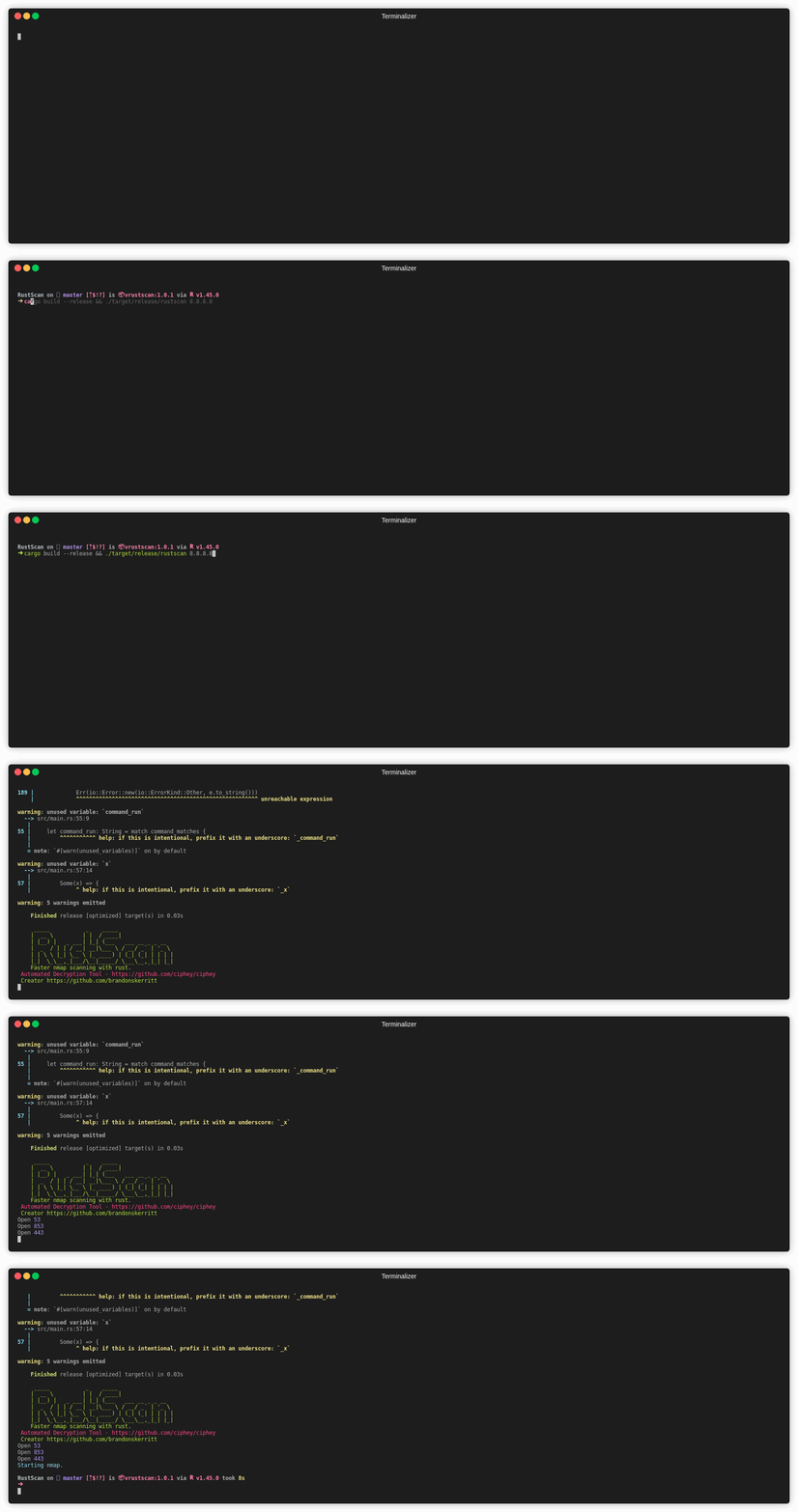
|
||||
|
||||
## 🧋 Speed
|
||||
**RustScan running in 8 seconds and finding all open ports out of 65k.**
|
||||
|
||||
![fast][speed-1]
|
||||
## 📊 RustScan vs Nmap vs MassScan
|
||||
|
||||
Speed is guaranteed via RustScan. However, if you want to run a slow scan due to stealth, that is possible too.
|
||||
|
||||
Firstly, let's talk code.
|
||||
|
||||
We have tests that check to see if RustScan is significantly slower than the previous version. If it is, the continuous integration fails, and we can't commit code to master unless we make it faster.
|
||||
|
||||
[HyperFine][speed-2] is used to monitor RustScan's performance over time to answer the question, "Are we getting faster? Are we getting slower?".
|
||||
|
||||
Every pull request is reviewed by **one** person, but more often than not, **two** people review it. We test it manually and ensure the code doesn't negatively affect performance.
|
||||
|
||||
[Read more here][speed-3].
|
||||
|
||||
## ⚙️ Extensible
|
||||
|
||||
![scripts][extensible-1]
|
||||
|
||||
### _RustScan piping results into the custom Python script_
|
||||
|
||||
RustScan has a new scripting engine that allows anyone to write scripts in most languages. Python, Lua, and Shell are all supported.
|
||||
|
||||
Want to take your found ports and pipe them into Nmap for further analysis? That's possible. Want to run `smb-enum` if SMB is found open? Possible.
|
||||
|
||||
The possibilities are endless -- and you can write scripts in whatever language you feel comfortable with.
|
||||
|
||||
[Read more here][extensible-2].
|
||||
|
||||
## 🌊 Adaptive
|
||||
|
||||
![adaptive][adaptive-1]
|
||||
|
||||
### _RustScan automatically fine-tunes itself to match the host OS_
|
||||
|
||||
RustScan has a cool set of features called "Adaptive Learning". These features "learn" about the environment you are scanning and how _you_ use RustScan to **improve itself over time**.
|
||||
|
||||
We use this umbrella term for any feature that fits this criterion. The list constantly changes, so [check out our wiki for more information][adaptive-learning].
|
||||
|
||||
## 👩🦯 Accessible
|
||||
|
||||
![fast][accessible-1]
|
||||
|
||||
RustScan is one of the first penetration testing tools that aims to be entirely accessible.
|
||||
|
||||
[Most penetration testing tools are not accessible][accessible-2], which negatively affects the whole industry.
|
||||
|
||||
RustScan has continuous integration testing that aims to ensure it is accessible, and we are constantly working on ways to improve our accessibility and ensure _everyone_ can use RustScan.
|
||||
| **Name** | RustScan | Nmap | Masscan |
|
||||
| ------------------------------------------------------------------------------------------ | -------- | ---- | ------- |
|
||||
| Fast | ✅ | ❌ | ✅ |
|
||||
| Actually useful | ❌ | ✅ | ❌ |
|
||||
| Realises it's not useful, and pipes the only useful data into the only useful port scanner | ✅ | ❌ | ❌ |
|
||||
|
||||
# 📖 Full Installation Guide
|
||||
|
||||
You can find our guide [here][install-1].
|
||||
**You need Nmap**. If you have Kali Linux or Parrot OS installed, you already have Nmap. If not, [follow the nmap install guide](https://nmap.org/download.html).
|
||||
|
||||
The easiest way to install RustScan is to use one of the packages provided for your system, such as HomeBrew or Yay for Arch Linux.
|
||||
|
||||
The most universal way is to use `cargo`, Rust's built in package manager (think Pip but for Rust). [Follow this guide to installing Rust & Cargo](https://doc.rust-lang.org/cargo/getting-started/installation.html).
|
||||
|
||||
If you face any issues at all, please leave a GitHub issue. I have only tested this on Linux, so there may be issues for Mac OS or Windows.
|
||||
|
||||
Note: sometimes Rust doesn't add Cargo to the path. Please see [this issue](https://github.com/rust-lang/rustup/issues/2436) for how to fix that.
|
||||
|
||||
## 🖥️ Debian / Kali
|
||||
|
||||
Download the .deb file from the releases page:
|
||||
|
||||
[https://github.com/RustScan/RustScan/releases](https://github.com/RustScan/RustScan/releases)
|
||||
|
||||
Run the command `dpkg -i` on the file.
|
||||
|
||||
Note: sometimes you can double click the file to achieve the same result.
|
||||
|
||||
## Docker :whale:
|
||||
|
||||
Docker is the recommended way of installing RustScan. This is because:
|
||||
|
||||
- It has a high open file descriptor limit, which is one of the [main problems](https://github.com/RustScan/RustScan/issues/40) with RustScan. Now you don't have to fiddle around trying to understand your OS.
|
||||
- It works on all systems, regardless of OS. Even Windows, which we don't officially support.
|
||||
- The Docker image uses the latest build from Cargo, our main source-of-truth package. This means that you will always be using the latest version.
|
||||
- No need to install Rust, Cargo, or Nmap.
|
||||
|
||||
To install Docker, [follow their guide](https://docs.docker.com/engine/install/).
|
||||
|
||||
**Once Docker is installed, you can either build your own image using the `Dockerfile` (alpine) provided in the repo, or alternatively, use the published Docker image like below (most convenient)**
|
||||
|
||||
Please see our [DockerHub](https://hub.docker.com/repository/docker/rustscan/rustscan) for further our published versions. However, we recommend using our latest release [v1.9.0](https://github.com/RustScan/RustScan/releases/tag/1.9.0)
|
||||
|
||||
```
|
||||
Stable and supported: rustscan/rustscan:v1.9.0
|
||||
|
||||
Bleeding edge (run at your own risk!): rustscan/rustscan:latest
|
||||
```
|
||||
|
||||
We strongly recommend using the `v1.9.0` tag, as this is the latest major - stable - release of RustScan. This README uses the `v1.9.0` image by default, however, note that the `latest` image is considered experimental.
|
||||
|
||||
#### To get started:
|
||||
|
||||
Simply run this command against the IP you want to target:
|
||||
|
||||
```bash
|
||||
docker run -it --rm --name rustscan rustscan/rustscan:v1.9.0 <rustscan arguments here> <ip address to scan>
|
||||
```
|
||||
|
||||
Note: this will scan the Docker's localhost, not your own.
|
||||
|
||||
Once done, you will no longer need to re-download the image (except when RustScan updates) and can use RustScan like a normal application.
|
||||
|
||||
You will have to run this command every time, so we suggest aliasing it to something memorable.
|
||||
|
||||
```bash
|
||||
alias rustscan='docker run -it --rm --name rustscan rustscan/rustscan:v1.9.0'
|
||||
```
|
||||
|
||||
Then we can scan:
|
||||
|
||||
```bash
|
||||
rustscan 192.168.1.0/24 -t 500 -b 1500 -- -A
|
||||
```
|
||||
|
||||
#### To build your own image:
|
||||
|
||||
Download the repo:
|
||||
|
||||
```bash
|
||||
git clone https://github.com/RustScan/RustScan.git
|
||||
```
|
||||
|
||||
Ensure you navigate to the download location of the repo:
|
||||
|
||||
```bash
|
||||
cd /path/to/download/RustScan
|
||||
```
|
||||
|
||||
Build away!
|
||||
|
||||
```bash
|
||||
docker build -t <yourimagename> .
|
||||
```
|
||||
|
||||
## 🍺 HomeBrew
|
||||
|
||||
**Note for Mac users** Mac OS has a very, very small ulimit size. This will negatively impact RustScan by a significant amount. Please use the Docker container, or tell RustScan to up the ulimit size on every run.
|
||||
|
||||
```
|
||||
brew install rustscan
|
||||
```
|
||||
|
||||
## 🔧 Building it yourself
|
||||
|
||||
1. Git clone the repo.
|
||||
2. Install Rust. You can do this with `curl --proto '=https' --tlsv1.2 -sSf https://sh.rustup.rs | sh` which I took from the Rust website https://www.rust-lang.org/tools/install
|
||||
3. cd into the Git repo, and run `cargo build --release`
|
||||
4. The binary is located at `target/release/rustscan`
|
||||
5. Symlink to the binary or something. Whatever you want!
|
||||
|
||||
## 🦊 Community Distributions
|
||||
|
||||
Here are all of RustScan's community distributions.
|
||||
|
||||
If you maintain a community distribution and want it listed here, leave an issue / pull request / Discord message or however, you want to let us know.
|
||||
If you maintain a community distribution and want it listed here, leave an issue / pull request / Discord message or however you want to let us know.
|
||||
|
||||
- [Open Suse][distributions-1]
|
||||
- [Fedora/CentOS][distributions-2]
|
||||
- [OpenSuse](https://software.opensuse.org/package/rustscan?search_term=rustscan)
|
||||
- [Fedora/CentOS](https://copr.fedorainfracloud.org/coprs/atim/rustscan/)
|
||||
|
||||
[![Packaging status][rustscan-svg]][repology-1]
|
||||
[](https://repology.org/project/rustscan/versions)
|
||||
|
||||
# 🤸 Usage
|
||||
|
||||
We have 2 usage guides. [Basic Usage][usage-1] and [Things you may want to do][usage-2].
|
||||
```console
|
||||
$ rustscan -h
|
||||
|
||||
We also have documentation about our config file [here][config-file-here].
|
||||
Fast Port Scanner built in Rust. WARNING Do not use this program against sensitive infrastructure since the specified
|
||||
server may not be able to handle this many socket connections at once. - Discord https://discord.gg/GFrQsGy - GitHub
|
||||
https://github.com/RustScan/RustScan
|
||||
|
||||
USAGE:
|
||||
rustscan [FLAGS] [OPTIONS] [addresses]... [-- <command>...]
|
||||
|
||||
FLAGS:
|
||||
--accessible Accessible mode. Turns off features which negatively affect screen readers
|
||||
-h, --help Prints help information
|
||||
-n, --no-config Whether to ignore the configuration file or not
|
||||
--no-nmap Turns off Nmap
|
||||
-q, --quiet Quiet mode. Only output the ports. No Nmap. Useful for grep or outputting to a file
|
||||
-V, --version Prints version information
|
||||
|
||||
OPTIONS:
|
||||
-b, --batch-size <batch-size> The batch size for port scanning, it increases or slows the speed of scanning.
|
||||
Depends on the open file limit of your OS. If you do 65535 it will do every port
|
||||
at the same time. Although, your OS may not support this [default: 4500]
|
||||
-p, --ports <ports>... A list of comma separed ports to be scanned. Example: 80,443,8080
|
||||
-r, --range <range> A range of ports with format start-end. Example: 1-1000
|
||||
--scan-order <scan-order> The order of scanning to be performed. The "serial" option will scan ports in
|
||||
ascending order while the "random" option will scan ports randomly [default:
|
||||
serial] [possible values: Serial, Random]
|
||||
-t, --timeout <timeout> The timeout in milliseconds before a port is assumed to be closed [default: 1500]
|
||||
-u, --ulimit <ulimit> Automatically ups the ULIMIT with the value you provided
|
||||
|
||||
ARGS:
|
||||
<addresses>... A list of comma separated CIDRs, IPs, or hosts to be scanned
|
||||
<command>... The Nmap arguments to run. To use the argument -A, end RustScan's args with '-- -A'. Example:
|
||||
'rustscan -t 1500 127.0.0.1 -- -A -sC'. This command adds -Pn -vvv -p $PORTS automatically to
|
||||
nmap. For things like --script '(safe and vuln)' enclose it in quotations marks \"'(safe and
|
||||
vuln)'\"")
|
||||
```
|
||||
|
||||
The format is `rustscan -b 500 -t 1500 192.168.0.1` to scan 192.168.0.1 with 500 batch size with a timeout of 1500ms. The timeout is how long RustScan waits for a response until it assumes the port is closed.
|
||||
|
||||
The batch size determines how fast RustScan is. Set it to 65k, and it will scan all 65k ports at the same time. This means at at 65k batch size, RustScan will take TIMEOUT long to scan all ports. Essentially, if timeout is 1000ms, **RustScan can scan in 1 second**.
|
||||
|
||||
Your operating system may not support this, but it is worth it to play around and see where your open file limit is. Shortly I will be releasing a dockerised version with a much larger open file limit, so this will be possible.
|
||||
|
||||
## Configuration file
|
||||
|
||||
This binary accepts a configuration file that is read from the home directory of the user. It follows the TOML format
|
||||
and accepts the following fields:
|
||||
|
||||
- `addresses`
|
||||
- `ports`
|
||||
- `range`
|
||||
- `scan_order`
|
||||
- `command`
|
||||
- `accessible`
|
||||
- `quiet`
|
||||
- `batch-size`
|
||||
- `timeout`
|
||||
- `ulimit`
|
||||
|
||||
### Format example
|
||||
|
||||
```toml
|
||||
addresses = ["127.0.0.1", "192.168.0.0/30", "www.google.com"]
|
||||
command = ["-A"]
|
||||
ports = [80, 443, 8080]
|
||||
range = { start = 1, end = 10 }
|
||||
quiet = false
|
||||
accessible = true
|
||||
scan_order = "Serial"
|
||||
batch_size = 1000
|
||||
timeout = 1000
|
||||
ulimit = 1000
|
||||
```
|
||||
|
||||
## ⚠️ WARNING
|
||||
|
||||
This program, by default, scans 5000 ports at a time (5000 per second).
|
||||
|
||||
This may cause damage to a server, or may make it incredibly obvious you are scanning the server.
|
||||
|
||||
Servers as well as individual services can block your IP completely after a huge amount of simultaneous connections/tries, Possibly causing you to see false positives. False positives are open ports at the initial scanning process later found closed when you want to do further scanning, or connect to it.
|
||||
|
||||
There are 2 ways to deal with this;
|
||||
|
||||
1. Decrease batch size
|
||||
`rustscan -b 10` will run 10 port scans for 1 second, and then another 10 for 1 second and so on.
|
||||
2. Increase timeout
|
||||
`rustscan -T 5000` will mean RustScan waits 5 seconds until it scans the next ports.
|
||||
|
||||
You can also use both of these at the same time, to make it as slow or as fast as you want. A fun favourite is 65535 batch size with 1 second timeout. Theoretically, this scans all 65535 ports in 1 second.
|
||||
|
||||
**Please** do not use this tool against sensitive servers. It is designed mainly for Capture the Flag events, not real world servers with sensitive data.
|
||||
|
||||
## 🚨 Thread Panicked at Main: Too Many Open Files
|
||||
|
||||
This is the most common error found in RustScan.
|
||||
|
||||
The open file limit is how many open sockets you can have at any given time.
|
||||
|
||||
This limit changes from OS to OS.
|
||||
|
||||
RustScan does not automatically create defaults (other than 5000) like Nmap does with their -T1, -T2 system.
|
||||
|
||||
By figuring out for yourself the optimal batch size, you will know that RustScan is the most optimised port scanner for your system.
|
||||
|
||||
There are 2 things you can do:
|
||||
|
||||
1. Decrease batch size
|
||||
2. Increase open file limit
|
||||
|
||||
Decreasing batch size slows down the program, so as long as it isn't too drastic, this is a good option.
|
||||
|
||||
Run these 3 commands:
|
||||
|
||||
```bash
|
||||
ulimit -a
|
||||
ulimit -Hn
|
||||
ulimit -Sn
|
||||
```
|
||||
|
||||
They will give you an idea on the open file limit of your OS.
|
||||
|
||||
If it says "250", run `rustscan -b 240` for a batch size of 240.
|
||||
|
||||
Increasing the open file limit increases speed, but poses danger. Although, **opening more file sockets on the specified IP address may damage it**.
|
||||
|
||||
To open more, set the ulimit to a higher number:
|
||||
|
||||
```bash
|
||||
ulimit -n 5000
|
||||
```
|
||||
|
||||
**Mac OS**
|
||||
Mac OS has, from what I can tell, a naturally very low open file descriptor limit. The limit for Ubuntu is 8800. The limit for Mac OS is 255!
|
||||
|
||||
In this case, I would say it is safe to increase the open file limit. As most Linux based OS' have limits in the thousands.
|
||||
|
||||
Although, if this breaks anything, please don't blame me.
|
||||
|
||||
**Windows Subsystem for Linux**
|
||||
Windows Subsystem for Linux does not support ulimit (see issue #39).
|
||||
|
||||
The best way is to use it on a host computer, in Docker, or in a VM that isn't WSL.
|
||||
|
||||
**Automatic Ulimit updating**
|
||||
We are currently working on automatic Ulimit updating. If it is too high, it will lower itself. If it is too low, it will suggest a higher Ulimit. Watch [this issue](https://github.com/RustScan/RustScan/issues/25) for more.
|
||||
|
||||
## 🔌 Nmap Custom Flags
|
||||
|
||||
To run your own nmap commands, end the RustScan command with `-- -A` where `--` indicates "end of RustScan flags, please do not parse anything further" and any flags after that will be entered into nmap.
|
||||
|
||||
RustScan automatically runs `nmap -vvv -p $PORTS $IP`. To make it run `-A`, execute the command `rustscan 127.0.0.1 -- -A`.
|
||||
|
||||
If you want to run commands such as `--script (vuln and safe)`, you will need to enclose it in quotations like so `--script '"(vuln and safe) or default"'`.
|
||||
|
||||
## 🎯 Increasing speed / accuracy
|
||||
|
||||
- Batch size
|
||||
|
||||
This increases speed, by allowing us to process more at once. Something experimental I am working on is changing the open file limit. You can do this manually with `ulimit -n 70000` and then running rustscan with `-b 65535`. This _should_ scan all 65535 ports at the exact same time. But this is extremely experimental.
|
||||
|
||||
For non-experimental speed increases, slowly increase the batch size until it no longer gets open ports, or it breaks.
|
||||
|
||||
- Accuracy (and some speed)
|
||||
|
||||
To increase accuracy, the easiest way is to increase the timeout. The default is 1.5 seconds, by setting it to 4 seconds (4000) we are telling RustScan "if we do not hear back from a port in 4 seconds, assume it is closed".
|
||||
|
||||
Decreasing accuracy gives some speed bonus, but my testing found that batch size dramatically changed the speed whereas timeout did, but not so much.
|
||||
|
||||
# 🎪 Community
|
||||
|
||||
[Contributing][community-1] Read this to learn how.
|
||||
Howdy Space Cow-Person 🤠🌌
|
||||
|
||||
RustScan is always looking for contributors. Whether that's spelling mistakes or major changes, your help is **wanted** and welcomed here.
|
||||
|
||||
Before contributing, read our [code of conduct](https://github.com/RustScan/RustScan/blob/master/CODE_OF_CONDUCT.md).
|
||||
|
||||
TL;DR if you abuse members of our community you will be **perma-banned** 🤗
|
||||
|
||||
RustScan has 2 major labels for GitHub issues you should look at:
|
||||
|
||||
- Good First issue
|
||||
These are issues for newcomers to open source!
|
||||
[https://github.com/RustScan/RustScan/issues?q=is%3Aopen+is%3Aissue+label%3A%22good+first+issue%22](https://github.com/RustScan/RustScan/issues?q=is%3Aopen+is%3Aissue+label%3A%22good+first+issue%22)
|
||||
- Help wanted
|
||||
These are issues that aren't really for newcomers, but we could still do wiht help!
|
||||
[https://github.com/RustScan/RustScan/issues?q=is%3Aopen+is%3Aissue+label%3A%22good+first+issue%22+label%3A%22help+wanted%22](https://github.com/RustScan/RustScan/issues?q=is%3Aopen+is%3Aissue+label%3A%22good+first+issue%22+label%3A%22help+wanted%22)
|
||||
|
||||
If you want to, solve the issue or comment on the issue for help.
|
||||
|
||||
The flow for contributing to open source software is:
|
||||
|
||||
- Fork the repo
|
||||
- Make changes
|
||||
- Pull request to the repo
|
||||
|
||||
And then comment on the issue that you've done.
|
||||
|
||||
RustScan also has some `// TODO`'s in the codebase, which are meant more for the core team but we wouldn't say no to help with these issues.
|
||||
|
||||
If you have any feature suggestions or bugs, leave a GitHub issue. We welcome any and all support :D
|
||||
|
||||
We communicate over Discord. [Click here](https://discord.gg/GFrQsGy) to join our Discord community!
|
||||
|
||||
## Rewarding you
|
||||
|
||||
I cannot pay you :-( But, I can place your GitHub profile on the README under `#Contributors` as a thank you! :)
|
||||
|
||||
Please read the [contributing.md file](contributing.md)
|
||||
|
||||
## Contributors ✨
|
||||
|
||||
<!-- ALL-CONTRIBUTORS-BADGE:START - Do not remove or modify this section -->
|
||||
|
||||
[](#contributors-)
|
||||
|
||||
[](#contributors-)
|
||||
<!-- ALL-CONTRIBUTORS-BADGE:END -->
|
||||
|
||||
Thanks goes to these wonderful people ([emoji key](https://allcontributors.org/docs/en/emoji-key)):
|
||||
@@ -155,7 +447,7 @@ Thanks goes to these wonderful people ([emoji key](https://allcontributors.org/d
|
||||
</tr>
|
||||
<tr>
|
||||
<td align="center"><a href="https://github.com/Atul9"><img src="https://avatars1.githubusercontent.com/u/3390330?v=4" width="100px;" alt=""/><br /><sub><b>Atul Bhosale</b></sub></a><br /><a href="https://github.com/RustScan/RustScan/commits?author=Atul9" title="Code">💻</a></td>
|
||||
<td align="center"><a href="https://tgotwig.dev"><img src="https://avatars0.githubusercontent.com/u/30773779?v=4" width="100px;" alt=""/><br /><sub><b>Thomas Gotwig</b></sub></a><br /><a href="#platform-TGotwig" title="Packaging/porting to new platform">📦</a></td>
|
||||
<td align="center"><a href="https://tgotwig.me"><img src="https://avatars0.githubusercontent.com/u/30773779?v=4" width="100px;" alt=""/><br /><sub><b>Thomas Gotwig</b></sub></a><br /><a href="#platform-TGotwig" title="Packaging/porting to new platform">📦</a></td>
|
||||
<td align="center"><a href="https://github.com/remigourdon"><img src="https://avatars3.githubusercontent.com/u/2874133?v=4" width="100px;" alt=""/><br /><sub><b>Rémi Gourdon</b></sub></a><br /><a href="https://github.com/RustScan/RustScan/commits?author=remigourdon" title="Documentation">📖</a> <a href="https://github.com/RustScan/RustScan/commits?author=remigourdon" title="Code">💻</a></td>
|
||||
<td align="center"><a href="https://cmnatic.co.uk"><img src="https://avatars3.githubusercontent.com/u/4163116?v=4" width="100px;" alt=""/><br /><sub><b>Ben (CMNatic)</b></sub></a><br /><a href="https://github.com/RustScan/RustScan/commits?author=cmnatic" title="Code">💻</a> <a href="https://github.com/RustScan/RustScan/commits?author=cmnatic" title="Documentation">📖</a> <a href="#design-cmnatic" title="Design">🎨</a></td>
|
||||
<td align="center"><a href="https://github.com/Ferryistaken"><img src="https://avatars3.githubusercontent.com/u/47927670?v=4" width="100px;" alt=""/><br /><sub><b>Alessandro Ferrari</b></sub></a><br /><a href="#content-Ferryistaken" title="Content">🖋</a></td>
|
||||
@@ -164,72 +456,15 @@ Thanks goes to these wonderful people ([emoji key](https://allcontributors.org/d
|
||||
</tr>
|
||||
<tr>
|
||||
<td align="center"><a href="https://swag.lgbt"><img src="https://avatars2.githubusercontent.com/u/25358963?v=4" width="100px;" alt=""/><br /><sub><b>Cass</b></sub></a><br /><a href="#platform-caass" title="Packaging/porting to new platform">📦</a> <a href="https://github.com/RustScan/RustScan/commits?author=caass" title="Code">💻</a> <a href="https://github.com/RustScan/RustScan/issues?q=author%3Acaass" title="Bug reports">🐛</a></td>
|
||||
<td align="center"><a href="https://github.com/niklasmohrin"><img src="https://avatars0.githubusercontent.com/u/47574893?v=4" width="100px;" alt=""/><br /><sub><b>Niklas Mohrin</b></sub></a><br /><a href="https://github.com/RustScan/RustScan/commits?author=niklasmohrin" title="Documentation">📖</a> <a href="https://github.com/RustScan/RustScan/commits?author=niklasmohrin" title="Code">💻</a> <a href="https://github.com/RustScan/RustScan/issues?q=author%3Aniklasmohrin" title="Bug reports">🐛</a></td>
|
||||
<td align="center"><a href="https://github.com/niklasmohrin"><img src="https://avatars0.githubusercontent.com/u/47574893?v=4" width="100px;" alt=""/><br /><sub><b>Niklas Mohrin</b></sub></a><br /><a href="https://github.com/RustScan/RustScan/commits?author=niklasmohrin" title="Documentation">📖</a></td>
|
||||
<td align="center"><a href="https://liberapay.com/Artem4/"><img src="https://avatars0.githubusercontent.com/u/5614476?v=4" width="100px;" alt=""/><br /><sub><b>Artem Polishchuk</b></sub></a><br /><a href="#platform-tim77" title="Packaging/porting to new platform">📦</a></td>
|
||||
<td align="center"><a href="https://github.com/buermarc"><img src="https://avatars2.githubusercontent.com/u/44375277?v=4" width="100px;" alt=""/><br /><sub><b>buermarc</b></sub></a><br /><a href="https://github.com/RustScan/RustScan/commits?author=buermarc" title="Code">💻</a></td>
|
||||
<td align="center"><a href="https://github.com/bergabman"><img src="https://avatars1.githubusercontent.com/u/44554109?v=4" width="100px;" alt=""/><br /><sub><b>bergabman</b></sub></a><br /><a href="https://github.com/RustScan/RustScan/commits?author=bergabman" title="Code">💻</a> <a href="https://github.com/RustScan/RustScan/issues?q=author%3Abergabman" title="Bug reports">🐛</a> <a href="#design-bergabman" title="Design">🎨</a></td>
|
||||
<td align="center"><a href="https://github.com/dmitris"><img src="https://avatars0.githubusercontent.com/u/31205?v=4" width="100px;" alt=""/><br /><sub><b>Dmitry Savintsev</b></sub></a><br /><a href="https://github.com/RustScan/RustScan/commits?author=dmitris" title="Code">💻</a></td>
|
||||
<td align="center"><a href="https://github.com/bofh69"><img src="https://avatars3.githubusercontent.com/u/1444315?v=4" width="100px;" alt=""/><br /><sub><b>Sebastian Andersson</b></sub></a><br /><a href="https://github.com/RustScan/RustScan/commits?author=bofh69" title="Code">💻</a></td>
|
||||
</tr>
|
||||
<tr>
|
||||
<td align="center"><a href="https://github.com/mattcorbin"><img src="https://avatars3.githubusercontent.com/u/6537765?v=4" width="100px;" alt=""/><br /><sub><b>Matt Corbin</b></sub></a><br /><a href="https://github.com/RustScan/RustScan/commits?author=mattcorbin" title="Code">💻</a></td>
|
||||
<td align="center"><a href="http://rootsploit.com"><img src="https://avatars2.githubusercontent.com/u/67270834?v=4" width="100px;" alt=""/><br /><sub><b>RootSploit</b></sub></a><br /><a href="#blog-rootsploit" title="Blogposts">📝</a></td>
|
||||
<td align="center"><a href="https://github.com/eiffel-fl"><img src="https://avatars2.githubusercontent.com/u/12171754?v=4" width="100px;" alt=""/><br /><sub><b>eiffel-fl</b></sub></a><br /><a href="https://github.com/RustScan/RustScan/commits?author=eiffel-fl" title="Code">💻</a></td>
|
||||
<td align="center"><a href="https://github.com/u5surf"><img src="https://avatars1.githubusercontent.com/u/14180225?v=4" width="100px;" alt=""/><br /><sub><b>Y.Horie</b></sub></a><br /><a href="https://github.com/RustScan/RustScan/commits?author=u5surf" title="Code">💻</a></td>
|
||||
<td align="center"><a href="https://github.com/okrplay"><img src="https://avatars3.githubusercontent.com/u/32576280?v=4" width="100px;" alt=""/><br /><sub><b>Oskar</b></sub></a><br /><a href="https://github.com/RustScan/RustScan/commits?author=okrplay" title="Code">💻</a> <a href="https://github.com/RustScan/RustScan/commits?author=okrplay" title="Tests">⚠️</a></td>
|
||||
</tr>
|
||||
</table>
|
||||
|
||||
<!-- markdownlint-enable -->
|
||||
<!-- prettier-ignore-end -->
|
||||
|
||||
<!-- ALL-CONTRIBUTORS-LIST:END -->
|
||||
|
||||
This project follows the [all-contributors](https://github.com/all-contributors/all-contributors) specification. Contributions of any kind welcome!
|
||||
|
||||
<!--Links-->
|
||||
|
||||
[Docker]: https://hub.docker.com/r/cmnatic/rustscan "This is the recommended distribution of rustscan"
|
||||
[kali]: https://github.com/RustScan/RustScan/wiki/Installation-Guide#%EF%B8%8F-debian--kali "Read the install guide"
|
||||
[Kali/Debian]: https://github.com/RustScan/RustScan/releases "Kali Debian"
|
||||
[Arch-Linux]: https://archlinux.org/packages/extra/x86_64/rustscan/ "Arch Linux installation of Rustscan"
|
||||
[Homebrew]: https://crates.io/crates/rustscan/ "Homebrew install of Rustscan"
|
||||
[usage-1]: https://github.com/RustScan/RustScan/wiki/Usage "Basic Usage of Rustscan"
|
||||
[usage-0]: https://github.com/RustScan/RustScan/wiki/Installation-Guide#docker-whale "Use Docker Rustscan"
|
||||
[config-file-here]: https://github.com/RustScan/RustScan/wiki/Config-File "RustScan Configuration File"
|
||||
[usage-2]: https://github.com/RustScan/RustScan/wiki/Things-you-may-want-to-do-with-RustScan-but-don't-understand-how "Things you may want to do with rustscan but don't know how"
|
||||
[community-1]: https://github.com/RustScan/RustScan/wiki/Contributing "Learn how to contribute"
|
||||
[distributions-1]: https://software.opensuse.org/package/rustscan?search_term=rustscan "Open Suse rustscan distribution"
|
||||
[distributions-2]: https://copr.fedorainfracloud.org/coprs/atim/rustscan/ "Rustscan in Fedora"
|
||||
[repology-1]: https://repology.org/project/rustscan/versions "Packaging Status"
|
||||
[install-1]: https://github.com/RustScan/RustScan/wiki/Installation-Guide "Installation guide"
|
||||
[accessible-2]: https://bees.substack.com/p/making-hacking-accessible "Making Hacking Accessible"
|
||||
[extensible-2]: https://github.com/RustScan/RustScan/wiki/RustScan-Scripting-Engine "Scripting Engine"
|
||||
[speed-2]: https://github.com/sharkdp/hyperfine "Hyperfine"
|
||||
[speed-3]: https://github.com/RustScan/RustScan/wiki/Increasing-Speed-&-Accuracy "Increasing Speed & Accuracy"
|
||||
[toc-community]: https://github.com/RustScan/RustScan#-community "Community"
|
||||
[links-table-1]: https://github.com/RustScan/RustScan#-full-installation-guide "Full installation guide"
|
||||
[links-table-2]: https://rustscan.github.io/RustScan/ "Rustscan"
|
||||
[discord]: http://discord.skerritt.blog "Discord blog"
|
||||
[toc-install]: https://github.com/RustScan/RustScan/wiki/Installation-Guide "Installation Guide Wiki"
|
||||
[toc-docker-usage]: https://github.com/RustScan/RustScan/wiki/Installation-Guide#docker- "Docker Installation Guide Wiki"
|
||||
[usage-guide]: https://github.com/RustScan/RustScan#-usage
|
||||
[adaptive-learning]: https://github.com/RustScan/RustScan/wiki/Adaptive-Learning "Adaptive Learning"
|
||||
|
||||
<!--Pictures-->
|
||||
|
||||
[DockerPic]: https://github.com/RustScan/RustScan/blob/master/pictures/docker.png?raw=true "Docker install"
|
||||
[Kali1]: https://github.com/RustScan/RustScan/blob/master/pictures/kali.png?raw=true "Kali Picture"
|
||||
[Arch]: https://github.com/RustScan/RustScan/blob/master/pictures/arch.png?raw=true "Arch Linux"
|
||||
[Apple]: https://raw.githubusercontent.com/RustScan/RustScan/master/pictures/apple.png?size "Apple"
|
||||
[rustscan-svg]: https://repology.org/badge/vertical-allrepos/rustscan.svg "Picture of rustscan repology"
|
||||
[accessible-1]: pictures/accessible.gif "Fast"
|
||||
[adaptive-1]: pictures/adaptive.gif "Adaptive"
|
||||
[extensible-1]: pictures/scripts.gif "Scripts"
|
||||
[speed-1]: pictures/fast.gif "Speed"
|
||||
[badge-1]: https://img.shields.io/archlinux/v/extra/x86_64/rustscan?style=plastic&logo=archlinux&link=https%3A%2F%2Farchlinux.org%2Fpackages%2Fextra%2Fx86_64%2Frustscan%2F
|
||||
[badge-2]: https://img.shields.io/badge/Built%20with-Rust-Purple
|
||||
[badge-3]: https://img.shields.io/github/downloads/rustscan/rustscan/total?label=GitHub%20Downloads
|
||||
[badge-4]: https://img.shields.io/crates/d/rustscan?label=Cargo%20Downloads
|
||||
[badge-5]: https://img.shields.io/discord/754001738184392704
|
||||
[badge-6]: https://github.com/RustScan/RustScan/workflows/Continuous%20integration/badge.svg?branch=master
|
||||
@@ -1,5 +0,0 @@
|
||||
FROM rust
|
||||
# Install nmap first.
|
||||
RUN apt-get update -qy && apt-get install -qy nmap
|
||||
# Then install rustfmt and clippy for cargo.
|
||||
RUN rustup component add rustfmt clippy
|
||||
@@ -7,21 +7,19 @@ Before contributing, read our [code of conduct](https://github.com/RustScan/Rust
|
||||
TL;DR if you abuse members of our community you will be **perma-banned** with no chance to get unbanned. No warnings either. 🤗
|
||||
|
||||
RustScan has 2 major labels for GitHub issues you should look at:
|
||||
|
||||
- Good First issue
|
||||
These are issues for newcomers to open source!
|
||||
[https://github.com/RustScan/RustScan/issues?q=is%3Aopen+is%3Aissue+label%3A%22good+first+issue%22](https://github.com/RustScan/RustScan/issues?q=is%3Aopen+is%3Aissue+label%3A%22good+first+issue%22)
|
||||
- Help wanted
|
||||
These are issues that aren't really for newcomers, but we could still do with help!
|
||||
[https://github.com/RustScan/RustScan/issues?q=is%3Aopen+is%3Aissue+label%3A%22good+first+issue%22+label%3A%22help+wanted%22](https://github.com/RustScan/RustScan/issues?q=is%3Aopen+is%3Aissue+label%3A%22good+first+issue%22+label%3A%22help+wanted%22)
|
||||
* Good First issue
|
||||
These are issues for newcomers to open source!
|
||||
[https://github.com/RustScan/RustScan/issues?q=is%3Aopen+is%3Aissue+label%3A%22good+first+issue%22](https://github.com/RustScan/RustScan/issues?q=is%3Aopen+is%3Aissue+label%3A%22good+first+issue%22)
|
||||
* Help wanted
|
||||
These are issues that aren't really for newcomers, but we could still do with help!
|
||||
[https://github.com/RustScan/RustScan/issues?q=is%3Aopen+is%3Aissue+label%3A%22good+first+issue%22+label%3A%22help+wanted%22](https://github.com/RustScan/RustScan/issues?q=is%3Aopen+is%3Aissue+label%3A%22good+first+issue%22+label%3A%22help+wanted%22)
|
||||
|
||||
If you want to, solve the issue or comment on the issue for help.
|
||||
|
||||
The flow for contributing to open source software is:
|
||||
|
||||
- Fork the repo
|
||||
- Make changes
|
||||
- Pull request to the repo
|
||||
The [flow for contributing](https://guides.github.com/introduction/flow/) to open source software is:
|
||||
* Fork the repo
|
||||
* Make changes
|
||||
* Pull request to the repo
|
||||
|
||||
And then comment on the issue that you've done.
|
||||
|
||||
@@ -30,40 +28,4 @@ RustScan also has some `// TODO`'s in the codebase, which are meant more for the
|
||||
If you have any feature suggestions or bugs, leave a GitHub issue. We welcome any and all support :D
|
||||
|
||||
## Rewarding you
|
||||
|
||||
I cannot pay you :-( But, I can place your GitHub profile on the README under `#Contributors` as a thank you! :)
|
||||
|
||||
## Contributing development environment
|
||||
|
||||
To ease contribution to RustScan, you can use the `contributing.Dockerfile` to create a Docker image ready to build and play with RustScan.
|
||||
To build it you just need to run:
|
||||
|
||||
```bash
|
||||
you@home:~/RustScan$ docker build -t rustscan_contributing -f contributing.Dockerfile
|
||||
```
|
||||
|
||||
Then you need to run the container with a volume so it can access, _with read and write permissions_, to RustScan files:
|
||||
|
||||
```bash
|
||||
you@home:~/RustScan$ docker run -ti --rm -v "$PWD":/rustscan -w /rustscan rustscan_contributing bash
|
||||
```
|
||||
|
||||
You can now modify RustScan files with your favorite editor, once you want to compile and test your modifications, type the following in the container prompt:
|
||||
|
||||
```bash
|
||||
root@container:/rustscan# cargo build
|
||||
```
|
||||
|
||||
You are now ready to use RustScan:
|
||||
|
||||
```bash
|
||||
root@container:/rustscan# cargo run -- -b 2000 -t 5000 -a 127.0.0.1
|
||||
```
|
||||
|
||||
You can also format, lint with `clippy` and test the code with the following commands:
|
||||
|
||||
```bash
|
||||
root@container:/rustscan# cargo fmt
|
||||
root@container:/rustscan# cargo clippy
|
||||
root@container:/rustscan# cargo test
|
||||
```
|
||||
@@ -1,23 +0,0 @@
|
||||
#!/usr/bin/perl
|
||||
#tags = ["core_approved", "example",]
|
||||
#developer = [ "example", "https://example.org" ]
|
||||
#ports_separator = ","
|
||||
#call_format = "perl {{script}} {{ip}} {{port}}"
|
||||
|
||||
# Sriptfile parser stops at the first blank line with parsing.
|
||||
# This script will run itself as an argument with the system installed perl interpreter, ports will be concatenated with "," .
|
||||
# Unused field: trigger_port = "80"
|
||||
# get total arg passed to this script
|
||||
my $total = $#ARGV + 1;
|
||||
my $counter = 1;
|
||||
|
||||
# get script name
|
||||
my $scriptname = $0;
|
||||
|
||||
print "Total args passed to $scriptname : $total\n";
|
||||
|
||||
# Use loop to print all args stored in an array called @ARGV
|
||||
foreach my $a(@ARGV) {
|
||||
print "Arg # $counter : $a\n";
|
||||
$counter++;
|
||||
}
|
||||
@@ -1,13 +0,0 @@
|
||||
#!/usr/bin/python3
|
||||
#tags = ["core_approved", "example",]
|
||||
#developer = [ "example", "https://example.org" ]
|
||||
#trigger_port = "80"
|
||||
#call_format = "python3 {{script}} {{ip}} {{port}}"
|
||||
|
||||
# Sriptfile parser stops at the first blank line with parsing.
|
||||
# This script will run itself as an argument with the system installed python interpreter, only scanning port 80.
|
||||
# Unused filed: ports_separator = ","
|
||||
|
||||
import sys
|
||||
|
||||
print('Python script ran with arguments', str(sys.argv))
|
||||
@@ -1,12 +0,0 @@
|
||||
#!/bin/bash
|
||||
#tags = ["core_approved", "example",]
|
||||
#developer = [ "example", "https://example.org" ]
|
||||
#ports_separator = ","
|
||||
#call_format = "bash {{script}} {{ip}} {{port}}"
|
||||
|
||||
# Sriptfile parser stops at the first blank line with parsing.
|
||||
# This script will run itself as an argument with the system installed bash interpreter, scanning all ports concatenated with "," .
|
||||
# Unused filed: trigger_port = "80"
|
||||
|
||||
# print all arguments passed to the script
|
||||
echo $@
|
||||
@@ -1,9 +0,0 @@
|
||||
#!intentional_blank_line
|
||||
#tags = ["core_approved", "example"]
|
||||
#developer = [ "example", "https://example.org" ]
|
||||
#ports_separator = ","
|
||||
#call_format = "nmap -vvv -p {{port}} {{ip}}"
|
||||
|
||||
# Scriptfile parser stops at the first blank line with parsing.
|
||||
# This script will run the system installed nmap, ports will be concatenated with "," .
|
||||
# Unused field: trigger_port = "80"
|
||||
@@ -1,7 +0,0 @@
|
||||
#!intentional_blank_line
|
||||
#tags = "core_approved"
|
||||
#developer = [ "example", "https://example.org" ]
|
||||
#ports_separator = ","
|
||||
#call_format = "nmap -vvv -p {{port}} {{ip}}"
|
||||
|
||||
# tags has to be an array, thus this file won't be parsed
|
||||
@@ -1,6 +0,0 @@
|
||||
127.0.0.1
|
||||
google.com
|
||||
example.com
|
||||
66666666666666.666666666666666666.66666666666666666.6666666666
|
||||
....
|
||||
e3b0c44298fc1c149afbf4c8996fb92427ae41e4649b934ca495991b7852b855.radiatorFixtures
|
||||
@@ -1,42 +0,0 @@
|
||||
# https://github.com/minimaxir/big-list-of-naughty-strings
|
||||
|
||||
|
||||
|
||||
|
||||
Ω≈ç√∫˜µ≤≥÷
|
||||
åß∂ƒ©˙∆˚¬…æ
|
||||
œ∑´®†¥¨ˆøπ“‘
|
||||
¡™£¢∞§¶•ªº–≠
|
||||
¸˛Ç◊ı˜Â¯˘¿
|
||||
ÅÍÎÏ˝ÓÔÒÚÆ☃
|
||||
Œ„´‰ˇÁ¨ˆØ∏”’
|
||||
`⁄€‹›fifl‡°·‚—±
|
||||
⅛⅜⅝⅞
|
||||
ЁЂЃЄЅІЇЈЉЊЋЌЍЎЏАБВГДЕЖЗИЙКЛМНОПРСТУФХЦЧШЩЪЫЬЭЮЯабвгдежзийклмнопрстуфхцчшщъыьэюя
|
||||
٠١٢٣٤٥٦٧٨٩
|
||||
|
||||
|
||||
|
||||
⁰⁴⁵
|
||||
₀₁₂
|
||||
⁰⁴⁵₀₁₂
|
||||
ด้้้้้็็็็็้้้้้็็็็็้้้้้้้้็็็็็้้้้้็็็็็้้้้้้้้็็็็็้้้้้็็็็็้้้้้้้้็็็็็้้้้้็็็็ ด้้้้้็็็็็้้้้้็็็็็้้้้้้้้็็็็็้้้้้็็็็็้้้้้้้้็็็็็้้้้้็็็็็้้้้้้้้็็็็็้้้้้็็็็ ด้้้้้็็็็็้้้้้็็็็็้้้้้้้้็็็็็้้้้้็็็็็้้้้้้้้็็็็็้้้้้็็็็็้้้้้้้้็็็็็้้้้้็็็็
|
||||
|
||||
田中さんにあげて下さい
|
||||
パーティーへ行かないか
|
||||
和製漢語
|
||||
部落格
|
||||
사회과학원 어학연구소
|
||||
찦차를 타고 온 펲시맨과 쑛다리 똠방각하
|
||||
社會科學院語學研究所
|
||||
울란바토르
|
||||
𠜎𠜱𠝹𠱓𠱸𠲖𠳏
|
||||
𝐓𝐡𝐞 𝐪𝐮𝐢𝐜𝐤 𝐛𝐫𝐨𝐰𝐧 𝐟𝐨𝐱 𝐣𝐮𝐦𝐩𝐬 𝐨𝐯𝐞𝐫 𝐭𝐡𝐞 𝐥𝐚𝐳𝐲 𝐝𝐨𝐠
|
||||
𝕿𝖍𝖊 𝖖𝖚𝖎𝖈𝖐 𝖇𝖗𝖔𝖜𝖓 𝖋𝖔𝖝 𝖏𝖚𝖒𝖕𝖘 𝖔𝖛𝖊𝖗 𝖙𝖍𝖊 𝖑𝖆𝖟𝖞 𝖉𝖔𝖌
|
||||
𝑻𝒉𝒆 𝒒𝒖𝒊𝒄𝒌 𝒃𝒓𝒐𝒘𝒏 𝒇𝒐𝒙 𝒋𝒖𝒎𝒑𝒔 𝒐𝒗𝒆𝒓 𝒕𝒉𝒆 𝒍𝒂𝒛𝒚 𝒅𝒐𝒈
|
||||
𝓣𝓱𝓮 𝓺𝓾𝓲𝓬𝓴 𝓫𝓻𝓸𝔀𝓷 𝓯𝓸𝔁 𝓳𝓾𝓶𝓹𝓼 𝓸𝓿𝓮𝓻 𝓽𝓱𝓮 𝓵𝓪𝔃𝔂 𝓭𝓸𝓰
|
||||
𝕋𝕙𝕖 𝕢𝕦𝕚𝕔𝕜 𝕓𝕣𝕠𝕨𝕟 𝕗𝕠𝕩 𝕛𝕦𝕞𝕡𝕤 𝕠𝕧𝕖𝕣 𝕥𝕙𝕖 𝕝𝕒𝕫𝕪 𝕕𝕠𝕘
|
||||
𝚃𝚑𝚎 𝚚𝚞𝚒𝚌𝚔 𝚋𝚛𝚘𝚠𝚗 𝚏𝚘𝚡 𝚓𝚞𝚖𝚙𝚜 𝚘𝚟𝚎𝚛 𝚝𝚑𝚎 𝚕𝚊𝚣𝚢 𝚍𝚘𝚐
|
||||
⒯⒣⒠ ⒬⒰⒤⒞⒦ ⒝⒭⒪⒲⒩ ⒡⒪⒳ ⒥⒰⒨⒫⒮ ⒪⒱⒠⒭ ⒯⒣⒠ ⒧⒜⒵⒴ ⒟⒪⒢
|
||||
|
||||
ثم نفس سقطت وبالتحديد،, جزيرتي باستخدام أن دنو. إذ هنا؟ الستار وتنصيب كان. أهّل ايطاليا، بريطانيا-فرنسا قد أخذ. سليمان، إتفاقية بين ما, يذكر الحدود أي بعد, معاملة بولندا، الإطلاق عل إيو.
|
||||
@@ -1,14 +0,0 @@
|
||||
# Test/Example ScriptConfig file
|
||||
|
||||
# Tags to filter on scripts. Only scripts containing all these tags will run.
|
||||
tags = ["core_approved", "example"]
|
||||
|
||||
# If it's present then only those scripts will run which has a tag ports = "80". Not yet implemented.
|
||||
#
|
||||
# ex.:
|
||||
# ports = ["80"]
|
||||
# ports = ["80","81","8080"]
|
||||
ports = ["80"]
|
||||
|
||||
# Only this developer(s) scripts to run. Not yet implemented.
|
||||
developer = ["example"]
|
||||

|
Before Width: | Height: | Size: 134 KiB |
@@ -1,131 +0,0 @@
|
||||
# The configurations that used for the recording, feel free to edit them
|
||||
config:
|
||||
|
||||
# Specify a command to be executed
|
||||
# like `/bin/bash -l`, `ls`, or any other commands
|
||||
# the default is bash for Linux
|
||||
# or powershell.exe for Windows
|
||||
command: zsh
|
||||
|
||||
# Specify the current working directory path
|
||||
# the default is the current working directory path
|
||||
cwd: /home/bee/Documents/RustScan
|
||||
|
||||
# Export additional ENV variables
|
||||
env:
|
||||
recording: true
|
||||
|
||||
# Explicitly set the number of columns
|
||||
# or use `auto` to take the current
|
||||
# number of columns of your shell
|
||||
cols: 107
|
||||
|
||||
# Explicitly set the number of rows
|
||||
# or use `auto` to take the current
|
||||
# number of rows of your shell
|
||||
rows: 43
|
||||
|
||||
# Amount of times to repeat GIF
|
||||
# If value is -1, play once
|
||||
# If value is 0, loop indefinitely
|
||||
# If value is a positive number, loop n times
|
||||
repeat: 0
|
||||
|
||||
# Quality
|
||||
# 1 - 100
|
||||
quality: 100
|
||||
|
||||
# Delay between frames in ms
|
||||
# If the value is `auto` use the actual recording delays
|
||||
frameDelay: auto
|
||||
|
||||
# Maximum delay between frames in ms
|
||||
# Ignored if the `frameDelay` isn't set to `auto`
|
||||
# Set to `auto` to prevent limiting the max idle time
|
||||
maxIdleTime: 2000
|
||||
|
||||
# The surrounding frame box
|
||||
# The `type` can be null, window, floating, or solid`
|
||||
# To hide the title use the value null
|
||||
# Don't forget to add a backgroundColor style with a null as type
|
||||
frameBox:
|
||||
type: floating
|
||||
title: Terminalizer
|
||||
style:
|
||||
border: 0px black solid
|
||||
# boxShadow: none
|
||||
# margin: 0px
|
||||
|
||||
# Add a watermark image to the rendered gif
|
||||
# You need to specify an absolute path for
|
||||
# the image on your machine or a URL, and you can also
|
||||
# add your own CSS styles
|
||||
watermark:
|
||||
imagePath: null
|
||||
style:
|
||||
position: absolute
|
||||
right: 15px
|
||||
bottom: 15px
|
||||
width: 100px
|
||||
opacity: 0.9
|
||||
|
||||
# Cursor style can be one of
|
||||
# `block`, `underline`, or `bar`
|
||||
cursorStyle: block
|
||||
|
||||
# Font family
|
||||
# You can use any font that is installed on your machine
|
||||
# in CSS-like syntax
|
||||
fontFamily: "Monaco, Lucida Console, Ubuntu Mono, Monospace"
|
||||
|
||||
# The size of the font
|
||||
fontSize: 12
|
||||
|
||||
# The height of lines
|
||||
lineHeight: 1
|
||||
|
||||
# The spacing between letters
|
||||
letterSpacing: 0
|
||||
|
||||
# Theme
|
||||
theme:
|
||||
background: "transparent"
|
||||
foreground: "#afafaf"
|
||||
cursor: "#c7c7c7"
|
||||
black: "#232628"
|
||||
red: "#fc4384"
|
||||
green: "#b3e33b"
|
||||
yellow: "#ffa727"
|
||||
blue: "#75dff2"
|
||||
magenta: "#ae89fe"
|
||||
cyan: "#708387"
|
||||
white: "#d5d5d0"
|
||||
brightBlack: "#626566"
|
||||
brightRed: "#ff7fac"
|
||||
brightGreen: "#c8ed71"
|
||||
brightYellow: "#ebdf86"
|
||||
brightBlue: "#75dff2"
|
||||
brightMagenta: "#ae89fe"
|
||||
brightCyan: "#b1c6ca"
|
||||
brightWhite: "#f9f9f4"
|
||||
|
||||
# Records, feel free to edit them
|
||||
records:
|
||||
- delay: 436
|
||||
content: "\e[1m\e[7m%\e[27m\e[1m\e[0m \r \r\e]2;bee@beehive:~/Documents/RustScan\a\e]1;..ents/RustScan\a"
|
||||
- delay: 162
|
||||
content: "\r\e[0m\e[27m\e[24m\e[J\r\n\e[1m\e[0m\e[1m\e[36mRustScan\e[0m\e[36m\e[39m\e[1m \e[0m\e[1mon \e[0m\e[1m\e[37m\e[1m\e[37m\e[0m\e[37m\e[1m\e[37m\e[35m master\e[0m\e[35m\e[39m\e[1m\e[0m\e[1m\e[0m\e[1m\e[31m [?]\e[0m\e[31m\e[39m\e[1m\e[0m\e[0m\e[39m\e[1m \e[0m\e[1mis \e[0m\e[1m\e[31m\U0001F4E6 vrustscan:1.10.0\e[0m\e[31m\e[39m\e[1m \e[0m\e[1mvia \e[0m\e[1m\e[31m\U0001D5E5 v1.46.0\e[0m\e[31m\e[39m\e[1m \e[0m\r\n\e[1m\e[0m\e[1m\e[32m➜ \e[0m\e[32m\e[39m\e[1m\e[0m\e[K\e[?1h\e=\e[?2004h"
|
||||
- delay: 471
|
||||
content: "r\brustscan 127.0.0.1 --accessible --no-nmap --ulimit 5000\e[55D\e[7mr\e[7mu\e[7ms\e[7mt\e[7ms\e[7mc\e[7ma\e[7mn\e[7m \e[7m1\e[7m2\e[7m7\e[7m.\e[7m0\e[7m.\e[7m0\e[7m.\e[7m1\e[7m \e[7m-\e[7m-\e[7ma\e[7mc\e[7mc\e[7me\e[7ms\e[7ms\e[7mi\e[7mb\e[7ml\e[7me\e[7m \e[7m-\e[7m-\e[7mn\e[7mo\e[7m-\e[7mn\e[7mm\e[7ma\e[7mp\e[7m \e[7m-\e[7m-\e[7mu\e[7ml\e[7mi\e[7mm\e[7mi\e[7mt\e[7m \e[7m5\e[7m0\e[7m0\e[7m0\e[27m"
|
||||
- delay: 269
|
||||
content: "\e[55D\e[27mr\e[27mu\e[27ms\e[27mt\e[27ms\e[27mc\e[27ma\e[27mn\e[27m \e[27m1\e[27m2\e[27m7\e[27m.\e[27m0\e[27m.\e[27m0\e[27m.\e[27m1\e[27m \e[27m-\e[27m-\e[27ma\e[27mc\e[27mc\e[27me\e[27ms\e[27ms\e[27mi\e[27mb\e[27ml\e[27me\e[27m \e[27m-\e[27m-\e[27mn\e[27mo\e[27m-\e[27mn\e[27mm\e[27ma\e[27mp\e[27m \e[27m-\e[27m-\e[27mu\e[27ml\e[27mi\e[27mm\e[27mi\e[27mt\e[27m \e[27m5\e[27m0\e[27m0\e[27m0\e[?1l\e>\e[?2004l\r\r\n\e]2;rustscan 127.0.0.1 --accessible --no-nmap --ulimit 5000\a\e]1;rustscan\aAutomatically increasing ulimit value to 5000.\r\n"
|
||||
- delay: 1536
|
||||
content: "Open 127.0.0.1:38602\r\n"
|
||||
- delay: 395
|
||||
content: "Open 127.0.0.1:50078\r\n"
|
||||
- delay: 450
|
||||
content: "127.0.0.1 -> [38602,50078]\r\n\e[1m\e[7m%\e[27m\e[1m\e[0m \r \r\e]2;bee@beehive:~/Documents/RustScan\a\e]1;..ents/RustScan\a"
|
||||
- delay: 143
|
||||
content: "\r\e[0m\e[27m\e[24m\e[J\r\n\e[1m\e[0m\e[1m\e[36mRustScan\e[0m\e[36m\e[39m\e[1m \e[0m\e[1mon \e[0m\e[1m\e[37m\e[1m\e[37m\e[0m\e[37m\e[1m\e[37m\e[35m master\e[0m\e[35m\e[39m\e[1m\e[0m\e[1m\e[0m\e[1m\e[31m [?]\e[0m\e[31m\e[39m\e[1m\e[0m\e[0m\e[39m\e[1m \e[0m\e[1mis \e[0m\e[1m\e[31m\U0001F4E6 vrustscan:1.10.0\e[0m\e[31m\e[39m\e[1m \e[0m\e[1mvia \e[0m\e[1m\e[31m\U0001D5E5 v1.46.0\e[0m\e[31m\e[39m\e[1m \e[0m\e[1mtook \e[0m\e[1m\e[33m2s\e[0m\e[33m\e[39m\e[1m \e[0m\r\n\e[1m\e[0m\e[1m\e[32m➜ \e[0m\e[32m\e[39m\e[1m\e[0m\e[K\e[?1h\e=\e[?2004h"
|
||||
- delay: 563
|
||||
content: "\e[?2004l\r\r\n"
|
||||

|
Before Width: | Height: | Size: 160 KiB |

|
Before Width: | Height: | Size: 9.1 KiB After Width: | Height: | Size: 4.1 KiB |

|
Before Width: | Height: | Size: 131 KiB |

|
Before Width: | Height: | Size: 55 KiB After Width: | Height: | Size: 29 KiB |

|
Before Width: | Height: | Size: 258 KiB |
@@ -1 +0,0 @@
|
||||
cargo publish && cargo build --release && git add Cargo.lock && git commit -m 'Updating lock file' && gpsup
|
||||
@@ -0,0 +1,20 @@
|
||||
FROM rust:latest
|
||||
|
||||
RUN git clone https://github.com/brandonskerritt/RustScan
|
||||
WORKDIR "/RustScan"
|
||||
RUN git pull --force
|
||||
RUN cargo install cargo-deb
|
||||
|
||||
RUN apt update -y && apt upgrade -y
|
||||
RUN apt install libc6-dev-i386 -y
|
||||
RUN git clone --depth=1 https://github.com/raspberrypi/tools /raspberrypi-tools
|
||||
ENV PATH=/raspberrypi-tools/arm-bcm2708/gcc-linaro-arm-linux-gnueabihf-raspbian-x64/bin/:$PATH
|
||||
ENV CARGO_TARGET_ARM_UNKNOWN_LINUX_GNUEABIHF_LINKER=arm-linux-gnueabihf-gcc
|
||||
RUN mkdir /root/.cargo
|
||||
RUN echo "[target.arm-unknown-linux-gnueabihf]" >> /root/.cargo/config
|
||||
RUN echo "strip = { path = \"arm-linux-gnueabihf-strip\" }" >> /root/.cargo/config
|
||||
RUN echo "objcopy = { path = \"arm-linux-gnueabihf-objcopy\" }" >> /root/.cargo/config
|
||||
|
||||
COPY ./entrypoint.sh /entrypoint.sh
|
||||
RUN chmod +x /entrypoint.sh
|
||||
ENTRYPOINT ["/entrypoint.sh"]
|
||||
@@ -0,0 +1,17 @@
|
||||
#!/bin/bash
|
||||
|
||||
cd /RustScan
|
||||
git pull --force
|
||||
|
||||
#amd64
|
||||
cargo deb
|
||||
|
||||
#arm64
|
||||
rustup target add arm-unknown-linux-gnueabihf
|
||||
cargo deb --target=arm-unknown-linux-gnueabihf
|
||||
|
||||
#i386
|
||||
rustup target add i686-unknown-linux-gnu
|
||||
cargo deb --target=i686-unknown-linux-gnu
|
||||
|
||||
find target/ -name \*.deb -exec cp {} /debs \;
|
||||
@@ -0,0 +1,8 @@
|
||||
#!/bin/bash
|
||||
docker build -t rustscan-builder . || exit
|
||||
|
||||
# This creates a volume which binds your currentdirectory/debs to
|
||||
# the location where the deb files get spat out in the container.
|
||||
# You don't need to worry about it. Just chmod +x run.sh && ./run.sh and
|
||||
# you'll get yer .deb file in a few minutes. It runs faster after you've used it the first time.
|
||||
docker run -v "$(pwd)/debs:/debs" rustscan-builder
|
||||
@@ -1,20 +1,15 @@
|
||||
//! Provides functionality to capture timing information for scans.
|
||||
//!
|
||||
//! # Usage
|
||||
//!
|
||||
//! ```rust
|
||||
//! ```
|
||||
//! // Initiate Benchmark vector
|
||||
//! # use rustscan::benchmark::{Benchmark, NamedTimer};
|
||||
//! # use log::info;
|
||||
//! let mut bm = Benchmark::init();
|
||||
//! // Start named timer with name
|
||||
//! let mut example_bench = NamedTimer::start("Example Bench");
|
||||
//! // Stop named timer
|
||||
//! example_bench.end();
|
||||
//! example_bench.stop();
|
||||
//! // Add named timer to Benchmarks
|
||||
//! bm.push(example_bench);
|
||||
//! // Print Benchmark Summary
|
||||
//! info!("{}", bm.summary());
|
||||
//! info!({}, bm.summary());
|
||||
//! ```
|
||||
use std::time::Instant;
|
||||
|
||||
@@ -48,7 +43,7 @@ impl Benchmark {
|
||||
.unwrap()
|
||||
.saturating_duration_since(timer.start.unwrap())
|
||||
.as_secs_f32();
|
||||
summary.push_str(&format!("\n{0: <10} | {1: <10}s", timer.name, runtime_secs));
|
||||
summary.push_str(&format!("\n{0: <10} | {1: <10}s", timer.name, runtime_secs))
|
||||
}
|
||||
}
|
||||
summary
|
||||
@@ -69,7 +64,7 @@ pub struct NamedTimer {
|
||||
impl NamedTimer {
|
||||
pub fn start(name: &'static str) -> Self {
|
||||
Self {
|
||||
name,
|
||||
name: name,
|
||||
start: Some(Instant::now()),
|
||||
end: None,
|
||||
}
|
||||
@@ -90,5 +85,5 @@ fn benchmark() {
|
||||
assert!(benchmarks
|
||||
.summary()
|
||||
.contains("\nRustScan Benchmark Summary\ntest | 0."));
|
||||
assert!(!benchmarks.summary().contains("only_start"));
|
||||
assert_ne!(benchmarks.summary().contains("only_start"), true);
|
||||
}
|
||||
@@ -1,4 +1,3 @@
|
||||
//! Provides a means to read, parse and hold configuration options for scans.
|
||||
use serde_derive::Deserialize;
|
||||
use std::collections::HashMap;
|
||||
use std::fs;
|
||||
@@ -12,28 +11,15 @@ arg_enum! {
|
||||
/// Represents the strategy in which the port scanning will run.
|
||||
/// - Serial will run from start to end, for example 1 to 1_000.
|
||||
/// - Random will randomize the order in which ports will be scanned.
|
||||
#[derive(Deserialize, Debug, StructOpt, Clone, Copy, PartialEq, Eq)]
|
||||
#[derive(Deserialize, Debug, StructOpt, Clone, PartialEq)]
|
||||
pub enum ScanOrder {
|
||||
Serial,
|
||||
Random,
|
||||
}
|
||||
}
|
||||
|
||||
arg_enum! {
|
||||
/// Represents the scripts variant.
|
||||
/// - none will avoid running any script, only portscan results will be shown.
|
||||
/// - default will run the default embedded nmap script, that's part of RustScan since the beginning.
|
||||
/// - custom will read the ScriptConfig file and the available scripts in the predefined folders
|
||||
#[derive(Deserialize, Debug, StructOpt, Clone, PartialEq, Eq, Copy)]
|
||||
pub enum ScriptsRequired {
|
||||
None,
|
||||
Default,
|
||||
Custom,
|
||||
}
|
||||
}
|
||||
|
||||
/// Represents the range of ports to be scanned.
|
||||
#[derive(Deserialize, Debug, Clone, PartialEq, Eq)]
|
||||
#[derive(Deserialize, Debug, Clone, PartialEq)]
|
||||
pub struct PortRange {
|
||||
pub start: u16,
|
||||
pub end: u16,
|
||||
@@ -42,8 +28,8 @@ pub struct PortRange {
|
||||
#[cfg(not(tarpaulin_include))]
|
||||
fn parse_range(input: &str) -> Result<PortRange, String> {
|
||||
let range = input
|
||||
.split('-')
|
||||
.map(str::parse)
|
||||
.split("-")
|
||||
.map(|x| x.parse::<u16>())
|
||||
.collect::<Result<Vec<u16>, std::num::ParseIntError>>();
|
||||
|
||||
if range.is_err() {
|
||||
@@ -63,20 +49,19 @@ fn parse_range(input: &str) -> Result<PortRange, String> {
|
||||
}
|
||||
}
|
||||
|
||||
#[derive(StructOpt, Debug, Clone)]
|
||||
#[derive(StructOpt, Debug)]
|
||||
#[structopt(name = "rustscan", setting = structopt::clap::AppSettings::TrailingVarArg)]
|
||||
#[allow(clippy::struct_excessive_bools)]
|
||||
/// Fast Port Scanner built in Rust.
|
||||
/// WARNING Do not use this program against sensitive infrastructure since the
|
||||
/// specified server may not be able to handle this many socket connections at once.
|
||||
/// - Discord <http://discord.skerritt.blog>
|
||||
/// - GitHub <https://github.com/RustScan/RustScan>
|
||||
/// - Discord https://discord.gg/GFrQsGy
|
||||
/// - GitHub https://github.com/RustScan/RustScan
|
||||
pub struct Opts {
|
||||
/// A comma-delimited list or newline-delimited file of separated CIDRs, IPs, or hosts to be scanned.
|
||||
#[structopt(short, long, use_delimiter = true)]
|
||||
/// A list of comma separated CIDRs, IPs, or hosts to be scanned.
|
||||
#[structopt(use_delimiter = true)]
|
||||
pub addresses: Vec<String>,
|
||||
|
||||
/// A list of comma separated ports to be scanned. Example: 80,443,8080.
|
||||
/// A list of comma separed ports to be scanned. Example: 80,443,8080.
|
||||
#[structopt(short, long, use_delimiter = true)]
|
||||
pub ports: Option<Vec<u16>>,
|
||||
|
||||
@@ -88,10 +73,6 @@ pub struct Opts {
|
||||
#[structopt(short, long)]
|
||||
pub no_config: bool,
|
||||
|
||||
/// Custom path to config file
|
||||
#[structopt(short, long, parse(from_os_str))]
|
||||
pub config_path: Option<PathBuf>,
|
||||
|
||||
/// Greppable mode. Only output the ports. No Nmap. Useful for grep or outputting to a file.
|
||||
#[structopt(short, long)]
|
||||
pub greppable: bool,
|
||||
@@ -100,6 +81,10 @@ pub struct Opts {
|
||||
#[structopt(long)]
|
||||
pub accessible: bool,
|
||||
|
||||
/// Turns off Nmap.
|
||||
#[structopt(long)]
|
||||
pub no_nmap: bool,
|
||||
|
||||
/// The batch size for port scanning, it increases or slows the speed of
|
||||
/// scanning. Depends on the open file limit of your OS. If you do 65535
|
||||
/// it will do every port at the same time. Although, your OS may not
|
||||
@@ -111,14 +96,9 @@ pub struct Opts {
|
||||
#[structopt(short, long, default_value = "1500")]
|
||||
pub timeout: u32,
|
||||
|
||||
/// The number of tries before a port is assumed to be closed.
|
||||
/// If set to 0, rustscan will correct it to 1.
|
||||
#[structopt(long, default_value = "1")]
|
||||
pub tries: u8,
|
||||
|
||||
/// Automatically ups the ULIMIT with the value you provided.
|
||||
#[structopt(short, long)]
|
||||
pub ulimit: Option<u64>,
|
||||
pub ulimit: Option<rlimit::rlim>,
|
||||
|
||||
/// The order of scanning to be performed. The "serial" option will
|
||||
/// scan ports in ascending order while the "random" option will scan
|
||||
@@ -126,25 +106,21 @@ pub struct Opts {
|
||||
#[structopt(long, possible_values = &ScanOrder::variants(), case_insensitive = true, default_value = "serial")]
|
||||
pub scan_order: ScanOrder,
|
||||
|
||||
/// Level of scripting required for the run.
|
||||
#[structopt(long, possible_values = &ScriptsRequired::variants(), case_insensitive = true, default_value = "default")]
|
||||
pub scripts: ScriptsRequired,
|
||||
/// Input file containing IP addresses delimited by new lines
|
||||
#[structopt(short, long)]
|
||||
pub input: Option<PathBuf>,
|
||||
|
||||
/// The Nmap arguments to run.
|
||||
/// To use the argument -A, end RustScan's args with '-- -A'.
|
||||
/// Example: 'rustscan -T 1500 127.0.0.1 -- -A -sC'.
|
||||
/// This command adds -Pn -vvv -p $PORTS automatically to nmap.
|
||||
/// For things like --script '(safe and vuln)' enclose it in quotations marks \"'(safe and vuln)'\"")
|
||||
#[structopt(last = true)]
|
||||
pub command: Vec<String>,
|
||||
|
||||
/// Use the top 1000 ports.
|
||||
#[structopt(long)]
|
||||
pub top: bool,
|
||||
|
||||
/// The Script arguments to run.
|
||||
/// To use the argument -A, end RustScan's args with '-- -A'.
|
||||
/// Example: 'rustscan -t 1500 -a 127.0.0.1 -- -A -sC'.
|
||||
/// This command adds -Pn -vvv -p $PORTS automatically to nmap.
|
||||
/// For things like --script '(safe and vuln)' enclose it in quotations marks \"'(safe and vuln)'\"
|
||||
#[structopt(last = true)]
|
||||
pub command: Vec<String>,
|
||||
|
||||
/// A list of comma separated ports to be excluded from scanning. Example: 80,443,8080.
|
||||
#[structopt(short, long, use_delimiter = true)]
|
||||
pub exclude_ports: Option<Vec<u16>>,
|
||||
}
|
||||
|
||||
#[cfg(not(tarpaulin_include))]
|
||||
@@ -166,8 +142,8 @@ impl Opts {
|
||||
/// values found within the user configuration file.
|
||||
pub fn merge(&mut self, config: &Config) {
|
||||
if !self.no_config {
|
||||
self.merge_required(config);
|
||||
self.merge_optional(config);
|
||||
self.merge_required(&config);
|
||||
self.merge_optional(&config);
|
||||
}
|
||||
}
|
||||
|
||||
@@ -182,10 +158,7 @@ impl Opts {
|
||||
}
|
||||
}
|
||||
|
||||
merge_required!(
|
||||
addresses, greppable, accessible, batch_size, timeout, tries, scan_order, scripts,
|
||||
command
|
||||
);
|
||||
merge_required!(addresses, greppable, accessible, batch_size, timeout, scan_order, command);
|
||||
}
|
||||
|
||||
fn merge_optional(&mut self, config: &Config) {
|
||||
@@ -200,38 +173,17 @@ impl Opts {
|
||||
}
|
||||
|
||||
// Only use top ports when the user asks for them
|
||||
if self.top && config.ports.is_some() {
|
||||
let mut ports: Vec<u16> = Vec::with_capacity(config.ports.clone().unwrap().len());
|
||||
for entry in config.ports.clone().unwrap().keys() {
|
||||
ports.push(entry.parse().unwrap());
|
||||
if self.top {
|
||||
if config.ports.is_some() {
|
||||
let mut ports: Vec<u16> = Vec::with_capacity(config.ports.clone().unwrap().len());
|
||||
for entry in config.ports.clone().unwrap().keys() {
|
||||
ports.push(entry.parse().unwrap())
|
||||
}
|
||||
self.ports = Some(ports);
|
||||
}
|
||||
self.ports = Some(ports);
|
||||
}
|
||||
|
||||
merge_optional!(range, ulimit, exclude_ports);
|
||||
}
|
||||
}
|
||||
|
||||
impl Default for Opts {
|
||||
fn default() -> Self {
|
||||
Self {
|
||||
addresses: vec![],
|
||||
ports: None,
|
||||
range: None,
|
||||
greppable: true,
|
||||
batch_size: 0,
|
||||
timeout: 0,
|
||||
tries: 0,
|
||||
ulimit: None,
|
||||
command: vec![],
|
||||
accessible: false,
|
||||
scan_order: ScanOrder::Serial,
|
||||
no_config: true,
|
||||
top: false,
|
||||
scripts: ScriptsRequired::Default,
|
||||
config_path: None,
|
||||
exclude_ports: None,
|
||||
}
|
||||
merge_optional!(range, ulimit);
|
||||
}
|
||||
}
|
||||
|
||||
@@ -248,16 +200,14 @@ pub struct Config {
|
||||
accessible: Option<bool>,
|
||||
batch_size: Option<u16>,
|
||||
timeout: Option<u32>,
|
||||
tries: Option<u8>,
|
||||
ulimit: Option<u64>,
|
||||
no_nmap: Option<bool>,
|
||||
ulimit: Option<rlimit::rlim>,
|
||||
scan_order: Option<ScanOrder>,
|
||||
input: Option<PathBuf>,
|
||||
command: Option<Vec<String>>,
|
||||
scripts: Option<ScriptsRequired>,
|
||||
exclude_ports: Option<Vec<u16>>,
|
||||
}
|
||||
|
||||
#[cfg(not(tarpaulin_include))]
|
||||
#[allow(clippy::doc_link_with_quotes)]
|
||||
impl Config {
|
||||
/// Reads the configuration file with TOML format and parses it into a
|
||||
/// Config struct.
|
||||
@@ -266,15 +216,19 @@ impl Config {
|
||||
///
|
||||
/// addresses = ["127.0.0.1", "127.0.0.1"]
|
||||
/// ports = [80, 443, 8080]
|
||||
/// greppable = true
|
||||
/// quiet = true
|
||||
/// scan_order: "Serial"
|
||||
/// exclude_ports = [8080, 9090, 80]
|
||||
///
|
||||
pub fn read(custom_config_path: Option<PathBuf>) -> Self {
|
||||
pub fn read() -> Self {
|
||||
let mut home_dir = match dirs::home_dir() {
|
||||
Some(dir) => dir,
|
||||
None => panic!("Could not infer config file path."),
|
||||
};
|
||||
home_dir.push(".rustscan.toml");
|
||||
|
||||
let mut content = String::new();
|
||||
let config_path = custom_config_path.unwrap_or_else(default_config_path);
|
||||
if config_path.exists() {
|
||||
content = match fs::read_to_string(config_path) {
|
||||
if home_dir.exists() {
|
||||
content = match fs::read_to_string(home_dir) {
|
||||
Ok(content) => content,
|
||||
Err(_) => String::new(),
|
||||
}
|
||||
@@ -283,7 +237,7 @@ impl Config {
|
||||
let config: Config = match toml::from_str(&content) {
|
||||
Ok(config) => config,
|
||||
Err(e) => {
|
||||
println!("Found {e} in configuration file.\nAborting scan.\n");
|
||||
println!("Found {} in configuration file.\nAborting scan.\n", e);
|
||||
std::process::exit(1);
|
||||
}
|
||||
};
|
||||
@@ -292,18 +246,9 @@ impl Config {
|
||||
}
|
||||
}
|
||||
|
||||
/// Constructs default path to config toml
|
||||
pub fn default_config_path() -> PathBuf {
|
||||
let Some(mut config_path) = dirs::home_dir() else {
|
||||
panic!("Could not infer config file path.");
|
||||
};
|
||||
config_path.push(".rustscan.toml");
|
||||
config_path
|
||||
}
|
||||
|
||||
#[cfg(test)]
|
||||
mod tests {
|
||||
use super::{Config, Opts, PortRange, ScanOrder, ScriptsRequired};
|
||||
use super::{Config, Opts, PortRange, ScanOrder};
|
||||
impl Config {
|
||||
fn default() -> Self {
|
||||
Self {
|
||||
@@ -313,13 +258,31 @@ mod tests {
|
||||
greppable: Some(true),
|
||||
batch_size: Some(25_000),
|
||||
timeout: Some(1_000),
|
||||
tries: Some(1),
|
||||
ulimit: None,
|
||||
no_nmap: Some(false),
|
||||
command: Some(vec!["-A".to_owned()]),
|
||||
accessible: Some(true),
|
||||
scan_order: Some(ScanOrder::Random),
|
||||
scripts: None,
|
||||
exclude_ports: None,
|
||||
}
|
||||
}
|
||||
}
|
||||
|
||||
impl Opts {
|
||||
pub fn default() -> Self {
|
||||
Self {
|
||||
addresses: vec![],
|
||||
ports: None,
|
||||
range: None,
|
||||
greppable: true,
|
||||
batch_size: 0,
|
||||
timeout: 0,
|
||||
ulimit: None,
|
||||
command: vec![],
|
||||
accessible: false,
|
||||
no_nmap: false,
|
||||
scan_order: ScanOrder::Serial,
|
||||
no_config: true,
|
||||
top: false,
|
||||
}
|
||||
}
|
||||
}
|
||||
@@ -332,8 +295,8 @@ mod tests {
|
||||
opts.merge(&config);
|
||||
|
||||
assert_eq!(opts.addresses, vec![] as Vec<String>);
|
||||
assert!(opts.greppable);
|
||||
assert!(!opts.accessible);
|
||||
assert_eq!(opts.greppable, true);
|
||||
assert_eq!(opts.accessible, false);
|
||||
assert_eq!(opts.timeout, 0);
|
||||
assert_eq!(opts.command, vec![] as Vec<String>);
|
||||
assert_eq!(opts.scan_order, ScanOrder::Serial);
|
||||
@@ -352,7 +315,6 @@ mod tests {
|
||||
assert_eq!(opts.command, config.command.unwrap());
|
||||
assert_eq!(opts.accessible, config.accessible.unwrap());
|
||||
assert_eq!(opts.scan_order, config.scan_order.unwrap());
|
||||
assert_eq!(opts.scripts, ScriptsRequired::Default);
|
||||
}
|
||||
|
||||
#[test]
|
||||
|
||||
@@ -1,53 +0,0 @@
|
||||
//! This crate exposes the internal functionality of the
|
||||
//! [RustScan](https://rustscan.github.io/RustScan) port scanner.
|
||||
//!
|
||||
//! ## Example: perform a scan against localhost
|
||||
//!
|
||||
//! The core scanning behaviour is managed by
|
||||
//! [`Scanner`](crate::scanner::Scanner) which in turn requires a
|
||||
//! [`PortStrategy`](crate::port_strategy::PortStrategy):
|
||||
//!
|
||||
//! ```rust
|
||||
//! use async_std::task::block_on;
|
||||
//! use std::{net::IpAddr, time::Duration};
|
||||
//!
|
||||
//! use rustscan::input::{PortRange, ScanOrder};
|
||||
//! use rustscan::port_strategy::PortStrategy;
|
||||
//! use rustscan::scanner::Scanner;
|
||||
//!
|
||||
//! fn main() {
|
||||
//! let addrs = vec!["127.0.0.1".parse::<IpAddr>().unwrap()];
|
||||
//! let range = PortRange {
|
||||
//! start: 1,
|
||||
//! end: 1_000,
|
||||
//! };
|
||||
//! let strategy = PortStrategy::pick(&Some(range), None, ScanOrder::Random);
|
||||
//! let scanner = Scanner::new(
|
||||
//! &addrs,
|
||||
//! 10,
|
||||
//! Duration::from_millis(100),
|
||||
//! 1,
|
||||
//! true,
|
||||
//! strategy,
|
||||
//! true,
|
||||
//! vec![9000],
|
||||
//! );
|
||||
//!
|
||||
//! let scan_result = block_on(scanner.run());
|
||||
//!
|
||||
//! println!("{:?}", scan_result);
|
||||
//! }
|
||||
//! ```
|
||||
#![allow(clippy::needless_doctest_main)]
|
||||
|
||||
pub mod tui;
|
||||
|
||||
pub mod input;
|
||||
|
||||
pub mod scanner;
|
||||
|
||||
pub mod port_strategy;
|
||||
|
||||
pub mod benchmark;
|
||||
|
||||
pub mod scripts;
|
||||
@@ -1,43 +1,46 @@
|
||||
#![deny(clippy::all)]
|
||||
#![warn(clippy::pedantic)]
|
||||
#![allow(clippy::doc_markdown, clippy::if_not_else, clippy::non_ascii_literal)]
|
||||
extern crate shell_words;
|
||||
|
||||
use rustscan::benchmark::{Benchmark, NamedTimer};
|
||||
use rustscan::input::{self, Config, Opts, ScriptsRequired};
|
||||
use rustscan::port_strategy::PortStrategy;
|
||||
use rustscan::scanner::Scanner;
|
||||
use rustscan::scripts::{init_scripts, Script, ScriptFile};
|
||||
use rustscan::{detail, funny_opening, output, warning};
|
||||
mod tui;
|
||||
|
||||
mod input;
|
||||
use input::{Config, Opts, PortRange, ScanOrder};
|
||||
|
||||
mod scanner;
|
||||
use scanner::Scanner;
|
||||
|
||||
mod port_strategy;
|
||||
use port_strategy::PortStrategy;
|
||||
|
||||
mod benchmark;
|
||||
use benchmark::{Benchmark, NamedTimer};
|
||||
|
||||
use cidr_utils::cidr::IpCidr;
|
||||
use colorful::{Color, Colorful};
|
||||
use colorful::Color;
|
||||
use colorful::Colorful;
|
||||
use futures::executor::block_on;
|
||||
use rlimit::Resource;
|
||||
use rlimit::{getrlimit, setrlimit};
|
||||
use std::collections::HashMap;
|
||||
use std::fs::File;
|
||||
use std::io::{prelude::*, BufReader};
|
||||
use std::net::{IpAddr, ToSocketAddrs};
|
||||
use std::path::Path;
|
||||
use std::string::ToString;
|
||||
use std::time::Duration;
|
||||
use trust_dns_resolver::{
|
||||
config::{ResolverConfig, ResolverOpts},
|
||||
Resolver,
|
||||
};
|
||||
use std::io::prelude::*;
|
||||
use std::io::BufReader;
|
||||
use std::net::ToSocketAddrs;
|
||||
use std::process::Command;
|
||||
use std::str::FromStr;
|
||||
use std::{net::IpAddr, time::Duration};
|
||||
|
||||
extern crate colorful;
|
||||
extern crate dirs;
|
||||
|
||||
// Average value for Ubuntu
|
||||
#[cfg(unix)]
|
||||
const DEFAULT_FILE_DESCRIPTORS_LIMIT: u64 = 8000;
|
||||
const DEFAULT_FILE_DESCRIPTORS_LIMIT: rlimit::rlim = 8000;
|
||||
// Safest batch size based on experimentation
|
||||
const AVERAGE_BATCH_SIZE: u16 = 3000;
|
||||
const AVERAGE_BATCH_SIZE: rlimit::rlim = 3000;
|
||||
|
||||
#[macro_use]
|
||||
extern crate log;
|
||||
|
||||
#[cfg(not(tarpaulin_include))]
|
||||
#[allow(clippy::too_many_lines)]
|
||||
/// Faster Nmap scanning with Rust
|
||||
/// If you're looking for the actual scanning, check out the module Scanner
|
||||
fn main() {
|
||||
@@ -46,25 +49,11 @@ fn main() {
|
||||
let mut rustscan_bench = NamedTimer::start("RustScan");
|
||||
|
||||
let mut opts: Opts = Opts::read();
|
||||
let config = Config::read(opts.config_path.clone());
|
||||
let config = Config::read();
|
||||
opts.merge(&config);
|
||||
|
||||
debug!("Main() `opts` arguments are {:?}", opts);
|
||||
|
||||
let scripts_to_run: Vec<ScriptFile> = match init_scripts(opts.scripts) {
|
||||
Ok(scripts_to_run) => scripts_to_run,
|
||||
Err(e) => {
|
||||
warning!(
|
||||
format!("Initiating scripts failed!\n{e}"),
|
||||
opts.greppable,
|
||||
opts.accessible
|
||||
);
|
||||
std::process::exit(1);
|
||||
}
|
||||
};
|
||||
|
||||
debug!("Scripts initialized {:?}", &scripts_to_run);
|
||||
|
||||
if !opts.greppable && !opts.accessible {
|
||||
print_opening(&opts);
|
||||
}
|
||||
@@ -80,24 +69,16 @@ fn main() {
|
||||
std::process::exit(1);
|
||||
}
|
||||
|
||||
#[cfg(unix)]
|
||||
let batch_size: u16 = infer_batch_size(&opts, adjust_ulimit_size(&opts));
|
||||
let ulimit: rlimit::rlim = adjust_ulimit_size(&opts);
|
||||
let batch_size: u16 = infer_batch_size(&opts, ulimit);
|
||||
|
||||
#[cfg(not(unix))]
|
||||
let batch_size: u16 = AVERAGE_BATCH_SIZE;
|
||||
|
||||
// Added by wasuaje - 01/26/2024:
|
||||
// exclude_ports is an exclusion port list
|
||||
//
|
||||
let scanner = Scanner::new(
|
||||
&ips,
|
||||
batch_size,
|
||||
Duration::from_millis(opts.timeout.into()),
|
||||
opts.tries,
|
||||
opts.greppable,
|
||||
PortStrategy::pick(&opts.range, opts.ports, opts.scan_order),
|
||||
PortStrategy::pick(opts.range, opts.ports, opts.scan_order),
|
||||
opts.accessible,
|
||||
opts.exclude_ports.unwrap_or_default(),
|
||||
);
|
||||
debug!("Scanner finished building: {:?}", scanner);
|
||||
|
||||
@@ -128,68 +109,50 @@ fn main() {
|
||||
\n Alternatively, increase the timeout if your ping is high. Rustscan -t 2000 for 2000 milliseconds (2s) timeout.\n",
|
||||
ip,
|
||||
opts.batch_size,
|
||||
"'rustscan -b <batch_size> -a <ip address>'");
|
||||
"'rustscan -b <batch_size> <ip address>'");
|
||||
warning!(x, opts.greppable, opts.accessible);
|
||||
}
|
||||
|
||||
let mut script_bench = NamedTimer::start("Scripts");
|
||||
for (ip, ports) in &ports_per_ip {
|
||||
let vec_str_ports: Vec<String> = ports.iter().map(ToString::to_string).collect();
|
||||
let mut nmap_bench = NamedTimer::start("Nmap");
|
||||
for (ip, ports) in ports_per_ip.iter_mut() {
|
||||
let nmap_str_ports: Vec<String> = ports.into_iter().map(|port| port.to_string()).collect();
|
||||
|
||||
// nmap port style is 80,443. Comma separated with no spaces.
|
||||
let ports_str = vec_str_ports.join(",");
|
||||
let ports_str = nmap_str_ports.join(",");
|
||||
|
||||
// if option scripts is none, no script will be spawned
|
||||
if opts.greppable || opts.scripts == ScriptsRequired::None {
|
||||
// if quiet mode is on nmap should not be spawned
|
||||
if opts.greppable || opts.no_nmap {
|
||||
println!("{} -> [{}]", &ip, ports_str);
|
||||
continue;
|
||||
}
|
||||
detail!("Starting Script(s)", opts.greppable, opts.accessible);
|
||||
detail!("Starting Nmap", opts.greppable, opts.accessible);
|
||||
|
||||
// Run all the scripts we found and parsed based on the script config file tags field.
|
||||
for mut script_f in scripts_to_run.clone() {
|
||||
// This part allows us to add commandline arguments to the Script call_format, appending them to the end of the command.
|
||||
if !opts.command.is_empty() {
|
||||
let user_extra_args = &opts.command.join(" ");
|
||||
debug!("Extra args vec {:?}", user_extra_args);
|
||||
if script_f.call_format.is_some() {
|
||||
let mut call_f = script_f.call_format.unwrap();
|
||||
call_f.push(' ');
|
||||
call_f.push_str(user_extra_args);
|
||||
output!(
|
||||
format!("Running script {:?} on ip {}\nDepending on the complexity of the script, results may take some time to appear.", call_f, &ip),
|
||||
opts.greppable,
|
||||
opts.accessible
|
||||
);
|
||||
debug!("Call format {}", call_f);
|
||||
script_f.call_format = Some(call_f);
|
||||
}
|
||||
}
|
||||
let addr = ip.to_string();
|
||||
let user_nmap_args =
|
||||
shell_words::split(&opts.command.join(" ")).expect("failed to parse nmap arguments");
|
||||
let nmap_args = build_nmap_arguments(&addr, &ports_str, &user_nmap_args, ip.is_ipv6());
|
||||
|
||||
// Building the script with the arguments from the ScriptFile, and ip-ports.
|
||||
let script = Script::build(
|
||||
script_f.path,
|
||||
*ip,
|
||||
ports.clone(),
|
||||
script_f.port,
|
||||
script_f.ports_separator,
|
||||
script_f.tags,
|
||||
script_f.call_format,
|
||||
);
|
||||
match script.run() {
|
||||
Ok(script_result) => {
|
||||
detail!(script_result.to_string(), opts.greppable, opts.accessible);
|
||||
}
|
||||
Err(e) => {
|
||||
warning!(&format!("Error {e}"), opts.greppable, opts.accessible);
|
||||
}
|
||||
}
|
||||
}
|
||||
output!(
|
||||
format!(
|
||||
"The Nmap command to be run is nmap {}\n",
|
||||
&nmap_args.join(" ")
|
||||
),
|
||||
opts.greppable.clone(),
|
||||
opts.accessible.clone()
|
||||
);
|
||||
|
||||
// Runs the nmap command and spawns it as a process.
|
||||
let mut child = Command::new("nmap")
|
||||
.args(&nmap_args)
|
||||
.spawn()
|
||||
.expect("failed to execute nmap process");
|
||||
|
||||
child.wait().expect("failed to wait on nmap process");
|
||||
}
|
||||
|
||||
// To use the runtime benchmark, run the process as: RUST_LOG=info ./rustscan
|
||||
script_bench.end();
|
||||
benchmarks.push(script_bench);
|
||||
nmap_bench.end();
|
||||
benchmarks.push(nmap_bench);
|
||||
rustscan_bench.end();
|
||||
benchmarks.push(rustscan_bench);
|
||||
debug!("Benchmarks raw {:?}", benchmarks);
|
||||
@@ -197,167 +160,127 @@ fn main() {
|
||||
}
|
||||
|
||||
/// Prints the opening title of RustScan
|
||||
#[allow(clippy::items_after_statements, clippy::needless_raw_string_hashes)]
|
||||
fn print_opening(opts: &Opts) {
|
||||
debug!("Printing opening");
|
||||
let s = format!(
|
||||
"{}\n{}\n{}\n{}\n{}",
|
||||
r#".----. .-. .-. .----..---. .----. .---. .--. .-. .-."#,
|
||||
r#"| {} }| { } |{ {__ {_ _}{ {__ / ___} / {} \ | `| |"#,
|
||||
r#"| .-. \| {_} |.-._} } | | .-._} }\ }/ /\ \| |\ |"#,
|
||||
r#"`-' `-'`-----'`----' `-' `----' `---' `-' `-'`-' `-'"#,
|
||||
r#"The Modern Day Port Scanner."#
|
||||
);
|
||||
let s = r#".----. .-. .-. .----..---. .----. .---. .--. .-. .-.
|
||||
| {} }| { } |{ {__ {_ _}{ {__ / ___} / {} \ | `| |
|
||||
| .-. \| {_} |.-._} } | | .-._} }\ }/ /\ \| |\ |
|
||||
`-' `-'`-----'`----' `-' `----' `---' `-' `-'`-' `-'
|
||||
Faster Nmap scanning with Rust."#;
|
||||
println!("{}", s.gradient(Color::Green).bold());
|
||||
let info = format!(
|
||||
"{}\n{}\n{}\n{}",
|
||||
r#"________________________________________"#,
|
||||
r#": http://discord.skerritt.blog :"#,
|
||||
r#": https://github.com/RustScan/RustScan :"#,
|
||||
r#" --------------------------------------"#
|
||||
);
|
||||
let info = r#"________________________________________
|
||||
: https://discord.gg/GFrQsGy :
|
||||
: https://github.com/RustScan/RustScan :
|
||||
--------------------------------------"#;
|
||||
println!("{}", info.gradient(Color::Yellow).bold());
|
||||
funny_opening!();
|
||||
|
||||
let config_path = opts
|
||||
.config_path
|
||||
.clone()
|
||||
.unwrap_or_else(input::default_config_path);
|
||||
let mut home_dir = match dirs::home_dir() {
|
||||
Some(dir) => dir,
|
||||
None => panic!("Could not infer config file path."),
|
||||
};
|
||||
home_dir.push(".rustscan.toml");
|
||||
|
||||
detail!(
|
||||
format!("The config file is expected to be at {config_path:?}"),
|
||||
format!("The config file is expected to be at {:?}", home_dir),
|
||||
opts.greppable,
|
||||
opts.accessible
|
||||
);
|
||||
}
|
||||
#[cfg(not(tarpaulin_include))]
|
||||
fn build_nmap_arguments<'a>(
|
||||
addr: &'a str,
|
||||
ports: &'a str,
|
||||
user_args: &'a Vec<String>,
|
||||
is_ipv6: bool,
|
||||
) -> Vec<&'a str> {
|
||||
let mut arguments: Vec<&str> = user_args.iter().map(AsRef::as_ref).collect();
|
||||
arguments.push("-vvv");
|
||||
|
||||
/// Goes through all possible IP inputs (files or via argparsing)
|
||||
/// Parses the string(s) into IPs
|
||||
fn parse_addresses(input: &Opts) -> Vec<IpAddr> {
|
||||
let mut ips: Vec<IpAddr> = Vec::new();
|
||||
let mut unresolved_addresses: Vec<&str> = Vec::new();
|
||||
let backup_resolver =
|
||||
Resolver::new(ResolverConfig::cloudflare_tls(), ResolverOpts::default()).unwrap();
|
||||
|
||||
for address in &input.addresses {
|
||||
let parsed_ips = parse_address(address, &backup_resolver);
|
||||
if !parsed_ips.is_empty() {
|
||||
ips.extend(parsed_ips);
|
||||
} else {
|
||||
unresolved_addresses.push(address);
|
||||
}
|
||||
if is_ipv6 {
|
||||
arguments.push("-6");
|
||||
}
|
||||
|
||||
// If we got to this point this can only be a file path or the wrong input.
|
||||
for file_path in unresolved_addresses {
|
||||
let file_path = Path::new(file_path);
|
||||
arguments.push("-p");
|
||||
arguments.push(ports);
|
||||
arguments.push(addr);
|
||||
|
||||
if !file_path.is_file() {
|
||||
warning!(
|
||||
format!("Host {file_path:?} could not be resolved."),
|
||||
input.greppable,
|
||||
input.accessible
|
||||
);
|
||||
|
||||
continue;
|
||||
}
|
||||
|
||||
if let Ok(x) = read_ips_from_file(file_path, &backup_resolver) {
|
||||
ips.extend(x);
|
||||
} else {
|
||||
warning!(
|
||||
format!("Host {file_path:?} could not be resolved."),
|
||||
input.greppable,
|
||||
input.accessible
|
||||
);
|
||||
}
|
||||
}
|
||||
|
||||
ips
|
||||
}
|
||||
|
||||
/// Given a string, parse it as a host, IP address, or CIDR.
|
||||
/// This allows us to pass files as hosts or cidr or IPs easily
|
||||
/// Call this every time you have a possible IP_or_host
|
||||
fn parse_address(address: &str, resolver: &Resolver) -> Vec<IpAddr> {
|
||||
IpCidr::from_str(address)
|
||||
.map(|cidr| cidr.iter().collect())
|
||||
.ok()
|
||||
.or_else(|| {
|
||||
format!("{}:{}", &address, 80)
|
||||
.to_socket_addrs()
|
||||
.ok()
|
||||
.map(|mut iter| vec![iter.next().unwrap().ip()])
|
||||
})
|
||||
.unwrap_or_else(|| resolve_ips_from_host(address, resolver))
|
||||
}
|
||||
|
||||
/// Uses DNS to get the IPS associated with host
|
||||
fn resolve_ips_from_host(source: &str, backup_resolver: &Resolver) -> Vec<IpAddr> {
|
||||
let mut ips: Vec<std::net::IpAddr> = Vec::new();
|
||||
|
||||
if let Ok(addrs) = source.to_socket_addrs() {
|
||||
for ip in addrs {
|
||||
ips.push(ip.ip());
|
||||
}
|
||||
} else if let Ok(addrs) = backup_resolver.lookup_ip(source) {
|
||||
ips.extend(addrs.iter());
|
||||
}
|
||||
|
||||
ips
|
||||
arguments
|
||||
}
|
||||
|
||||
#[cfg(not(tarpaulin_include))]
|
||||
/// Parses an input file of IPs and uses those
|
||||
fn read_ips_from_file(
|
||||
ips: &std::path::Path,
|
||||
backup_resolver: &Resolver,
|
||||
) -> Result<Vec<std::net::IpAddr>, std::io::Error> {
|
||||
fn read_ips_from_file(ips: String) -> Result<Vec<std::net::IpAddr>, std::io::Error> {
|
||||
// if we cannot open it as a file, it is not a file so move on
|
||||
let file = File::open(ips)?;
|
||||
let reader = BufReader::new(file);
|
||||
|
||||
let mut ips: Vec<std::net::IpAddr> = Vec::new();
|
||||
|
||||
for address_line in reader.lines() {
|
||||
if let Ok(address) = address_line {
|
||||
ips.extend(parse_address(&address, backup_resolver));
|
||||
} else {
|
||||
debug!("Line in file is not valid");
|
||||
for str_ip in reader.lines() {
|
||||
match IpAddr::from_str(&str_ip.unwrap()) {
|
||||
Ok(x) => ips.push(x),
|
||||
Err(y) => panic!("File does not contain valid IP address. Error at {}", y),
|
||||
}
|
||||
}
|
||||
|
||||
Ok(ips)
|
||||
}
|
||||
|
||||
#[cfg(unix)]
|
||||
fn adjust_ulimit_size(opts: &Opts) -> u64 {
|
||||
use rlimit::Resource;
|
||||
fn parse_addresses(opts: &Opts) -> Vec<IpAddr> {
|
||||
let mut ips: Vec<IpAddr> = Vec::new();
|
||||
|
||||
if let Some(limit) = opts.ulimit {
|
||||
if Resource::NOFILE.set(limit, limit).is_ok() {
|
||||
detail!(
|
||||
format!("Automatically increasing ulimit value to {limit}."),
|
||||
opts.greppable,
|
||||
opts.accessible
|
||||
);
|
||||
} else {
|
||||
warning!(
|
||||
"ERROR. Failed to set ulimit value.",
|
||||
opts.greppable,
|
||||
opts.accessible
|
||||
);
|
||||
for ip_or_host in &opts.addresses {
|
||||
match IpCidr::from_str(ip_or_host) {
|
||||
Ok(cidr) => cidr.iter().for_each(|ip| ips.push(ip)),
|
||||
_ => match format!("{}:{}", &ip_or_host, 80).to_socket_addrs() {
|
||||
Ok(mut iter) => ips.push(iter.nth(0).unwrap().ip()),
|
||||
_ => {
|
||||
warning!(
|
||||
format!("Host {:?} could not be resolved.", ip_or_host),
|
||||
opts.greppable,
|
||||
opts.accessible
|
||||
);
|
||||
}
|
||||
},
|
||||
}
|
||||
match read_ips_from_file(ip_or_host.to_owned()) {
|
||||
Ok(x) => ips.extend(x),
|
||||
_ => (),
|
||||
}
|
||||
}
|
||||
|
||||
let (soft, _) = Resource::NOFILE.get().unwrap();
|
||||
soft
|
||||
ips
|
||||
}
|
||||
|
||||
#[cfg(unix)]
|
||||
fn infer_batch_size(opts: &Opts, ulimit: u64) -> u16 {
|
||||
use std::convert::TryInto;
|
||||
fn adjust_ulimit_size(opts: &Opts) -> rlimit::rlim {
|
||||
if opts.ulimit.is_some() {
|
||||
let limit: rlimit::rlim = opts.ulimit.unwrap();
|
||||
|
||||
let mut batch_size: u64 = opts.batch_size.into();
|
||||
match setrlimit(Resource::NOFILE, limit, limit) {
|
||||
Ok(_) => {
|
||||
detail!(
|
||||
format!("Automatically increasing ulimit value to {}.", limit),
|
||||
opts.greppable,
|
||||
opts.accessible
|
||||
);
|
||||
}
|
||||
Err(_) => {
|
||||
warning!(
|
||||
"ERROR. Failed to set ulimit value.",
|
||||
opts.greppable,
|
||||
opts.accessible
|
||||
);
|
||||
}
|
||||
}
|
||||
}
|
||||
|
||||
let (rlim, _) = getrlimit(Resource::NOFILE).unwrap();
|
||||
|
||||
rlim
|
||||
}
|
||||
|
||||
fn infer_batch_size(opts: &Opts, ulimit: rlimit::rlim) -> u16 {
|
||||
let mut batch_size: rlimit::rlim = opts.batch_size.into();
|
||||
|
||||
// Adjust the batch size when the ulimit value is lower than the desired batch size
|
||||
if ulimit < batch_size {
|
||||
@@ -368,41 +291,36 @@ fn infer_batch_size(opts: &Opts, ulimit: u64) -> u16 {
|
||||
// When the OS supports high file limits like 8000, but the user
|
||||
// selected a batch size higher than this we should reduce it to
|
||||
// a lower number.
|
||||
if ulimit < AVERAGE_BATCH_SIZE.into() {
|
||||
if ulimit < AVERAGE_BATCH_SIZE {
|
||||
// ulimit is smaller than aveage batch size
|
||||
// user must have very small ulimit
|
||||
// decrease batch size to half of ulimit
|
||||
warning!("Your file limit is very small, which negatively impacts RustScan's speed. Use the Docker image, or up the Ulimit with '--ulimit 5000'. ", opts.greppable, opts.accessible);
|
||||
info!("Halving batch_size because ulimit is smaller than average batch size");
|
||||
batch_size = ulimit / 2;
|
||||
batch_size = ulimit / 2
|
||||
} else if ulimit > DEFAULT_FILE_DESCRIPTORS_LIMIT {
|
||||
info!("Batch size is now average batch size");
|
||||
batch_size = AVERAGE_BATCH_SIZE.into();
|
||||
batch_size = AVERAGE_BATCH_SIZE
|
||||
} else {
|
||||
batch_size = ulimit - 100;
|
||||
batch_size = ulimit - 100
|
||||
}
|
||||
}
|
||||
// When the ulimit is higher than the batch size let the user know that the
|
||||
// batch size can be increased unless they specified the ulimit themselves.
|
||||
else if ulimit + 2 > batch_size && (opts.ulimit.is_none()) {
|
||||
detail!(format!("File limit higher than batch size. Can increase speed by increasing batch size '-b {}'.", ulimit - 100),
|
||||
opts.greppable, opts.accessible);
|
||||
detail!(format!("File limit higher than batch size. Can increase speed by increasing batch size '-b {}'.", ulimit - 100),
|
||||
opts.greppable, opts.accessible);
|
||||
}
|
||||
|
||||
batch_size
|
||||
.try_into()
|
||||
.expect("Couldn't fit the batch size into a u16.")
|
||||
batch_size as u16
|
||||
}
|
||||
|
||||
#[cfg(test)]
|
||||
mod tests {
|
||||
#[cfg(unix)]
|
||||
use super::{adjust_ulimit_size, infer_batch_size};
|
||||
use super::{parse_addresses, print_opening, Opts};
|
||||
use crate::{adjust_ulimit_size, infer_batch_size, parse_addresses, print_opening, Opts};
|
||||
use std::net::Ipv4Addr;
|
||||
|
||||
#[test]
|
||||
#[cfg(unix)]
|
||||
fn batch_size_lowered() {
|
||||
let mut opts = Opts::default();
|
||||
opts.batch_size = 50_000;
|
||||
@@ -412,7 +330,6 @@ mod tests {
|
||||
}
|
||||
|
||||
#[test]
|
||||
#[cfg(unix)]
|
||||
fn batch_size_lowered_average_size() {
|
||||
let mut opts = Opts::default();
|
||||
opts.batch_size = 50_000;
|
||||
@@ -421,7 +338,6 @@ mod tests {
|
||||
assert!(batch_size == 3_000);
|
||||
}
|
||||
#[test]
|
||||
#[cfg(unix)]
|
||||
fn batch_size_equals_ulimit_lowered() {
|
||||
// because ulimit and batch size are same size, batch size is lowered
|
||||
// to ULIMIT - 100
|
||||
@@ -432,7 +348,6 @@ mod tests {
|
||||
assert!(batch_size == 4_900);
|
||||
}
|
||||
#[test]
|
||||
#[cfg(unix)]
|
||||
fn batch_size_adjusted_2000() {
|
||||
// ulimit == batch_size
|
||||
let mut opts = Opts::default();
|
||||
@@ -448,10 +363,9 @@ mod tests {
|
||||
opts.ulimit = Some(2_000);
|
||||
// print opening should not panic
|
||||
print_opening(&opts);
|
||||
assert!(1 == 1);
|
||||
}
|
||||
|
||||
#[test]
|
||||
#[cfg(unix)]
|
||||
fn test_high_ulimit_no_greppable_mode() {
|
||||
let mut opts = Opts::default();
|
||||
opts.batch_size = 10;
|
||||
@@ -504,32 +418,6 @@ mod tests {
|
||||
opts.addresses = vec!["im_wrong".to_owned(), "300.10.1.1".to_owned()];
|
||||
let ips = parse_addresses(&opts);
|
||||
|
||||
assert!(ips.is_empty());
|
||||
}
|
||||
#[test]
|
||||
fn parse_hosts_file_and_incorrect_hosts() {
|
||||
// Host file contains IP, Hosts, incorrect IPs, incorrect hosts
|
||||
let mut opts = Opts::default();
|
||||
opts.addresses = vec!["fixtures/hosts.txt".to_owned()];
|
||||
let ips = parse_addresses(&opts);
|
||||
assert_eq!(ips.len(), 3);
|
||||
}
|
||||
|
||||
#[test]
|
||||
fn parse_empty_hosts_file() {
|
||||
// Host file contains IP, Hosts, incorrect IPs, incorrect hosts
|
||||
let mut opts = Opts::default();
|
||||
opts.addresses = vec!["fixtures/empty_hosts.txt".to_owned()];
|
||||
let ips = parse_addresses(&opts);
|
||||
assert_eq!(ips.len(), 0);
|
||||
}
|
||||
|
||||
#[test]
|
||||
fn parse_naughty_host_file() {
|
||||
// Host file contains IP, Hosts, incorrect IPs, incorrect hosts
|
||||
let mut opts = Opts::default();
|
||||
opts.addresses = vec!["fixtures/naughty_string.txt".to_owned()];
|
||||
let ips = parse_addresses(&opts);
|
||||
assert_eq!(ips.len(), 0);
|
||||
assert_eq!(ips.is_empty(), true);
|
||||
}
|
||||
}
|
||||
@@ -1,6 +1,5 @@
|
||||
//! Provides a means to hold configuration options specifically for port scanning.
|
||||
mod range_iterator;
|
||||
use crate::input::{PortRange, ScanOrder};
|
||||
use super::{PortRange, ScanOrder};
|
||||
use rand::seq::SliceRandom;
|
||||
use rand::thread_rng;
|
||||
use range_iterator::RangeIterator;
|
||||
@@ -17,7 +16,7 @@ pub enum PortStrategy {
|
||||
}
|
||||
|
||||
impl PortStrategy {
|
||||
pub fn pick(range: &Option<PortRange>, ports: Option<Vec<u16>>, order: ScanOrder) -> Self {
|
||||
pub fn pick(range: Option<PortRange>, ports: Option<Vec<u16>>, order: ScanOrder) -> Self {
|
||||
match order {
|
||||
ScanOrder::Serial if ports.is_none() => {
|
||||
let range = range.as_ref().unwrap();
|
||||
@@ -45,7 +44,7 @@ impl PortStrategy {
|
||||
|
||||
pub fn order(&self) -> Vec<u16> {
|
||||
match self {
|
||||
PortStrategy::Manual(ports) => ports.clone(),
|
||||
PortStrategy::Manual(ports) => ports.to_vec(),
|
||||
PortStrategy::Serial(range) => range.generate(),
|
||||
PortStrategy::Random(range) => range.generate(),
|
||||
}
|
||||
@@ -68,7 +67,7 @@ pub struct SerialRange {
|
||||
|
||||
impl RangeOrder for SerialRange {
|
||||
fn generate(&self) -> Vec<u16> {
|
||||
(self.start..=self.end).collect()
|
||||
(self.start..self.end).collect()
|
||||
}
|
||||
}
|
||||
|
||||
@@ -98,43 +97,43 @@ impl RangeOrder for RandomRange {
|
||||
#[cfg(test)]
|
||||
mod tests {
|
||||
use super::PortStrategy;
|
||||
use crate::input::{PortRange, ScanOrder};
|
||||
use crate::{PortRange, ScanOrder};
|
||||
|
||||
#[test]
|
||||
fn serial_strategy_with_range() {
|
||||
let range = PortRange { start: 1, end: 100 };
|
||||
let strategy = PortStrategy::pick(&Some(range), None, ScanOrder::Serial);
|
||||
let strategy = PortStrategy::pick(Some(range), None, ScanOrder::Serial);
|
||||
let result = strategy.order();
|
||||
let expected_range = (1..=100).into_iter().collect::<Vec<u16>>();
|
||||
let expected_range = (1..100).into_iter().collect::<Vec<u16>>();
|
||||
assert_eq!(expected_range, result);
|
||||
}
|
||||
#[test]
|
||||
fn random_strategy_with_range() {
|
||||
let range = PortRange { start: 1, end: 100 };
|
||||
let strategy = PortStrategy::pick(&Some(range), None, ScanOrder::Random);
|
||||
let strategy = PortStrategy::pick(Some(range), None, ScanOrder::Random);
|
||||
let mut result = strategy.order();
|
||||
let expected_range = (1..=100).into_iter().collect::<Vec<u16>>();
|
||||
let expected_range = (1..100).into_iter().collect::<Vec<u16>>();
|
||||
assert_ne!(expected_range, result);
|
||||
|
||||
result.sort_unstable();
|
||||
result.sort();
|
||||
assert_eq!(expected_range, result);
|
||||
}
|
||||
|
||||
#[test]
|
||||
fn serial_strategy_with_ports() {
|
||||
let strategy = PortStrategy::pick(&None, Some(vec![80, 443]), ScanOrder::Serial);
|
||||
let strategy = PortStrategy::pick(None, Some(vec![80, 443]), ScanOrder::Serial);
|
||||
let result = strategy.order();
|
||||
assert_eq!(vec![80, 443], result);
|
||||
}
|
||||
|
||||
#[test]
|
||||
fn random_strategy_with_ports() {
|
||||
let strategy = PortStrategy::pick(&None, Some((1..10).collect()), ScanOrder::Random);
|
||||
let strategy = PortStrategy::pick(None, Some((1..10).collect()), ScanOrder::Random);
|
||||
let mut result = strategy.order();
|
||||
let expected_range = (1..10).into_iter().collect::<Vec<u16>>();
|
||||
assert_ne!(expected_range, result);
|
||||
|
||||
result.sort_unstable();
|
||||
result.sort();
|
||||
assert_eq!(expected_range, result);
|
||||
}
|
||||
}
|
||||
@@ -1,6 +1,5 @@
|
||||
use gcd::Gcd;
|
||||
use rand::Rng;
|
||||
use std::convert::TryInto;
|
||||
|
||||
pub struct RangeIterator {
|
||||
active: bool,
|
||||
@@ -13,16 +12,16 @@ pub struct RangeIterator {
|
||||
|
||||
/// An iterator that follows the `Linear Congruential Generator` algorithm.
|
||||
///
|
||||
/// For more information: <https://en.wikipedia.org/wiki/Linear_congruential_generator>
|
||||
/// For more information: https://en.wikipedia.org/wiki/Linear_congruential_generator
|
||||
impl RangeIterator {
|
||||
/// Receives the start and end of a range and normalize
|
||||
/// Receives the the start and end of a range and normalize
|
||||
/// these values before selecting a coprime for the end of the range
|
||||
/// which will server as the step for the algorithm.
|
||||
///
|
||||
/// For example, the range `1000-2500` will be normalized to `0-1500`
|
||||
/// before going through the algorithm.
|
||||
pub fn new(start: u32, end: u32) -> Self {
|
||||
let normalized_end = end - start + 1;
|
||||
let normalized_end = end - start;
|
||||
let step = pick_random_coprime(normalized_end);
|
||||
|
||||
// Randomly choose a number within the range to be the first
|
||||
@@ -61,11 +60,7 @@ impl Iterator for RangeIterator {
|
||||
}
|
||||
|
||||
self.normalized_pick = next_pick;
|
||||
Some(
|
||||
(self.actual_start + current_pick)
|
||||
.try_into()
|
||||
.expect("Could not convert u32 to u16"),
|
||||
)
|
||||
Some((self.actual_start + current_pick) as u16)
|
||||
}
|
||||
}
|
||||
|
||||
@@ -89,8 +84,9 @@ fn pick_random_coprime(end: u32) -> u32 {
|
||||
for _ in 0..10 {
|
||||
if end.gcd(candidate) == 1 {
|
||||
return candidate;
|
||||
} else {
|
||||
candidate = rng.gen_range(lower_range, upper_range);
|
||||
}
|
||||
candidate = rng.gen_range(lower_range, upper_range);
|
||||
}
|
||||
|
||||
end - 1
|
||||
@@ -103,30 +99,30 @@ mod tests {
|
||||
#[test]
|
||||
fn range_iterator_iterates_through_the_entire_range() {
|
||||
let result = generate_sorted_range(1, 10);
|
||||
let expected_range = (1..=10).into_iter().collect::<Vec<u16>>();
|
||||
let expected_range = (1..10).into_iter().collect::<Vec<u16>>();
|
||||
assert_eq!(expected_range, result);
|
||||
|
||||
let result = generate_sorted_range(1, 100);
|
||||
let expected_range = (1..=100).into_iter().collect::<Vec<u16>>();
|
||||
let expected_range = (1..100).into_iter().collect::<Vec<u16>>();
|
||||
assert_eq!(expected_range, result);
|
||||
|
||||
let result = generate_sorted_range(1, 1000);
|
||||
let expected_range = (1..=1000).into_iter().collect::<Vec<u16>>();
|
||||
let expected_range = (1..1000).into_iter().collect::<Vec<u16>>();
|
||||
assert_eq!(expected_range, result);
|
||||
|
||||
let result = generate_sorted_range(1, 65_535);
|
||||
let expected_range = (1..=65_535).into_iter().collect::<Vec<u16>>();
|
||||
let expected_range = (1..65_535).into_iter().collect::<Vec<u16>>();
|
||||
assert_eq!(expected_range, result);
|
||||
|
||||
let result = generate_sorted_range(1000, 2000);
|
||||
let expected_range = (1000..=2000).into_iter().collect::<Vec<u16>>();
|
||||
let expected_range = (1000..2000).into_iter().collect::<Vec<u16>>();
|
||||
assert_eq!(expected_range, result);
|
||||
}
|
||||
|
||||
fn generate_sorted_range(start: u32, end: u32) -> Vec<u16> {
|
||||
let range = RangeIterator::new(start, end);
|
||||
let mut result = range.into_iter().collect::<Vec<u16>>();
|
||||
result.sort_unstable();
|
||||
result.sort();
|
||||
|
||||
result
|
||||
}
|
||||
|
||||
@@ -1,6 +1,4 @@
|
||||
//! Core functionality for actual scanning behaviour.
|
||||
use crate::port_strategy::PortStrategy;
|
||||
use log::debug;
|
||||
use super::PortStrategy;
|
||||
|
||||
mod socket_iterator;
|
||||
use socket_iterator::SocketIterator;
|
||||
@@ -8,12 +6,11 @@ use socket_iterator::SocketIterator;
|
||||
use async_std::io;
|
||||
use async_std::net::TcpStream;
|
||||
use async_std::prelude::*;
|
||||
use colored::Colorize;
|
||||
use colored::*;
|
||||
use futures::stream::FuturesUnordered;
|
||||
use std::{
|
||||
collections::HashSet,
|
||||
io::ErrorKind,
|
||||
net::{IpAddr, Shutdown, SocketAddr},
|
||||
num::NonZeroU8,
|
||||
time::Duration,
|
||||
};
|
||||
|
||||
@@ -22,64 +19,45 @@ use std::{
|
||||
/// start & end is where the port scan starts and ends
|
||||
/// batch_size is how many ports at a time should be scanned
|
||||
/// Timeout is the time RustScan should wait before declaring a port closed. As datatype Duration.
|
||||
/// greppable is whether or not RustScan should print things, or wait until the end to print only the ip and open ports.
|
||||
/// Added by wasuaje - 01/26/2024:
|
||||
/// exclude_ports is an exclusion port list
|
||||
/// Quiet is whether or not RustScan should print things, or wait until the end to print only open ports.
|
||||
#[cfg(not(tarpaulin_include))]
|
||||
#[derive(Debug)]
|
||||
pub struct Scanner {
|
||||
ips: Vec<IpAddr>,
|
||||
batch_size: u16,
|
||||
timeout: Duration,
|
||||
tries: NonZeroU8,
|
||||
greppable: bool,
|
||||
port_strategy: PortStrategy,
|
||||
accessible: bool,
|
||||
exclude_ports: Vec<u16>,
|
||||
}
|
||||
|
||||
// Allowing too many arguments for clippy.
|
||||
#[allow(clippy::too_many_arguments)]
|
||||
impl Scanner {
|
||||
pub fn new(
|
||||
ips: &[IpAddr],
|
||||
batch_size: u16,
|
||||
timeout: Duration,
|
||||
tries: u8,
|
||||
greppable: bool,
|
||||
port_strategy: PortStrategy,
|
||||
accessible: bool,
|
||||
exclude_ports: Vec<u16>,
|
||||
) -> Self {
|
||||
Self {
|
||||
batch_size,
|
||||
timeout,
|
||||
tries: NonZeroU8::new(std::cmp::max(tries, 1)).unwrap(),
|
||||
greppable,
|
||||
port_strategy,
|
||||
ips: ips.iter().map(ToOwned::to_owned).collect(),
|
||||
ips: ips.iter().map(|ip| ip.to_owned()).collect(),
|
||||
accessible,
|
||||
exclude_ports,
|
||||
}
|
||||
}
|
||||
|
||||
/// Runs scan_range with chunk sizes
|
||||
/// If you want to run RustScan normally, this is the entry point used
|
||||
/// Returns all open ports as `Vec<u16>`
|
||||
/// Added by wasuaje - 01/26/2024:
|
||||
/// Filtering port against exclude port list
|
||||
/// Returns all open ports as Vec<u16>
|
||||
pub async fn run(&self) -> Vec<SocketAddr> {
|
||||
let ports: Vec<u16> = self
|
||||
.port_strategy
|
||||
.order()
|
||||
.iter()
|
||||
.filter(|&port| !self.exclude_ports.contains(port))
|
||||
.copied()
|
||||
.collect();
|
||||
let ports: Vec<u16> = self.port_strategy.order();
|
||||
let mut socket_iterator: SocketIterator = SocketIterator::new(&self.ips, &ports);
|
||||
let mut open_sockets: Vec<SocketAddr> = Vec::new();
|
||||
let mut ftrs = FuturesUnordered::new();
|
||||
let mut errors: HashSet<String> = HashSet::new();
|
||||
|
||||
for _ in 0..self.batch_size {
|
||||
if let Some(socket) = socket_iterator.next() {
|
||||
@@ -89,11 +67,11 @@ impl Scanner {
|
||||
}
|
||||
}
|
||||
|
||||
debug!("Start scanning sockets. \nBatch size {}\nNumber of ip-s {}\nNumber of ports {}\nTargets all together {} ",
|
||||
debug!("Start scanning sockets. \nBatch size {}\nNumber of ip-s {}\nNumber of ports {}\nTargets all together {} ",
|
||||
self.batch_size,
|
||||
self.ips.len(),
|
||||
&ports.len(),
|
||||
(self.ips.len() * ports.len()));
|
||||
(self.ips.len() * &ports.len()));
|
||||
|
||||
while let Some(result) = ftrs.next().await {
|
||||
if let Some(socket) = socket_iterator.next() {
|
||||
@@ -102,86 +80,73 @@ impl Scanner {
|
||||
|
||||
match result {
|
||||
Ok(socket) => open_sockets.push(socket),
|
||||
Err(e) => {
|
||||
let error_string = e.to_string();
|
||||
if errors.len() < self.ips.len() * 1000 {
|
||||
errors.insert(error_string);
|
||||
}
|
||||
}
|
||||
_ => {}
|
||||
}
|
||||
}
|
||||
debug!("Typical socket connection errors {:?}", errors);
|
||||
debug!("Open Sockets found: {:?}", &open_sockets);
|
||||
open_sockets
|
||||
}
|
||||
|
||||
/// Given a socket, scan it self.tries times.
|
||||
/// Given a port, scan it.
|
||||
/// Turns the address into a SocketAddr
|
||||
/// Deals with the `<result>` type
|
||||
/// Deals with the <result> type
|
||||
/// If it experiences error ErrorKind::Other then too many files are open and it Panics!
|
||||
/// Else any other error, it returns the error in Result as a string
|
||||
/// If no errors occur, it returns the port number in Result to signify the port is open.
|
||||
/// ese any other error, it returns the error in Result as a string
|
||||
/// If no errors occur, it returns the port number in Result to signify the port is open.
|
||||
/// This function mainly deals with the logic of Results handling.
|
||||
/// # Example
|
||||
///
|
||||
/// ```compile_fail
|
||||
/// scanner.scan_socket(socket)
|
||||
/// ```
|
||||
/// self.scan_port(10:u16)
|
||||
///
|
||||
/// Note: `self` must contain `self.ip`.
|
||||
async fn scan_socket(&self, socket: SocketAddr) -> io::Result<SocketAddr> {
|
||||
let tries = self.tries.get();
|
||||
|
||||
for nr_try in 1..=tries {
|
||||
match self.connect(socket).await {
|
||||
Ok(x) => {
|
||||
debug!(
|
||||
"Connection was successful, shutting down stream {}",
|
||||
&socket
|
||||
);
|
||||
if let Err(e) = x.shutdown(Shutdown::Both) {
|
||||
debug!("Shutdown stream error {}", &e);
|
||||
}
|
||||
if !self.greppable {
|
||||
if self.accessible {
|
||||
println!("Open {socket}");
|
||||
} else {
|
||||
println!("Open {}", socket.to_string().purple());
|
||||
}
|
||||
}
|
||||
|
||||
debug!("Return Ok after {} tries", nr_try);
|
||||
return Ok(socket);
|
||||
match self.connect(socket).await {
|
||||
Ok(x) => {
|
||||
debug!(
|
||||
"Connection was successful, shutting down stream {}",
|
||||
&socket
|
||||
);
|
||||
match x.shutdown(Shutdown::Both) {
|
||||
Err(e) => debug!("Shutdown stream error {}", &e),
|
||||
_ => {}
|
||||
}
|
||||
Err(e) => {
|
||||
let mut error_string = e.to_string();
|
||||
|
||||
assert!(!error_string.to_lowercase().contains("too many open files"), "Too many open files. Please reduce batch size. The default is 5000. Try -b 2500.");
|
||||
|
||||
if nr_try == tries {
|
||||
error_string.push(' ');
|
||||
error_string.push_str(&socket.ip().to_string());
|
||||
return Err(io::Error::new(io::ErrorKind::Other, error_string));
|
||||
if !self.greppable {
|
||||
if self.accessible {
|
||||
println!("Open {}", socket.to_string());
|
||||
} else {
|
||||
println!("Open {}", socket.to_string().purple());
|
||||
}
|
||||
}
|
||||
};
|
||||
|
||||
Ok(socket)
|
||||
}
|
||||
Err(e) => match e.kind() {
|
||||
ErrorKind::Other => {
|
||||
if e.to_string().contains("No route to host")
|
||||
|| e.to_string().contains("Network is unreachable")
|
||||
{
|
||||
debug!("Socket connect error: {} {}", &e.to_string(), &socket);
|
||||
Err(io::Error::new(io::ErrorKind::Other, e.to_string()))
|
||||
} else {
|
||||
debug!("Socket connect error: {} {}", &e.to_string(), &socket);
|
||||
panic!("Too many open files. Please reduce batch size. The default is 5000. Try -b 2500.");
|
||||
}
|
||||
}
|
||||
_ => Err(io::Error::new(io::ErrorKind::Other, e.to_string())),
|
||||
},
|
||||
}
|
||||
unreachable!();
|
||||
}
|
||||
|
||||
/// Performs the connection to the socket with timeout
|
||||
/// # Example
|
||||
///
|
||||
/// ```compile_fail
|
||||
/// # use std::net::{IpAddr, Ipv6Addr, SocketAddr};
|
||||
/// let port: u16 = 80;
|
||||
/// // ip is an IpAddr type
|
||||
/// let ip = IpAddr::V6(Ipv6Addr::new(0, 0, 0, 0, 0, 0, 0, 1));
|
||||
/// let socket = SocketAddr::new(ip, port);
|
||||
/// scanner.connect(socket);
|
||||
/// // returns Result which is either Ok(stream) for port is open, or Er for port is closed.
|
||||
/// // Timeout occurs after self.timeout seconds
|
||||
/// ```
|
||||
/// let port: u16 = 80
|
||||
/// // ip is an IpAddr type
|
||||
/// let ip = IpAddr::V6(Ipv6Addr::new(0, 0, 0, 0, 0, 0, 0, 1));
|
||||
/// let socket = SocketAddr::new(ip, port);
|
||||
/// self.connect(socket)
|
||||
/// // returns Result which is either Ok(stream) for port is open, or Er for port is closed.
|
||||
/// // Timeout occurs after self.timeout seconds
|
||||
///
|
||||
async fn connect(&self, socket: SocketAddr) -> io::Result<TcpStream> {
|
||||
let stream = io::timeout(
|
||||
@@ -196,7 +161,7 @@ impl Scanner {
|
||||
#[cfg(test)]
|
||||
mod tests {
|
||||
use super::*;
|
||||
use crate::input::{PortRange, ScanOrder};
|
||||
use crate::{PortRange, ScanOrder};
|
||||
use async_std::task::block_on;
|
||||
use std::{net::IpAddr, time::Duration};
|
||||
|
||||
@@ -208,17 +173,8 @@ mod tests {
|
||||
start: 1,
|
||||
end: 1_000,
|
||||
};
|
||||
let strategy = PortStrategy::pick(&Some(range), None, ScanOrder::Random);
|
||||
let scanner = Scanner::new(
|
||||
&addrs,
|
||||
10,
|
||||
Duration::from_millis(100),
|
||||
1,
|
||||
true,
|
||||
strategy,
|
||||
true,
|
||||
vec![9000],
|
||||
);
|
||||
let strategy = PortStrategy::pick(Some(range), None, ScanOrder::Random);
|
||||
let scanner = Scanner::new(&addrs, 10, Duration::from_millis(100), true, strategy, true);
|
||||
block_on(scanner.run());
|
||||
// if the scan fails, it wouldn't be able to assert_eq! as it panicked!
|
||||
assert_eq!(1, 1);
|
||||
@@ -231,17 +187,8 @@ mod tests {
|
||||
start: 1,
|
||||
end: 1_000,
|
||||
};
|
||||
let strategy = PortStrategy::pick(&Some(range), None, ScanOrder::Random);
|
||||
let scanner = Scanner::new(
|
||||
&addrs,
|
||||
10,
|
||||
Duration::from_millis(100),
|
||||
1,
|
||||
true,
|
||||
strategy,
|
||||
true,
|
||||
vec![9000],
|
||||
);
|
||||
let strategy = PortStrategy::pick(Some(range), None, ScanOrder::Random);
|
||||
let scanner = Scanner::new(&addrs, 10, Duration::from_millis(100), true, strategy, true);
|
||||
block_on(scanner.run());
|
||||
// if the scan fails, it wouldn't be able to assert_eq! as it panicked!
|
||||
assert_eq!(1, 1);
|
||||
@@ -253,17 +200,8 @@ mod tests {
|
||||
start: 1,
|
||||
end: 1_000,
|
||||
};
|
||||
let strategy = PortStrategy::pick(&Some(range), None, ScanOrder::Random);
|
||||
let scanner = Scanner::new(
|
||||
&addrs,
|
||||
10,
|
||||
Duration::from_millis(100),
|
||||
1,
|
||||
true,
|
||||
strategy,
|
||||
true,
|
||||
vec![9000],
|
||||
);
|
||||
let strategy = PortStrategy::pick(Some(range), None, ScanOrder::Random);
|
||||
let scanner = Scanner::new(&addrs, 10, Duration::from_millis(100), true, strategy, true);
|
||||
block_on(scanner.run());
|
||||
assert_eq!(1, 1);
|
||||
}
|
||||
@@ -274,17 +212,8 @@ mod tests {
|
||||
start: 400,
|
||||
end: 445,
|
||||
};
|
||||
let strategy = PortStrategy::pick(&Some(range), None, ScanOrder::Random);
|
||||
let scanner = Scanner::new(
|
||||
&addrs,
|
||||
10,
|
||||
Duration::from_millis(100),
|
||||
1,
|
||||
true,
|
||||
strategy,
|
||||
true,
|
||||
vec![9000],
|
||||
);
|
||||
let strategy = PortStrategy::pick(Some(range), None, ScanOrder::Random);
|
||||
let scanner = Scanner::new(&addrs, 10, Duration::from_millis(100), true, strategy, true);
|
||||
block_on(scanner.run());
|
||||
assert_eq!(1, 1);
|
||||
}
|
||||
@@ -298,17 +227,8 @@ mod tests {
|
||||
start: 400,
|
||||
end: 600,
|
||||
};
|
||||
let strategy = PortStrategy::pick(&Some(range), None, ScanOrder::Random);
|
||||
let scanner = Scanner::new(
|
||||
&addrs,
|
||||
10,
|
||||
Duration::from_millis(100),
|
||||
1,
|
||||
true,
|
||||
strategy,
|
||||
true,
|
||||
vec![9000],
|
||||
);
|
||||
let strategy = PortStrategy::pick(Some(range), None, ScanOrder::Random);
|
||||
let scanner = Scanner::new(&addrs, 10, Duration::from_millis(100), true, strategy, true);
|
||||
block_on(scanner.run());
|
||||
assert_eq!(1, 1);
|
||||
}
|
||||
|
||||
@@ -17,19 +17,18 @@ pub struct SocketIterator<'s> {
|
||||
/// An iterator that receives a slice of IPs and ports and returns a Socket
|
||||
/// for each IP and port pair until all of these combinations are exhausted.
|
||||
/// The goal of this iterator is to go over every IP and port combination
|
||||
/// without generating a big memory footprint. The alternative would be
|
||||
/// wihout generating a big memory footprint. The alternative would be
|
||||
/// generating a vector containing all these combinations.
|
||||
impl<'s> SocketIterator<'s> {
|
||||
pub fn new(ips: &'s [IpAddr], ports: &'s [u16]) -> Self {
|
||||
let ports_it = Box::new(ports.iter());
|
||||
let ips_it = Box::new(ips.iter());
|
||||
let ports_it = Box::new(ports.into_iter());
|
||||
let ips_it = Box::new(ips.into_iter());
|
||||
Self {
|
||||
product_it: iproduct!(ports_it, ips_it),
|
||||
}
|
||||
}
|
||||
}
|
||||
|
||||
#[allow(clippy::doc_link_with_quotes)]
|
||||
impl<'s> Iterator for SocketIterator<'s> {
|
||||
type Item = SocketAddr;
|
||||
|
||||
@@ -44,9 +43,10 @@ impl<'s> Iterator for SocketIterator<'s> {
|
||||
/// it.next(); // 192.168.0.1:443
|
||||
/// it.next(); // None
|
||||
fn next(&mut self) -> Option<Self::Item> {
|
||||
self.product_it
|
||||
.next()
|
||||
.map(|(port, ip)| SocketAddr::new(*ip, *port))
|
||||
match self.product_it.next() {
|
||||
None => None,
|
||||
Some((port, ip)) => Some(SocketAddr::new(*ip, *port)),
|
||||
}
|
||||
}
|
||||
}
|
||||
|
||||
|
||||
@@ -1,494 +0,0 @@
|
||||
//! Scripting Engine to run scripts based on tags.
|
||||
//!
|
||||
//! This module serves to filter and run the scripts selected by the user.
|
||||
//!
|
||||
//! A new commandline and configuration file option was added.
|
||||
//!
|
||||
//! ## `--scripts`
|
||||
//!
|
||||
//! ### `default`
|
||||
//!
|
||||
//! This is the default behavior, like as it was from the beginning of RustScan.
|
||||
//!
|
||||
//! The user do not have to chose anything for this. This is the only script
|
||||
//! embedded in RustScan running as default.
|
||||
//!
|
||||
//! ### `none`
|
||||
//!
|
||||
//! The user have to use the `--scripts none` commandline argument or `scripts =
|
||||
//! "none"` in the config file.
|
||||
//!
|
||||
//! None of the scripts will run, this replaces the removed `--no-nmap` option.
|
||||
//!
|
||||
//! ### `custom`
|
||||
//!
|
||||
//! The user have to use the `--scripts custom` commandline argument or
|
||||
//! `scripts = "custom"` in the config file.
|
||||
//!
|
||||
//! RustScan will look for the script configuration file in the user's home
|
||||
//! dir: `home_dir/.rustscan_scripts.toml`
|
||||
//!
|
||||
//! The config file have 3 optional fields: `tag`, `developer` and `port`. Just
|
||||
//! the `tag` field will be used forther in the process.
|
||||
//!
|
||||
//! RustScan will also look for available scripts in the user's home dir:
|
||||
//! `home_dir/.rustscan_scripts` and will try to read all the files, and parse
|
||||
//! them into a vector of [`ScriptFile`].
|
||||
//!
|
||||
//! Filtering on tags means the tags found in the `rustscan_scripts.toml` file
|
||||
//! will also have to be present in the [`ScriptFile`], otherwise the script
|
||||
//! will not be selected.
|
||||
//!
|
||||
//! All of the `rustscan_script.toml` tags have to be present at minimum in a
|
||||
//! [`ScriptFile`] to get selected, but can be also more.
|
||||
//!
|
||||
//! Config file example:
|
||||
//!
|
||||
//! - `fixtures/test_rustscan_scripts.toml`
|
||||
//!
|
||||
//! Script file examples:
|
||||
//!
|
||||
//! - `fixtures/test_script.py`
|
||||
//! - `fixtures/test_script.pl`
|
||||
//! - `fixtures/test_script.sh`
|
||||
//! - `fixtures/test_script.txt`
|
||||
//!
|
||||
//! `call_format` in script files can be of 2 variants:
|
||||
//!
|
||||
//! One is where all of the possible tags `{{script}}`, `{{ip}}` and `{{port}}`
|
||||
//! are there.
|
||||
//!
|
||||
//! - The `{{script}}` part will be replaced with the scriptfile full path
|
||||
//! gathered while parsing available scripts.
|
||||
//! - The `{{ip}}` part will be replaced with the ip we got from the scan.
|
||||
//! - The `{{port}}` part will be reaplced with the ports separated with the
|
||||
//! `ports_separator` found in the script file
|
||||
//!
|
||||
//! And when there is only `{{ip}}` and `{{port}}` is in the format, only those
|
||||
//! will be replaced with the arguments from the scan.
|
||||
//!
|
||||
//! This makes it easy to run a system installed command like `nmap`, and give
|
||||
//! any kind of arguments to it.
|
||||
//!
|
||||
//! If the format is different, the script will be silently discarded and will
|
||||
//! not run. With the `Debug` option it's possible to see where it goes wrong.
|
||||
|
||||
#![allow(clippy::module_name_repetitions)]
|
||||
|
||||
use crate::input::ScriptsRequired;
|
||||
use anyhow::{anyhow, Result};
|
||||
use log::debug;
|
||||
use serde_derive::{Deserialize, Serialize};
|
||||
use std::collections::HashSet;
|
||||
use std::convert::TryInto;
|
||||
use std::fs::{self, File};
|
||||
use std::io::{self, prelude::*};
|
||||
use std::net::IpAddr;
|
||||
use std::path::PathBuf;
|
||||
use std::string::ToString;
|
||||
use subprocess::{Exec, ExitStatus};
|
||||
use text_placeholder::Template;
|
||||
|
||||
static DEFAULT: &str = r#"tags = ["core_approved", "RustScan", "default"]
|
||||
developer = [ "RustScan", "https://github.com/RustScan" ]
|
||||
ports_separator = ","
|
||||
call_format = "nmap -vvv -p {{port}} {{ip}}"
|
||||
"#;
|
||||
|
||||
#[cfg(not(tarpaulin_include))]
|
||||
pub fn init_scripts(scripts: ScriptsRequired) -> Result<Vec<ScriptFile>> {
|
||||
let mut scripts_to_run: Vec<ScriptFile> = Vec::new();
|
||||
|
||||
match scripts {
|
||||
ScriptsRequired::None => Ok(scripts_to_run),
|
||||
ScriptsRequired::Default => {
|
||||
let default_script =
|
||||
toml::from_str::<ScriptFile>(DEFAULT).expect("Failed to parse Script file.");
|
||||
scripts_to_run.push(default_script);
|
||||
Ok(scripts_to_run)
|
||||
}
|
||||
ScriptsRequired::Custom => {
|
||||
let Some(scripts_dir_base) = dirs::home_dir() else {
|
||||
return Err(anyhow!("Could not infer scripts path."));
|
||||
};
|
||||
let script_paths = match find_scripts(scripts_dir_base) {
|
||||
Ok(script_paths) => script_paths,
|
||||
Err(e) => return Err(anyhow!(e)),
|
||||
};
|
||||
debug!("Scripts paths \n{:?}", script_paths);
|
||||
|
||||
let parsed_scripts = parse_scripts(script_paths);
|
||||
debug!("Scripts parsed \n{:?}", parsed_scripts);
|
||||
|
||||
let script_config = match ScriptConfig::read_config() {
|
||||
Ok(script_config) => script_config,
|
||||
Err(e) => return Err(anyhow!(e)),
|
||||
};
|
||||
debug!("Script config \n{:?}", script_config);
|
||||
|
||||
// Only Scripts that contain all the tags found in ScriptConfig will be selected.
|
||||
if script_config.tags.is_some() {
|
||||
let config_hashset: HashSet<String> =
|
||||
script_config.tags.unwrap().into_iter().collect();
|
||||
for script in &parsed_scripts {
|
||||
if script.tags.is_some() {
|
||||
let script_hashset: HashSet<String> =
|
||||
script.tags.clone().unwrap().into_iter().collect();
|
||||
if config_hashset.is_subset(&script_hashset) {
|
||||
scripts_to_run.push(script.clone());
|
||||
} else {
|
||||
debug!(
|
||||
"\nScript tags does not match config tags {:?} {}",
|
||||
&script_hashset,
|
||||
script.path.clone().unwrap().display()
|
||||
);
|
||||
}
|
||||
}
|
||||
}
|
||||
}
|
||||
debug!("\nScript(s) to run {:?}", scripts_to_run);
|
||||
Ok(scripts_to_run)
|
||||
}
|
||||
}
|
||||
}
|
||||
|
||||
pub fn parse_scripts(scripts: Vec<PathBuf>) -> Vec<ScriptFile> {
|
||||
let mut parsed_scripts: Vec<ScriptFile> = Vec::with_capacity(scripts.len());
|
||||
for script in scripts {
|
||||
debug!("Parsing script {}", &script.display());
|
||||
if let Some(script_file) = ScriptFile::new(script) {
|
||||
parsed_scripts.push(script_file);
|
||||
}
|
||||
}
|
||||
parsed_scripts
|
||||
}
|
||||
|
||||
#[derive(Clone, Debug)]
|
||||
#[allow(dead_code)]
|
||||
pub struct Script {
|
||||
// Path to the script itself.
|
||||
path: Option<PathBuf>,
|
||||
|
||||
// Ip got from scanner.
|
||||
ip: IpAddr,
|
||||
|
||||
// Ports found with portscan.
|
||||
open_ports: Vec<u16>,
|
||||
|
||||
// Port found in ScriptFile, if defined only this will run with the ip.
|
||||
trigger_port: Option<String>,
|
||||
|
||||
// Character to join ports in case we want to use a string format of them, for example nmap -p.
|
||||
ports_separator: Option<String>,
|
||||
|
||||
// Tags found in ScriptFile.
|
||||
tags: Option<Vec<String>>,
|
||||
|
||||
// The format how we want the script to run.
|
||||
call_format: Option<String>,
|
||||
}
|
||||
|
||||
#[derive(Serialize)]
|
||||
struct ExecPartsScript {
|
||||
script: String,
|
||||
ip: String,
|
||||
port: String,
|
||||
}
|
||||
|
||||
#[derive(Serialize)]
|
||||
struct ExecParts {
|
||||
ip: String,
|
||||
port: String,
|
||||
}
|
||||
|
||||
impl Script {
|
||||
pub fn build(
|
||||
path: Option<PathBuf>,
|
||||
ip: IpAddr,
|
||||
open_ports: Vec<u16>,
|
||||
trigger_port: Option<String>,
|
||||
ports_separator: Option<String>,
|
||||
tags: Option<Vec<String>>,
|
||||
call_format: Option<String>,
|
||||
) -> Self {
|
||||
Self {
|
||||
path,
|
||||
ip,
|
||||
open_ports,
|
||||
trigger_port,
|
||||
ports_separator,
|
||||
tags,
|
||||
call_format,
|
||||
}
|
||||
}
|
||||
|
||||
// Some variables get changed before read, and compiler throws warning on warn(unused_assignments)
|
||||
#[allow(unused_assignments)]
|
||||
pub fn run(self) -> Result<String> {
|
||||
debug!("run self {:?}", &self);
|
||||
|
||||
let separator = self.ports_separator.unwrap_or_else(|| ",".into());
|
||||
|
||||
let mut ports_str = self
|
||||
.open_ports
|
||||
.iter()
|
||||
.map(ToString::to_string)
|
||||
.collect::<Vec<String>>()
|
||||
.join(&separator);
|
||||
if let Some(port) = self.trigger_port {
|
||||
ports_str = port;
|
||||
}
|
||||
|
||||
let mut final_call_format = String::new();
|
||||
if let Some(call_format) = self.call_format {
|
||||
final_call_format = call_format;
|
||||
} else {
|
||||
return Err(anyhow!("Failed to parse execution format."));
|
||||
}
|
||||
let default_template: Template = Template::new(&final_call_format);
|
||||
let mut to_run = String::new();
|
||||
|
||||
if final_call_format.contains("{{script}}") {
|
||||
let exec_parts_script: ExecPartsScript = ExecPartsScript {
|
||||
script: self.path.unwrap().to_str().unwrap().to_string(),
|
||||
ip: self.ip.to_string(),
|
||||
port: ports_str,
|
||||
};
|
||||
to_run = default_template.fill_with_struct(&exec_parts_script)?;
|
||||
} else {
|
||||
let exec_parts: ExecParts = ExecParts {
|
||||
ip: self.ip.to_string(),
|
||||
port: ports_str,
|
||||
};
|
||||
to_run = default_template.fill_with_struct(&exec_parts)?;
|
||||
}
|
||||
debug!("\nScript format to run {}", to_run);
|
||||
|
||||
execute_script(&to_run)
|
||||
}
|
||||
}
|
||||
|
||||
#[cfg(not(tarpaulin_include))]
|
||||
fn execute_script(script: &str) -> Result<String> {
|
||||
debug!("\nScript arguments {}", script);
|
||||
let process = Exec::shell(script);
|
||||
match process.capture() {
|
||||
Ok(c) => {
|
||||
let es = match c.exit_status {
|
||||
ExitStatus::Exited(c) => c.try_into().unwrap(),
|
||||
ExitStatus::Signaled(c) => c.into(),
|
||||
ExitStatus::Other(c) => c,
|
||||
ExitStatus::Undetermined => -1,
|
||||
};
|
||||
if es != 0 {
|
||||
return Err(anyhow!("Exit code = {}", es));
|
||||
}
|
||||
Ok(c.stdout_str())
|
||||
}
|
||||
Err(error) => {
|
||||
debug!("Command error {}", error.to_string());
|
||||
Err(anyhow!(error.to_string()))
|
||||
}
|
||||
}
|
||||
}
|
||||
|
||||
pub fn find_scripts(mut path: PathBuf) -> Result<Vec<PathBuf>> {
|
||||
path.push(".rustscan_scripts");
|
||||
if path.is_dir() {
|
||||
debug!("Scripts folder found {}", &path.display());
|
||||
let mut files_vec: Vec<PathBuf> = Vec::new();
|
||||
for entry in fs::read_dir(path)? {
|
||||
let entry = entry?;
|
||||
files_vec.push(entry.path());
|
||||
}
|
||||
Ok(files_vec)
|
||||
} else {
|
||||
Err(anyhow!("Can't find scripts folder {}", path.display()))
|
||||
}
|
||||
}
|
||||
|
||||
#[derive(Debug, Clone, Deserialize)]
|
||||
pub struct ScriptFile {
|
||||
pub path: Option<PathBuf>,
|
||||
pub tags: Option<Vec<String>>,
|
||||
pub developer: Option<Vec<String>>,
|
||||
pub port: Option<String>,
|
||||
pub ports_separator: Option<String>,
|
||||
pub call_format: Option<String>,
|
||||
}
|
||||
|
||||
impl ScriptFile {
|
||||
fn new(script: PathBuf) -> Option<ScriptFile> {
|
||||
let real_path = script.clone();
|
||||
let mut lines_buf = String::new();
|
||||
if let Ok(file) = File::open(script) {
|
||||
for mut line in io::BufReader::new(file).lines().skip(1).flatten() {
|
||||
if line.starts_with('#') {
|
||||
line.retain(|c| c != '#');
|
||||
line = line.trim().to_string();
|
||||
line.push('\n');
|
||||
lines_buf.push_str(&line);
|
||||
} else {
|
||||
break;
|
||||
}
|
||||
}
|
||||
} else {
|
||||
debug!("Failed to read file: {}", &real_path.display());
|
||||
return None;
|
||||
}
|
||||
debug!("ScriptFile {} lines\n{}", &real_path.display(), &lines_buf);
|
||||
|
||||
match toml::from_str::<ScriptFile>(&lines_buf) {
|
||||
Ok(mut parsed) => {
|
||||
debug!("Parsed ScriptFile{} \n{:?}", &real_path.display(), &parsed);
|
||||
parsed.path = Some(real_path);
|
||||
// parsed_scripts.push(parsed);
|
||||
Some(parsed)
|
||||
}
|
||||
Err(e) => {
|
||||
debug!("Failed to parse ScriptFile headers {}", e.to_string());
|
||||
None
|
||||
}
|
||||
}
|
||||
}
|
||||
}
|
||||
|
||||
#[derive(Debug, Deserialize, Clone)]
|
||||
pub struct ScriptConfig {
|
||||
pub tags: Option<Vec<String>>,
|
||||
pub ports: Option<Vec<String>>,
|
||||
pub developer: Option<Vec<String>>,
|
||||
}
|
||||
|
||||
#[cfg(not(tarpaulin_include))]
|
||||
impl ScriptConfig {
|
||||
pub fn read_config() -> Result<ScriptConfig> {
|
||||
let Some(mut home_dir) = dirs::home_dir() else {
|
||||
return Err(anyhow!("Could not infer ScriptConfig path."));
|
||||
};
|
||||
home_dir.push(".rustscan_scripts.toml");
|
||||
|
||||
let content = fs::read_to_string(home_dir)?;
|
||||
let config = toml::from_str::<ScriptConfig>(&content)?;
|
||||
Ok(config)
|
||||
}
|
||||
}
|
||||
|
||||
#[cfg(test)]
|
||||
mod tests {
|
||||
use super::{find_scripts, parse_scripts, Script, ScriptFile};
|
||||
|
||||
// Function for testing only, it inserts static values into ip and open_ports
|
||||
// Doesn't use impl in case it's implemented in the super module at some point
|
||||
fn into_script(script_f: ScriptFile) -> Script {
|
||||
Script::build(
|
||||
script_f.path,
|
||||
"127.0.0.1".parse().unwrap(),
|
||||
vec![80, 8080],
|
||||
script_f.port,
|
||||
script_f.ports_separator,
|
||||
script_f.tags,
|
||||
script_f.call_format,
|
||||
)
|
||||
}
|
||||
|
||||
#[test]
|
||||
fn find_and_parse_scripts() {
|
||||
let scripts = find_scripts("fixtures/".into()).unwrap();
|
||||
let scripts = parse_scripts(scripts);
|
||||
assert_eq!(scripts.len(), 4);
|
||||
}
|
||||
|
||||
#[test]
|
||||
#[should_panic]
|
||||
fn find_invalid_folder() {
|
||||
let _scripts = find_scripts("Cargo.toml".into()).unwrap();
|
||||
}
|
||||
|
||||
#[test]
|
||||
#[should_panic]
|
||||
fn open_script_file_invalid_headers() {
|
||||
ScriptFile::new("fixtures/.rustscan_scripts/test_script_invalid_headers.txt".into())
|
||||
.unwrap();
|
||||
}
|
||||
|
||||
#[test]
|
||||
#[should_panic]
|
||||
fn open_script_file_invalid_call_format() {
|
||||
let mut script_f =
|
||||
ScriptFile::new("fixtures/.rustscan_scripts/test_script.txt".into()).unwrap();
|
||||
script_f.call_format = Some("qwertyuiop".to_string());
|
||||
let script: Script = into_script(script_f);
|
||||
let _output = script.run().unwrap();
|
||||
}
|
||||
|
||||
#[test]
|
||||
#[should_panic]
|
||||
fn open_script_file_missing_call_format() {
|
||||
let mut script_f =
|
||||
ScriptFile::new("fixtures/.rustscan_scripts/test_script.txt".into()).unwrap();
|
||||
script_f.call_format = None;
|
||||
let script: Script = into_script(script_f);
|
||||
let _output = script.run().unwrap();
|
||||
}
|
||||
|
||||
#[test]
|
||||
#[should_panic]
|
||||
fn open_nonexisting_script_file() {
|
||||
ScriptFile::new("qwertyuiop.txt".into()).unwrap();
|
||||
}
|
||||
|
||||
#[test]
|
||||
fn parse_txt_script() {
|
||||
let script_f =
|
||||
ScriptFile::new("fixtures/.rustscan_scripts/test_script.txt".into()).unwrap();
|
||||
assert_eq!(
|
||||
script_f.tags,
|
||||
Some(vec!["core_approved".to_string(), "example".to_string()])
|
||||
);
|
||||
assert_eq!(
|
||||
script_f.developer,
|
||||
Some(vec![
|
||||
"example".to_string(),
|
||||
"https://example.org".to_string()
|
||||
])
|
||||
);
|
||||
assert_eq!(script_f.ports_separator, Some(",".to_string()));
|
||||
assert_eq!(
|
||||
script_f.call_format,
|
||||
Some("nmap -vvv -p {{port}} {{ip}}".to_string())
|
||||
);
|
||||
}
|
||||
|
||||
#[test]
|
||||
#[cfg(unix)]
|
||||
fn run_bash_script() {
|
||||
let script_f = ScriptFile::new("fixtures/.rustscan_scripts/test_script.sh".into()).unwrap();
|
||||
let script: Script = into_script(script_f);
|
||||
let output = script.run().unwrap();
|
||||
// output has a newline at the end by default, .trim() trims it
|
||||
assert_eq!(output.trim(), "127.0.0.1 80,8080");
|
||||
}
|
||||
|
||||
#[test]
|
||||
fn run_python_script() {
|
||||
let script_f = ScriptFile::new("fixtures/.rustscan_scripts/test_script.py".into()).unwrap();
|
||||
let script: Script = into_script(script_f);
|
||||
let output = script.run().unwrap();
|
||||
// output has a newline at the end by default, .trim() trims it
|
||||
assert_eq!(
|
||||
output.trim(),
|
||||
"Python script ran with arguments ['fixtures/.rustscan_scripts/test_script.py', '127.0.0.1', '80,8080']"
|
||||
);
|
||||
}
|
||||
|
||||
#[test]
|
||||
#[cfg(unix)]
|
||||
fn run_perl_script() {
|
||||
let script_f = ScriptFile::new("fixtures/.rustscan_scripts/test_script.pl".into()).unwrap();
|
||||
let script: Script = into_script(script_f);
|
||||
let output = script.run().unwrap();
|
||||
// output has a newline at the end by default, .trim() trims it
|
||||
assert_eq!(output.trim(), "Total args passed to fixtures/.rustscan_scripts/test_script.pl : 2\nArg # 1 : 127.0.0.1\nArg # 2 : 80,8080");
|
||||
}
|
||||
}
|
||||
@@ -1,20 +1,21 @@
|
||||
//! Utilities for terminal output during scanning.
|
||||
|
||||
/// Terminal User Interface Module for RustScan
|
||||
/// Defines macros to use
|
||||
|
||||
#[macro_export]
|
||||
macro_rules! warning {
|
||||
($name:expr) => {
|
||||
println!("{} {}", ansi_term::Colour::Red.bold().paint("[!]"), $name);
|
||||
use ansi_term::Colour::Red;
|
||||
println!("{} {}", Red.bold().paint("[!]"), $name);
|
||||
};
|
||||
($name:expr, $greppable:expr, $accessible:expr) => {
|
||||
use ansi_term::Colour::Red;
|
||||
// if not greppable then print, otherwise no else statement so do not print.
|
||||
if !$greppable {
|
||||
if $accessible {
|
||||
// Don't print the ascii art
|
||||
println!("{}", $name);
|
||||
} else {
|
||||
println!("{} {}", ansi_term::Colour::Red.bold().paint("[!]"), $name);
|
||||
println!("{} {}", Red.bold().paint("[!]"), $name);
|
||||
}
|
||||
}
|
||||
};
|
||||
@@ -23,16 +24,18 @@ macro_rules! warning {
|
||||
#[macro_export]
|
||||
macro_rules! detail {
|
||||
($name:expr) => {
|
||||
println!("{} {}", ansi_term::Colour::Blue.bold().paint("[~]"), $name);
|
||||
use ansi_term::Colour::Blue;
|
||||
println!("{} {}", Blue.bold().paint("[~]"), $name);
|
||||
};
|
||||
($name:expr, $greppable:expr, $accessible:expr) => {
|
||||
use ansi_term::Colour::Blue;
|
||||
// if not greppable then print, otherwise no else statement so do not print.
|
||||
if !$greppable {
|
||||
if $accessible {
|
||||
// Don't print the ascii art
|
||||
println!("{}", $name);
|
||||
} else {
|
||||
println!("{} {}", ansi_term::Colour::Blue.bold().paint("[~]"), $name);
|
||||
println!("{} {}", Blue.bold().paint("[~]"), $name);
|
||||
}
|
||||
}
|
||||
};
|
||||
@@ -41,24 +44,18 @@ macro_rules! detail {
|
||||
#[macro_export]
|
||||
macro_rules! output {
|
||||
($name:expr) => {
|
||||
println!(
|
||||
"{} {}",
|
||||
RGansi_term::Colour::RGB(0, 255, 9).bold().paint("[>]"),
|
||||
$name
|
||||
);
|
||||
use ansi_term::Colour::RGB;
|
||||
println!("{} {}", RGB(0, 255, 9).bold().paint("[>]"), $name);
|
||||
};
|
||||
($name:expr, $greppable:expr, $accessible:expr) => {
|
||||
use ansi_term::Colour::RGB;
|
||||
// if not greppable then print, otherwise no else statement so do not print.
|
||||
if !$greppable {
|
||||
if $accessible {
|
||||
// Don't print the ascii art
|
||||
println!("{}", $name);
|
||||
} else {
|
||||
println!(
|
||||
"{} {}",
|
||||
ansi_term::Colour::RGB(0, 255, 9).bold().paint("[>]"),
|
||||
$name
|
||||
);
|
||||
println!("{} {}", RGB(0, 255, 9).bold().paint("[>]"), $name);
|
||||
}
|
||||
}
|
||||
};
|
||||
@@ -75,27 +72,10 @@ macro_rules! funny_opening {
|
||||
"Real hackers hack time ⌛",
|
||||
"Please contribute more quotes to our GitHub https://github.com/rustscan/rustscan",
|
||||
"😵 https://admin.tryhackme.com",
|
||||
"0day was here ♥",
|
||||
"I don't always scan ports, but when I do, I prefer RustScan.",
|
||||
"RustScan: Where scanning meets swagging. 😎",
|
||||
"To scan or not to scan? That is the question.",
|
||||
"RustScan: Because guessing isn't hacking.",
|
||||
"Scanning ports like it's my full-time job. Wait, it is.",
|
||||
"Open ports, closed hearts.",
|
||||
"I scanned my computer so many times, it thinks we're dating.",
|
||||
"Port scanning: Making networking exciting since... whenever.",
|
||||
"You miss 100% of the ports you don't scan. - RustScan",
|
||||
"Breaking and entering... into the world of open ports.",
|
||||
"TCP handshake? More like a friendly high-five!",
|
||||
"Scanning ports: The virtual equivalent of knocking on doors.",
|
||||
"RustScan: Making sure 'closed' isn't just a state of mind.",
|
||||
"Port scanning: Because every port has a story to tell.",
|
||||
"I scanned ports so fast, even my computer was surprised.",
|
||||
"RustScan: Where '404 Not Found' meets '200 OK'.",
|
||||
"RustScan: Exploring the digital landscape, one IP at a time.",
|
||||
];
|
||||
let random_quote = quotes.choose(&mut rand::thread_rng()).unwrap();
|
||||
|
||||
println!("{}\n", random_quote);
|
||||
// println!("{} {}", RGB(0, 255, 9).bold().paint("[>]"), $name);
|
||||
};
|
||||
}
|
||||
@@ -1,109 +0,0 @@
|
||||
/*
|
||||
* Test rustscan against different targets with a time limit.
|
||||
* The tests assumes target/debug/rustscan has already been built.
|
||||
*
|
||||
* The tests are #[ignore] to avoid running them during normal development.
|
||||
*
|
||||
* Their tests in the timelimits module are run by travis during CI.
|
||||
*/
|
||||
|
||||
use std::process::Command;
|
||||
use std::time::Duration;
|
||||
use wait_timeout::ChildExt;
|
||||
|
||||
const TIMEOUT_MARGIN: u32 = 3;
|
||||
|
||||
#[cfg(not(tarpaulin_include))]
|
||||
fn run_rustscan_with_timeout(args: &[&str], timeout: Duration) {
|
||||
println!("Running: target/debug/rustscan: {}", args.join(" "));
|
||||
|
||||
use std::time::Instant;
|
||||
|
||||
let start = Instant::now();
|
||||
|
||||
let mut child = Command::new("target/debug/rustscan")
|
||||
.args(args)
|
||||
.spawn()
|
||||
.unwrap();
|
||||
|
||||
let mut tries = TIMEOUT_MARGIN;
|
||||
loop {
|
||||
match child.wait_timeout(timeout).unwrap() {
|
||||
Some(_status) => break,
|
||||
None => {
|
||||
tries -= 1;
|
||||
if tries == 0 {
|
||||
// child hasn't exited yet
|
||||
child.kill().unwrap();
|
||||
child.wait().unwrap().code().unwrap();
|
||||
panic!("Timeout while running command");
|
||||
}
|
||||
}
|
||||
}
|
||||
}
|
||||
let end = Instant::now();
|
||||
let duration = end.saturating_duration_since(start).as_secs_f32();
|
||||
|
||||
println!("time: {:1.1}s", duration);
|
||||
}
|
||||
|
||||
mod timelimits {
|
||||
|
||||
#[test]
|
||||
#[ignore]
|
||||
fn scan_localhost() {
|
||||
let timeout = super::Duration::from_secs(25);
|
||||
super::run_rustscan_with_timeout(&["--greppable", "--no-nmap", "127.0.0.1"], timeout);
|
||||
}
|
||||
|
||||
#[test]
|
||||
#[ignore]
|
||||
fn scan_google_com() {
|
||||
super::run_rustscan_with_timeout(
|
||||
&[
|
||||
"--greppable",
|
||||
"--no-nmap",
|
||||
"-u",
|
||||
"5000",
|
||||
"-b",
|
||||
"2500",
|
||||
"google.com",
|
||||
],
|
||||
super::Duration::from_secs(28),
|
||||
);
|
||||
}
|
||||
|
||||
#[test]
|
||||
#[ignore]
|
||||
fn scan_example_com() {
|
||||
super::run_rustscan_with_timeout(
|
||||
&[
|
||||
"--greppable",
|
||||
"--no-nmap",
|
||||
"-u",
|
||||
"5000",
|
||||
"-b",
|
||||
"2500",
|
||||
"example.com",
|
||||
],
|
||||
super::Duration::from_secs(28),
|
||||
);
|
||||
}
|
||||
|
||||
#[test]
|
||||
#[ignore]
|
||||
fn scan_rustscan_cmnatic_co_uk() {
|
||||
super::run_rustscan_with_timeout(
|
||||
&[
|
||||
"--greppable",
|
||||
"--no-nmap",
|
||||
"-u",
|
||||
"5000",
|
||||
"-b",
|
||||
"2500",
|
||||
"rustscan.cmnatic.co.uk",
|
||||
],
|
||||
super::Duration::from_secs(26),
|
||||
);
|
||||
}
|
||||
}
|
||||