 esengine
d84bc0c625
SignPath has no quota left, so Studio Windows builds could only ship
unsigned. Port the 1.x Certum SimplySign signer, pointed at Studio's own
account and certificate.

- Signing runs only when STUDIO_SIGNING_ENABLED=true, as three jobs, so
  the SimplySign session is never up while third-party code runs:
  windows-sign-payload signs the window, kernel and computer-use helper;
  windows-package builds the installer and zip on a separate runner with
  no environment or secrets; windows-sign-installer signs the installer.
  The two signing jobs check out only workflow_sha, install no
  toolchain, leave Defender on, and stop SimplySign after signing.
- Verification checks trust, the pinned thumbprint, the
  STUDIO_SIGNING_SUBJECT subject, an issuer and a timestamp on every
  signed executable, on the installer, and on the zip's copies.
- The SimplySign MSI is pinned by SHA-256 as well as by its signature.
- With the switch on, a missing secret or subject, or any signing
  failure, blocks publish. The release body's Windows sentence follows
  windows-sign-installer's result.
- Credentials are STUDIO_CERTUM_USERNAME, STUDIO_CERTUM_OTP_URI and
  STUDIO_CERTUM_KEY_ID only. The concurrency group is
  studio-certum-signing, shared with a new non-publishing smoke workflow.
- publish downloads every package artifact by its exact name, taking
  Windows from windows-sign-installer when it ran, and fails when two
  artifacts carry the same file name.
- signing-contract validates and fingerprints both the tag's tree and the
  workflow_sha tree.
- The SignPath request steps, artifact configurations and request helper
  are removed. The contract now covers the Certum files, and its call
  graph detects Certum credentials.
- The runbook lists the repository settings to decide on before enabling
  and says which PE files stay unsigned (Electron DLLs, elevate.exe, the
  NSIS uninstaller).

English · 简体中文 · Guide · ACP · Extensions · Spec · Website · Discord


Open source · MIT · a single Go binary
A coding agent you can leave running.
One local engine, four ways in — terminal, desktop app, browser, or your editor over ACP. Plan mode, permissions, a workspace sandbox and per-turn checkpoints keep a long autonomous run something you can still read and undo.
Maintained by Huahui Yu.
Important
Community · 加入社区 — bilingual Discord for setup help (
#help/#求助), workflow showcases, and feature ideas. → https://discord.gg/XF78rEME2D
Versions
Reasonix ships on two lines. See the version roadmap announcement for the reasoning behind the split.
| Line | Branch | Status | Get it |
|---|---|---|---|
| Reasonix 2.x | studio (this branch) |
Active development, pre-release | Studio releases |
| Reasonix 1.x | main-v2 |
Maintenance / stable | npm i -g reasonix · desktop download |
- Want something stable? Stay on 1.x. It keeps receiving bug fixes, provider/API compatibility, updater and security fixes; its core architecture is no longer being extended.
- Want the new architecture? Use 2.x Reasonix Studio. It is still moving quickly; reports are welcome.
Valuable fixes, tests and behaviour from 1.x are reviewed one by one and ported or reimplemented on 2.x where they fit the new architecture.
- Moving from 1.x to 2.x: what the two lines share, and how to run both on one machine without losing sessions.
- 2.x roadmap: what 2.x still has to deliver, how it ships, and the decisions still open.
Features
- Config-driven. Providers, the agent, enabled tools, and plugins are all
declared in
reasonix.toml. No hardcoded models. - Multi-model & composable. DeepSeek ships as a preset; any OpenAI-compatible endpoint is a config entry, not new code. Optionally run two models together (executor + planner) in separate, cache-stable sessions.
- Plugin-driven. MCP servers contribute tools, prompts, and resources; Extension Protocol v1 sidecars can also intercept runtime events, contribute Providers and structured UI, and ship versioned plugin packages.
- Cache-aware context maintenance. Startup injects a small stable environment summary, stale tool output is snipped/pruned before summary compaction, and the built-in tool schema contract is documented for regression review.
- Zero-friction distribution.
CGO_ENABLED=0single binary; cross-compile to six targets with one command. The result is a fully self-contained static binary — nothing to install on the target machine beyond the binary itself.
Install
This branch is Reasonix 2.x. Its desktop app is Reasonix Studio; the CLI, Studio, and editor integrations all run the same local Reasonix engine.
Reasonix Studio (2.x)
Download the package for your platform from the latest
Studio release
(tagged studio-v2.*, published as pre-releases while 2.x is in active
development):
| Platform | Package | Architecture |
|---|---|---|
| macOS | .dmg or .zip |
Apple Silicon (arm64) / Intel (amd64) |
| Windows | Installer -installer.exe or portable .zip |
x64 |
| Linux | .deb |
x64 |
Every package ships with a .minisig signature, and the release carries
SHA256SUMS. Once installed, Studio updates itself in place.
The same release also carries the 2.x reasonix CLI as archives for
darwin|linux|windows × amd64|arm64.
Reasonix 1.x (stable)
The 1.x CLI installs through npm on any supported platform, or Homebrew on macOS:
npm i -g reasonix                  # any OS; pulls the prebuilt native binary
brew install esengine/reasonix/reasonix   # macOS
The 1.x desktop app is on the official download page. Windows installers are code-signed with a Certum code-signing certificate.
VS Code extension
The extension does not bundle the CLI; it starts your local reasonix acp
backend and adds native chat, editor context, tool-call approvals, model
selection, and workspace sessions. Install the 1.x CLI first.
- VS Code: install from Visual Studio Marketplace
- VSCodium / Eclipse Theia: install from Open VSX Registry
- Extension ID:
SivanLiu.reasonix-agent· source and usage guide
Build from source
Clone the repository; studio builds 2.x and main-v2 builds 1.x:
git clone https://github.com/esengine/DeepSeek-Reasonix.git
cd DeepSeek-Reasonix
git switch studio
CLI
The CLI build requires Go 1.25+. The module pins a toolchain directive;
keep GOTOOLCHAIN=auto so Go downloads the pinned toolchain, or install it.
make build      # -> bin/reasonix(.exe)
make cross      # -> dist/ (darwin|linux|windows × amd64|arm64)
Studio
Studio additionally requires Node 24+ and pnpm 10
(npm install -g pnpm@10) for the frontend.
make studio
See the Studio build guide for platform webview dependencies and Linux build tags.
Quick start
Reasonix Studio
Install and launch Studio, then connect a provider and model in the app. No CLI setup is needed.
CLI / TUI
reasonix setup                      # configure a provider and model
reasonix                            # start an interactive session
reasonix run "implement the TODOs in main.go"
In an interactive session, run /init when you want Reasonix to create project
instructions.
For advanced CLI usage and configuration, see the CLI reference, Guide, and configuration paths.
Documentation
- Getting started: Guide · CLI reference · Configuration paths · ACP editor integration
- Features & troubleshooting: Subagent profiles · Context Engine v2 · Capability diagnostics · Recovery and updates · Checkpoints & rewind
- Engineering & migration: Spec · Task contracts & pause policy · Tool contract · Moving from 1.x to 2.x · 2.x roadmap
- Extension development: Extensions · Plugin packages and Manifest v1 · Extension Protocol · Go SDK and starter
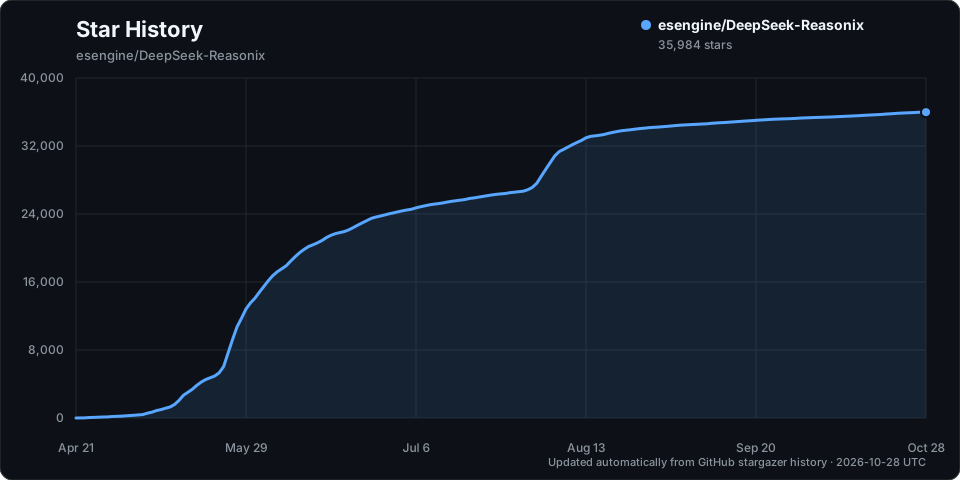
Star History
Acknowledgments
A small list of folks whose work has shaped Reasonix the most — the current top 20 contributors by commit count. The full contributor graph is on GitHub.
| Contributor | Contributor | Contributor | Contributor |
|---|---|---|---|
| SivanCola | esengine | ttmouse | lifu963 |
| reasonix | HUQIANTAO | GTC2080 | light-front-theory |
| merge-order-check | Li-Charles-One | eghrhegpe | wufengfan |
| CVEngineer66 | dependabot[bot] | lanshi17 | SuMuxi66 |
| CnsMaple | cyq1017 | JesonChou | XTLine |
Special thanks to Bernardxu123 for designing the project logo and intro video.
MIT — see LICENSE
Built by the community at esengine/DeepSeek-Reasonix
Support this project
If Reasonix has been useful and you'd like to say thanks, you can. It stays a coffee, not a contract — donations don't buy feature priority or change how issues get triaged.
- International — PayPal: paypal.me/yuhuahui
- 国内 — 微信支付(扫码)
