 Vaibhav JindalandClaude Opus 4.6
b7025a7027
Vaibhav JindalandClaude Opus 4.6
b7025a7027
## Summary
This has been generated using the `liger-kernel-perf` skill introduced
in #1185 .

Restructure the backward kernel of `fused_add_rms_norm` to reduce peak
register liveness, dropping register count from **115 → 95 per thread**
on H100. This eliminates a performance cliff at large hidden sizes and
yields up to **70% backward speedup** at H=16384.

## Root Cause Analysis

NCU profiling on H100 revealed the backward kernel was severely
underutilizing the GPU:

| Metric | Forward Kernel | Backward Kernel |
|--------|---------------|-----------------|
| Registers/Thread | 40 | **115** |
| Theoretical Occupancy | 75% | **25%** |
| Achieved Occupancy | 67.87% | **12.49%** |
| Blocks/SM (register-limited) | 6 | **2** |
| Waves/SM | 5.17 | **0.50** |
| Memory Throughput (% peak) | 78.24% | 60.88% |
| Compute Throughput (% peak) | 27.64% | 19.87% |

The H100 has 65,536 registers per SM. With 256 threads/block (8 warps x
32 threads), each thread using 115 registers consumes 115 x 256 = 29,440
registers per block. This means only `floor(65536 / 29440) = 2` blocks
can run concurrently per SM, yielding just 12.5% occupancy. With so few
active warps, the GPU cannot overlap memory accesses with computation —
stalling 77.5% of scheduler slots.

### Why so many registers?

The backward kernel processes one row per loop iteration, maintaining
several BLOCK_SIZE-wide vectors simultaneously in registers. With
BLOCK_SIZE=4096 and 256 threads, each thread handles 16 elements per
vector, requiring 16 registers per vector. The original code had up to
**~8 vectors live simultaneously** at peak:

| Vector | Lifetime | Purpose |
|--------|----------|---------|
| `W_row` | Persistent (loop-invariant) | Weight + offset |
| `dW_row` | Persistent (accumulator) | Weight gradient |
| `col_offsets` | Persistent | Column indices |
| `mask` | Persistent | Bounds mask |
| `dY_row` | Per-iteration | Upstream gradient |
| `X_row` | Per-iteration | Saved residual (fp32) |
| `m` | Per-iteration | `dY * W` intermediate |
| `dX_row` | Per-iteration | Output gradient |
| `dS_out_row` | Per-iteration (conditional) | Residual stream gradient
|

At 16 registers per vector x 8 vectors = 128 registers, plus
scalars/pointers/loop vars, this matches the observed 115 registers
(compiler optimizes some away).

## Changes

### 1. Reorder: compute dW before dX

**Before:** The original code computed `m -> dX -> dW -> store dX`. This
meant `dY_row`, `m`, `X_row`, `dX_row`, and `dW_row` were all live
simultaneously during the dW accumulation.

**After:** By computing `dW` first (`dW -> m -> dX -> store dX`), the
compiler can reuse `dY_row`'s registers when computing `m = dY_row *
W_row`, since `dY_row` is no longer needed independently after the dW
step. This is safe because both `dW` and `m` read `dY_row` — they don't
modify it (except in GEMMA mode where the cast happens after dW).

### 2. Factor the dX formula with a precomputed scalar

**Before:**
```python
dX_row = rstd_row * m
dX_row += (rstd_row) * (-(1 / n_cols) * rstd_row * rstd_row * tl.sum(m * X_row, axis=0) * X_row)
```

This expression keeps `m`, `X_row`, and the intermediate `rstd * (... *
X_row)` vector all live while computing the compound expression.

**After:**
```python
dot = tl.sum(m * X_row, axis=0)                              # scalar reduction
c = -(1.0 / n_cols) * rstd_row * rstd_row * rstd_row * dot   # scalar
dX_row = rstd_row * m + c * X_row                             # single fused expression
```

By precomputing `c` as a scalar, the final `dX_row` expression is a
simple element-wise combination of two vectors (`m` and `X_row`) scaled
by scalars. The compiler doesn't need to keep intermediate vector
results alive — it can compute each element of `dX_row` independently,
allowing better register reuse.

### 3. Defer dS_out load

**Before:** `dS_out_row` was loaded and added to `dX_row` inside the
compound correction expression, contributing to peak liveness.

**After:** `dS_out_row` is loaded only after the `dX_row = rstd * m + c
* X` computation is complete. By this point, `m` registers are freed, so
`dS_out_row` reuses them rather than competing for register space.

### 4. Add `num_stages=2` for Hopper software pipelining

**Rationale:** The current code never sets `num_stages`, so Triton
defaults to `num_stages=1` (no software pipelining). On H100 (Hopper
architecture), setting `num_stages >= 2` enables the compiler to overlap
memory loads for the next iteration with computation for the current
iteration using Hopper's async copy engine (TMA).

A parameter sweep confirmed `num_stages=2` is safe across all hidden
sizes with no regressions. Higher values (3-4) showed no additional
benefit for this kernel because the backward kernel's low occupancy
limits the pipeline depth that can be effectively utilized.
`num_stages=2` was chosen as the conservative optimal: it enables basic
pipelining without increasing register pressure (higher stages require
more pipeline buffer registers).

The `num_stages` value is passed through `ctx` from forward to backward,
following the same pattern as `BLOCK_SIZE` and `num_warps`.

### Combined effect

After these changes, the peak register liveness drops to ~5-6 vectors:

| Vector | Still live? |
|--------|------------|
| `W_row` | Yes (persistent) |
| `dW_row` | Yes (persistent) |
| `col_offsets` | Yes (persistent) |
| `mask` | Yes (persistent) |
| `dY_row` / `m` | **Shared** (compiler reuses registers) |
| `X_row` / `dX_row` | **Shared** (compiler reuses after dot product) |
| `dS_out_row` | Loaded late, **reuses freed `m` registers** |

NCU confirmed registers dropped from **115 → 95 per thread** (17%
reduction). While this doesn't cross the 85-register threshold needed
for 3 blocks/SM, the reduced pressure gives the compiler more freedom
for instruction scheduling and ILP (instruction-level parallelism),
which explains the dramatic speedup especially at H=16384 where the
original had extreme register spilling.

## Benchmark Results

**NVIDIA H100 80GB HBM3, M=2048, dtype=float32**

### Speed

| Mode | H | Before (ms) | After (ms) | Improvement |
|------|---|------------|-----------|-------------|
| Backward | 2048 | 0.124 | 0.096 | **23% faster** |
| Backward | 4096 | 0.124 | 0.101 | **18% faster** |
| Backward | 8192 | 0.153 | 0.154 | ~same |
| Backward | 16384 | 1.006 | 0.300 | **70% faster (3.35x)** |
| Backward | 32768 | 1.390 | 1.119 | **20% faster** |
| Full | 16384 | 1.186 | 0.482 | **59% faster** |
| Full | 32768 | 1.819 | 1.550 | **15% faster** |
| Forward | all sizes | - | - | unchanged |

### Memory

No change at any size (~30% savings vs HuggingFace maintained).

### Plots

**Backward Speed** (before / after / HuggingFace):

<!-- Paste backward speed plot here -->

**Full Pass Speed**:

<!-- Paste full pass speed plot here -->

**Forward Speed** (unchanged):

<!-- Paste forward speed plot here -->

**Memory** (unchanged):

<!-- Paste memory plot here -->

## Test plan

- [x] Full test suite passed: `python -m pytest
test/transformers/test_fused_add_rms_norm.py -xvs` (40/40 tests, all
casting modes + dtypes + shapes)
- [x] Checkstyle passed (ruff)
- [x] No memory regression at any hidden size
- [x] No forward pass regression
- [x] Benchmarked on NVIDIA H100 80GB HBM3
- [x] NCU profiling confirmed register reduction (115 → 95)

---------

Co-authored-by: Claude Opus 4.6 (1M context) <[email protected]>
Liger Kernel: Efficient Triton Kernels for LLM Training
| Stable | Nightly | Discord | ||
|---|---|---|---|---|

|

|

|

|
|

Installation | Getting Started | Examples | High-level APIs | Low-level APIs | Cite our work
Latest News 🔥
- [2025/12/19] We announced a liger kernel discord channel at https://discord.gg/X4MaxPgA; We will be hosting Liger Kernel x Triton China Meetup in mid of January 2026
- [2025/03/06] We release a joint blog post on TorchTune × Liger - Peak Performance, Minimized Memory: Optimizing torchtune’s performance with torch.compile & Liger Kernel
- [2024/12/11] We release v0.5.0: 80% more memory efficient post training losses (DPO, ORPO, CPO, etc)!
- [2024/12/5] We release LinkedIn Engineering Blog - Liger-Kernel: Empowering an open source ecosystem of Triton Kernels for Efficient LLM Training
- [2024/11/6] We release v0.4.0: Full AMD support, Tech Report, Modal CI, Llama-3.2-Vision!
- [2024/10/21] We have released the tech report of Liger Kernel on Arxiv: https://arxiv.org/pdf/2410.10989
- [2024/9/6] We release v0.2.1 (X post). 2500+ Stars, 10+ New Contributors, 50+ PRs, 50k Downloads in two weeks!
- [2024/8/31] CUDA MODE talk, Liger-Kernel: Real-world Triton kernel for LLM Training, Slides
- [2024/8/23] Official release: check out our X post
Liger Kernel is a collection of Triton kernels designed specifically for LLM training. It can effectively increase multi-GPU training throughput by 20% and reduces memory usage by 60%. We have implemented Hugging Face Compatible RMSNorm, RoPE, SwiGLU, CrossEntropy, FusedLinearCrossEntropy, and more to come. The kernel works out of the box with Flash Attention, PyTorch FSDP, and Microsoft DeepSpeed. We welcome contributions from the community to gather the best kernels for LLM training.
We've also added optimized Post-Training kernels that deliver up to 80% memory savings for alignment and distillation tasks. We support losses like DPO, CPO, ORPO, SimPO, KTO, JSD, and many more. Check out how we optimize the memory.
You can view the documentation site for additional installation, usage examples, and API references:https://linkedin.github.io/Liger-Kernel/
You can view the Liger Kernel Technical Report: https://openreview.net/forum?id=36SjAIT42G
Supercharge Your Model with Liger Kernel
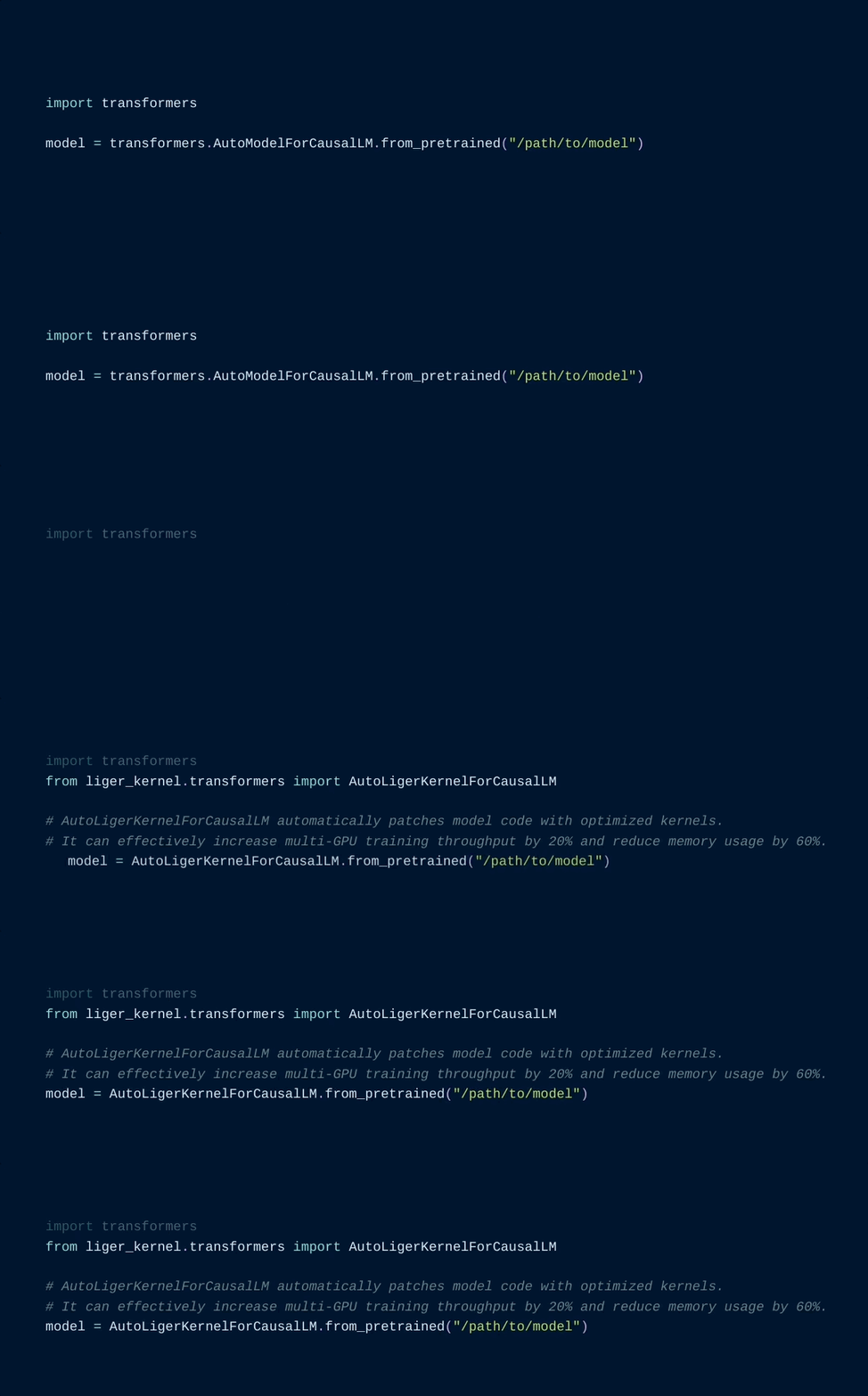
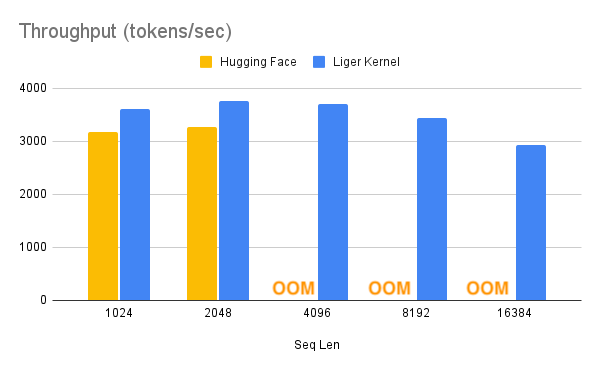
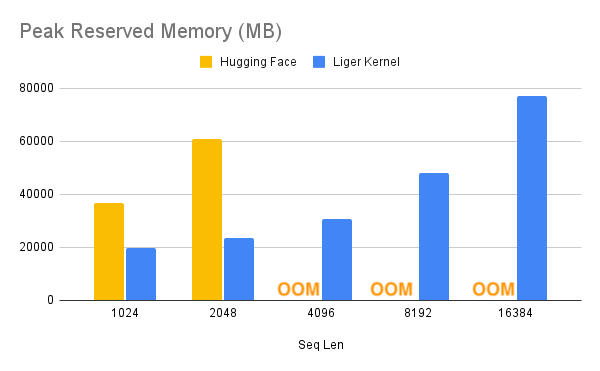
With one line of code, Liger Kernel can increase throughput by more than 20% and reduce memory usage by 60%, thereby enabling longer context lengths, larger batch sizes, and massive vocabularies.
| Speed Up | Memory Reduction |
|---|---|
 |
 |
Note:
- Benchmark conditions: LLaMA 3-8B, Batch Size = 8, Data Type =
bf16, Optimizer = AdamW, Gradient Checkpointing = True, Distributed Strategy = FSDP1 on 8 A100s.- Hugging Face models start to OOM at a 4K context length, whereas Hugging Face + Liger Kernel scales up to 16K.
Optimize Post Training with Liger Kernel
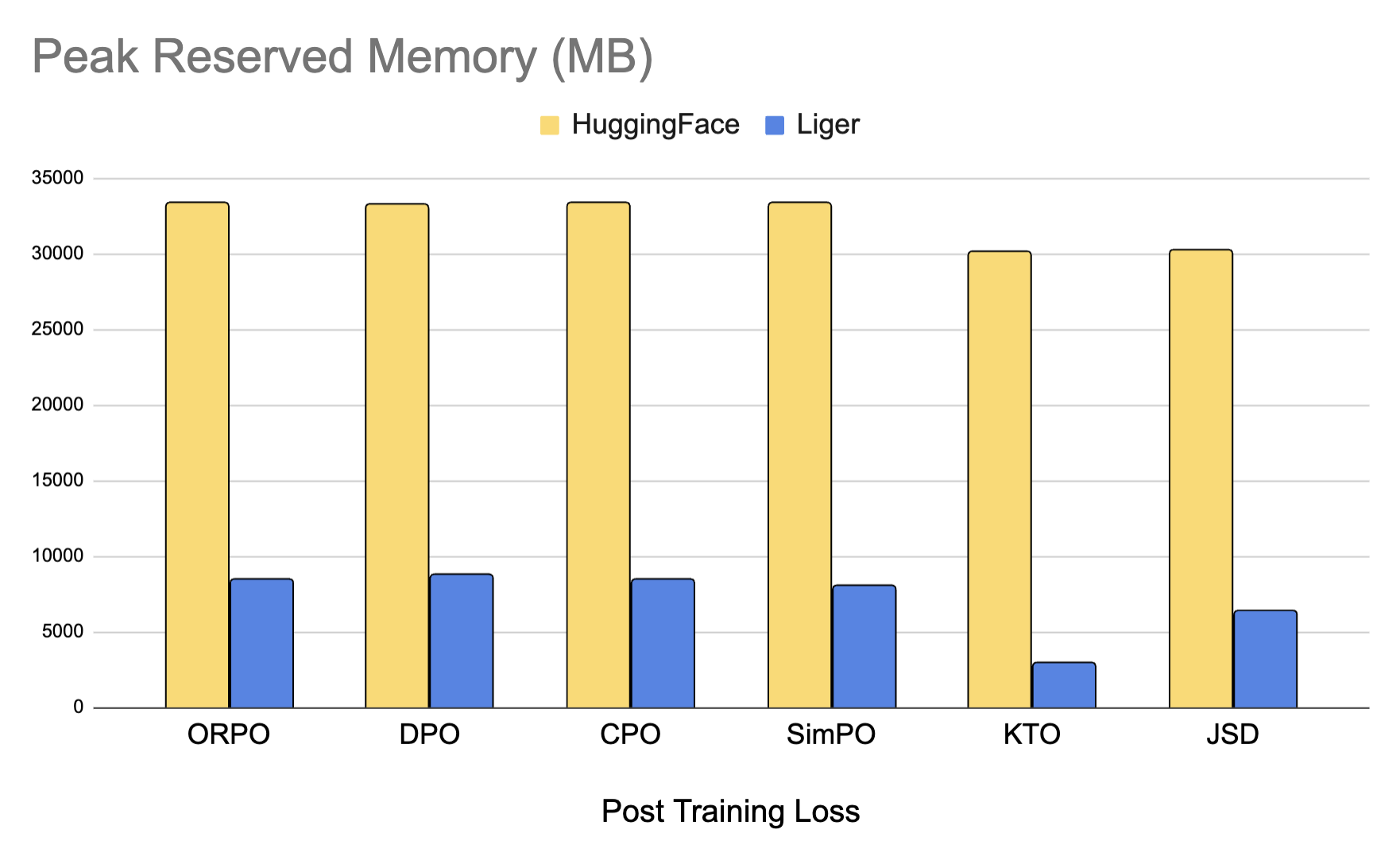
We provide optimized post training kernels like DPO, ORPO, SimPO, and more which can reduce memory usage by up to 80%. You can easily use them as python modules.
from liger_kernel.chunked_loss import LigerFusedLinearORPOLoss
orpo_loss = LigerFusedLinearORPOLoss()
y = orpo_loss(lm_head.weight, x, target)
Examples
| Use Case | Description |
|---|---|
| Hugging Face Trainer | Train LLaMA 3-8B ~20% faster with over 40% memory reduction on Alpaca dataset using 4 A100s with FSDP |
| Lightning Trainer | Increase 15% throughput and reduce memory usage by 40% with LLaMA3-8B on MMLU dataset using 8 A100s with DeepSpeed ZeRO3 |
| Medusa Multi-head LLM (Retraining Phase) | Reduce memory usage by 80% with 5 LM heads and improve throughput by 40% using 8 A100s with FSDP |
| Vision-Language Model SFT | Finetune Qwen2-VL on image-text data using 4 A100s with FSDP |
| Liger ORPO Trainer | Align Llama 3.2 using Liger ORPO Trainer with FSDP with 50% memory reduction |
Key Features
- Ease of use: Simply patch your Hugging Face model with one line of code, or compose your own model using our Liger Kernel modules.
- Time and memory efficient: In the same spirit as Flash-Attn, but for layers like RMSNorm, RoPE, SwiGLU, and CrossEntropy! Increases multi-GPU training throughput by 20% and reduces memory usage by 60% with kernel fusion, in-place replacement, and chunking techniques.
- Exact: Computation is exact—no approximations! Both forward and backward passes are implemented with rigorous unit tests and undergo convergence testing against training runs without Liger Kernel to ensure accuracy.
- Lightweight: Liger Kernel has minimal dependencies, requiring only Torch and Triton—no extra libraries needed! Say goodbye to dependency headaches!
- Multi-GPU supported: Compatible with multi-GPU setups (PyTorch FSDP, DeepSpeed, DDP, etc.).
- Trainer Framework Integration: Axolotl, LLaMa-Factory, SFTTrainer, Hugging Face Trainer, SWIFT, oumi
Installation
Dependencies
CUDA
torch >= 2.1.2triton >= 2.3.0
ROCm
torch >= 2.5.0Install according to the instruction in Pytorch official webpage.triton >= 3.0.0Install from pypi. (e.g.pip install triton==3.0.0)
pip install -e .[dev]
pip3 install --pre torch torchvision torchaudio --index-url https://download.pytorch.org/whl/nightly/rocm6.3/
Optional Dependencies
transformers >= 4.x: Required if you plan to use the transformers models patching APIs. The specific model you are working will dictate the minimum version of transformers.
Note: Our kernels inherit the full spectrum of hardware compatibility offered by Triton.
To install the stable version:
$ pip install liger-kernel
To install the nightly version:
$ pip install liger-kernel-nightly
To install from source:
git clone https://github.com/linkedin/Liger-Kernel.git
cd Liger-Kernel

# Install Default Dependencies
# Setup.py will detect whether you are using AMD or NVIDIA
pip install -e .

# Setup Development Dependencies
pip install -e ".[dev]"

# NOTE -> For AMD users only
pip3 install --pre torch torchvision torchaudio --index-url https://download.pytorch.org/whl/nightly/rocm6.3/
Getting Started
There are a couple of ways to apply Liger kernels, depending on the level of customization required.
1. Use AutoLigerKernelForCausalLM
Using the AutoLigerKernelForCausalLM is the simplest approach, as you don't have to import a model-specific patching API. If the model type is supported, the modeling code will be automatically patched using the default settings.
from liger_kernel.transformers import AutoLigerKernelForCausalLM

# This AutoModel wrapper class automatically monkey-patches the
# model with the optimized Liger kernels if the model is supported.
model = AutoLigerKernelForCausalLM.from_pretrained("path/to/some/model")
2. Apply Model-Specific Patching APIs
Using the patching APIs, you can swap Hugging Face models with optimized Liger Kernels.
import transformers
from liger_kernel.transformers import apply_liger_kernel_to_llama

# 1a. Adding this line automatically monkey-patches the model with the optimized Liger kernels
apply_liger_kernel_to_llama()

# 1b. You could alternatively specify exactly which kernels are applied
apply_liger_kernel_to_llama(
  rope=True,
  swiglu=True,
  cross_entropy=True,
  fused_linear_cross_entropy=False,
  rms_norm=False
)

# 2. Instantiate patched model
model = transformers.AutoModelForCausalLM("path/to/llama/model")
3. Compose Your Own Model
You can take individual kernels to compose your models.
from liger_kernel.transformers import LigerFusedLinearCrossEntropyLoss
import torch.nn as nn
import torch

model = nn.Linear(128, 256).cuda()

# fuses linear + cross entropy layers together and performs chunk-by-chunk computation to reduce memory
loss_fn = LigerFusedLinearCrossEntropyLoss()

input = torch.randn(4, 128, requires_grad=True, device="cuda")
target = torch.randint(256, (4, ), device="cuda")

loss = loss_fn(model.weight, input, target)
loss.backward()
High-level APIs
AutoModel
| AutoModel Variant | API |
|---|---|
| AutoModelForCausalLM | liger_kernel.transformers.AutoLigerKernelForCausalLM |
Patching
| Model | API | Supported Operations |
|---|---|---|
| Llama4 (Text) & (Multimodal) | liger_kernel.transformers.apply_liger_kernel_to_llama4 |
RMSNorm, LayerNorm, GeGLU, CrossEntropyLoss, FusedLinearCrossEntropy |
| LLaMA 2 & 3 | liger_kernel.transformers.apply_liger_kernel_to_llama |
RoPE, RMSNorm, SwiGLU, CrossEntropyLoss, FusedLinearCrossEntropy |
| LLaMA 3.2-Vision | liger_kernel.transformers.apply_liger_kernel_to_mllama |
RoPE, RMSNorm, SwiGLU, CrossEntropyLoss, FusedLinearCrossEntropy |
| Ministral | liger_kernel.transformers.apply_liger_kernel_to_ministral |
RoPE, RMSNorm, SwiGLU, CrossEntropyLoss, FusedLinearCrossEntropy |
| Mistral | liger_kernel.transformers.apply_liger_kernel_to_mistral |
RoPE, RMSNorm, SwiGLU, CrossEntropyLoss, FusedLinearCrossEntropy |
| Mixtral | liger_kernel.transformers.apply_liger_kernel_to_mixtral |
RoPE, RMSNorm, SwiGLU, CrossEntropyLoss, FusedLinearCrossEntropy |
| Nemotron | liger_kernel.transformers.apply_liger_kernel_to_nemotron |
ReLUSquared, CrossEntropyLoss, FusedLinearCrossEntropy |
| Pixtral | liger_kernel.transformers.apply_liger_kernel_to_pixtral |
RoPE, RMSNorm, SwiGLU |
| Gemma1 | liger_kernel.transformers.apply_liger_kernel_to_gemma |
RoPE, RMSNorm, GeGLU, CrossEntropyLoss, FusedLinearCrossEntropy |
| Gemma2 | liger_kernel.transformers.apply_liger_kernel_to_gemma2 |
RoPE, RMSNorm, GeGLU, CrossEntropyLoss, FusedLinearCrossEntropy |
| Gemma3 (Text) | liger_kernel.transformers.apply_liger_kernel_to_gemma3_text |
RoPE, RMSNorm, GeGLU, CrossEntropyLoss, FusedLinearCrossEntropy |
| Gemma3 (Multimodal) | liger_kernel.transformers.apply_liger_kernel_to_gemma3 |
LayerNorm, RoPE, RMSNorm, GeGLU, CrossEntropyLoss, FusedLinearCrossEntropy |
| Paligemma, Paligemma2, & Paligemma2 Mix | liger_kernel.transformers.apply_liger_kernel_to_paligemma |
LayerNorm, RoPE, RMSNorm, GeGLU, CrossEntropyLoss, FusedLinearCrossEntropy |
| Qwen2, Qwen2.5, & QwQ | liger_kernel.transformers.apply_liger_kernel_to_qwen2 |
RoPE, RMSNorm, SwiGLU, CrossEntropyLoss, FusedLinearCrossEntropy |
| Qwen2-VL, & QVQ | liger_kernel.transformers.apply_liger_kernel_to_qwen2_vl |
RMSNorm, LayerNorm, SwiGLU, CrossEntropyLoss, FusedLinearCrossEntropy |
| Qwen2.5-VL | liger_kernel.transformers.apply_liger_kernel_to_qwen2_5_vl |
RMSNorm, SwiGLU, CrossEntropyLoss, FusedLinearCrossEntropy |
| Qwen3 | liger_kernel.transformers.apply_liger_kernel_to_qwen3 |
RoPE, RMSNorm, SwiGLU, CrossEntropyLoss, FusedLinearCrossEntropy |
| Qwen3 MoE | liger_kernel.transformers.apply_liger_kernel_to_qwen3_moe |
RoPE, RMSNorm, SwiGLU, CrossEntropyLoss, FusedLinearCrossEntropy |
| Qwen3.5 | liger_kernel.transformers.apply_liger_kernel_to_qwen3_5 |
RMSNorm, SwiGLU, CrossEntropyLoss, FusedLinearCrossEntropy |
| Phi3 & Phi3.5 | liger_kernel.transformers.apply_liger_kernel_to_phi3 |
RoPE, RMSNorm, SwiGLU, CrossEntropyLoss, FusedLinearCrossEntropy |
| Granite 3.0 & 3.1 | liger_kernel.transformers.apply_liger_kernel_to_granite |
RoPE, RMSNorm, SwiGLU, CrossEntropyLoss |
| OLMo2 | liger_kernel.transformers.apply_liger_kernel_to_olmo2 |
RoPE, RMSNorm, SwiGLU, CrossEntropyLoss, FusedLinearCrossEntropy |
| Olmo3 | liger_kernel.transformers.apply_liger_kernel_to_olmo3 |
RoPE, RMSNorm, SwiGLU, CrossEntropyLoss, FusedLinearCrossEntropy |
| GLM-4 | liger_kernel.transformers.apply_liger_kernel_to_glm4 |
RoPE, RMSNorm, SwiGLU, CrossEntropyLoss, FusedLinearCrossEntropy |
| GPT-OSS | liger_kernel.transformers.apply_liger_kernel_to_gpt_oss |
RoPE, RMSNorm, CrossEntropyLoss, FusedLinearCrossEntropy |
| InternVL3 | liger_kernel.transformers.apply_liger_kernel_to_internvl |
RoPE, RMSNorm, SwiGLU, CrossEntropyLoss, FusedLinearCrossEntropy |
| HunyuanV1 | liger_kernel.transformers.apply_liger_kernel_to_hunyuan_v1_dense |
RoPE, RMSNorm, SwiGLU, CrossEntropyLoss, FusedLinearCrossEntropy |
| HunyuanV1 MoE | liger_kernel.transformers.apply_liger_kernel_to_hunyuan_v1_moe |
RoPE, RMSNorm, SwiGLU, CrossEntropyLoss, FusedLinearCrossEntropy |
Low-level APIs
Fused Linearkernels combine linear layers with losses, reducing memory usage by up to 80% - ideal for HBM-constrained workloads.- Other kernels use fusion and in-place techniques for memory and performance optimization.
Model Kernels
| Kernel | API |
|---|---|
| RMSNorm | liger_kernel.transformers.LigerRMSNorm |
| LayerNorm | liger_kernel.transformers.LigerLayerNorm |
| RoPE | liger_kernel.transformers.liger_rotary_pos_emb |
| SwiGLU | liger_kernel.transformers.LigerSwiGLUMLP |
| GeGLU | liger_kernel.transformers.LigerGEGLUMLP |
| CrossEntropy | liger_kernel.transformers.LigerCrossEntropyLoss |
| Fused Linear CrossEntropy | liger_kernel.transformers.LigerFusedLinearCrossEntropyLoss |
| Multi Token Attention | liger_kernel.transformers.LigerMultiTokenAttention |
| Softmax | liger_kernel.transformers.LigerSoftmax |
| Sparsemax | liger_kernel.transformers.LigerSparsemax |
| mHC (Hyper-Connections) | liger_kernel.transformers.LigerMHC |
Alignment Kernels
| Kernel | API |
|---|---|
| Fused Linear CPO Loss | liger_kernel.chunked_loss.LigerFusedLinearCPOLoss |
| Fused Linear DPO Loss | liger_kernel.chunked_loss.LigerFusedLinearDPOLoss |
| Fused Linear ORPO Loss | liger_kernel.chunked_loss.LigerFusedLinearORPOLoss |
| Fused Linear SimPO Loss | liger_kernel.chunked_loss.LigerFusedLinearSimPOLoss |
| Fused Linear KTO Loss | liger_kernel.chunked_loss.LigerFusedLinearKTOLoss |
Distillation Kernels
| Kernel | API |
|---|---|
| KLDivergence | liger_kernel.transformers.LigerKLDIVLoss |
| JSD | liger_kernel.transformers.LigerJSD |
| Fused Linear JSD | liger_kernel.transformers.LigerFusedLinearJSD |
| TVD | liger_kernel.transformers.LigerTVDLoss |
Experimental Kernels
| Kernel | API |
|---|---|
| Embedding | liger_kernel.transformers.experimental.LigerEmbedding |
| Matmul int2xint8 | liger_kernel.transformers.experimental.matmul |
Contributing, Acknowledgements, and License
Sponsorship and Collaboration
- Glows.ai: Sponsoring NVIDIA GPUs for our open source developers.
- AMD: Providing AMD GPUs for our AMD CI.
- Intel: Providing Intel GPUs for our Intel CI.
- Modal: Free 3000 credits from GPU MODE IRL for our NVIDIA CI.
- EmbeddedLLM: Making Liger Kernel run fast and stable on AMD.
- HuggingFace: Integrating Liger Kernel into Hugging Face Transformers and TRL.
- Lightning AI: Integrating Liger Kernel into Lightning Thunder.
- Axolotl: Integrating Liger Kernel into Axolotl.
- Llama-Factory: Integrating Liger Kernel into Llama-Factory.
CI status
| Build |
|---|


|
Contact
- For issues, create a Github ticket in this repository
- For open discussion, join our discord channel on GPUMode
- For formal collaboration, send an email to Yanning Chen([email protected]) and Zhipeng Wang([email protected])
Cite this work
Biblatex entry:
@inproceedings{
hsu2025ligerkernel,
title={Liger-Kernel: Efficient Triton Kernels for {LLM} Training},
author={Pin-Lun Hsu and Yun Dai and Vignesh Kothapalli and Qingquan Song and Shao Tang and Siyu Zhu and Steven Shimizu and Shivam Sahni and Haowen Ning and Yanning Chen and Zhipeng Wang},
booktitle={Championing Open-source DEvelopment in ML Workshop @ ICML25},
year={2025},
url={https://openreview.net/forum?id=36SjAIT42G}
}