In the original game, they had no choice but to use the memory card file
as their method of persisting settings. We are not limited by such
things.
It's inconvenient to have to load your save-file when launching the game
to initialize these settings to your liking, it's also confusing
behaviour to even some players that have played the game heavily for
over a decade. We can do better by globally saving these settings to the
`pc-settings` file instead.
Originally I only migrated the volume settings, then i figured it would
be nice to also have play-hints and subtitles settings persisted. More
could debatably be moved (language is a big one...) but these were the
low hanging fruit.
I also reduced the default volumes as that is something else that has
come up a few times.
Fixes https://github.com/open-goal/jak-project/issues/3563
These users have the following spamming in logs:
> OpenGL error 0x502 S8246 T824C: GL_INVALID_OPERATION error generated.
Source and destination dimensions must be identical with the current
filtering modes.
And the solution is to correctly set their game-size. The way this
change accomplishes that is by confirming whether or not the set
`game-size` is a valid resolution informed by SDL, if not, it defaults
to the monitor's currently set display mode's resolution.
This also moves the selected display id, and the display mode into the
C++ settings -- closer to where it's actually managed and used. I'm
tempted to do this eventually for the resolutions as well but that stuff
is much more burdensome. This hopefully simplifies debugging, reduces
startup flickering, and removes back-and-forth complexity. Hopefully
this makes debugging display related problems easier. It also adds a
bunch more logging to the related code.
They still don't work yet, this is just naming/comments to help with
debug.
The vehicle tracks are now at least trying to draw, but like the others,
don't actually show up.
This attempts to do a best-effort quick fix for the sprite alignment in
the menus and first person views on higher aspect ratios. This:
- Hides the binocular borders completely when using a non-standard ratio

- Hides the borders in jak's first person view when using a non-standard
ratio

- Uses a combination of manual alignment and approximation to get the
pause menu closer.

> 32:9 screenshot.
I accomplished the last one by manually aligning all of the core sprites
and text for the most popular aspect ratios. This means that from a
practical standpoint, things should align "perfectly". However, I then
used all of those values to derive a polynomial for each adjustment
based on the aspect ratio. This allows the game to do a half-decent
approximation/interpolation for every aspect ratio in-between the common
ones. It won't be perfect, but it will be better than this:

For the FJ Mirrors, Muse, Lightning Moles, and Gambler's race the tasks
are completed in one level, then turned in at the hub. This presents a
spot of confusion for new players with the autosplitter and requires
hacky workarounds for those who want to split on these conditions. This
pull request adds in the necessary code to the autosplit-h.gc and
autosplit.gc files so that the autosplitter can identify these events,
similar to the talk to fisherman and catch fish options in the current
autosplitter.
A few minor fixes:
- Fix crash in overlord3 during final boss
https://github.com/open-goal/jak-project/issues/3605
- Update goal_src for `scene-actor.gc`, which was not updated after a
bug fix for decompiling skelgroups, making some cutscene actors
invisible due to using the wrong joint for culling checks.
- Stop using `-1` as an invalid value for texture id's in Merc.cpp. This
could sometimes cause Merc2.cpp to accidentally skip updating the OpenGL
texture. This fixes the bug where skull gems sometimes didn't have the
animated textures.
I found two issues with Jak 3 eyes. The first was simple - we were
missing a `-pc` texture upload in `texture.gc` for `pris2` textures,
which has eye textures for a few characters, like torn or damas.
The second was a little more annoying. Unlike jak 2 and jak 1, jak 3 can
dynamically assign eye slots when merc models are loaded. This involves
modifying eye data to tell the eye renderer where to render, and
modifying the merc model's adgif shaders to point to the correct eye
texture. The modification to the merc adgif shader is problematic since
our PC port of merc assumes this slot is constant.
My solution here was to bypass this whole slot system entirely for jak
3. I modified the GOAL eye renderer to tell the c++ eye renderer the
name of the merc-ctrl containing the eye. Then, the PC C++ Merc renderer
can just look up the merc-ctrl by name. To make this fit nicely in the
existing memory layout, I used a 64-bit fnv hash of the name. (which
honestly is how we should have handled a lot of other texture/model
names stuff...)
Unrelated fix to Overlord2 so it handles the case where file size
changes after the game starts, I had this in jak2/jak1 and forgot it for
jak 3.
This adds support for replacing existing merc models in FR3 files with
custom GLB model files. The replacements go in
`custom_assets/<GAME>/merc_replacements`, similar to texture
replacements. When a `.glb` file with a file name that matches any model
present in an FR3 is detected (e.g. `eichar-lod0` for Jak), all merc
model data is replaced with the given model.
Additionally, models for custom actors can now also be added to vanilla
FR3s. The models for this go in
`custom_assets/<GAME>/models/<LEVEL_NAME>` (e.g.
`custom_assets/jak1/models/jungleb/test-actor-lod0.glb`) and will be
added to the FR3 that has a matching name (exception: to add things to
the common level file, the folder should be named `common` instead of
`GAME`).
For custom levels, these now go in
`custom_assets/<GAME>/models/custom_levels` (previously
`custom_assets/<GAME>/models`).
Another small change: When level ripping is enabled, the resulting model
files will now be stored in game name subfolders inside of `glb_out`.
Fixes a couple of NaN bugs, making the Arena and Marauder Stronghold
missions, the leaper corralling mission and final boss playable:
- Fixes#3579:
- After catching a leaper, the `flut` that spawns would have a NaN
`world-sphere`
- Fixes#3580:
- `vf0` was being clobbered after a `suspend`, causing them to spawn at
the origin.
- The Terraformer's `world-sphere` would be NaN until an animation
started playing.
This centralizes the code that both `extractor` and the decompiler
executes. In the past this code was partially-duplicated, meaning that
the `extractor` could only do _some_ operations and not others (ie.
could not extract the audio files).
I also simplified the process to enable audio streaming in the
configuration. This is to support a new feature in the launcher that
allows you to enable these options for the decompiler:

- Can make the event buffer larger or smaller
- UI shows the current event index / size, so you know how fast it's
filling up
- Can save compressed, 10x reduction in filesize and Windows 11 explorer
actually supports ZSTD natively now so this isn't inconvenient at all

> An example of almost 1 million events. Results in a 4mb file.
Currently PS2 Actor Vis and FPS are only enforced when starting a run -
this enforces them on every frame similar to cheats.
In the progress menu, FPS is already disabled in speedrunner mode - this
adds the same restriction for PS2 Actor Vis.
Jak 2 already does this properly, no change needed there
This PR does two main things:
1. Work through the main low-hanging fruit issues in the formatter
keeping it from feeling mature and usable
2. Iterate and prove that point by formatting all of the Jak 1 code
base. **This has removed around 100K lines in total.**
- The decompiler will now format it's results for jak 1 to keep things
from drifting back to where they were. This is controlled by a new
config flag `format_code`.
How am I confident this hasn't broken anything?:
- I compiled the entire project and stored it's `out/jak1/obj` files
separately
- I then recompiled the project after formatting and wrote a script that
md5's each file and compares it (`compare-compilation-outputs.py`
- The results (eventually) were the same:

> This proves that the only difference before and after is non-critical
whitespace for all code/macros that is actually in use.
I'm still aware of improvements that could be made to the formatter, as
well as general optimization of it's performance. But in general these
are for rare or non-critical situations in my opinion and I'll work
through them before doing Jak 2. The vast majority looks great and is
working properly at this point. Those known issues are the following if
you are curious:

People seem to be translating lines that aren't in the base english one,
such as `mtn-plat-buried-rocks-a`
This is fine, but Crowdin will continue to remove these every sync PR
because they aren't in the base english file. So some kind of
segregation needs to happen.
If we didn't want these scenes translated, then they should be banned
from being translated via the editor / etc in the first place (shouldn't
have been included in the metadata).
This adds support for generating collide meshes when importing custom
models. A couple of things to keep in mind:
- A single `collide-mesh` may only have up to 255 vertices.
- When exporting a GLTF file in Blender, a `collide-mesh` will be
generated for every mesh object that has collision properties applied
(ideally, you would set all visual meshes to `ignore` and your collision
meshes to `invisible` in the OpenGOAL plugin's custom properties).
- Ensure that your actor using the model properly allocates enough
`collide-shape-prim-mesh`es for each `collide-mesh` ([example from the
original game that uses multiple
meshes](https://github.com/open-goal/jak-project/blob/f6688659f2ef85f5ceaacea6271580c9f4d91ed1/goal_src/jak1/levels/finalboss/robotboss.gc#L2628-L2806)).
~One annoying problem that I haven't fully figured out yet (unrelated to
the actual functionality):
`collide-mesh`es are stored in art groups as an `(array collide-mesh)`
in the `art-joint-geo`'s `extra`, so I had to add a new `Res` type to
support this. The way that `array`s are stored in `res-lump`s is a bit
of a hack right now. The lump only stores a pointer to the array, so the
size of that is 4 bytes, but because we have to generate all the actual
array data too, the current `ResLump` code in C++ doesn't handle this
case well and would assert, so I decided to omit the asserts if an
`array` tag is present and "fake" the size so the object file is
generated more closely to how the game expects it until we figure out
something better.~
This was fixed by generating the array data beforehand and creating a
`ResRef` class that takes the pointer to the array data and adds it to
the lump.
This does a couple of things:
- The `custom_levels` folder was renamed to `custom_assets` and contains
`levels`, `models` and `texture_replacements` folders for Jak 1, 2 and 3
in order to keep everything regarding custom stuff in one place.
- With this, texture replacements now use separate folders for all games
- A build actor tool was added that generates art groups for custom
actors
- Custom levels can now specify what custom models from the `models`
folder they want to import, this will add them to the level's FR3.
- A `test-zone-obs.gc` file was added, containing a `test-actor` process
that uses a custom model as an example.
The build actor tool is still very WIP, the joints and the default
animation are hardcoded, but it allows for importing any GLB file as a
merc model.
For now, this just adds sky (clouds and fog), darkjak, and skull gem.
There are some unknown issues with drawing the skull gems still, but I
think it's unrelated to texture animations.
Also fixes https://github.com/open-goal/jak-project/issues/3523
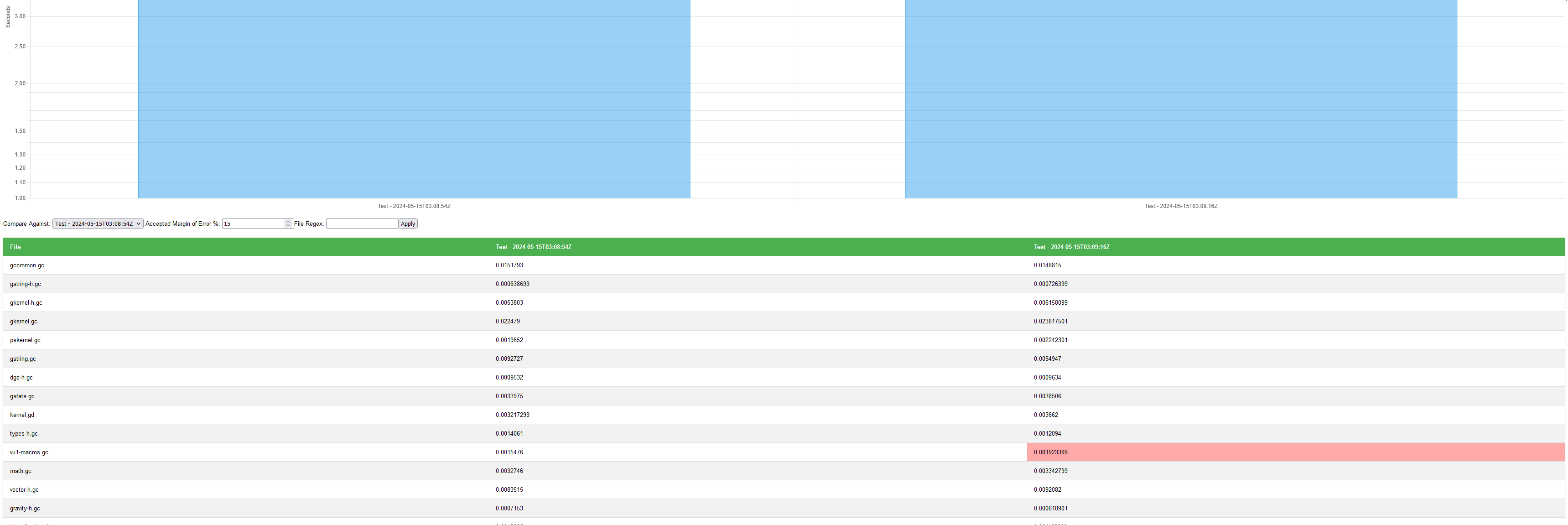
Adds a quick perf report feature to `goalc` that lets you compare how
much faster / slower it takes to compile the projects, with some simple
features like filtering the files, adjusting for how large of a margin
of error in the speeds you care about, and which test iteration you want
to compare against.
This is something I plan to use as I work more in `goalc` as an easy way
to track / show the results.
Relates to #1353
This adds no new functionality or overhead to the compiler, yet. This is
the preliminary work that has:
- added code to the compiler in several spots to flag when something is
used without being properly required/imported/whatever (disabled by
default)
- that was used to generate project wide file dependencies (some
circulars were manually fixed)
- then that graph underwent a transitive reduction and the result was
written to all `jak1` source files.
The next step will be making this actually produce and use a dependency
graph. Some of the reasons why I'm working on this:
- eliminates more `game.gp` boilerplate. This includes the `.gd` files
to some extent (`*-ag` files and `tpage` files will still need to be
handled) this is the point of the new `bundles` form. This should make
it even easier to add a new file into the source tree.
- a build order that is actually informed from something real and
compiler warnings that tell you when you are using something that won't
be available at build time.
- narrows the search space for doing LSP actions -- like searching for
references. Since it would be way too much work to store in the compiler
every location where every symbol/function/etc is used, I have to do
ad-hoc searches. By having a dependency graph i can significantly reduce
that search space.
- opens the doors for common shared code with a legitimate pattern.
Right now jak 2 shares code from the jak 1 folder. This is basically a
hack -- but by having an explicit require syntax, it would be possible
to reference arbitrary file paths, such as a `common` folder.
Some stats:
- Jak 1 has about 2500 edges between files, including transitives
- With transitives reduced at the source code level, each file seems to
have a modest amount of explicit requirements.
Known issues:
- Tracking the location for where `defmacro`s and virtual state
definitions were defined (and therefore the file) is still problematic.
Because those forms are in a macro environment, the reader does not
track them. I'm wondering if a workaround could be to search the
reader's text_db by not just the `goos::Object` but by the text
position. But for the purposes of finishing this work, I just statically
analyzed and searched the code with throwaway python code.
This adds hfrag, but with a few remaining issues:
- The textures aren't animated. Instead, it just uses one texture.
- The texture filtering isn't as good as at it could be.
I also cleaned up a few issues with the background renderers:
- Cleaned up some stuff that is common to hfrag, tie, tfrag, shrub
- Moved time-of-day color packing stuff to FR3 creation, rather than at
level load. This appears to reduce the frame time spikes when a level is
first drawn by about 5 or 6 ms in big levels.
- Cleaned up the x86 specific stuff used in time of day. Now there's
only one place where we have an `ifdef`, rather than spreading it all
over the rendering code.
This fixes issues with certain Jak 3 levels not rendering because there
is a mismatch between the DGO name, nickname and real level name (bsp
name).
FR3s use a different filename, so you can delete the ones you have after
this is merged.
This affects custom levels, but I don't have that toolchain set up so
someone else will have to test that.
This is primarily driven for proper mod-support. Mods would like to
isolate their settings and saves (potentially) and that is currently
done by find-and-replacing code before building. Bad!
Additionally, this has the side-effect of allowing for portable
installations of the game so, win-win.
Testing in progress, i'll merge once it is ready.
Patching up the extractor while working on the launcher, fixes:
- makes it so you can compile successfully given a folder path
(currently assumes your project path contains `iso_data`)
- ignore `buildinfo.json` from validation code.
- fixes an edge-case that could recursively fill up your entire
hard-drive!
- allows overriding the decompilation configuration via flag
- adds a way to specify where the ISO should be extracted to
I noticed that jak 3's compilation was spending a lot of time accessing
the `unordered_map`s we use to store constants and symbol types.
I repurposed the `EnvironmentMap` originally made for GOOS for this. It
turns out that we were copying the entire constant map whenever we
encountered a `deftype`, and fixed that too.
This speeds up jak3 compiles from ~16 to 11 seconds for me.
This includes all the collision stuff needed to spawn `target`,
decompiles the sparticle code and adds some of the PC hacks needed for
merc to run (it doesn't work quite right and looks bad, likely due to a
combination of code copied from Jak 2 and the time of day hacks).
There are a bunch of temporary hacks (see commits) in place to prevent
the game from crashing quite as much, but it is still extremely prone to
doing so due to lots of missing functions/potentially bad decomp.
---------
Co-authored-by: water <[email protected]>
This was hiding options for people that only had 60hz monitors since the
two menus drifted -- it is not necessary for an entire separate menu,
just disable the option if applicable.
Don't merge this without testing it throughly
The `test-play` macro is back, though it doesn't call `play` yet. We can
at least load all of `game.cgo`, which involves loading a lot of the
code we've decompiled, loading/linking objects files compiled by
OpenGOAL (like dir-tpages), and loading/linking Jak's art-groups (for
jak 3 they are stored v5 format that I added to the linker).
There were no major issues - just a few forgotten mips2c entries and
minor bugs/functions that needed stubs. Most of the work was updating
the linker. Hopefully I'll never have to touch that code again - I think
it supports everything we need for jak 3!
- `fma-sphere`
- `prim-beam-h`
- `cam-start`
- `ragdoll`
- `light-trails-h`
- `light-trails`
- `menu`
- `water`
- `water-flow`
- `hud`
- `hud-classes`
- `progress`
- `progress-draw`
---
The `get-texture` macro replaces calls to `lookup-texture-by-id` and
`lookup-texture-by-id-fast`. The `defpart` macro detection was modified
to print a pair like `(texture-name tpage-name)` for the texture field
that gets turned into a `texture-id` constant. Only used in Jak 3 at the
moment, I'll probably go through the other games at a later point.
Small fix to decompiler when the original compiler uses `ra` register.
This seems to happen in "normal" code very rarely - perhaps they
manually specified this in an `rlet`.
Start figuring out buckets/textures for Jak 3.
The foreground code is not yet modified for PC - I want to wait until
the game is running, since it is too hard to do it now.
Reverse engineer the skinning matrix calculation and port to GOAL. This
is about 3x faster than the MIPS2c version.
As usual, there is a `*use-new-bones*` flag to go back to the old
version.
Fix for a bug in the compiler's `.div.vf` implementation (only happens
if src/dst are the same), and fix for a typo in the register allocator
that would sometimes cause it not to consider xmm8-xmm15.
This is not a fix, but it temporarily works around the potential crash
discussed here https://github.com/open-goal/jak-project/issues/2988
As long as this doesn't impact other things, this feels like a good
interim fix, as having a broken cutscene is better than a fatal crash
and it might be some time before this is properly identified and fixed.
The original buildcache action has been archived, and buildcache itself
has also moved to github.
I forked the action and was updating it to work, but then the latest
buildcache release once again breaks support for older runners (in our
case, macos-12 is the lowest, which is acceptable as 11 is EOL).
Either way, switching to sccache is not only a way cleaner solution but
it is also well maintained (and works!)
This updates `fmt` to the latest version and moves to just being a copy
of their repo to make updating easier (no editing their cmake / figuring
out which files to minimally include).
The motivation for this is now that we switched to C++ 20, there were a
ton of deprecated function usages that is going away in future compiler
versions. This gets rid of all those warnings.
- `speech`
- `ambient`
- `water-h`
- `vol-h`
- `generic-obs`
- `carry-h`
- `pilot-h`
- `board-h`
- `gun-h`
- `flut-h`
- `indax-h`
- `lightjak-h`
- `darkjak-h`
- `target-util`
- `history`
- `collide-reaction-target`
- `logic-target`
- `sidekick`
- `projectile`
- `voicebox`
- `ragdoll-edit`
- most of `ragdoll` (not added to gsrc yet)
- `curves`
- `find-nearest`
- `lightjak-wings`
- `target-handler`
- `target-anim`
- `target`
- `target2`
- `target-swim`
- `target-lightjak`
- `target-invisible`
- `target-death`
- `target-gun`
- `gun-util`
- `board-util`
- `target-board`
- `board-states`
- `mech-h`
- `vol`
- `vent`
- `viewer`
- `gem-pool`
- `collectables`
- `crates`
- `secrets-menu`
Additionally:
- Detection of non-virtual state inheritance
- Added a config file that allows overriding the process stack size set
by `stack-size-set!` calls
- Fix for integer multiplication with `r0`
- Fixed detection for the following macros:
- `static-attack-info`
- `defpart` and `defpartgroup` (probably still needs adjustments, uses
Jak 2 implementation at the moment)
- `sound-play` (Jak 3 seems to always call `sound-play-by-name` with a
`sound-group` of 0, so the macro has been temporarily defaulted to use
that)
One somewhat significant change made here that should be noted is that
the return type of `process::init-from-entity!` was changed to `object`.
I've been thinking about this for a while, since it looks a bit nicer
without the `(none)` at the end and I have recently encountered init
methods that early return `0`.
Removes trailing whitespace from goal_src files, eventually the
formatter will do this as well but it's not ready yet so this is a
decent interim solution.
A competent text editor will also do this / flag it for you.
During level extraction, the last 4 characters of the level name are
always removed, because it is assumed that '-vis' is there. But it isn't
always there. This is especially true in post-TPL games.
This causes multiple problems:
- There can be levels in the extraction that will miss their last 4
characters from their name, which is sad, and may make it harder to
identify them.
- If there are '-vis'-less levels whose names are identical apart from
the last 4 characters, the extractor will only get the last one (it
probably extracts all but overwrites everything but the last one). For
example 'ctyasha' and 'ctykora'.
This issue affects the glb extraction and the entities json extraction.
I personally think that just keeping the -vis in the name would be the
best solution, but I guess there was a reason why it was decided that it
should be removed from the name. So to adapt to this, my implementation
will still remove '-vis' from the name, but only if it is actually in
the name - otherwise it won't remove anything.
I hope my changes didn't break anything. Extraction seemed to run fine
after my changes, and I was able to see both ctyasha and ctykora json
files. And didn't see any '-vis', so it is still properly removed.
---------
Co-authored-by: Tyler Wilding <[email protected]>
For example, `AppData/OpenGOAL/jak2/features/speedrun-categories.json`
is defined as such:
```json
[
{
"cheats": 0,
"completed_task": 0,
"continue_point_name": "",
"features": 0,
"forbidden_features": 992,
"name": "Gunless",
"secrets": 0
},
{
"cheats": 1,
"completed_task": 29,
"continue_point_name": "ctypal-shaft",
"features": 1024,
"forbidden_features": 0,
"name": "Turbo Jetboard - After Praxis 1",
"secrets": 0
}
]
```
> These entries can be created using the in-game menu as well.
https://github.com/open-goal/jak-project/assets/13153231/9b17a116-4aa9-40ad-b9f5-02b04e0ad4f3
---------
Co-authored-by: dallmeyer <[email protected]>
The game stores the last 3 frames of input (50ms of time at 60fps) and
often checks if a button was pressed within those 3 saved frames as a
condition.
When transitioning states, it often checks if some input was received
during the previous state (within those 3 frames) in order to quickly
transition out. A good example of this is when transitioning to
standing, it checks if you can jump this frame and if you had pressed X
recently, and if so, transition immediately to jump. This allows
transitions between states to feel more smooth/forgiving by letting you
jump at a later time when you are transitioning from falling->standing
than if you were only falling.
At 165fps the last 3 frames is only 18ms of time so the input windows
for these smooth transitions are almost 3x shorter.
This PR saves 15 input frames (enough to cover 50ms of time at 300fps)
for each controller and adds a (recently-pressed?) macro that checks all
15 frames. However, it only updates the necessary frames in history
based on the current frame rate. This way, 60fps continues to only check
against 3 input frames, 165fps checks against 9, 240fps checks against
12, and 300fps checks all 15.
---------
Co-authored-by: Tyler Wilding <[email protected]>
It was narrowed down recently that a lot of people have issues with the
controller input because of Steam Input working as intended. Steam Input
can be configured to replicate controller inputs as keyboard inputs (for
example, pressing X on your controller presses Enter on the keyboard).
This results in the problem of "jumping pauses the game" and similar
issues. This is a consequence of the intended behaviour of the game
listening to all input sources at the same time.
Since the vast majority of players are using controllers over keyboards,
it makes sense to disable the keyboard input by default to solve this
problem. However that makes things awkward for users that want to use
the keyboard (how do they enable the setting). The solution is a new
imgui option in the settings menu:

**Known issue that I don't care about** -- in Jak 1's menu code, since
the flags are controlled by pointers to values instead of a lambda like
in jak 2, the menu won't update live with the imgui option. This has no
functional impact and I don't care enough to fix it.
I also made the pc-settings.gc file persist on first load if the file
wasn't found. Hopefully this helps diagnose the support issues related
to the black screen.
# Why not just ignore the keyboard inputs for a period of time?
This won't work, the keyboard is polled every frame. Therefore if you
hold down the X button on your controller, steam is continuously
signaling that `Enter` is held down on the keyboard.
Yes it would be possible to completely disable the keyboard while the
controller is being used, but this defeats the purpose of creating an
input system that allows multiple input sources at the same time.
With an explicit option, not only can the user decide the behaviour they
want (do they want the keyboard ignored or simultaneously listened to)
but we avoid breaking strange edge-cases in usage leading to never
ending complexity:
- ie. imagine steam input sends events to the mouse, well you can't
disable the mouse while using the keyboard because most times people are
using mouse and keyboard
- ie. a user that wants to hold a direction with the keyboard and press
buttons on the controller in tandem (something i frequently do while
TAS'ing, to move in a perfect straight line)
The bind carried forward from Jak 1 is annoying -- R1 shoots the gun.
Allow the user to use whatever button combination they want by modifying
it in the `pc-settings` file.
```clj
(controller-led-status? 1360729)
(speedrunner-mode-custom-bind 4098)
```
- Wired up the menu settings to change the settings in game, not just on
boot
- Removed all the duplication in the game options menu code
- Fixed the mouse code so that it properly brings the virtual analog
stick back to neutral when the mouse stops
- Extended the sensitivity min/max for those that want to ensure the
slightest movement maxes out virtual analog stick.
While trying to narrow down why sometimes SDL takes 20-40seconds to
initialize I built up some more profiling features.
TLDR - I still don't know why SDL is taking a long time but I've
narrowed it down to it initializing the `GAME_CONTROLLER` subsystem.
This isn't unprecedented, I found numerous github issues and articles
suggesting this is the problem:

I imagine it is hardware/OS related on some level, there are even some
recent commits in SDL that have made it worse on certain platforms. I've
had this problem myself so I will hope to get it again soon so i can
debug where in the SDL code the delay occurs and make a proper bug
report. Hopefully this helps but it's not yet confirmed -
https://github.com/open-goal/jak-project/pull/3384
This didn't really pan out as I hoped since files can have thousands of
these and there is a limit to how many diagnostics are shown (starting
from the top of the file). This also may have caused the recent
instability in the LSP, disabling this i wasn't able to reproduce an LSP
crash cycling through 50-100 files.
I finally read through all the joint code and wrote up some
documentation. I think this will be really helpful when we try to
understand all the functions in `process-drawable`, or if somebody ever
wants to import/export animations.
This switches all three games to using a new faster GOAL joint
decompressor. It is on by default, but you can go back to the old
version by setting `*use-new-decompressor*` to false.
Also fix the log-related crash, fix the clock speed used in timer math.
- `transformq`
- `wind-work`
- `progress-static`
- `merc-vu1`
- `emerc-vu1`
- `merc`
- `emerc`
- `cloth-h`
- Most of `cloth`, not added to gsrc yet
Art group dumps were incorrect for Jak 3 because the master art group
fields were at different offsets.
- `entity-h`
- `eye-h`
- `simple-sprite-h`
- `sprite-h`
- `cam-debug-h`
- `cam-update-h`
- `cam-interface-h`
- `hud-h`
- `actor-link-h`
- `camera-h`
- `progress-h`
Also fills out a lot of the `text-id` enum. `progress-static` is also
very close to ready, only being blocked by #3361.
Decomp aligner-h, joint-h, prim-h, debug-h, game-h, penetrate-h,
bones-h, foreground-h, scene-h, script-h.
Also, has a little bit of the joint-mod-h file, but it's not finished
yet.
- `pat-h`
- `engines`
- `res-h`
- `res`
- `fact-h`
- `game-info-h`
- `wind-h`
- `merc-h`
- `shadow-vu1-h`
- `shadow-cpu-h`
- `dynamics-h`
- `memcard-h`
- `surface-h`
- part of `gui-h`
- `ambient-h`
- `speech-h`
- `prototype-h`
- `smush-control-h`
- `generic-merc-h`
- `generic-work-h`
- `collide-func-h`
- `collide-mesh-h`
- `collide-shape-h` (only missing the `new` method for `collide-shape`
because we don't have `process-drawable` yet and that also needs joint
stuff etc.)
- `collide-touch-h`
- `collide-edge-grab-h`
- `lightning-h`
This also adds argument name remaps for the `relocate` and `mem-usage`
methods (Jak 1 and 2 ref tests were updated, but not the gsrc).
Added a new `rip_collision` flag to the decompiler config and wired it
up. Cleaned up the comments around these fields in the JSON too for
clarity
Also refactored a bunch of the related extract functions to read from
`config` object rather than pass down a bunch of booleans
types-h, vu1-macros, gsound-h, dma-h, video-h, vu1-user-h, profile-h
The `gsound-h` is very simple, but the rest have decent docs and all the
macros we had from jak 2.
So far, barely any differences! (there's a few in gsound-h)
Adds two new lump types: `cell-info` and `buzzer-info`.
`cell-info` takes a `game-task` enum value and defines an `eco-info`
lump for power cells.
`buzzer-info` takes a `game-task` enum value and an integer and
automatically calculates the required value for the buzzer task with the
formula `task + buzzer * (1 << 16)`.
Decompile `gcommon`. I adjusted the spacing of docstring comments, and
removed some spammy decompiler warning prints.
I also added some random notes I had on VU programs from jak1/jak2. They
are not polished, but I think it's still worth including since we'll
have to go through them again for jak 3.
- `vector-h`
- `gravity-h`
- `bounding-box-h`
- `matrix-h`
- `quaternion-h`
- `euler-h`
- `transform-h`
- `geometry-h`
- `trigonometry-h`
- `transformq-h`
- `bounding-box`
- `matrix`
- `matrix-compose`
- `transform`
- `quaternion`
- `euler`
- `trigonometry`
Not a whole lot of changes, just a couple of new functions and one new
file (`matrix-compose`).
In #3300, `per_object` in `ObjectFileDB::ir2_analyze_all_types()` was
changed to an `unordered_map`, which messed with the object file order
in `all-types`. This fixes the issue by going through each object file
in order and then looking up the type info from the map instead of
iterating through the map.
This also removes the method IDs from the old method comments and adds a
stub for the `new` method if there is an old method comment for it, in
order to stay consistent with the rest of the method list.
When giving entities custom actor IDs in your level JSON, it is possible
to break entity lookups by actor ID if the actors are not sorted by ID
because `entity-by-aid` expects them to be in order.
This sorts the actor list by ID before generating the level file and
also checks for any duplicates.
This sets up the C Kernel for Jak 3, and makes it possible to build and
load code built with `goalc --jak3`.
There's not too much interesting here, other than they switched to a
system where symbol IDs (unique numbers less than 2^14) are generated at
compile time, and those get included in the object file itself.
This is kind of annoying, since it means all tools that produce a GOAL
object file need to work together to assign unique symbol IDs. And since
the symbol IDs can't conflict, and are only a number between 0 and 2^14,
you can't just hash and hope for no collisions.
We work around this by ignoring the IDs and re-assigning our own. I
think this is very similar to what the C Kernel did on early builds of
Jak 3 which supported loading old format level files, which didn't have
the IDs included.
As far as I can tell, this shouldn't cause any problems. It defeats all
of their fancy tricks to save memory by not storing the symbol string,
but we don't care.
This sets out the bones of a Jak 3 build, many things are stubbed out,
guessed, or copied from Jak 2 but it should at least be good enough to:
run `task set-game-jak3`
launch the repl
run builds from the repl
build outputs themselves are untested but the build itself runs without
errors
---------
Co-authored-by: Tyler Wilding <[email protected]>
Updates Zydis to it's latest commit, this should fix building the
project on intel macs with a more recent version of macOS. This likely
needs some sanity checks that the debugger stuff still works as
expected.
This is the more correct way of doing what that code is trying to do.
Fixes#3296
Also fixed some type inconsistencies with related code, probably wasn't
causing issues though.
May also fix the "black screen on startup" issues people keep having,
but that would simply be a nice bonus and isn't the aim of this PR.
This adds support for using enums in lumps using the new lump types
`enum-int32` and `enum-uint32`. Also adds these other new lump types:
- `water-height` (takes 3 meter floats, an enum and another optional
meter float)
- `eco-info` (takes an enum and an int)
- `vector3m` (3 meter floats + `w` set to 1.0)
The logger used in `goalc` tries to print an already-formatted string
`message` using `fmt::print(message);` Usually this doesn't cause
problems, but if you try to print, for example, an exception that has
special characters (notably `{`) it will try to do another round of
formatting/replacements, despite not having any args to replace with,
which ends up throwing another exception. This is why errors when
parsing custom level JSON cause the REPL to exit.
I've hopefully identified all the various instances of this across the
codebase
Currently only tracks enemy kills, and how they were killed. There is
currently no menu for this, but I've already added most of the text for
it. Also did a bunch of misc decompilation fixes and renamed some
methods.
Fixes#3277Fixes#3278
This was just not implemented end to end. There are still two notable
issues, one that I can live with, one I need to narrow down eventually:
1. Rebinding confirm buttons with trigger (ie. X) behaviour is not 100%
as it should be. I fixed it enough that I can live with it but it's
still not proper. The difficulty is that unlike a button it will
re-trigger the pressed state on the journey back to neutral (aka
unpressed).
2. If you change the bind for the confirm button, then reset your
bindings, the next confirm input is eaten. This is unrelated to these
changes but I briefly looked into it and was unable to find the root
cause.
Adds the opengoal cheats to the secrets menu. Only cheats that are fully
functional and unlockable are there right now, which is eight cheats.
This update will reset most Jak 2 settings.
Also fixes#3274 .
Boards that have no runs yet look kinda awkward but i'd rather just wait
until those fill out (won't take long) rather than add another string to
be translated.
There are art groups that are present in multiple levels, and that means
that also their textures are present in multiple levels. With texture
replacement, currently we need to make replacements for all instances if
we want it replaced everywhere, but this is not ideal, especially when
you make changes to your replacement texture and now you have to put it
in each folder again.
I added a way to replace all instances of a texture, by letting
texture-replacer people put their replacements into an '_all' folder. I
set up the logic in such a way that if you have a replacement for the
texture in its corresponding folder, it will take priority over a
replacement that you placed into the '_all' folder.
I personally found this very useful for replacing guard textures. The
guards appear in a lot of levels. But ideally you want them to look the
same everywhere. And that is why I looked into this and made a PR.
Oh and I changed what is printed in the 'Replacing ' part because it was
printing the path to our replacement, which didn't look nicely when
several textures got replaced by the same replacement from the '_all'
folder. So now it will print the original texture's page and name, I
think this information is more useful anyway.
@@ -12,7 +12,6 @@ Also in general I found it _really_ hard to find modern and easy to understand a
Atleast for me, it helps to understand the path code takes as it flows through the formatting process. Originally I tried to do as much at once for sake of efficiency but this just makes things incredibly hard to reason about and fix bugs. So like any problem that is complex, break it down, the formatter goes through many distinct phases chipping away at the problem:
Loaded 100 of 6386 files, more files were not shown because too many files have changed in this diff.
Show more
Reference in new issue
Block a user
Blocking a user prevents them from interacting with repositories, such as opening or commenting on pull requests or issues. Learn more about blocking a user.
 Tyler Wilding