 7c9e79e70b
* perf(release): reuse verified native audio prebuilds across releases

Every release rebuilds the five native audio prebuilds even when nothing
that affects those binaries changed. The build is short; the wait is not.
For v0.26.3 the Linux x64 prebuild queued 74 minutes to execute for 50
seconds, and the collection step queued again after it — and `publish`
depends on that collection, so the whole release sits behind it.

Fingerprint the audio build inputs and reuse an artifact from an earlier
successful official main release when the fingerprint matches. The key
covers the audio package, the dependency lock, the package manager pin and
the contents of the producing workflow and this helper, so the Node pin and
the prebuildify target arguments are part of it. The package version is
excluded deliberately: no part of the native build reads it, and including
it would make reuse impossible between releases.

Reuse means executing bytes an earlier run produced, so provenance is
checked rather than assumed: exact fingerprint name, unexpired, same
repository for both run and head run, and a completed successful
release.yml run on main from workflow_dispatch or schedule. The pinned
download-artifact already verifies the artifact digest.

Retention is checked differently at selection and consumption. Selection
requires 48 hours of headroom so the artifact outlives the release;
consumers require only that it has not expired. Re-applying the margin
against a later clock would reject an artifact the release had already
committed to, after the native matrix was skipped and with no fallback.

Lookup, trial download and payload validation are all non-fatal, and the
reuse ID is published only once a trial download has validated; an empty ID
runs the full matrix, which is today's behaviour. The publisher does not
trust that decision: it recomputes the fingerprint from its own checkout,
re-verifies the source run, and validates the payload again, fatally — by
then the matrix was skipped, so a bad artifact must stop the release.

This does not depend on ECS_RELEASE_HOST_RUNNER_ENABLED and takes effect
with the switch unset.

The collector needed three fixes to be a trustworthy producer. Its
`rm -rf -- "$GITHUB_WORKSPACE/packages/audio-capture/prebuilds"` resolved
through whatever `packages` was on a persistent host: with a leftover
symlink it deleted an external tree and exited 0, and the following
download wrote through the same symlink. It now wipes through a shared
preflight that canonicalises the workspace and refuses paths resolving
outside it. It also ran `node` with no Node contract, inheriting Node from
the hosted image by accident. And its release-only label pinned `x64` while
the runners holding that label are ARM64, which never matches and queues
until timeout.

Contract tests pin the wiring, each confirmed to fail against an injected
regression. Design doc in both languages.

* fix(release): reconcile audio reuse workflow contracts

Share the pre-checkout wipe, preserve the workflow size cap, and let fingerprint failures rebuild native audio.

Co-authored-by: Qwen-Coder <[email protected]>

* fix(ci): use block-style release permissions

Co-authored-by: Qwen-Coder <[email protected]>

* fix(release): drop x64 from publish's release-host expression

The review's unresolved item: collect got the ARM64 label fix but publish kept
["self-hosted", "linux", "x64", "ecs-qwen-release-host"], which can never
match the ARM64 machines holding that label, so the OIDC-carrying job would
queue forever once ECS_RELEASE_HOST_RUNNER_ENABLED is true. Same expression as
the collect fix, same one-word drop.

* docs(release): clarify audio reuse rollout and validation

Co-authored-by: Qwen-Coder <[email protected]>

* test(release): cover artifact overwrite and contained symlink guards

* test(web-shell): include transcript coverage in recovery fixture

Bring the fixture correction from #15883 into this branch to address the observed smoke failure.

Co-authored-by: Qwen-Coder <[email protected]>

* fix(release): make audio cache seeding best effort

Keep the validated same-run artifact usable when retaining a keyed copy fails. Pin the reuse wiring and correct the retention and producer fixtures without changing release trust boundaries.

Co-authored-by: Qwen-Coder <[email protected]>

* chore(test): apply prettier to the audio prebuild fixtures

* docs(release): clarify audio reuse run provenance

Co-authored-by: Qwen-Coder <[email protected]>

---------

Co-authored-by: Qwen-Coder <[email protected]>
Co-authored-by: zzj <[email protected]>


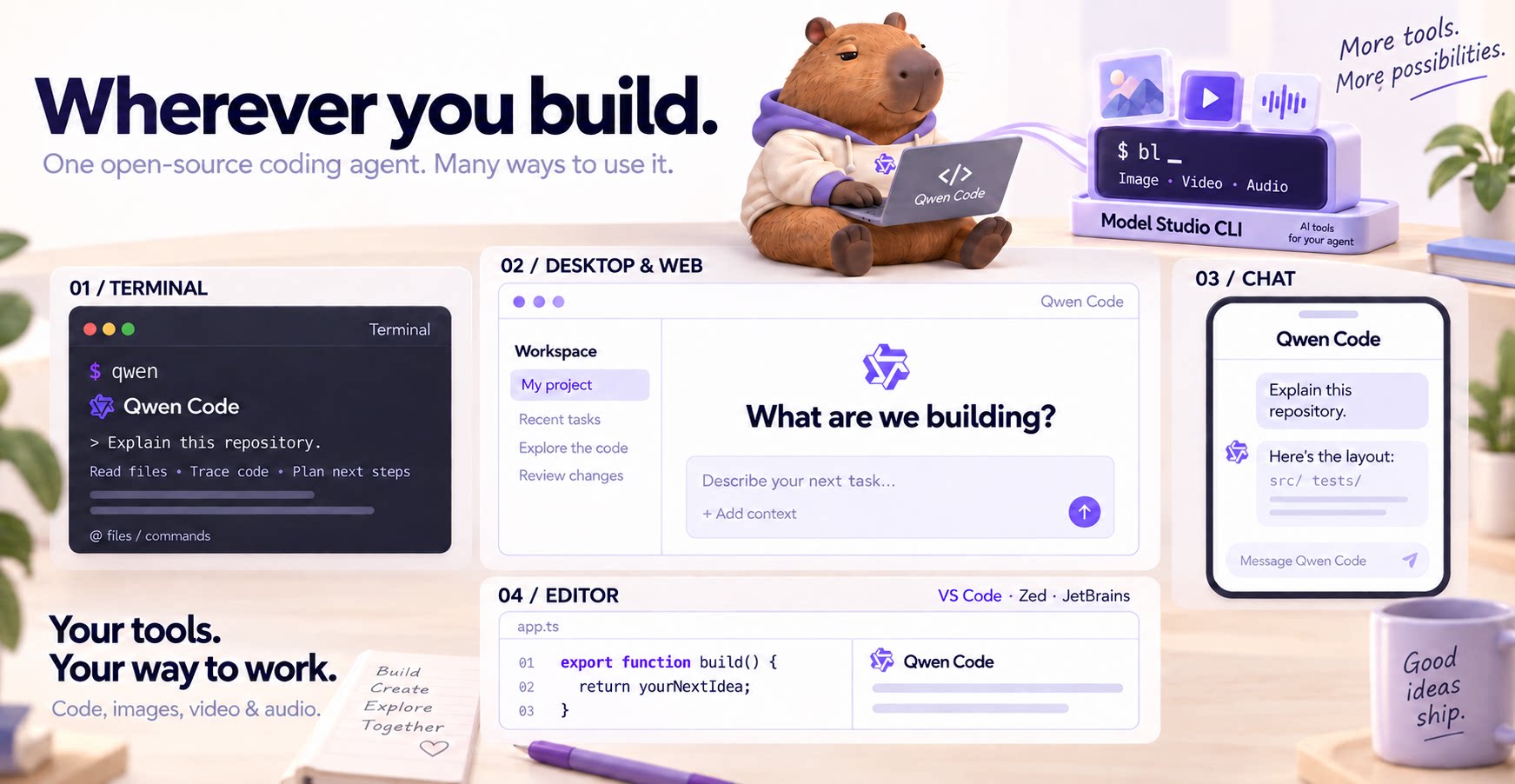
The open-source AI coding agent for your terminal, editor, desktop, browser, and chat.
中文 | Deutsch | français | 日本語 | Русский | Português (Brasil) | 한국어
Why Qwen Code?
- Agentic out of the box — Auto-Memory, Auto-Skills, SubAgents, Agent Teams, and MCP. Dynamic workflows, zero setup.
- Open-source, inside and out — The framework and the Qwen models are open-source. They evolve together. No vendor lock-in.
- Multi-protocol — Supports OpenAI, Anthropic, Gemini, and Qwen APIs. Any third-party provider or local model (Ollama / vLLM). Switch at runtime.
- Beyond the terminal — IDE plugins, Desktop app, Web UI, SDKs, and chat integrations (Telegram / DingTalk / WeChat / Feishu).
Tip
Qwen Code is actively iterating on itself — using its own agent and models to file issues, submit PRs, review code, and run tests. Powered by the community, driven by AI.
Installation
Linux / macOS:
curl -fsSL https://qwen-code-assets.oss-cn-hangzhou.aliyuncs.com/installation/install-qwen-standalone.sh | bash
Windows:
irm https://qwen-code-assets.oss-cn-hangzhou.aliyuncs.com/installation/install-qwen-standalone.ps1 | iex
Restart your terminal after installation to ensure environment variables take effect.
NPM / Homebrew
NPM (requires Node.js 22+):
npm install -g @qwen-code/qwen-code@latest
Homebrew (macOS / Linux):
brew install qwen-code
Quick Start
Open a terminal in your project and start Qwen Code:
cd /path/to/your-project
qwen
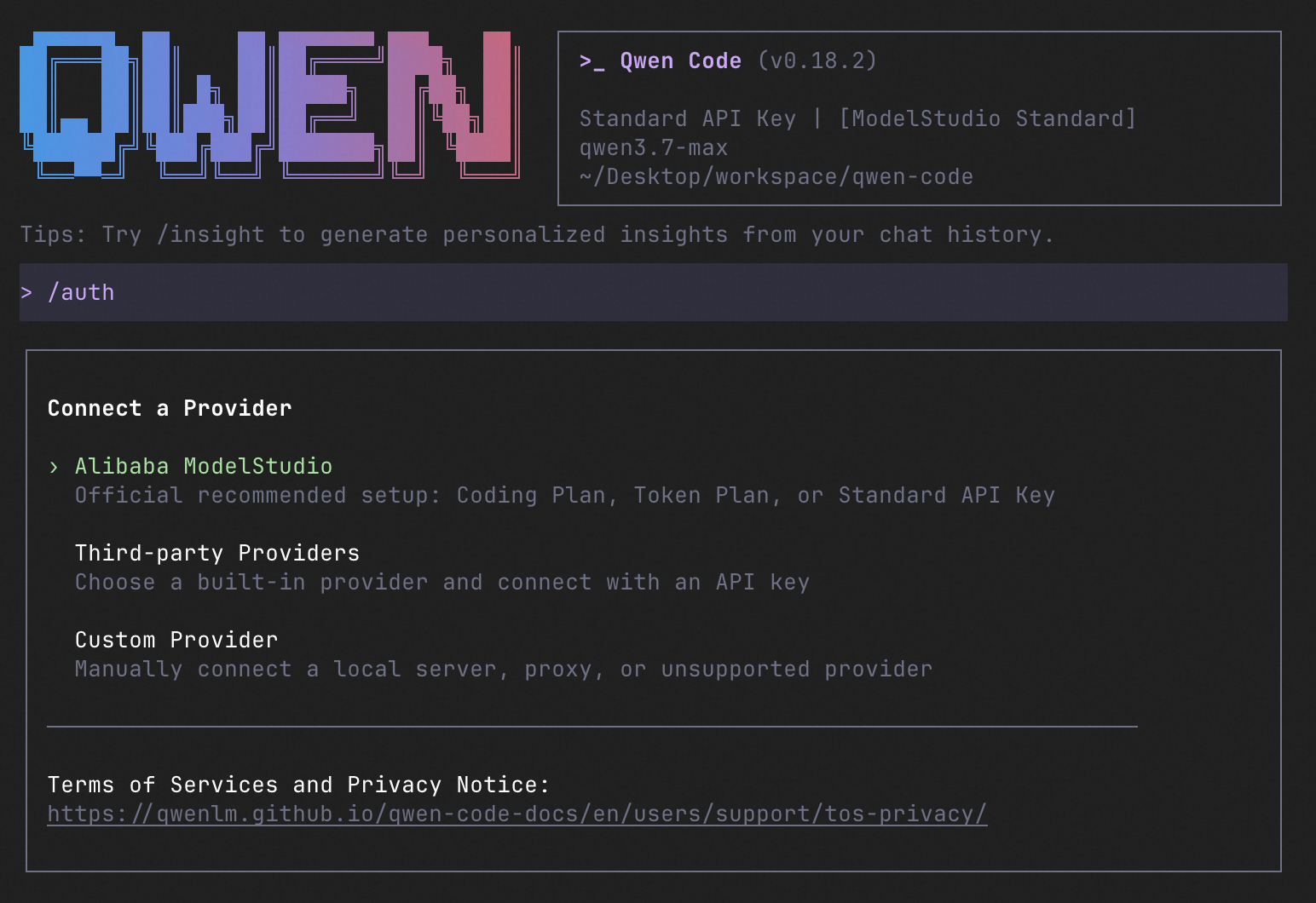
Inside the session, run /auth to configure your provider and API key. Then try:
Explain this repository and show me where to start.
See the Authentication Guide and Settings Reference for detailed setup.
See the terminal interface
How to Use Qwen Code
Choose the interface that fits your workflow:
| Interface | Get started |
|---|---|
| Terminal | Run qwen in your project — see Quick Start. |
| Desktop | Download Qwen Code Desktop for macOS, Windows, and Linux. |
| Web | Run qwen serve --open to open the Web UI in your browser. (experimental) |
| Editor | Set up VS Code, Zed, or JetBrains. |
| Chat | Connect Telegram, DingTalk, WeChat, or Feishu, then run qwen channel start. |
For automation and custom integrations:
- Headless — Run
qwen -p "..."in scripts, CI/CD, or batch jobs. - SDKs — Build with TypeScript, Python, or Java.
- Daemon — Run
qwen serveto connect clients over HTTP + SSE (ACP). (experimental) Daemon guide. - Computer Use — Set up native MCP tools or Node REPL + SDK in Qwen Code, Claude Code, or Codex.
SDK example (Python)
import asyncio

from qwen_code_sdk import is_sdk_result_message, query


async def main() -> None:
    result = query(
        "Summarize the repository layout.",
        {
            "cwd": "/path/to/project",
            "path_to_qwen_executable": "qwen",
        },
    )

    async for message in result:
        if is_sdk_result_message(message):
            print(message["result"])


asyncio.run(main())
Capabilities
If you know Claude Code, you already know Qwen Code — and then some. We've put significant effort into bringing Qwen Code to feature parity with Claude Code, improving both breadth and reliability across the board.
| Feature | Qwen Code | Claude Code |
|---|---|---|
| SubAgents, Agent Teams, Dynamic Workflows | ✓ | ✓ |
| Auto-Memory, Auto-Skills, Hooks | ✓ | ✓ |
| Built-in Skills (/review, /batch, /loop, /bugfix…) | ✓ | ✓ |
| MCP, Plan Mode, LSP Integration | ✓ | ✓ |
| Auto Mode, Sandbox, Git Worktrees | ✓ | ✓ |
| Computer Use (desktop automation) | ✓ | ✓ |
| IDE Plugins (VS Code / JetBrains / Zed) | ✓ | ✓ |
| SDK | ✓ | ✓ |
| Headless Mode, Session Management | ✓ | ✓ |
| Open-source — model and framework | ✓ | — |
| Multi-protocol (OpenAI / Anthropic / Gemini / Qwen + any provider) | ✓ | — |
| Agent Arena (multi-model head-to-head on same task) | ✓ | — |
Daemon Mode — qwen serve (multi-client shared agent) |
✓ | — |
| IM Channels (Telegram / DingTalk / WeChat / Feishu) | ✓ | — |
Qwen Code Evaluation
On SWE-bench Verified, seven Qwen Code versions scored 76.40%–77.80% on average using the same Qwen 3.7 Max model (500 tasks, three trials per version).

Full results and evaluation configuration →
Ecosystem
-
Qwen Code Desktop — Official desktop app for macOS, Windows, and Linux
-
AionUi — A modern GUI for command-line AI tools including Qwen Code
-
Gemini CLI Desktop — A cross-platform desktop/web/mobile UI for Qwen Code
-
qwen-audio-agent — Realtime full-duplex voice frontend for Qwen Code over ACP — talk hands-free with barge-in and a local wake word
-
🦞 Qwen Code Claw — Let other agents (Claude, Codex, etc.) delegate coding tasks to Qwen Code via ACP. Paste this prompt into your agent:
Use Qwen Code as a coding agent. First, fetch and read this skill reference:
https://raw.githubusercontent.com/QwenLM/qwen-code/refs/heads/main/.qwen/skills/qwen-code-claw/SKILL.md
Then follow the instructions inside to install, authenticate, and use Qwen Code via acpx for all coding tasks.
- Aliyun Model Studio CLI — Official CLI for Aliyun's AI platform (
bailian-cli). Extends Qwen Code with image/video generation, knowledge retrieval, app orchestration, and model deployment
Privacy
See the Terms of Service and Privacy Notice, including Chrome extension and Browser Use data handling.
Contributing
Contributions are welcome! See CONTRIBUTING.md for guidelines.
Acknowledgments
This project was originally based on Google Gemini CLI v0.8.2. We gratefully acknowledge the Gemini CLI team's excellent work. Starting from Qwen Code v0.1, we stopped syncing with upstream and began independent development as a multi-protocol, multi-platform agent framework with deep integrations for Qwen models and beyond.